Platform Engineering on AWS: Build Internal Developer Platforms
Learn Platform Engineering on AWS using Internal Developer Platforms, GitOps, Terraform, AWS CDK, Kubernetes, and enterprise best practices.
Cloud adoption has transformed the way organizations build, deploy, and operate software. Development teams are expected to release features faster, infrastructure teams must maintain secure and scalable cloud environments, and operations teams are responsible for ensuring reliability, compliance, and cost optimization. As cloud-native architectures become increasingly complex, many organizations discover that traditional DevOps practices alone are no longer enough to sustain rapid innovation at scale.
Over the last decade, DevOps has significantly improved collaboration between development and operations teams through automation, Continuous Integration (CI), Continuous Delivery (CD), Infrastructure as Code (IaC), and cloud-native deployment pipelines. These practices have reduced manual work and accelerated software delivery, but they have also introduced new operational challenges.
Large organizations often manage:
- Hundreds of development teams
- Thousands of cloud resources
- Multiple AWS accounts
- Kubernetes clusters
- Containerized applications
- Serverless workloads
- CI/CD pipelines
- Infrastructure repositories
- Security policies
- Compliance requirements
As engineering organizations grow, developers frequently spend more time configuring infrastructure, understanding deployment processes, requesting cloud resources, and navigating governance requirements than building customer-facing features.
This growing operational complexity has given rise to Platform Engineering.
Platform Engineering is an engineering discipline focused on building reusable internal platforms, standardized automation, and self-service capabilities that enable development teams to deliver software more efficiently while maintaining security, governance, and operational consistency.
Instead of every development team creating its own deployment pipelines, Kubernetes clusters, Terraform modules, monitoring systems, and security configurations, Platform Engineering provides a centralized Internal Developer Platform (IDP) that offers standardized tools, reusable templates, and automated workflows.
On AWS, Platform Engineering combines services such as:
- AWS Organizations
- AWS Control Tower
- AWS Identity and Access Management (IAM)
- Amazon VPC
- Amazon EKS
- Amazon ECS
- AWS Lambda
- AWS Systems Manager
- Amazon CloudWatch
- AWS CloudFormation
- AWS CDK
- Amazon EventBridge
- AWS Service Catalog
with modern engineering practices including:
- Infrastructure as Code
- GitOps
- DevSecOps
- CI/CD
- Kubernetes
- Docker
- Terraform
- Argo CD
- Helm
- Policy as Code
The result is a secure, scalable, and self-service cloud platform that improves developer productivity while ensuring operational excellence.
Organizations implementing Platform Engineering typically achieve:
- Faster software delivery
- Improved developer experience
- Standardized infrastructure
- Reduced operational overhead
- Stronger security governance
- Higher infrastructure consistency
- Better cloud cost management
- Simplified compliance
- Increased engineering scalability
What This Guide Covers
- What Platform Engineering is
- Why it has become essential for modern enterprises
- How it differs from DevOps and Site Reliability Engineering (SRE)
- What Internal Developer Platforms (IDPs) are
- AWS services used in Platform Engineering
- Self-service infrastructure design
- GitOps and CI/CD integration
- Kubernetes platform automation
- Governance and security best practices
- Common implementation mistakes
- How EaseCloud helps organizations build enterprise-ready AWS platforms
Whether you're modernizing cloud infrastructure, scaling engineering teams, or standardizing AWS operations, Platform Engineering provides the foundation for delivering software faster without sacrificing reliability or governance.
What Is Platform Engineering?
Platform Engineering is the practice of designing, building, and maintaining internal platforms that enable software development teams to provision infrastructure, deploy applications, and manage cloud resources through standardized, automated, and self-service workflows.
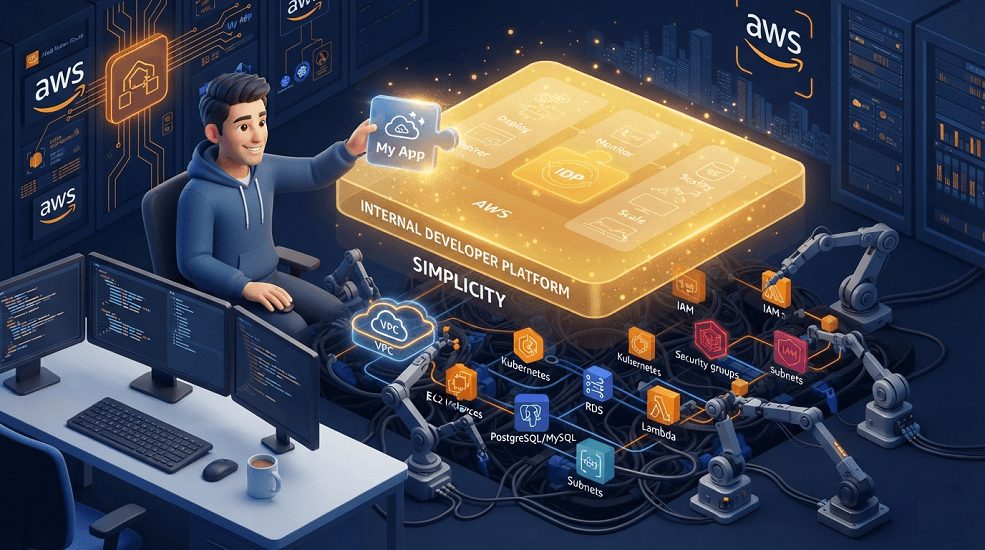
Rather than requiring every engineering team to become experts in AWS networking, Kubernetes administration, Infrastructure as Code, IAM, CI/CD pipelines, and cloud security, a dedicated platform team builds reusable services that abstract this complexity.
The objective is simple:
Provide developers with secure, self-service tools that allow them to focus on building applications instead of managing cloud infrastructure.
A Platform Engineering team typically develops:
- Internal Developer Platforms (IDPs)
- Infrastructure templates
- Terraform modules
- AWS CDK libraries
- CI/CD pipeline templates
- Kubernetes deployment standards
- Monitoring dashboards
- Security guardrails
- Service catalogs
- Developer portals
Developers consume these services through standardized interfaces rather than creating everything from scratch.
A simplified Platform Engineering workflow looks like this:
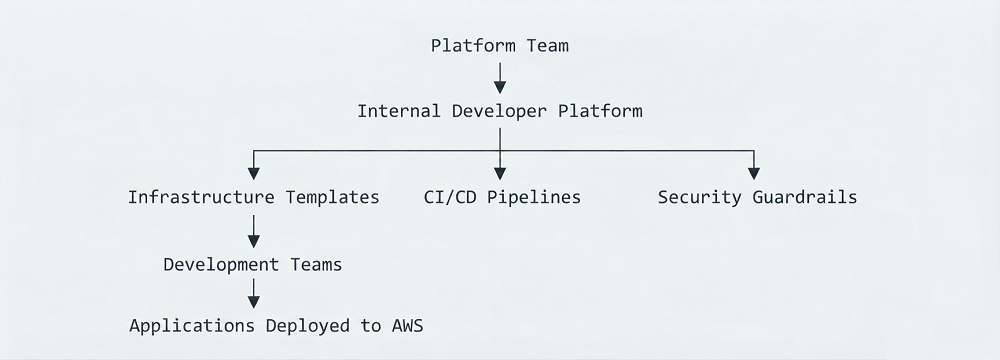
This model creates consistency across engineering teams while reducing operational overhead.
Why Platform Engineering Emerged
Platform Engineering did not replace DevOps. It evolved from the challenges organizations encountered after successfully adopting DevOps practices.
In many companies, DevOps enabled individual teams to build their own infrastructure automation, deployment pipelines, monitoring solutions, and cloud environments. While this improved autonomy, it also led to fragmentation.
Common challenges included:
- Multiple Terraform codebases following different standards
- Inconsistent CI/CD pipelines
- Duplicate Kubernetes configurations
- Different monitoring implementations
- Inconsistent IAM policies
- Security teams reviewing every deployment manually
- Developers spending excessive time managing infrastructure instead of delivering features
As organizations scaled from a handful of teams to dozens or hundreds of engineering groups, maintaining these separate implementations became increasingly difficult.
Platform Engineering addresses these issues by creating a shared engineering platform that provides reusable building blocks.
Instead of every team reinventing the same infrastructure, developers consume approved platform services while the platform team continuously improves the underlying capabilities.
This approach reduces operational complexity while preserving developer autonomy.
Platform Engineering vs DevOps
Platform Engineering and DevOps are complementary disciplines, but they focus on different responsibilities.
| Feature | DevOps | Platform Engineering |
|---|---|---|
| Primary Goal | Improve collaboration between Development and Operations | Build reusable platforms for development teams |
| Main Focus | Delivery automation | Developer enablement |
| Target Users | Development and Operations teams | Internal engineering teams |
| Infrastructure | Managed by each team | Standardized through shared platforms |
| CI/CD | Team-specific pipelines | Reusable pipeline templates |
| Infrastructure as Code | Individual implementations | Shared modules and blueprints |
| Governance | Often decentralized | Centralized guardrails with self-service |
| Developer Experience | Secondary outcome | Primary objective |
DevOps emphasizes collaboration and automation across the software delivery lifecycle.
Platform Engineering builds on those practices by creating standardized services that every engineering team can use.
Rather than replacing DevOps, Platform Engineering makes DevOps easier to adopt consistently across the organization.
Platform Engineering vs Site Reliability Engineering (SRE)
Platform Engineering and Site Reliability Engineering (SRE) also work together but solve different problems.
| Platform Engineering | Site Reliability Engineering |
|---|---|
| Builds internal platforms | Ensures platform reliability |
| Improves developer productivity | Improves service reliability |
| Focuses on self-service | Focuses on uptime and performance |
| Standardizes infrastructure | Defines reliability objectives |
| Automates provisioning | Automates operational excellence |
| Creates reusable templates | Reduces operational incidents |
A Platform Engineering team provides the tools and workflows that developers use every day.
A SRE team focuses on ensuring those systems remain available, scalable, and resilient through practices such as Service Level Objectives (SLOs), Service Level Indicators (SLIs), incident management, and observability.
In mature organizations, Platform Engineering and SRE operate together to deliver both an excellent developer experience and highly reliable production systems.
The Core Principles of Platform Engineering
Successful Platform Engineering initiatives are built around several guiding principles.
Developer Experience First
Developers should spend the majority of their time solving business problems rather than configuring cloud infrastructure.
A well-designed platform minimizes cognitive load by providing intuitive interfaces, reusable templates, and automated workflows.
When developers can provision environments or deploy applications in minutes instead of days, engineering productivity increases significantly.
Self-Service Infrastructure
One of the defining characteristics of Platform Engineering is self-service.
Instead of opening support tickets to request infrastructure, development teams can provision approved resources through automated workflows.
Typical self-service capabilities include:
- Creating development environments
- Deploying applications
- Provisioning databases
- Requesting Kubernetes namespaces
- Creating storage resources
- Managing secrets
- Accessing observability dashboards
Every request follows predefined governance policies while reducing dependency on centralized operations teams.
Standardization Without Restricting Innovation
Platform Engineering provides standardized building blocks rather than enforcing rigid processes.
Examples include:
- Approved Terraform modules
- Standard AWS CDK constructs
- Reusable GitHub Actions workflows
- Kubernetes deployment templates
- Security baselines
- Monitoring integrations
Development teams remain free to innovate while benefiting from proven patterns.
Automation by Default
Manual infrastructure management does not scale in modern cloud environments.
Every repeatable operational task should be automated, including:
- Infrastructure provisioning
- CI/CD pipeline creation
- Security validation
- Policy enforcement
- Cost reporting
- Monitoring configuration
- Backup policies
- Compliance validation
Automation improves consistency, reduces human error, and accelerates software delivery.
Platform as a Product
One of the biggest mindset shifts in Platform Engineering is treating the internal platform as a product rather than an internal IT project.
The platform has:
- Internal customers (developers)
- Product requirements
- Documentation
- Versioning
- User feedback
- Feature roadmaps
- Service-level objectives
Platform teams continuously improve the platform based on developer needs, ensuring it remains valuable, intuitive, and easy to adopt.
Internal Developer Platforms (IDPs)
At the heart of Platform Engineering is the Internal Developer Platform (IDP).
An IDP is a collection of tools, services, automation, and standardized workflows that provide developers with everything they need to build, deploy, monitor, and operate applications without managing the underlying infrastructure directly.
Instead of learning dozens of AWS services, Kubernetes configurations, networking concepts, and deployment mechanisms, developers interact with a simplified platform designed specifically for their organization.
A mature Internal Developer Platform typically includes:
- Developer portals
- Infrastructure templates
- CI/CD pipeline templates
- GitOps workflows
- Kubernetes deployment automation
- Identity and access management
- Secrets management
- Monitoring dashboards
- Logging platforms
- Service catalogs
- Cost visibility
- Documentation
- Security guardrails
The IDP becomes the single interface through which engineering teams consume cloud services safely and efficiently.
The Core Components of an Internal Developer Platform (IDP)
An Internal Developer Platform is more than a collection of DevOps tools. It is a unified platform that provides developers with everything they need to build, deploy, secure, monitor, and operate applications through standardized, automated workflows.
A mature IDP typically includes six major capability areas:
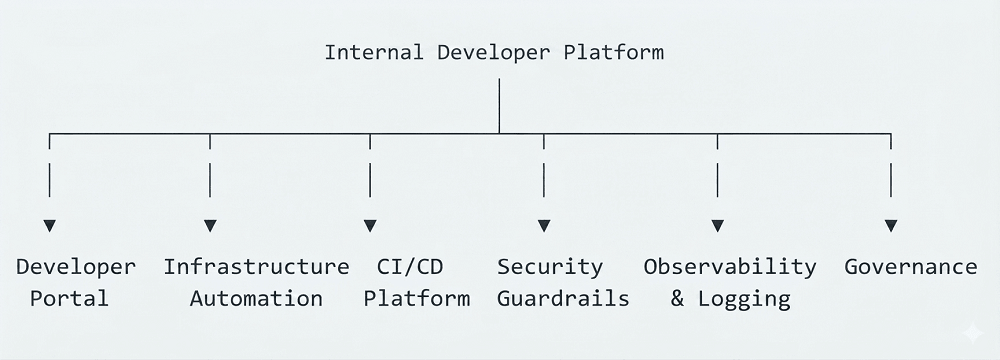
Each capability is designed to reduce complexity while improving consistency across engineering teams.
Developer Portal
The Developer Portal acts as the primary interface between engineers and the cloud platform.
Rather than navigating dozens of AWS services individually, developers interact with a single portal that provides access to approved services and automation.
Typical capabilities include:
- Creating new applications
- Deploying services
- Requesting infrastructure
- Viewing deployment status
- Monitoring application health
- Accessing documentation
- Managing environments
- Viewing service ownership
- Discovering APIs
- Accessing runbooks
Popular developer portal technologies include:
- Backstage
- Port
- Cortex
- OpsLevel
These platforms significantly improve the developer experience by centralizing engineering workflows.
Service Catalog
One of the biggest advantages of Platform Engineering is providing standardized resources instead of requiring every team to build infrastructure independently.
A Service Catalog offers reusable, pre-approved infrastructure templates such as:
- Kubernetes clusters
- Amazon ECS services
- AWS Lambda projects
- Amazon RDS databases
- Amazon S3 buckets
- Virtual Private Clouds (VPCs)
- API Gateway services
- Event-driven architectures
Instead of designing infrastructure from scratch, developers simply select an approved blueprint.
Benefits include:
- Faster provisioning
- Consistent architecture
- Reduced security risks
- Lower operational overhead
- Easier compliance
Infrastructure Automation
Infrastructure automation forms the backbone of every Internal Developer Platform.
Every infrastructure component should be defined as code and deployed automatically.
Organizations commonly standardize on:
- Terraform modules
- AWS CDK constructs
- AWS CloudFormation templates
Instead of allowing teams to create infrastructure manually, the platform provides reusable modules.
Example workflow:
- Developer Request
- Approved Terraform Module
- Policy Validation
- Infrastructure Provisioned
- Ready for Deployment
This ensures infrastructure remains consistent across development, staging, and production environments.
CI/CD Templates
Every engineering team needs deployment pipelines, but building unique pipelines for every application creates unnecessary duplication.
Platform teams typically provide reusable templates that include:
- Source integration
- Build automation
- Automated testing
- Security scanning
- Infrastructure deployment
- Deployment approvals
- Monitoring integration
- Rollback automation
Developers inherit these standardized pipelines while customizing only application-specific logic.
This approach improves both developer productivity and operational consistency.
Security Guardrails
Platform Engineering does not eliminate governance, it automates it.
Rather than relying on manual reviews, security guardrails are embedded into the platform itself.
Examples include:
- Mandatory encryption
- Approved AWS Regions
- IAM permission boundaries
- Secret management
- Logging requirements
- Resource tagging
- Policy validation
- Compliance checks
These controls operate automatically without slowing developers.
Observability Platform
Modern applications require centralized visibility.
A mature platform integrates:
- Metrics
- Logs
- Traces
- Alerts
- Dashboards
- Incident management
Developers should not need to configure monitoring manually.
Instead, every application automatically inherits standardized observability capabilities.
AWS Services Used in Platform Engineering
AWS provides nearly every building block required for enterprise Platform Engineering.
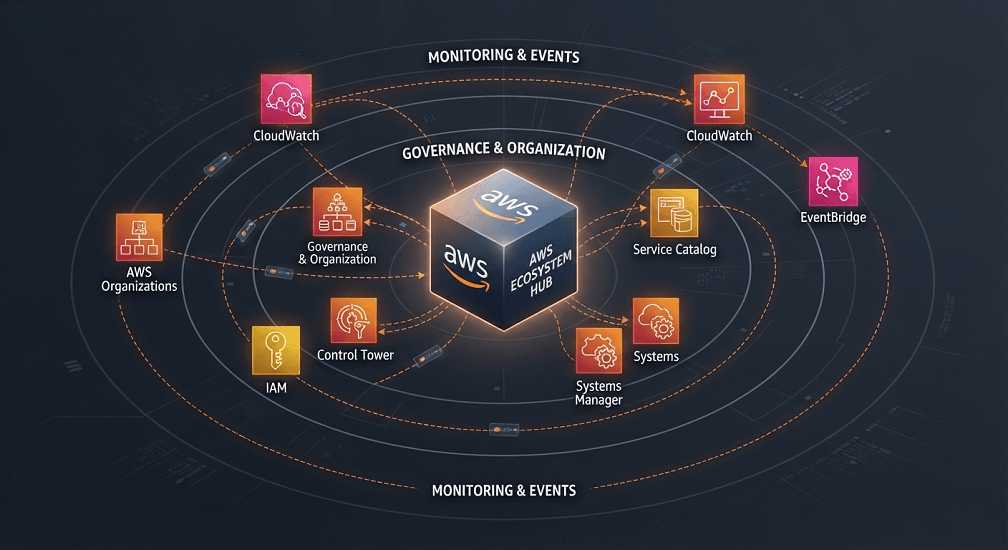
AWS Organizations
Large enterprises rarely operate within a single AWS account.
AWS Organizations enables centralized management of multiple AWS accounts.
Typical organizational structure:
AWS Organization
│
├── Security
├── Shared Services
├── Networking
├── Development
├── QA
├── Staging
├── Production
└── Sandbox
Benefits include:
- Account isolation
- Central governance
- Consolidated billing
- Standard security controls
- Reduced operational risk
AWS Control Tower
AWS Control Tower accelerates multi-account platform deployment.
It automates:
- Account provisioning
- Guardrails
- Logging
- Identity integration
- Governance
- Compliance
Instead of manually configuring dozens of AWS accounts, organizations receive a standardized landing zone.
AWS Identity and Access Management (IAM)
Platform Engineering depends heavily on identity management.
IAM enables:
- Developer authentication
- Service authentication
- Temporary credentials
- Least-privilege permissions
- Cross-account access
- Role assumption
Every platform service should authenticate using IAM Roles rather than long-lived credentials.
AWS Service Catalog
AWS Service Catalog enables platform teams to publish approved infrastructure products.
Examples include:
- Standard VPC deployments
- Amazon ECS clusters
- Amazon EKS environments
- Amazon RDS databases
- Amazon S3 storage
- Networking templates
Developers launch approved resources without needing administrative permissions.
This provides self-service while maintaining governance.
AWS Systems Manager
AWS Systems Manager provides operational automation across cloud environments.
Platform teams commonly use it for:
- Patch management
- Session Manager
- Parameter Store
- Automation documents
- Inventory
- Fleet management
Systems Manager reduces operational complexity while improving security.
Amazon CloudWatch
Every platform requires centralized monitoring.
CloudWatch provides:
- Infrastructure metrics
- Application metrics
- Log aggregation
- Dashboards
- Alarms
- Event monitoring
Standardized monitoring ensures every workload is observable from deployment.
Amazon EventBridge
Event-driven automation is a key Platform Engineering capability.
Examples include:
- Automatic deployments
- Incident notifications
- Security responses
- Infrastructure workflows
- Cost optimization automation
EventBridge connects AWS services into automated operational workflows.
Self-Service Infrastructure
One of Platform Engineering's greatest strengths is enabling developers to provision resources independently while remaining within organizational standards.
Instead of submitting infrastructure requests through manual approval processes, developers use approved automation.
Typical self-service requests include:
- Deploying Kubernetes applications
- Creating databases
- Provisioning storage
- Creating environments
- Managing secrets
- Deploying serverless applications
The platform validates every request before provisioning resources.
Example:
- Developer
- Developer Portal
- Terraform Module
- Security Validation
- AWS Deployment
- Application Ready
This dramatically reduces provisioning time while maintaining governance.
Golden Paths
A Golden Path is a predefined, recommended workflow for building and deploying applications.
Rather than forcing developers to design architectures independently, Platform Engineering provides well-tested implementation patterns.
Examples include:
- REST API template
- Microservices template
- Event-driven application
- Kubernetes deployment
- Serverless application
- Batch processing system
Golden Paths reduce architectural inconsistency while accelerating onboarding.
GitOps and Platform Engineering
GitOps naturally complements Platform Engineering.
Infrastructure and applications are managed through Git repositories.
Typical workflow:
- Developer Commit
- Git Repository
- Pull Request Review
- Approval
- GitOps Controller
- AWS Infrastructure Updated
Benefits include:
- Version control
- Rollback
- Audit history
- Automated reconciliation
- Reduced manual deployments
GitOps provides the operational model, while Platform Engineering delivers the reusable platform components.
CI/CD Integration
Every Internal Developer Platform should provide standardized deployment pipelines.
A typical workflow includes:
- Developer Commit
- GitHub Actions
- Build
- Testing
- Security Validation
- Terraform
- Deployment
- CloudWatch Monitoring
Developers focus on application code while the platform automates deployment.
Kubernetes as a Platform
Many Platform Engineering initiatives use Kubernetes as the underlying application platform.
Amazon EKS enables platform teams to standardize:
- Cluster provisioning
- Networking
- Security
- Service Mesh
- Ingress
- Monitoring
- Logging
- Autoscaling
Rather than every team operating separate clusters, the platform provides shared Kubernetes capabilities.
Backstage: The Open-Source Developer Portal
One of the most widely adopted technologies in Platform Engineering is Backstage, originally developed by Spotify.
Backstage provides:
- Software catalog
- Documentation
- Infrastructure templates
- Service ownership
- CI/CD visibility
- Kubernetes dashboards
- Plugin ecosystem
When integrated with AWS, Backstage becomes the front door to the Internal Developer Platform, allowing developers to discover services, provision infrastructure, and manage deployments through a single interface.
Governance in Platform Engineering
One of the primary objectives of Platform Engineering is enabling developer autonomy without sacrificing governance.
As engineering organizations scale, inconsistent infrastructure provisioning, ad hoc security configurations, and manual approval processes become major operational risks. Platform Engineering addresses this challenge by embedding governance directly into the platform.
Instead of requiring security or operations teams to review every infrastructure request manually, governance policies are automated and enforced throughout the platform lifecycle.
A mature governance model covers:
- Identity and Access Management (IAM)
- Infrastructure standards
- Network architecture
- Resource tagging
- Cost allocation
- Security controls
- Compliance validation
- Deployment approvals
- Audit logging
- Disaster recovery policies
Governance becomes part of the platform rather than an obstacle to developer productivity.
Governance Architecture
A typical enterprise Platform Engineering governance model looks like this:
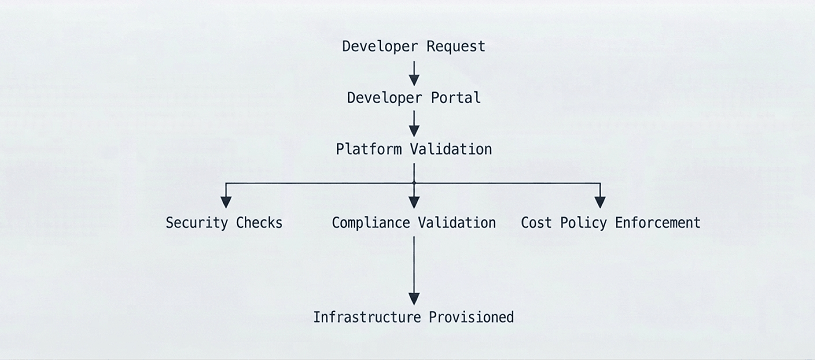
Every deployment automatically complies with organizational standards before reaching AWS.
Policy as Code
Modern Platform Engineering relies heavily on Policy as Code (PaC).
Rather than documenting security requirements in spreadsheets or PDFs, organizations define policies programmatically.
Examples include:
- Mandatory encryption
- Approved AWS Regions
- Resource naming conventions
- IAM permission boundaries
- Backup requirements
- Public access restrictions
- Approved instance types
- Network segmentation
These policies execute automatically during infrastructure provisioning.
Popular Policy as Code solutions include:
- Open Policy Agent (OPA)
- Gatekeeper
- Kyverno
- HashiCorp Sentinel
- AWS Config Rules
- AWS Organizations Service Control Policies (SCPs)
Policy as Code ensures every engineering team follows the same operational standards.
Security and DevSecOps Integration
Platform Engineering does not replace DevSecOps, it operationalizes it.
Every Internal Developer Platform should include built-in security capabilities.
Typical platform security services include:
- IAM Roles
- AWS Secrets Manager
- AWS Key Management Service (AWS KMS)
- Amazon GuardDuty
- Amazon Inspector
- AWS Security Hub
- AWS Config
- AWS CloudTrail
- Amazon Macie
- AWS WAF
- AWS Shield
Instead of requiring developers to configure these services manually, security controls are automatically applied to every workload.
For example:
- Every storage bucket is encrypted by default.
- Every application logs to Amazon CloudWatch.
- Every deployment is scanned for vulnerabilities.
- Every secret is stored securely.
- Every infrastructure change is audited.
This approach reduces human error while improving security consistency.
Cost Optimization and FinOps
As cloud environments grow, unmanaged infrastructure can lead to unnecessary spending.
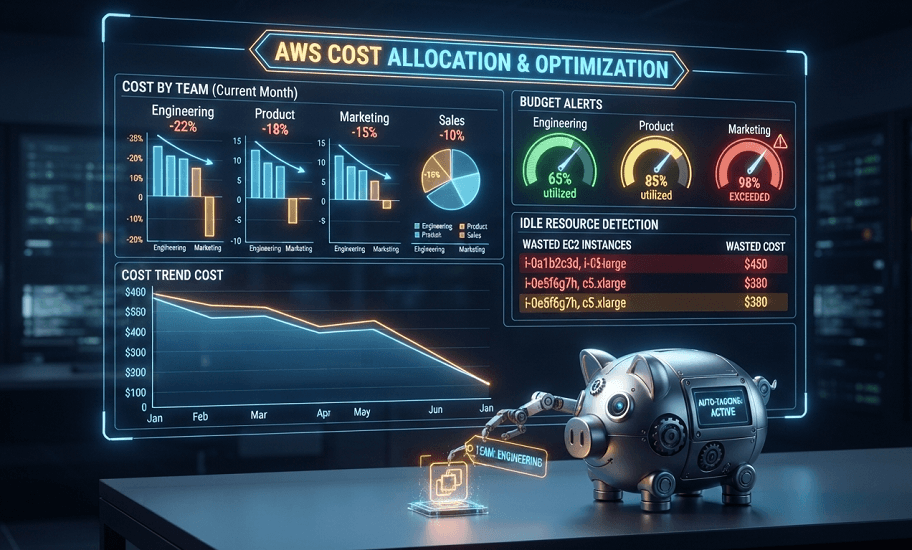
Platform Engineering incorporates FinOps principles by providing visibility into resource consumption and embedding cost controls into the platform itself.
Typical cost optimization capabilities include:
- Resource tagging
- Budget alerts
- Rightsizing recommendations
- Auto-scaling policies
- Idle resource detection
- Reserved Instance planning
- Savings Plans analysis
- Cost allocation by team
- Chargeback and showback reporting
By standardizing infrastructure and automating lifecycle management, organizations reduce cloud waste without limiting developer productivity.
Observability by Default
Every application deployed through the platform should automatically include observability capabilities.
Instead of asking teams to configure monitoring independently, the platform provisions standardized integrations.
A mature observability stack includes:
- Metrics
- Logs
- Distributed tracing
- Dashboards
- Alerts
- Health checks
- Service dependency mapping
Common AWS services include:
- Amazon CloudWatch
- AWS X-Ray
- Amazon EventBridge
- AWS CloudTrail
Developers gain immediate visibility into application health without additional configuration.
Platform Engineering Best Practices
Organizations that successfully implement Platform Engineering generally follow a consistent set of practices.
Treat the Platform as a Product
The Internal Developer Platform should have:
- A product roadmap
- Dedicated ownership
- Documentation
- User feedback mechanisms
- Release management
- Success metrics
Platform teams should continuously improve the platform based on developer needs.
Build Reusable Platform Components
Avoid creating application-specific automation.
Instead, provide reusable:
- Terraform modules
- AWS CDK constructs
- CloudFormation templates
- CI/CD workflows
- Security policies
- Monitoring integrations
Reusable components improve consistency and reduce maintenance effort.
Prioritize Developer Experience
An effective platform should reduce cognitive load.
Developers should be able to:
- Create applications quickly
- Provision infrastructure independently
- Deploy through standardized pipelines
- Access documentation easily
- Troubleshoot efficiently
A positive developer experience leads to higher platform adoption.
Standardize Without Restricting Innovation
Platform Engineering should establish approved patterns while allowing teams flexibility to solve business problems.
Golden Paths should guide, not constrain, engineering teams.
Measure Platform Success
Track meaningful metrics such as:
- Deployment frequency
- Lead time for changes
- Infrastructure provisioning time
- Mean Time to Recovery (MTTR)
- Developer satisfaction
- Platform adoption
- Service reliability
- Infrastructure consistency
These indicators help platform teams identify opportunities for continuous improvement.
Common Platform Engineering Mistakes
Even well-funded initiatives can fail when organizations misunderstand the purpose of Platform Engineering.
Building Too Much Too Early
Some organizations attempt to build an extensive platform before understanding developer needs.
Instead, start with a small number of high-value capabilities and expand incrementally.
Ignoring Developer Feedback
A platform exists to serve internal engineering teams.
Without continuous feedback, adoption often declines because developers seek alternative solutions.
Creating Excessive Complexity
An Internal Developer Platform should simplify engineering workflows.
Avoid exposing unnecessary infrastructure details when simpler abstractions are sufficient.
Over-Centralizing Decisions
Governance is essential, but requiring approvals for every action undermines the purpose of self-service infrastructure.
Platform Engineering should automate guardrails rather than create operational bottlenecks.
Neglecting Documentation
Even the most capable platform will struggle if developers cannot understand how to use it.
Comprehensive documentation, onboarding guides, examples, and service catalogs are essential for successful adoption.
Real-World Enterprise Example
A global software company supported hundreds of developers building cloud-native applications across multiple AWS Regions.
Although the organization had successfully adopted DevOps, every product team maintained its own Terraform modules, GitHub Actions workflows, Kubernetes configurations, monitoring dashboards, and deployment standards. Over time, this created duplication, inconsistent security controls, and increased operational complexity.
The company established a dedicated Platform Engineering team to create an Internal Developer Platform.
Platform Components
- Developer Portal
- AWS Service Catalog
- Terraform module library
- AWS CDK constructs
- GitHub Actions templates
- Amazon EKS platform
- Amazon CloudWatch dashboards
- AWS Organizations governance
- AWS Control Tower landing zone
Built-in Platform Capabilities
- Self-service infrastructure
- Standardized CI/CD pipelines
- Automated security scanning
- Policy as Code
- Secrets management
- Centralized monitoring
- Cost reporting
- Golden Path templates
Within the first 12 months, the organization achieved:
- More than 70% reduction in infrastructure provisioning time
- Consistent deployment pipelines across engineering teams
- Faster developer onboarding
- Improved cloud governance
- Reduced infrastructure duplication
- Higher developer satisfaction
- Lower operational overhead
- Stronger security compliance
Platform Engineering became the foundation for scalable cloud operations and accelerated software delivery.
Conclusion
Platform Engineering has emerged as a critical discipline for organizations operating at cloud scale. As engineering teams grow and cloud environments become more complex, standardized platforms enable developers to focus on delivering business value instead of managing infrastructure.
By combining Infrastructure as Code, GitOps, DevSecOps, CI/CD, Kubernetes, self-service infrastructure, and cloud governance into a unified Internal Developer Platform, organizations can improve developer experience, accelerate software delivery, strengthen security, and simplify operations.
For enterprises building on AWS, Platform Engineering is no longer just an operational improvement, it is a strategic capability that supports long-term scalability, innovation, and cloud maturity.
Frequently Asked Questions
What is Platform Engineering?
Platform Engineering is the discipline of building internal platforms that provide developers with secure, standardized, and self-service tools for deploying and operating applications.
What is an Internal Developer Platform (IDP)?
An Internal Developer Platform is a collection of automation, infrastructure templates, developer portals, CI/CD pipelines, security controls, and operational services that simplify software delivery for engineering teams.
How is Platform Engineering different from DevOps?
DevOps focuses on collaboration and automation between development and operations teams.
Platform Engineering builds reusable platforms that make DevOps practices easier to adopt consistently across an organization.
Does Platform Engineering replace Kubernetes?
No.
Kubernetes is an orchestration platform, while Platform Engineering provides the broader ecosystem, including infrastructure automation, governance, CI/CD, security, and developer experience, that can use Kubernetes as one of its deployment targets.
Which AWS services are commonly used for Platform Engineering?
Typical services include:
- AWS Organizations
- AWS Control Tower
- IAM
- AWS Service Catalog
- AWS Systems Manager
- Amazon CloudWatch
- Amazon EventBridge
- AWS CloudFormation
- AWS CDK
- Amazon ECS
- Amazon EKS
- AWS Lambda
These services combine to form a secure and scalable Internal Developer Platform.
How EaseCloud Helps Organizations Build Platform Engineering Solutions
At EaseCloud, we help organizations design and implement enterprise-grade Platform Engineering solutions that improve developer productivity while maintaining governance, security, and operational excellence. Whether you're standardizing cloud infrastructure or enabling hundreds of developers to deploy applications securely and efficiently, EaseCloud helps you build scalable Internal Developer Platforms aligned with AWS best practices.
Book Your Free Platform Engineering AssessmentSummarize this post with: