AWS Security & Compliance: SOC 2, HIPAA & GDPR on the Cloud
Achieve SOC 2, HIPAA, and GDPR compliance on AWS. Learn IAM, encryption, CloudTrail, GuardDuty, and Security Hub best practices for regulated workloads.
Modern organizations operating in regulated industries must balance innovation with stringent security and compliance requirements. Cloud computing provides scalability and flexibility, but it also introduces responsibilities around data protection, privacy, access management, and audit readiness. AWS offers a comprehensive suite of security services and compliance programs that help businesses align with frameworks such as SOC 2, HIPAA, and GDPR while maintaining a strong security posture.
This guide explores how organizations can build a secure, compliant AWS environment using industry best practices, encryption, identity management, monitoring, and governance controls.
TL;DR
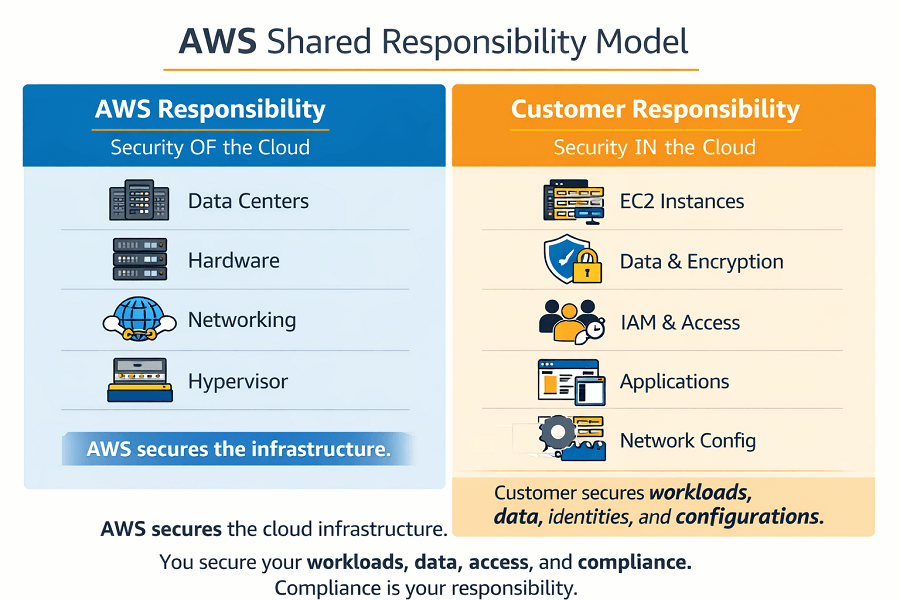
- Shared Responsibility: AWS secures infrastructure; you secure workloads, data, and access. Compliance is your responsibility.
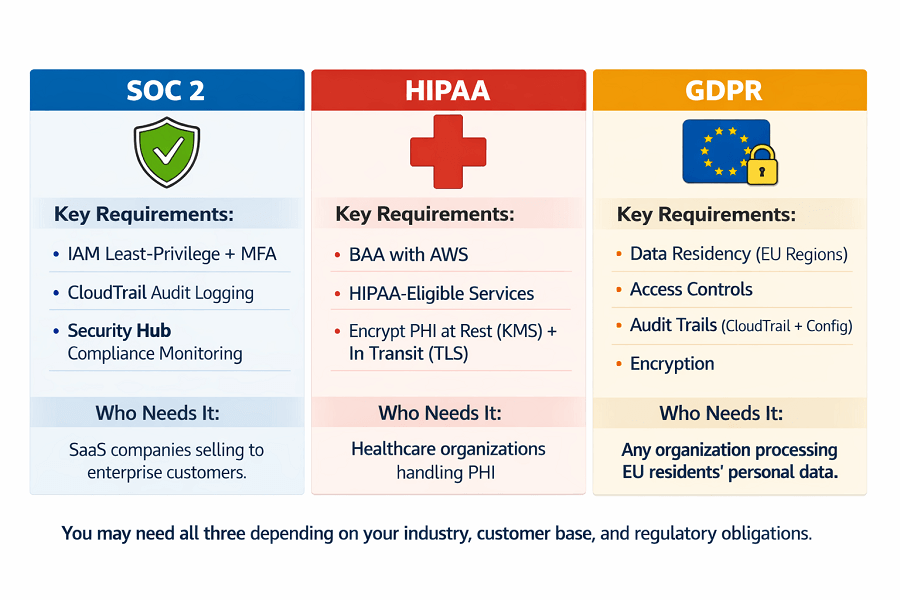
- SOC 2: Focus on IAM (least privilege, MFA), CloudTrail (audit logging), and Security Hub. Audit prep requires documented controls and evidence.
- HIPAA: Requires BAA with AWS and HIPAA-eligible services. Encrypt PHI at rest (KMS) and in transit (TLS). Monitor with CloudTrail and GuardDuty.
- GDPR: Focus on data residency, access controls, audit trails (CloudTrail + Config), and encryption. Accountability and privacy rights are core.
- Universal controls: Enable MFA, enforce least-privilege IAM, encrypt everything, enable CloudTrail, deploy GuardDuty + Security Hub, and maintain incident response plans.
Understanding AWS Cloud Security
AWS operates under a Shared Responsibility Model, where AWS secures the underlying cloud infrastructure, while customers are responsible for securing workloads, applications, identities, and data stored in the cloud.
A successful AWS security strategy should include:
- Strong identity and access management
- Data encryption and key management
- Continuous monitoring and threat detection
- Network segmentation and protection
- Compliance auditing and reporting
- Incident response and recovery planning
These controls form the foundation for meeting compliance obligations across multiple regulatory frameworks.
SOC 2 Compliance on AWS
SOC 2 is a widely recognized auditing framework that evaluates an organization's controls based on five Trust Service Criteria:
- Security
- Availability
- Processing Integrity
- Confidentiality
- Privacy
AWS provides infrastructure and services that support SOC 2 compliance initiatives, but organizations must implement their own operational controls to achieve certification.
Key AWS Services for SOC 2 Compliance
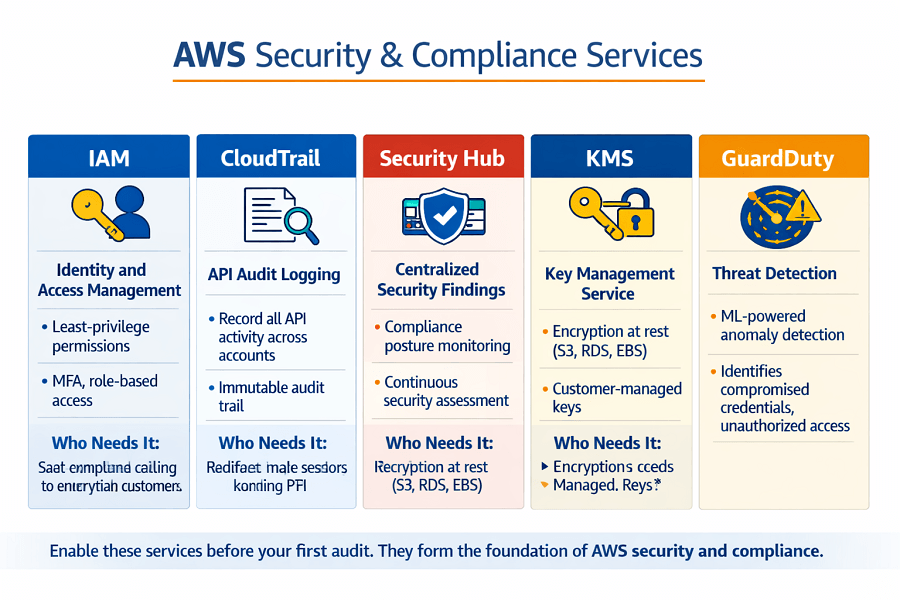
AWS Identity and Access Management (IAM)
IAM enables organizations to enforce least-privilege access by:
- Creating role-based permissions
- Managing user authentication
- Implementing multi-factor authentication (MFA)
- Restricting privileged account access
Proper IAM configuration is one of the most critical SOC 2 requirements.
AWS CloudTrail for Audit Logging
CloudTrail records API activity across AWS accounts and services.
Benefits include:
- User activity tracking
- Change monitoring
- Compliance evidence collection
- Incident investigation support
Maintaining immutable audit logs significantly strengthens SOC 2 readiness.
AWS Security Hub
AWS Security Hub centralizes security findings from multiple AWS services and third-party tools.
Key capabilities:
- Compliance posture monitoring
- Security control validation
- Automated findings aggregation
- Continuous security assessment
SOC 2 Audit Preparation Checklist
Before a SOC 2 audit, organizations should:
- Enable CloudTrail across all accounts
- Implement MFA for privileged users
- Enforce least-privilege IAM policies
- Encrypt sensitive data
- Establish incident response procedures
- Conduct vulnerability assessments
- Document security controls and policies
- Maintain evidence for auditors
HIPAA Compliance on AWS
Healthcare organizations handling Protected Health Information (PHI) must comply with HIPAA regulations.
AWS supports HIPAA workloads through HIPAA-eligible services and Business Associate Agreements (BAAs).
HIPAA Security Requirements
Organizations must address:
Administrative Safeguards
- Security awareness training
- Risk assessments
- Access management procedures
- Incident response planning
Physical Safeguards
AWS manages physical security of data centers, including:
- Facility access controls
- Environmental monitoring
- Hardware disposal procedures
Technical Safeguards
Customers must implement:
- User authentication
- Data encryption
- Activity logging
- Access controls
HIPAA-Eligible AWS Services
Common HIPAA-eligible services include:
- Amazon EC2
- Amazon S3
- Amazon RDS
- AWS Lambda
- Amazon EKS
- Amazon ECS
- AWS Backup
Organizations should verify eligibility before processing PHI in any AWS service.
Securing PHI on AWS
Best practices include:
Encrypt Data at Rest
Protect stored patient data using:
- AWS Key Management Service (KMS)
- Server-side encryption
- Encrypted database storage
Encrypt Data in Transit
Use:
- TLS 1.2 or higher
- HTTPS endpoints
- Secure API communication
Monitor Access
Track all interactions with PHI through:
- CloudTrail
- CloudWatch
- Security Hub
These monitoring capabilities help demonstrate HIPAA compliance during assessments.
GDPR Architecture on AWS
The General Data Protection Regulation (GDPR) requires organizations handling personal data of EU residents to implement strict privacy and security controls.
AWS provides tools that help organizations support GDPR obligations, including data protection, transparency, and accountability.
Core GDPR Security Principles
Organizations should focus on:
- Data minimization
- Purpose limitation
- Storage limitation
- Integrity and confidentiality
- Accountability
AWS services support these principles through configurable security controls and governance tools.
Building a GDPR-Compliant AWS Architecture
Data Classification and Governance
Identify:
- Personal data
- Sensitive personal data
- Business-critical information
Apply appropriate security policies based on classification levels.
Access Control Management
Implement IAM controls to:
- Limit data access
- Enforce role-based permissions
- Separate administrative duties
- Reduce insider threats
Data Residency and Regional Controls
AWS enables organizations to choose where customer data is stored and processed, helping satisfy regional data residency requirements.
Logging and Accountability
Maintain comprehensive audit trails using:
- CloudTrail
- AWS Config
- Security Hub
These records support GDPR accountability obligations and incident investigations.
🇪🇺 GDPR compliance on AWS requires data residency, access controls, audit trails, and encryption. We design your GDPR architecture.
Data classification, purpose limitation, storage limitation, integrity and confidentiality, accountability – AWS services support these principles through configurable security controls.
We help you:
- Implement data classification – Identify personal data, sensitive personal data, business-critical information
- Enforce access control – IAM role-based permissions, administrative separation, insider threat reduction
- Set data residency controls – Choose where customer data is stored and processed (eu-west-1, eu-central-1, etc.)
- Establish audit trails – CloudTrail, AWS Config, Security Hub for accountability obligations
- Support privacy rights – Data deletion, access requests, and portability (Article 15-20 compliance)
Encryption at Rest and In Transit
Encryption is a foundational requirement across SOC 2, HIPAA, and GDPR.
AWS KMS Encryption
AWS Key Management Service (KMS) allows organizations to:
- Create encryption keys
- Rotate keys automatically
- Control key access
- Audit key usage
KMS integrates with services such as:
- Amazon S3
- Amazon RDS
- Amazon EBS
- AWS Secrets Manager
Encryption Best Practices
- Enable encryption by default
- Use customer-managed keys where appropriate
- Rotate keys regularly
- Monitor key usage logs
- Protect backup data with encryption
AWS Threat Detection and Monitoring
Continuous monitoring is essential for both security and compliance.
Amazon GuardDuty Setup
GuardDuty provides intelligent threat detection using:
- Machine learning
- DNS analysis
- VPC Flow Logs
- CloudTrail events
GuardDuty can identify:
- Compromised credentials
- Unauthorized access attempts
- Malware activity
- Suspicious network behavior
AWS Security Hub
Security Hub enhances visibility by:
- Aggregating findings
- Prioritizing risks
- Mapping controls to compliance standards
- Providing centralized dashboards
Combining GuardDuty and Security Hub creates a proactive threat detection strategy.
DDoS Protection on AWS
Distributed Denial-of-Service (DDoS) attacks can impact availability and regulatory obligations.
AWS Shield
AWS Shield provides:
Shield Standard
- Automatic protection
- No additional cost
- Defense against common DDoS attacks
Shield Advanced
- Enhanced protection
- Detailed attack analytics
- Access to AWS DDoS Response Team
Organizations handling regulated workloads should evaluate Shield Advanced for critical applications.
Implementing Zero Trust Architecture on AWS
Zero Trust assumes no user, device, or network should be inherently trusted.
Core Zero Trust Principles
Verify Explicitly
- Authenticate every user
- Continuously validate identities
- Require MFA
Use Least Privilege Access
- Limit permissions
- Restrict administrative roles
- Apply just-in-time access where possible
Assume Breach
- Monitor continuously
- Segment workloads
- Detect anomalies quickly
AWS services such as IAM, Security Hub, GuardDuty, and AWS Organizations support Zero Trust implementation.
Compliance Best Practices for AWS
Organizations seeking SOC 2, HIPAA, and GDPR alignment should:
- Enable CloudTrail logging across all accounts.
- Enforce MFA and strong IAM controls.
- Encrypt data at rest and in transit.
- Deploy GuardDuty and Security Hub.
- Conduct regular risk assessments.
- Implement automated compliance monitoring.
- Establish incident response procedures.
- Perform continuous vulnerability management.
- Maintain evidence for audits.
- Adopt a Zero Trust security model.
Conclusion
Achieving SOC 2, HIPAA, and GDPR compliance on AWS requires more than simply deploying cloud infrastructure. Organizations must implement robust security controls, enforce identity governance, encrypt sensitive data, maintain comprehensive audit logs, and continuously monitor their environments for threats.
By leveraging AWS services such as IAM, CloudTrail, Security Hub, GuardDuty, KMS, and AWS Shield, businesses can build secure, audit-ready cloud environments that meet regulatory requirements while maintaining operational agility and customer trust.
FAQs
1. What's the difference between SOC 2, HIPAA, and GDPR compliance on AWS?
SOC 2 is a broad framework for service organizations covering security, availability, processing integrity, confidentiality, and privacy – required by many enterprise SaaS customers.
HIPAA applies specifically to healthcare organizations handling Protected Health Information (PHI) – requires a BAA with AWS and HIPAA-eligible services.
GDPR applies to any organization processing personal data of EU residents – focuses on data protection, privacy rights, accountability, and data residency. You may need all three depending on your industry and customer base.
2. Is my data automatically encrypted on AWS?
Not by default. You must enable encryption. AWS KMS allows you to encrypt data at rest (S3, RDS, EBS) and in transit (TLS for API endpoints). Best practice: enable encryption by default, use customer-managed keys where appropriate, rotate keys regularly, and monitor key usage.
3. What are the most common compliance gaps in first-time AWS audits?
- No MFA enforced on root and privileged IAM users
- CloudTrail not enabled across all regions or not properly secured (no integrity validation)
- S3 buckets with public access (blocked at account level is the fix)
- Encryption not enabled for production databases or storage
- No formal incident response plan documented or tested
- Overly permissive IAM policies (admin access for non-admin roles)
Summarize this post with: