vLLM vs SGLang for LLM Inference: Which Should You Choose in 2026?
Compare vLLM vs SGLang for LLM inference across performance, GPU utilization, Qwen, DeepSeek, GLM, batching, caching, Kubernetes and AWS.

TL;DR
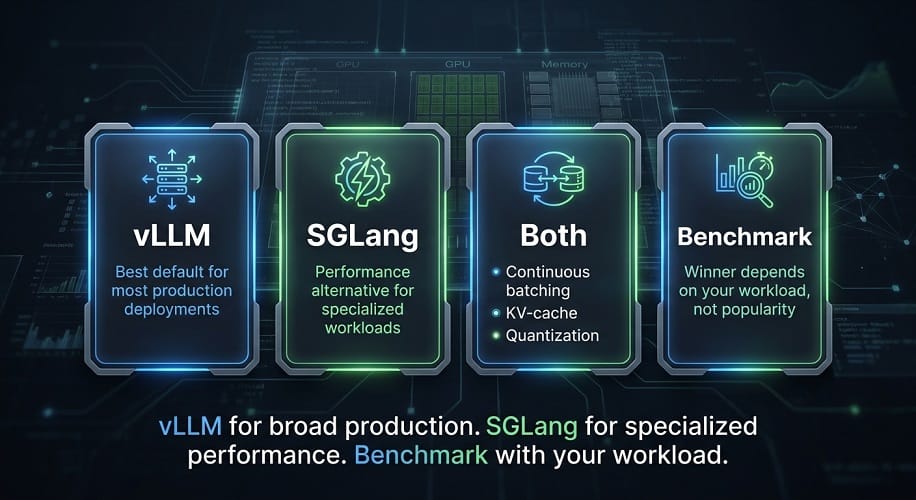
- vLLM is the best default for most production deployments. Broad model support (Qwen, DeepSeek, GLM, Llama, Mistral), mature ecosystem, Kubernetes integrations, Prometheus metrics, OpenAI-compatible APIs, and strong community. Start here.
- SGLang is the performance alternative. Excels at structured generation, specialized optimizations, and high-throughput workloads. Can outperform vLLM on specific models and use cases – but only if your benchmark proves it.
- Both support: continuous batching, KV-cache management, prefix caching, quantization (FP8/INT8/AWQ/GPTQ), tensor/data/expert parallelism, and multi-GPU inference.
- The winner depends on your workload, not popularity. Short prompts, long context, high concurrency, coding agents, RAG, and tool-calling all stress engines differently. Benchmark with your exact model, GPU, context, and concurrency.
- Measure what matters: Time to First Token (TTFT), tokens/sec, requests/sec, peak VRAM, queue time, and cost per successful task. Never compare on different hardware or precision. Keep hardware, model, and configuration identical.
What Is an LLM Inference Engine?
An LLM inference engine is the software layer responsible for running a trained model efficiently and serving responses to applications.
The model itself contains the learned parameters.
The inference engine determines how those parameters are loaded, scheduled, processed, and exposed to applications.
It manages areas such as:
- GPU memory
- Request scheduling
- Batching
- KV cache
- Context processing
- Token generation
- Quantization
- Multi-GPU execution
- API serving
- Monitoring
This layer can have a major effect on the actual open-source LLM cost optimization and performance of an LLM deployment.
Two teams can run the same Qwen model on the same H100 and still achieve different throughput and latency because their inference configurations are different.
Why the Inference Engine Matters
Consider an enterprise serving a Qwen coding model.
The organization already has:
- The same model
- The same GPUs
- The same context length
- Similar traffic
But one deployment uses vLLM and another uses SGLang.
The two systems can still differ in:
- Time to first token
- Tokens per second
- GPU utilization
- Memory usage
- Concurrency
- Queue time
- Cost per request
That makes the inference engine an important infrastructure decision.
What Is vLLM?
vLLM is an open-source inference and serving engine designed for efficient large-language-model deployment.
It is widely used for:
- Chat applications
- RAG
- Coding assistants
- AI agents
- Batch inference
- Enterprise APIs
One of its strongest advantages is its broad model and ecosystem support.
vLLM also provides OpenAI-compatible APIs, making it relatively straightforward to connect existing applications to locally hosted models.
Main vLLM Capabilities
Important capabilities include:
- Continuous batching
- KV-cache management
- Prefix caching
- Quantized inference
- Tensor parallelism
- Data parallelism
- Expert parallelism
- Speculative decoding
- OpenAI-compatible serving
- Prometheus metrics
- Kubernetes integrations
The vLLM ecosystem also includes a Production Stack for Kubernetes deployments, routing, scaling, and observability.
Why vLLM Is Popular
One reason vLLM has become widely adopted is that it is not limited to one model family.
It can be used with a broad range of models, including ecosystems such as:
- Qwen
- DeepSeek
- GLM
- Llama
- Mistral
- Gemma
This gives infrastructure teams a common serving layer instead of requiring a separate runtime for every model.
What Is SGLang?
SGLang is another high-performance framework for serving and programming large language models.
It focuses heavily on efficient execution, structured generation, caching, and high-performance inference.
SGLang can be used for:
- Chat
- RAG
- Coding
- Agents
- Structured generation
- Reasoning models
- Large-model serving
It is particularly interesting when the workload benefits from optimized execution patterns and model-specific serving support.
Why SGLang Is Important
SGLang has developed a strong position in high-performance LLM serving.
It is particularly relevant for teams that care about:
- High throughput
- Low latency
- Structured generation
- Complex agent workloads
- Large-model inference
- Specialized model optimizations
The important point is that SGLang is not simply a smaller alternative to vLLM.
It has its own optimization approach and can outperform other serving systems on some workloads.
vLLM vs SGLang: Basic Comparison
| Feature | vLLM | SGLang |
|---|---|---|
| Open‑source | Yes | Yes |
| LLM serving | Excellent | Excellent |
| OpenAI‑compatible APIs | Yes | Yes |
| Continuous batching | Yes | Yes |
| KV‑cache optimization | Strong | Strong |
| Prefix caching | Strong | Strong |
| Quantization | Strong | Strong |
| Tensor parallelism | Yes | Yes |
| Data parallelism | Yes | Yes |
| Expert parallelism | Yes | Yes |
| Kubernetes | Excellent | Strong |
| Production ecosystem | Very broad | Strong |
| Model coverage | Very broad | Broad |
| Best starting point | General production serving | Performance‑focused workloads |
This is a high-level comparison.
The actual winner depends on the model and workload.
vLLM vs SGLang for Production
There is no universal answer to:
Which one is better for production?
Instead, ask:
Which one performs better for my exact model and workload?
A useful production evaluation should include:
- Model
- GPU
- Precision
- Context length
- Concurrent requests
- Output length
- Tool usage
- Batch size
Then benchmark both frameworks under identical conditions.
vLLM's Biggest Advantage: Ecosystem
One of vLLM's biggest strengths is the breadth of its production ecosystem.
Organizations can build around:
- Kubernetes
- Prometheus and Grafana
- KEDA
- Gateway APIs
- AI gateways
- Model routers
- Cloud GPU infrastructure
This matters for enterprise teams and their DevOps culture because the inference server is rarely deployed by itself.
It usually becomes part of a larger platform sometimes behaving like a CDN for model weights, such as an internal developer platform.
SGLang's Biggest Advantage: Specialized Performance
SGLang is especially interesting when the workload benefits from specialized scheduling and execution optimizations.
That can include:
- Structured generation
- Large reasoning models
- Agentic workloads
- Long context
- Specialized model architectures
For some models, these optimizations can provide meaningful improvements in throughput or latency.
vLLM vs SGLang for Qwen
Qwen has strong support across both ecosystems.
For a Qwen deployment, compare:
- Model loading time
- Memory usage
- TTFT
- Decode speed
- Long-context performance
- Concurrent requests
- Tool calling
- Quantized serving
For coding workloads, also measure:
- Code generation latency
- Repository-query performance
- Agent task completion
- Long context
- Tool execution latency
The best engine can differ between a small Qwen model and a very large Qwen MoE model among the best Chinese open-source LLMs.
vLLM vs SGLang for DeepSeek
DeepSeek workloads can be more demanding because current models can involve:
- Large context
- Reasoning
- MoE architectures
- Tool use
- High token volumes
For DeepSeek, pay particular attention to:
- GPU memory
- KV cache
- Multi-GPU communication
- Expert parallelism
- Long-context performance
- Prefill performance
A benchmark that tests only short prompts may fail to reveal the differences that matter in production.
vLLM vs SGLang for GLM
GLM is another good candidate for side-by-side benchmarking.
For GLM deployments, evaluate:
- Large-context requests
- Coding
- Reasoning
- Tool calling
- Agentic tasks
- Multi-GPU serving
The exact result will depend on the model version and the serving configuration.
OpenAI-Compatible APIs
One major convenience of modern inference engines is API compatibility.
An application can often communicate with a local inference server using familiar API patterns.
That makes it easier to migrate between:
- Managed APIs
- vLLM
- SGLang
- Private GPU servers
- Kubernetes deployments
However, API compatibility does not mean every feature behaves identically.
Differences can still exist in:
- Tool calling
- Structured output
- Reasoning fields
- Streaming
- Chat templates
- Model-specific parameters
Always test the features your application actually depends on.
Continuous Batching
Continuous batching is important for high-throughput inference.
Instead of processing every request independently, the serving system can efficiently manage multiple active requests together.
This can increase:
- GPU utilization
- Throughput
- Tokens per second
It can also reduce the effective cost per request when traffic is sufficiently high.
The exact benefit depends on:
- Request length
- Concurrency
- Model size
- GPU
- Context
- Output length
KV Cache
KV cache stores intermediate attention state during generation.
It becomes particularly important for:
- Long conversations
- Large context
- High concurrency
- Coding agents
- RAG
A deployment that uses a large amount of context can consume substantial GPU memory even when the model weights themselves fit.
This is one reason inference-engine benchmarking should include real production context sizes.
Prefix Caching
Many applications repeatedly send similar prompt prefixes.
Examples include:
- System instructions
- Company policies
- Agent instructions
- Repeated RAG context
- Coding-agent context
Prefix caching can reuse previously computed information for these repeated prefixes.
This can reduce redundant computation and improve serving efficiency.
The benefit depends heavily on how repetitive your workload actually is.
Quantization Support
Both vLLM and SGLang support multiple quantization strategies depending on the model and hardware.
Common formats include:
- FP8
- INT8
- INT4
- AWQ
- GPTQ
- Model-specific low-precision formats
Quantization can lower:
- VRAM requirements
- GPU count
- Infrastructure cost
But it may also affect:
- Quality
- Throughput
- Compatibility
The correct choice should be benchmarked rather than assumed.
Multi-GPU Serving
Large models often require multiple GPUs.
Both vLLM and SGLang support multi-GPU serving for supported architectures.
Common approaches include:
- Tensor parallelism
- Data parallelism
- Expert parallelism
For very large MoE models, expert parallelism can become especially important.
The inference engine should therefore be evaluated not just on a single GPU but also on the topology you expect to use in production.
vLLM vs SGLang: What Should You Test?
For a serious benchmark, use the same:
- Model
- GPU
- Precision
- Context
- Prompt set
- Concurrency
- Output length
Then record:
| Metric | Why It Matters |
|---|---|
| TTFT | User‑perceived responsiveness |
| Tokens/sec | Generation speed |
| Requests/sec | Overall throughput |
| Peak VRAM | Hardware planning |
| GPU utilization | Cost efficiency |
| Queue time | Capacity pressure |
| Error rate | Reliability |
| Startup time | Scaling behavior |
| Cost / request | Economics |
This creates a meaningful comparison.
Why Vendor Benchmarks Aren't Enough
A framework may perform extremely well on one model and less well on another.
For example:
- Short prompts may favor one configuration.
- Long-context workloads may favor another.
- High concurrency can change the ranking.
- Quantization can change the result.
- Multi-GPU topology can change the result.
That is why the benchmark should match the actual workload you plan to serve.
vLLM vs SGLang Performance
Performance should be measured with the same model, same GPU, same precision, same context, and same request workload.
The most useful metrics are:
| Metric | What It Tells You |
|---|---|
| Time to first token | Initial responsiveness |
| Time per output token | Generation speed |
| Tokens per second | Throughput |
| Requests per second | Concurrent serving capacity |
| Peak VRAM | Memory requirement |
| GPU utilization | Hardware efficiency |
| Queue time | Capacity pressure |
| Error rate | Serving reliability |
| Startup time | Scaling behavior |
A framework that produces more tokens per second but uses substantially more memory may not be the better production choice.
Time to First Token
Time to first token, or TTFT, measures how long a user waits before receiving the first generated token.
It matters heavily for:
- Chat applications
- Coding assistants
- Interactive RAG
- AI agents
For an interactive application, reducing TTFT can make the system feel substantially faster even when total generation time remains similar.
Generation Throughput
Once generation begins, measure:
tokens per second
This matters for:
- Long answers
- Coding generation
- Batch processing
- Agent tasks
- High-volume APIs
A system with strong TTFT but poor decode speed may still perform badly when responses are long.
Prefill vs Decode
LLM inference has two important performance phases.
Prefill
The engine processes the input prompt.
Large contexts make this phase more expensive.
Decode
The engine generates the output tokens.
These phases can have very different performance characteristics.
This is particularly important for:
- Long-context RAG
- Coding repositories
- Large agent histories
- Research applications
A useful benchmark should measure both rather than relying only on overall latency.
vLLM vs SGLang for Short Prompts
For short prompts and simple responses, the difference between serving frameworks may be relatively small.
This type of workload is common in:
- Basic chat
- Classification
- Extraction
- Short RAG questions
At this scale, the more important decision may be:
Which framework is easiest for your team to operate?
This is where vLLM's broad production ecosystem can be attractive.
vLLM vs SGLang for Long Context
Long-context workloads are more demanding.
Test with realistic configurations such as:
- 32K
- 64K
- 128K
- 256K
- Higher where the model supports it
Measure:
- Prefill throughput
- Peak VRAM
- TTFT
- Decode speed
- Concurrent requests
Don't test only the model's maximum advertised context.
Use the context lengths your applications will actually send.
vLLM vs SGLang for High Concurrency
Concurrency changes the optimal configuration.
At one request:
latency may matter most.
At hundreds of concurrent requests:
throughput + queueing + memory efficiency
become much more important.
Run tests at several concurrency levels:
| Concurrency | What to Observe |
|---|---|
| 1 | Single-request latency |
| 4 | Early batching behavior |
| 16 | Production‑like utilization |
| 32 | Throughput scaling |
| 64+ | Saturation and queueing |
The actual levels should match your workload.
vLLM vs SGLang for Qwen
Qwen is an important benchmark because it covers:
- General models
- Coding models
- Reasoning models
- MoE models
- Long-context workloads
For Qwen, test at least:
General chat
Measures basic serving performance.
Qwen Coder
Measures coding generation and developer workloads.
Long-context Qwen
Measures memory pressure and prefill behavior.
Agentic Qwen
Measures repeated tool calls and longer sessions.
A framework that wins simple chat may not win a coding-agent workload.
vLLM vs SGLang for DeepSeek
DeepSeek is particularly useful for testing large-model inference because newer models can place significant demands on:
- Memory
- Context
- Parallelism
- Scheduling
For DeepSeek, benchmark:
- Short reasoning requests
- Long reasoning tasks
- Long-context requests
- High concurrency
- Multi-GPU serving
For very large models, test the exact GPU topology you intend to deploy.
vLLM vs SGLang for GLM
GLM should be evaluated using realistic:
- Coding requests
- Reasoning tasks
- Agent workloads
- Long-context inputs
- Tool-calling scenarios
Large GLM variants can make GPU requirements and parallelism much more important than they are for smaller models.
GPU Utilization Comparison
A strong inference engine should use the available GPU efficiently.
Track:
- GPU compute utilization
- Memory utilization
- KV-cache usage
- Tokens per second
- Requests per second
High GPU utilization is not always desirable.
If utilization is high but:
- queue time increases,
- TTFT becomes unacceptable,
- requests begin timing out,
then the system is overloaded.
The goal is efficient utilization at the required service level.
vLLM vs SGLang for Memory Efficiency
Memory efficiency is particularly important for large models.
Track:
Model weight memory
KV-cache memory
Runtime memory
Peak memory under concurrency
A framework that saves several GB of memory can sometimes allow:
- Larger context
- More concurrent users
- Fewer GPUs
- Higher throughput
That can translate directly into lower infrastructure costs.
Prefix Caching Performance
Prefix caching can have a large effect when many requests share the same prompt prefix.
For example:
- Large system prompt
- Company policy
- Agent instructions
- Shared RAG context
Measure:
- Cache hit rate
- TTFT with cache hit
- TTFT without cache hit
- GPU memory used by cache
- Throughput improvement
If your workload contains little repetition, prefix caching may provide limited benefit.
Continuous Batching
Both frameworks support batching strategies designed to improve GPU utilization.
The key benchmark is not simply whether batching exists.
Measure:
How much additional useful throughput does it produce on your workload?
Run:
- Low concurrency
- Medium concurrency
- Peak concurrency
Then compare the resulting:
- tokens/sec
- request latency
- GPU utilization
- cost
vLLM vs SGLang for Tool-Using Agents
Agents can create unusual inference patterns.
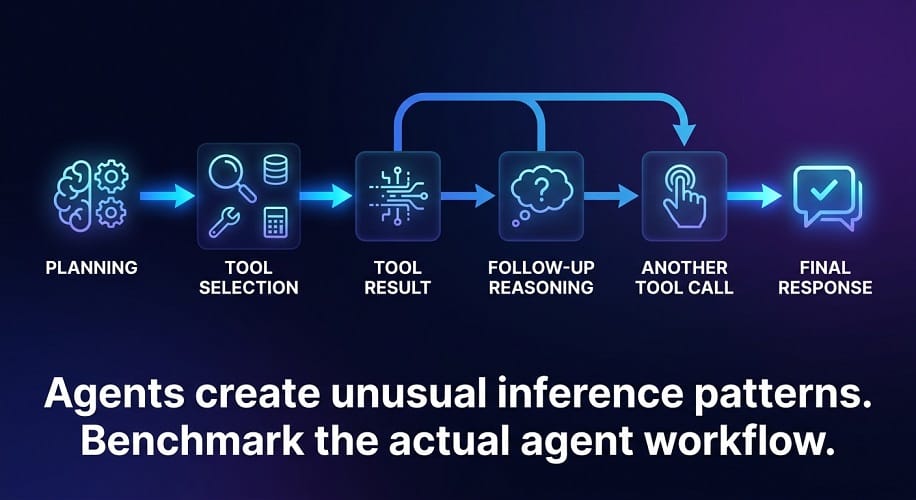
A single user task may generate:
- A planning call
- Tool-selection call
- Tool result
- Follow-up reasoning
- Another tool call
- Final response
This means the system may receive many short and medium requests rather than one large generation.
A framework that performs well under this pattern can be more valuable than one optimized for long standalone generations.
Structured Generation
Structured output can be important for enterprise applications.
Common examples include:
- JSON
- Tool arguments
- Database query plans
- API payloads
- Extraction schemas
SGLang is particularly relevant when structured generation and programmable execution are important parts of the workload.
vLLM also supports structured output and tool-oriented serving for supported models.
Test actual schemas rather than a single simple JSON example.
vLLM vs SGLang for RAG
RAG workloads often contain:
- Medium or large prompts
- Short-to-medium answers
- Repeated system instructions
- Repeated retrieval patterns
Measure:
- TTFT
- Context processing speed
- Output speed
- Cache effectiveness
- Concurrent request performance
For enterprise RAG, also calculate:
cost per grounded answer
not just raw tokens per second.
vLLM vs SGLang for Coding Assistants
Coding assistants typically care about:
- Fast TTFT
- Fast short completions
- Context handling
- Repository awareness
- Tool calls
For autocomplete, extremely low latency may matter more than maximum throughput.
For coding agents, the priority changes toward:
- Long context
- Tool calling
- Multi-step inference
- Error recovery
- High sustained throughput
Therefore, benchmark the actual developer workflow using the latest open-source AI models for coding rather than calling all coding workloads equivalent.
vLLM vs SGLang for Multi-GPU Models
Large models often require several GPUs.
Evaluate:
- Tensor parallelism
- Data parallelism
- Expert parallelism
- Communication overhead
- GPU memory balance
- Interconnect utilization
The inference engine should be tested on the actual topology.
For example, an 8-GPU H200 system may behave very differently from four separate GPU nodes connected over a network.
Single-Node vs Multi-Node
Single-node multi-GPU deployments generally provide faster GPU-to-GPU communication.
Multi-node deployments provide more flexibility but add network overhead.
For very large models, measure:
- Intra-node communication
- Inter-node communication
- Network bandwidth
- Request latency
- Synchronization overhead
The GPU isn't the only performance variable.
vLLM vs SGLang on AWS
AWS makes it possible to compare both engines on identical hardware.
For example, you can test:
- H100 on P5
- H200 on P5e/P5en
- B200 or B300 on P6
The benchmark should use the same:
- AWS instance
- Model checkpoint
- Quantization
- Context
- Requests
- Parallelism
- Runtime versions
This provides a fair comparison.
Kubernetes Performance
For production Kubernetes deployments, benchmark the infrastructure around the inference engine as well.
Track:
- Pod startup
- Model loading
- GPU scheduling
- Scaling delay
- Rolling update time
- Recovery time
- Health-check behavior
A model server can be extremely fast once running and still produce poor economics if scaling takes several minutes.
Autoscaling
Autoscaling should be tested under realistic bursts.
For example:
- Normal traffic
- 2× traffic
- 5× traffic
- Sudden burst
Measure:
- Time to provision GPU
- Model load time
- Time to become ready
- User latency during scale-up
- Cost after traffic decreases
For vLLM deployments, its production ecosystem includes integrations with KEDA and other scaling components.
SGLang can also be integrated into Kubernetes-based autoscaling architectures.
The exact implementation should be benchmarked rather than assuming identical scaling behavior.
Observability
A production framework should expose sufficient metrics for operators.
Track:
- Requests
- Tokens
- TTFT
- Decode latency
- Queue time
- GPU utilization
- KV-cache usage
- Errors
- Cache hits
Without these metrics, the SRE task of optimizing inference becomes guesswork.
Cost Comparison
The right economic metric is:
cost per useful inference
For example:
GPU hourly cost ÷ useful tokens generated per hour
For coding agents:
GPU and infrastructure cost ÷ successfully completed tasks
For RAG:
GPU and infrastructure cost ÷ successful grounded answers
This makes vLLM and SGLang directly comparable from a business perspective.
Benchmarking Rules
For a trustworthy comparison:
Keep hardware identical
Don't compare vLLM on H200 against SGLang on H100.
Keep the model identical
Use the same exact checkpoint.
Keep precision identical
Don't compare FP8 on one engine with BF16 on another.
Keep context identical
Use the same input lengths.
Keep output limits identical
Generation length affects performance.
Keep concurrency identical
Run the same load pattern.
Record runtime versions
Framework updates can change the result.
Which Should You Use: vLLM or SGLang?
For most teams starting a new production LLM deployment, vLLM is the better default choice.
That recommendation is mainly about the overall ecosystem:
- Broad model support
- Mature production tooling
- Kubernetes integrations
- Monitoring
- OpenAI-compatible APIs
- Scaling options
- Large community
- Extensive documentation
SGLang becomes particularly attractive when its performance or model-specific optimizations provide a measurable advantage for your workload.
The correct approach is therefore:
Start with vLLM, benchmark SGLang, then keep the engine that performs better for the actual application.
vLLM vs SGLang for Production
Choose vLLM when:
You need:
- Broad model compatibility
- A well-established serving stack
- Kubernetes deployment
- Production monitoring
- OpenAI-compatible APIs
- Model routing
- Scaling integrations
- A common runtime for multiple model families managed via GitOps
The current vLLM production ecosystem includes a dedicated Production Stack with Kubernetes deployment options, routing, monitoring, and autoscaling integrations.
Choose SGLang when:
You need:
- Specialized serving optimizations
- Structured generation
- Strong performance on a particular model
- Large reasoning workloads
- Agent-heavy inference
- A workload where SGLang wins your benchmark
The important word is benchmark.
A theoretical feature advantage is less important than measured performance on the model you are actually going to operate.
vLLM vs SGLang for Qwen
For Qwen, start with vLLM because of its broad ecosystem and deployment support.
Then test SGLang using:
- Same Qwen model
- Same GPU
- Same precision
- Same context
- Same concurrency
Measure:
- TTFT
- Tokens per second
- Peak VRAM
- Requests per second
- Cost per request
For Qwen Coder, add:
- Code completion latency
- Tool-call latency
- Repository workload
- Agent task completion
Recommendation for Qwen
vLLM for the default production path
SGLang when benchmarking shows a meaningful workload-specific advantage
vLLM vs SGLang for DeepSeek
DeepSeek can be a more demanding benchmark because large models can place substantial pressure on:
- GPU memory
- KV cache
- Multi-GPU communication
- Context processing
- Expert parallelism
For large DeepSeek deployments, compare the engines on the exact model configuration.
Measure:
- Prefill performance
- Decode performance
- Memory use
- Multi-GPU scaling
- Long-context performance
- Concurrent inference
Recommendation for DeepSeek
Use whichever engine has the stronger measured performance on the exact DeepSeek model.
For general production environments, start with vLLM.
For specialized large-model workloads, benchmark SGLang seriously before committing.
vLLM vs SGLang for GLM
GLM is also a good candidate for framework benchmarking.
Test:
- Coding
- Reasoning
- Long context
- Tool calling
- Agent workloads
- Multi-GPU serving
Large GLM models can create more demanding memory and parallelism requirements.
Recommendation for GLM
vLLM is a strong default.
SGLang can be preferable when model-specific optimizations provide better latency or throughput.
vLLM vs SGLang for RAG
RAG workloads tend to have:
- Medium or long prompts
- Short-to-medium outputs
- Repeated system context
- Variable retrieval sizes
- Potentially high concurrency
For RAG, evaluate:
time to first token
input processing speed
output speed
cache behavior
cost per grounded answer
Don't measure only token generation speed.
A fast generation engine can still perform poorly if prompt processing becomes the bottleneck.
vLLM vs SGLang for Coding Agents
Coding agents are especially interesting because a single user request can trigger many model calls.
A task might involve:
- Planning
- Repository search
- Tool selection
- File editing
- Test execution
- Error analysis
- Additional edits
The inference engine therefore needs to handle many related requests efficiently.
For coding agents, benchmark:
- TTFT
- Short-response latency
- Long-context handling
- Tool-call response speed
- Concurrent sessions
- Task completion
- GPU utilization
Recommendation
For a general coding platform:
Start with vLLM.
For a highly optimized agent platform:
Benchmark SGLang carefully.
The winner should be whichever reduces cost per successfully completed coding task.
vLLM vs SGLang for Long Context
Long-context applications can change the framework ranking.
Test:
- 32K
- 64K
- 128K
- 256K
- Larger supported contexts
Measure:
- Prefill latency
- Peak memory
- KV-cache usage
- TTFT
- Throughput
Do not assume the framework that wins at 8K context will also win at 256K.
vLLM vs SGLang for High-Concurrency Inference
For high traffic, throughput matters.
Run load tests at:
- Low concurrency
- Medium concurrency
- Peak concurrency
- Overload conditions
Then look at:
- Requests per second
- Tokens per second
- Queue time
- TTFT
- Error rate
- GPU utilization
The strongest engine should maintain acceptable latency while using the GPU efficiently.
Kubernetes Deployment
Both frameworks can be used inside Kubernetes-based infrastructure.
For enterprise environments, evaluate:
- GPU scheduling
- Pod startup
- Model loading
- Readiness
- Autoscaling
- Rolling updates
- Monitoring
- Recovery
vLLM currently has a particularly broad Kubernetes ecosystem, including its Production Stack and integrations with observability and autoscaling tools.
SGLang can also be deployed in Kubernetes, but organizations should compare the operational effort for the specific environment.
AWS Deployment
AWS provides a suitable environment for running both frameworks on GPU-backed infrastructure.
A simple deployment may use:
Amazon EC2 + vLLM or SGLang
A larger platform may use:
Amazon EKS + GPU nodes + inference engine
Available GPU options can include:
- H100
- H200
- B200
- B300
The important point is to keep the GPU constant when comparing the two engines.
A benchmark is meaningless if:
vLLM runs on H100
while:
SGLang runs on H200
Cost Optimization
The inference framework directly affects infrastructure economics.
Suppose:
vLLM
Produces 10,000 useful tokens per second
SGLang
Produces 12,000 useful tokens per second
If both use the same GPU and have similar quality, SGLang can provide greater useful throughput from the same hardware.
That can reduce effective cost.
But if SGLang requires substantially more memory or has lower reliability in your application, the result could reverse.
The correct metric is:
cost per useful production workload
Cost Per Million Tokens
This metric is helpful for raw infrastructure comparison.
A simplified calculation is:
GPU cost per hour ÷ useful tokens per hour
But it should not replace task-level economics.
For agents, use:
GPU and infrastructure cost ÷ successfully completed tasks
For RAG:
GPU and infrastructure cost ÷ successful grounded answers
Operational Cost Matters Too
A framework that is slightly faster can still be more expensive if it requires much more engineering work.
Include:
- Deployment complexity
- Debugging time
- Monitoring
- Upgrade effort
- Model compatibility
- Documentation
- Troubleshooting
This is especially important for smaller teams.
Model Compatibility
One of the biggest reasons to prefer vLLM is ecosystem breadth.
Before selecting either framework, confirm:
- Your exact model is supported
- Tool calling works
- Structured output works
- Quantization works
- Long context works
- Multi-GPU works
- The required model version is supported
Never assume that because a framework supports a model family, every model version has identical support.
Production Upgrade Strategy
Do not upgrade the inference engine and model simultaneously without testing.
For example:
Old model + old vLLM
to:
New model + new vLLM
can make it difficult to determine what caused a performance change.
A better approach is to evaluate:
- Existing model + new runtime
- New model + existing runtime
- New model + new runtime
Then compare the results.
Common vLLM and SGLang Mistakes
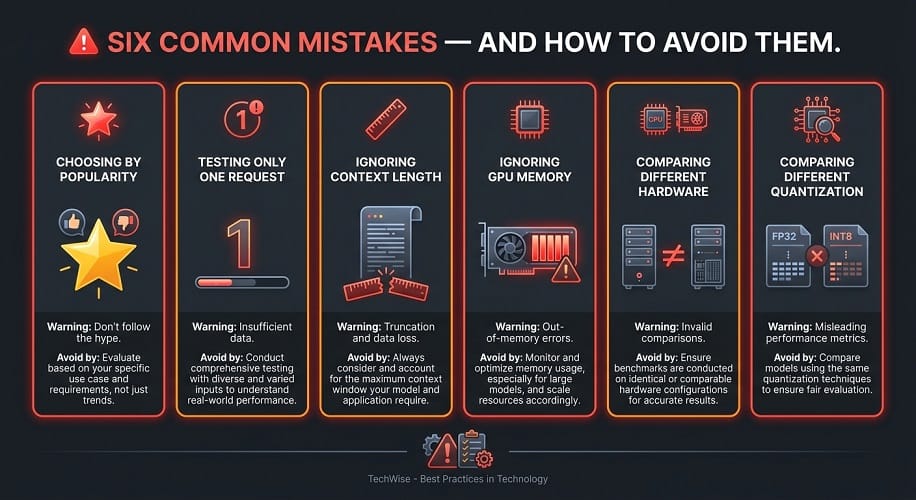
Choosing the framework by popularity
Popularity is useful, but your workload is more important.
Testing only one request
Single-request latency doesn't reveal high-concurrency behavior.
Ignoring context length
Large-context performance can be very different from short-context performance.
Ignoring GPU memory
Peak memory can determine whether the deployment is operationally safe.
Comparing different hardware
Always benchmark on identical hardware.
Comparing different quantization
Use the same precision and quantization.
Ignoring retries and errors
A framework that is fast but unreliable can have poor real-world economics.
Production Benchmark Checklist
Before choosing vLLM or SGLang, test:
| Category | Test |
|---|---|
| Model | Exact production checkpoint |
| Hardware | Same GPU |
| Precision | Same configuration |
| Context | Same lengths |
| Output | Same limits |
| Concurrency | Same load |
| Tools | Same tools |
| Cache | Same cache behavior |
| Parallelism | Same topology |
| Metrics | Same measurements |
Measure:
- TTFT
- Tokens/sec
- Requests/sec
- Peak VRAM
- Queue time
- Error rate
- Cost
- Task success
Final vLLM vs SGLang Recommendation
Best Default: vLLM
Choose vLLM when you want:
- Broad compatibility
- Production maturity
- Kubernetes support
- Large ecosystem
- Strong observability
- Easier multi-model platform development
Best Performance Candidate: SGLang
Choose SGLang when:
- Your exact model is strongly optimized for it
- Structured generation is important
- Benchmark results show higher throughput
- Latency is materially better
- The operational trade-off is acceptable
Best for Qwen
vLLM first, SGLang benchmark
Best for DeepSeek
Benchmark both on the exact model
Best for GLM
vLLM first, SGLang where specialized optimization helps
Best for Enterprise Platforms
vLLM is the safer general-purpose default
EaseCloud Recommendation
For organizations deploying Qwen, DeepSeek, GLM, Llama, or other open models, EaseCloud can help benchmark and optimize the entire inference environment rather than choosing a serving framework in isolation.
That can include:
- AWS GPU selection
- Amazon EC2
- Amazon EKS
- Kubernetes
- vLLM
- SGLang
- Multi-GPU inference
- Autoscaling
- GPU optimization
- Monitoring
- LLMOps
- Cost optimization
The goal is not to make a framework choice based on popularity.
The goal is to identify the serving stack that provides the required performance, reliability, scalability, and cost efficiency.
Frequently Asked Questions
Is vLLM better than SGLang?
Not universally. vLLM is generally the stronger default because of its broad ecosystem and production tooling, while SGLang can outperform it on specific models and workloads.
Is SGLang faster than vLLM?
Sometimes. Performance depends on the model, GPU, context, concurrency, precision, and serving configuration.
Which is better for Qwen?
Start with vLLM, then benchmark SGLang if latency or throughput is important.
Which is better for DeepSeek?
Benchmark both on the exact DeepSeek model and GPU configuration.
Which is better for GLM?
vLLM is a strong starting point, while SGLang should be tested for model-specific performance.
Is vLLM good for production?
Yes. Its broad ecosystem, OpenAI-compatible serving, Kubernetes integrations, monitoring, routing, and scaling capabilities make it a strong production choice.
Can vLLM and SGLang run on AWS?
Yes. Both can be deployed on AWS GPU infrastructure, including EC2 and Kubernetes-based environments.
Can I run vLLM or SGLang on H100 and H200?
Yes, supported models can be served on modern NVIDIA data-center GPUs. The exact configuration depends on the model and framework version.
Which costs less: vLLM or SGLang?
There is no universal answer. Compare GPU utilization, throughput, latency, and successful-task cost on the actual workload.
Final Verdict
vLLM is the best default choice for most production deployments.
SGLang is the strongest alternative when its specialized optimizations provide a measurable advantage.
For serious deployments, don't choose based on a generic benchmark.
Run the same Qwen, DeepSeek, or GLM model on the same GPU with the same workload and measure:
latency + throughput + memory + reliability + cost
That gives you the answer that actually matters for production.
For enterprises moving from model experimentation to production inference, EaseCloud can support the surrounding AWS, GPU, Kubernetes, vLLM, SGLang, observability, and cost-optimization infrastructure needed to operate these models reliably.