AWS Consulting Pricing: How Much Does It Actually Cost in 2026?
Transparent AWS consulting pricing for migrations, cost optimization, DevOps, security, and managed services. ROI benchmarks, pricing models, and how to get an accurate quote.
- What this guide covers: Real 2026 pricing ranges for every AWS consulting engagement type - by scope, complexity, and pricing model - plus an honest ROI framework to evaluate whether the investment makes sense for your situation.
- Why pricing is opaque: Most AWS consulting firms don't publish rates. This creates information asymmetry that disadvantages buyers. EaseCloud believes transparent pricing leads to better-fit engagements and healthier long-term partnerships.
- The key question: Don't ask 'what does it cost?' Ask 'what is the ROI?' A $15,000 migration that saves $6,000/month in infrastructure costs pays back in under 90 days.
1. Why AWS Consulting Pricing Is Hard to Find
Search 'AWS consulting pricing' and you will find almost no firm willing to publish specific numbers. The standard response is a contact form. This is not accidental.
AWS consulting pricing is genuinely variable, more so than most AWS professional services. A cloud migration for a five-server startup with clean documentation is a fundamentally different engagement than a migration for a 200-server company with a decade of undocumented infrastructure. Quoting both at the same rate would be wrong.
But variability is not the only reason for opcity. Some firms also use vague pricing as a negotiation tool, anchoring high before the client understands their options. This guide provides the reference ranges you need to evaluate proposals and negotiate from an informed position.
What makes AWS consulting prices vary
| Pricing Driver | How It Affects Cost |
| Environment complexity | The biggest driver. Five well-documented servers vs. 200 servers with undocumented dependencies is a 10× difference in migration scope. The complexity assessment during discovery determines true scope. |
| Engagement type | A one-time audit produces a different pricing model than an ongoing managed service. Project-based, retainer, and outcome-based engagements all have different structures. |
| Urgency and timeline | Emergency engagements (post-incident remediation, forced compliance deadlines) carry a premium. Planned engagements with adequate lead time are priced more competitively. |
| Firm tier and location | Global SIs (Accenture, Deloitte, Cognizant) charge 3–5× what boutique AWS specialists charge for equivalent work, primarily for brand and procurement risk coverage, not technical quality. |
| Scope definition clarity | Well-defined scope is priced more competitively. Vague scope carries contingency pricing. Invest in discovery before requesting a fixed-price proposal. |
| Compliance requirements | SOC 2, HIPAA, or PCI-DSS scope adds 20–40% to any engagement, additional controls, documentation, and testing that are non-negotiable but billable. |
2. AWS Consulting Pricing by Engagement Type (2026)
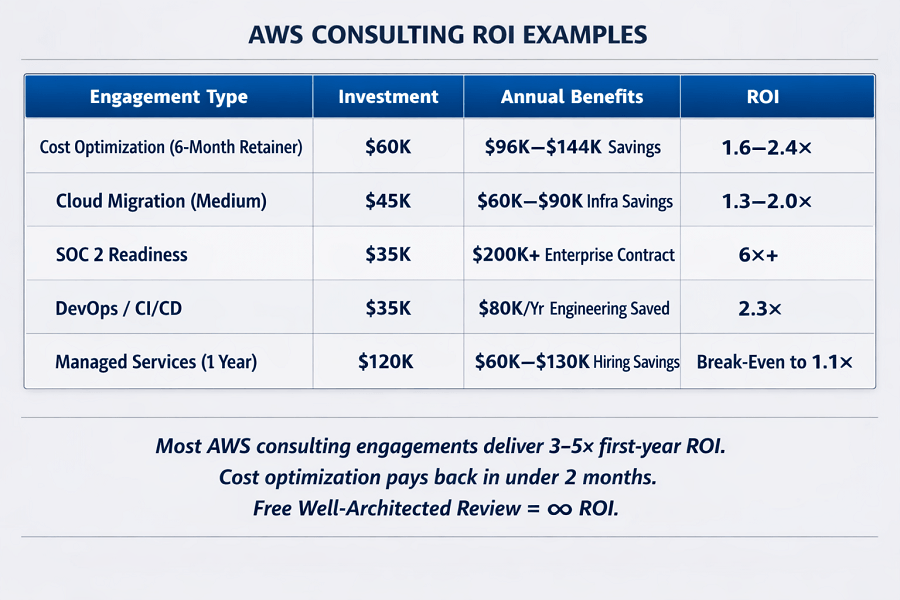
These ranges reflect market rates for competent, certified AWS consulting firms serving startups and SMBs in 2026. They are not the cheapest rates available (offshore body shops) nor the most expensive (global SIs). They represent quality-adjusted market pricing for firms with genuine AWS production expertise.
| Step & Time | Actions |
|---|---|
| ASSESSMENT Free |
No cost, no commitment required - Well-Architected Review: EaseCloud conducts this free - scoping call, architecture walkthrough, findings report, and readout - AWS cost analysis: Free initial assessment showing where your money goes and projected savings - Security posture review: Entry-level review of IAM, logging, network controls at no charge - What's free is genuine: no findings withheld, no obligation to engage further after delivery |
| MIGRATION $15,000–$120,000+ |
One-time project, scoped by environment size - Small environment (5-10 servers, simple apps): $15,000–$30,000, 4-8 weeks - Medium complexity (20-50 servers, database migration): $30,000–$60,000, 8-16 weeks - Large/complex environment (50-200 servers, multi-database, compliance): $60,000–$120,000, 16-26 weeks - Migration + DevOps pipeline build: add $20,000–$40,000 to base migration cost - Migration + compliance readiness (SOC 2/HIPAA): add $15,000–$30,000 - Price is for full-service delivery: discovery, architecture, execution, cutover, post-migration optimization |
| COST OPTIMIZATION $5,000–$15,000/month (retainer) |
Typically self-funding within 30-60 days - One-time cost audit (standalone): $5,000–$10,000 fixed fee; identifies savings, no execution - Optimization retainer: $5,000–$12,000/month; ongoing rightsizing, governance, and Savings Plan management - Average client savings identified: $8,000–$35,000/month depending on current AWS spend - Payback period: 30-60 days in most cases - the retainer costs less than the savings it generates - Free initial cost analysis available from EaseCloud - no engagement required to see where you stand |
| DEVOPS & CI/CD $20,000–$60,000 |
Project-based, 6-16 weeks - CI/CD pipeline build (GitHub Actions / CodePipeline + ECS/EKS): $20,000–$35,000 - Full infrastructure-as-code implementation (Terraform): $25,000–$45,000 - Observability stack (CloudWatch + X-Ray + dashboards + alerting): $10,000–$20,000 - Combined DevOps modernization (CI/CD + IaC + observability): $40,000–$75,000 - Typical outcome: 5-10× deployment frequency improvement, 60-80% reduction in deployment-related incidents |
| SECURITY & COMPLIANCE $15,000–$50,000 |
Project-based; scope-dependent - Security hardening (IAM, network controls, encryption, logging): $10,000–$20,000 - SOC 2 readiness: $20,000–$40,000; gap assessment + control implementation + pre-audit review - HIPAA implementation: $25,000–$45,000; PHI architecture, BAA management, audit trail - GDPR AWS architecture: $15,000–$30,000; data residency, deletion capability, processing documentation - Combined SOC 2 + security hardening (most common request): $30,000–$55,000 |
| MANAGED SERVICES $6,000–$25,000/month |
Ongoing; replaces or augments in-house infrastructure team - Essentials tier: $6,000–$10,000/month; 24/7 monitoring, alerting, incident response, monthly review - Standard tier: $10,000–$18,000/month; adds proactive patching, backup management, DR testing, cost governance - Premium tier: $18,000–$25,000/month; adds compliance monitoring, dedicated architect, architecture evolution - Pricing scales with: number of AWS accounts, SLA requirements, infrastructure complexity, compliance scope - Compare to hiring: a single mid-level AWS engineer costs $180,000–$250,000/year in total comp + benefits |
| ARCHITECTURE CONSULTING $8,000–$25,000 |
Short-term advisory or architecture design - Architecture review and design (1-3 week engagement): $8,000–$15,000 - New product infrastructure design (greenfield): $10,000–$20,000 - Modernization roadmap (monolith decomposition strategy): $12,000–$25,000 - Typically delivered as a combination of workshops, documentation, and IaC starter templates - Often the right entry point before committing to a larger migration or modernization program |
3. AWS Consulting Pricing Models: Fixed Fee vs. Retainer vs. T&M
The engagement type determines the pricing model. Understanding which model applies to your situation prevents proposal surprises.
| Model | When It Applies | Details & Tradeoffs |
|---|---|---|
| Fixed-fee project | One-time scope-defined work | Best for: migrations, DevOps builds, compliance readiness, architecture design. Requires clear scope definition upfront. Price is agreed before work starts. Changes to scope trigger a change order. Most predictable for budgeting. |
| Monthly retainer | Ongoing recurring services | Best for: managed services, cost optimization governance, continuous security monitoring. Predictable monthly cost. SLA-backed. Scales up/down quarterly based on environment complexity. Most clients stay on retainer long-term. |
| Time & Materials (T&M) | Flexible advisory or overflow | Best for: advisory engagements, ad-hoc architecture questions, complex engagements where full scope cannot be determined upfront. Billed at hourly or daily rate ($200–$350/hour for senior AWS engineers). Risk: total cost is variable. Mitigated with budget caps. |
| Outcome-based | Fee tied to delivered savings | Best for: cost optimization where savings are measurable. EaseCloud sometimes structures cost optimization engagements as a percentage of first-year savings achieved. Aligns incentives but requires agreed measurement methodology. |
4. What Drives AWS Consulting Prices Up and Down
Understanding the specific factors that push an engagement toward the high or low end of its range helps you get better proposals and avoid unexpected scope increases.
Factors that push price toward the high end
- Undocumented environment: discovery takes 2× longer when nothing is documented. Every undiscovered dependency adds time.
- Tight deadline or emergency timeline: urgency carries a 20–40% premium. Plan engagements with adequate lead time.
- Compliance scope: SOC 2, HIPAA, or PCI-DSS requirements add controls, documentation, and testing that extend any engagement.
- Legacy technology: migrating or modernizing systems built on deprecated software, unsupported OS versions, or proprietary middleware takes significantly longer.
- Multiple AWS accounts or regions: cross-account and multi-region architectures multiply configuration and testing surface area.
- Large team: more stakeholders, more review cycles, more coordination overhead. Larger organizations move slower.
Factors that push price toward the low end
- Clean, documented environment: a well-documented infrastructure with clear dependency maps reduces discovery time dramatically.
- Infrastructure already in code: if Terraform or CloudFormation exists, migration or modernization starts from a higher baseline.
- Flexible timeline: projects with adequate runway allow more efficient scheduling and less heroic delivery effort.
- Single AWS account, single region: simpler environments are genuinely simpler to work on.
- Engaged, available client team: engagements move faster when client engineers are available for questions, reviews, and testing without bottlenecks.
- Greenfield rather than migration: building something new is faster and less risky than refactoring or migrating something existing.
5. The ROI Framework: How to Evaluate Whether It's Worth It
Price in isolation means nothing. The right question is: what return does this investment generate, and over what timeframe?
AWS consulting ROI comes from three categories of return, each measurable in your own AWS billing dashboard and your own engineering metrics not on a consultant's slide deck.
ROI Category 1: Direct cost savings
| Savings Source | Typical Impact |
| AWS bill reduction | 30–40% average cost reduction after a cost optimization engagement. On a $20,000/month bill, that's $6,000–$8,000/month in savings $72,000–$96,000 per year. |
| Infrastructure decommission | Migrating from owned hardware or colocation saves 40–60% of total infrastructure cost. A company paying $15,000/month for colo typically pays $5,000–$8,000/month post-migration to AWS. |
| Avoided incident costs | A major production incident costs $5,000–$50,000+ in engineering time, customer compensation, and lost revenue. Proactive reliability work (multi-AZ, DR testing, monitoring) prevents them. |
| License elimination | Moving from self-managed software (databases, queues, search) to AWS managed services often eliminates software licensing costs and the engineering time to maintain them. |
ROI Category 2: Engineering productivity
- Deployment frequency: from 6/year to 200+/year after CI/CD implementation, each release is smaller, lower-risk, and faster
- Engineer time saved: 10–15 hours/week freed from infrastructure firefighting after managed services engagement, redirected to product development
- Onboarding time: new engineers ramp 50% faster when infrastructure is in code, documented, and reproducible
- Incident response time: 60–80% MTTR reduction after observability stack implementation
ROI Category 3: Business enablement
- Enterprise sales unlocked: SOC 2 compliance is a hard requirement at most companies above $1M ARR in enterprise sales. A single enterprise customer won because of compliance certification can exceed the compliance engagement cost in year one.
- Fundraising credibility: investors increasingly conduct technical due diligence. A Well-Architected review with a remediation roadmap in progress signals engineering maturity.
- Faster product velocity: modernization from monolith to microservices typically delivers 3–5× faster feature delivery, compounding business value over time.
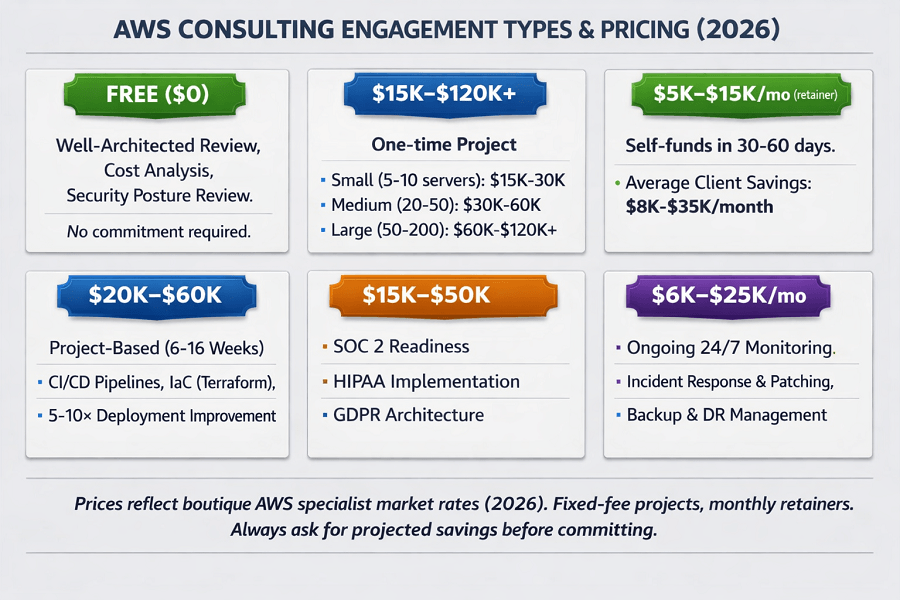
ROI examples by engagement type
| Engagement | Investment | Annual Savings / Value | First-Year ROI |
| Cost optimization retainer (6 months) | $60,000 | $96,000–$144,000/yr saved | 1.6–2.4× |
| Cloud migration (medium) | $45,000 | $60,000–$90,000/yr infra savings | 1.3–2.0× |
| SOC 2 readiness (unlocks enterprise) | $35,000 | $200,000+ first enterprise contract | 6×+ |
| DevOps / CI/CD implementation | $35,000 | $80,000/yr eng. time saved | 2.3× |
| Managed services (replaces hire) | $120,000/yr | $60,000–$130,000 vs. hiring | Break-even to 1.1× |
| Well-Architected Review | $0 | 5–12 high-risk findings remediated | ∞ (free) |
6. How EaseCloud Pricing Compares to the Market
AWS consulting options span a wide quality and price range. Here is how different provider types compare, not to disparage any category, but to help you understand what you are evaluating when you receive proposals.
| Provider Type | Relative Pricing | What You Get & When to Use |
| Global SIs (Accenture, Deloitte, Cognizant) | 3–5× boutique rates | Large teams, established processes, broad service lines. Appropriate for Fortune 500 procurement requirements. For startups and SMBs: significant overhead costs for account management, offshore/onshore blending, and prestige premium that does not translate to better technical outcomes. |
| AWS Professional Services (directly from Amazon) | Market rate, often higher | Credible and AWS-native. Useful for very large-scale or highly complex programs. Long engagement timelines and enterprise-oriented processes. Not optimized for startup speed or SMB budgets. |
| Boutique AWS specialists (like EaseCloud) | Market rate | Deep AWS specialization, lean delivery teams, direct access to senior engineers. Faster and more agile than large firms. No offshore blending, the engineers on the proposal are the engineers doing the work. |
| Freelance AWS engineers (Upwork, Toptal) | 40–60% of boutique rates | Individual engineers, not teams. No project management overhead. Risk: single point of failure, no breadth coverage, limited accountability. Appropriate for narrow, well-defined tasks, not end-to-end programs. |
| Offshore IT outsourcing firms | 30–50% of boutique rates | Lower hourly rates but higher total cost due to communication overhead, quality variability, and rework. For complex AWS work (migrations, security, compliance), offshore quality risk often outweighs rate savings. |
Boutique AWS specialists like EaseCloud: market rate, deep expertise, direct senior engineer access. No offshore bait-and-switch.
Global SIs charge 3–5× for the same work. Freelancers are cheaper but lack team depth. EaseCloud delivers enterprise-grade AWS expertise at startup-friendly pricing.
What you get:
- Senior engineers, not junior consultants – The people on the proposal are the people doing the work
- Transparent fixed-fee pricing – No uncapped T&M, no surprise invoices
- Free Well-Architected Review – Real findings, zero commitment
- Projected savings before you commit – See the ROI before you sign
7. How to Get an Accurate AWS Consulting Quote
A proposal based on incomplete information is either overpriced (contingency for unknown risk) or dangerously underpriced (and will balloon in scope). Here is how to get a quote that reflects reality.
Information to prepare before requesting a proposal
- Current infrastructure inventory: server count, AWS services in use, database types and sizes, third-party integrations
- Existing documentation: architecture diagrams, runbooks, network topology. Note gaps honestly, 'we have X but not Y'
- Compliance requirements: which frameworks apply (SOC 2, HIPAA, GDPR, PCI-DSS) and current status
- Team context: who currently manages infrastructure, their availability for the engagement, and their AWS skill level
- Timeline constraints: is there a deadline (compliance audit, contract requirement, lease end for on-premises) or is the timeline flexible
- Budget range: sharing your budget range accelerates scoping. A firm that knows you have $30,000 will propose accordingly, they will not guess at $100,000
Red flags in AWS consulting proposals
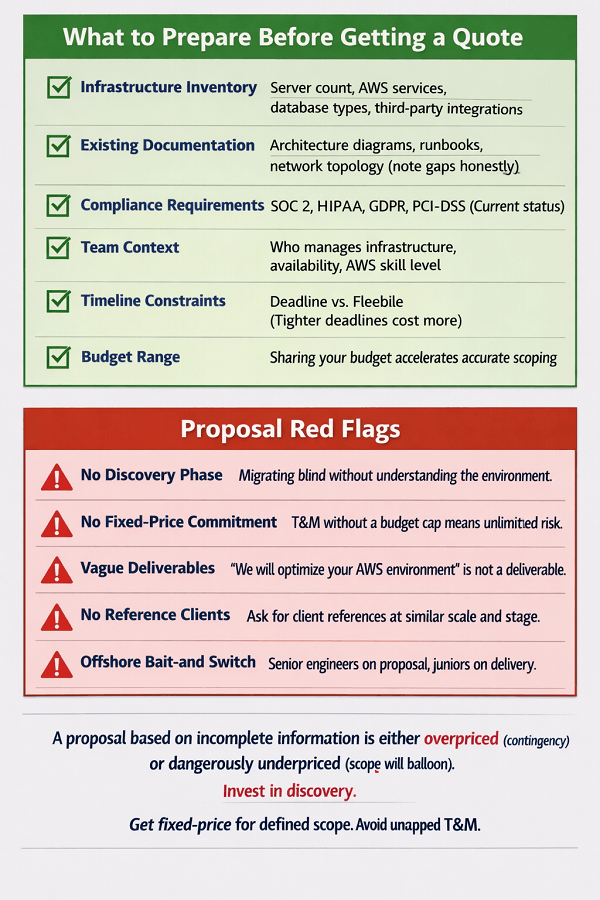
- No discovery phase: any migration or modernization proposal without a paid or included discovery phase is pricing blind. The firm does not know what they are building on.
- No fixed-price commitment: T&M without a budget cap on project work means unlimited risk to you. Legitimate firms will cap T&M or use fixed-fee for defined scope.
- Vague deliverables: 'we will optimize your AWS environment' is not a deliverable. 'We will deliver a rightsizing report, implement Reserved Instance commitments, and set up CloudWatch budget alerts by week 4' is.
- No reference clients: ask for two or three client references at similar scale and stage. A firm that cannot provide them has not done this before.
- Offshore bait-and-switch: proposal features senior engineers; delivery uses offshore juniors. Ask explicitly: who will be the primary engineers on this engagement?
Conclusion
AWS consulting pricing is not opaque by accident, but the ranges are predictable once you understand the drivers: environment complexity, engagement type, timeline, and compliance scope. The key question is not "what does it cost?" but "what is the ROI?" A $45K migration that saves $6K/month pays back in under 8 months.
A $35K SOC 2 engagement that unlocks a $200K enterprise contract delivers 6× ROI in year one. Start with a free AWS Well-Architected Framework Review to understand your baseline. Get fixed-price proposals for defined scope. Avoid uncapped T&M. And always ask for projected savings before committing. The right AWS consulting engagement funds itself.
Frequently Asked Questions
Can we start with a smaller engagement to test the relationship before committing to a large one?
Yes, and this is often the best approach. The Well-Architected Review (free) is the natural starting point: it demonstrates EaseCloud's expertise, gives you a concrete deliverable, and creates a shared understanding of your environment before any paid scope is agreed. Many clients follow the WAR with a targeted cost optimization engagement or security hardening project before committing to a full migration or managed services relationship.
Do prices include AWS service costs, or just consulting fees?
AWS consulting fees are separate from your AWS service charges. The consulting fee covers engineering time, project management, and deliverables. AWS charges (EC2, RDS, S3, data transfer, etc.) are billed directly to your AWS account. EaseCloud will project your post-engagement AWS costs as part of any proposal, so you understand the full picture, not just the consulting line item.
Are there ongoing costs after a project engagement ends?
For project-based engagements (migration, DevOps build, security hardening): no ongoing fees once the project delivers. You own everything the Terraform code, the CI/CD pipelines, the documentation. Some clients choose to add a lighter monthly retainer for ongoing advisory or cost governance after a project; that is optional and separately quoted.
What if the scope increases during the engagement?
EaseCloud uses change orders for out-of-scope work. If discovery reveals significantly more complexity than anticipated (common in migration engagements), we pause and present the revised scope and price before proceeding. We do not absorb surprise scope silently and we do not bill you for it without prior agreement. This is why investing in thorough discovery before a fixed-price proposal matters.
Is AWS consulting pricing negotiable?
Pricing reflects real engineering time. We don't inflate prices to negotiate down. What can flex: payment terms (phased invoicing tied to milestones rather than upfront), scope (reducing scope to fit budget while maintaining the most critical deliverables), and timing (flexible start dates that align with your budget cycle). We'd rather right-size the engagement than discount the work, discounted work gets cut somewhere.
Get a Transparent, Accurate Quote from EaseCloud
EaseCloud provides fixed-price proposals based on defined scope, not hourly guesses. Every proposal includes projected savings or ROI benchmarks so you can evaluate the investment before committing. We start with a free Well-Architected Review or cost analysis that gives you real value before any paid engagement begins.
Summarize this post with: