AWS Managed Services: What’s Included, What It Costs & When You Need It
Understand AWS managed services: 24/7 monitoring, incident response, security, backup, and cost optimization. Pricing models and when to choose managed operations over in-house.
As organizations scale their cloud infrastructure on Amazon Web Services (AWS), managing security, monitoring, incident response, compliance, and operational efficiency becomes increasingly complex. AWS Managed Services (AMS) and third-party AWS managed service providers help businesses offload day-to-day cloud operations, enabling internal teams to focus on innovation rather than infrastructure maintenance.
This guide explains what AWS managed services include, typical pricing models, and the scenarios where investing in managed cloud operations delivers the greatest value.
TL;DR
- AWS managed services = outsourced cloud operations – 24/7 monitoring, incident response, security, patching, backup, and cost optimization. Internal teams focus on product, not infrastructure.
- What's included: monitoring + alerting, incident response (with SLAs), proactive management, security/compliance (HIPAA, SOC 2, GDPR), backup/DR, and runbook automation.
- Pricing: 10-25% of AWS monthly spend, or fixed fees ($1K-$5K small, $5K-$20K mid, $20K+ enterprise).
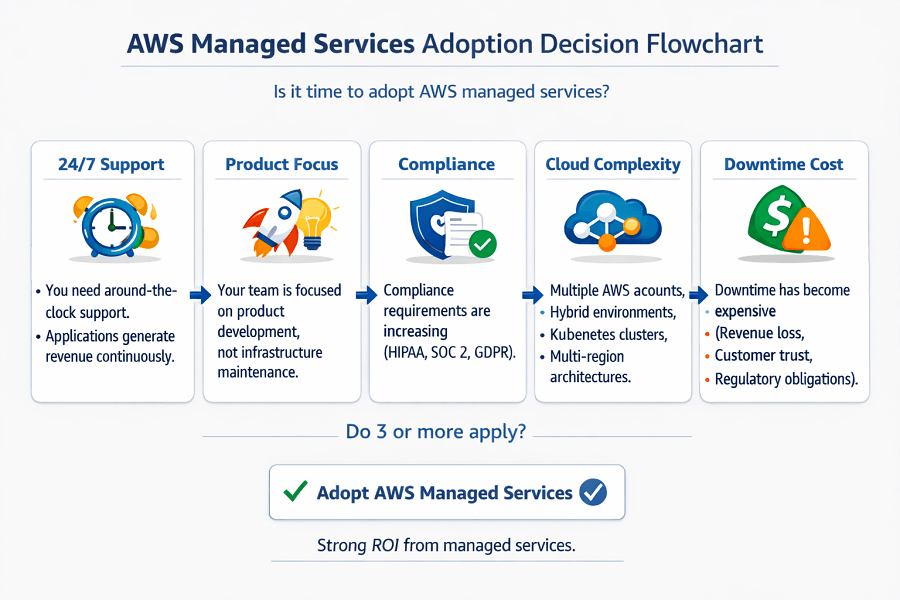
- When you need it: 24/7 support required, engineering focused on product, compliance increasing, cloud complexity growing, downtime is expensive.
- Managed vs in-house: Managed gives 24/7 coverage, specialized expertise, faster setup. In-house gives direct control. Most SMBs benefit from managed.
What Are AWS Managed Services?
AWS managed services refer to outsourced cloud operations where a specialized provider assumes responsibility for monitoring, maintenance, security, incident management, patching, backup, and ongoing optimization of AWS environments.
Rather than building a large in-house cloud operations team, organizations gain access to certified cloud engineers, 24/7 monitoring capabilities, automation frameworks, and established operational processes.
Managed service providers typically support:
- Infrastructure monitoring and alerting
- Incident detection and response
- Security management and compliance monitoring
- Backup and disaster recovery
- Cost optimization
- Patch and configuration management
- Cloud governance and operational reporting
- Performance optimization
For many organizations, managed services function as an extension of internal IT and DevOps teams.
What’s Included in AWS Managed Services?
1. 24/7 Cloud Monitoring
Continuous infrastructure monitoring helps detect performance issues before they impact users.
Typical monitoring services include:
- AWS resource health monitoring
- Application performance tracking
- Log aggregation and analysis
- Automated alerting
- Capacity planning
- Availability monitoring
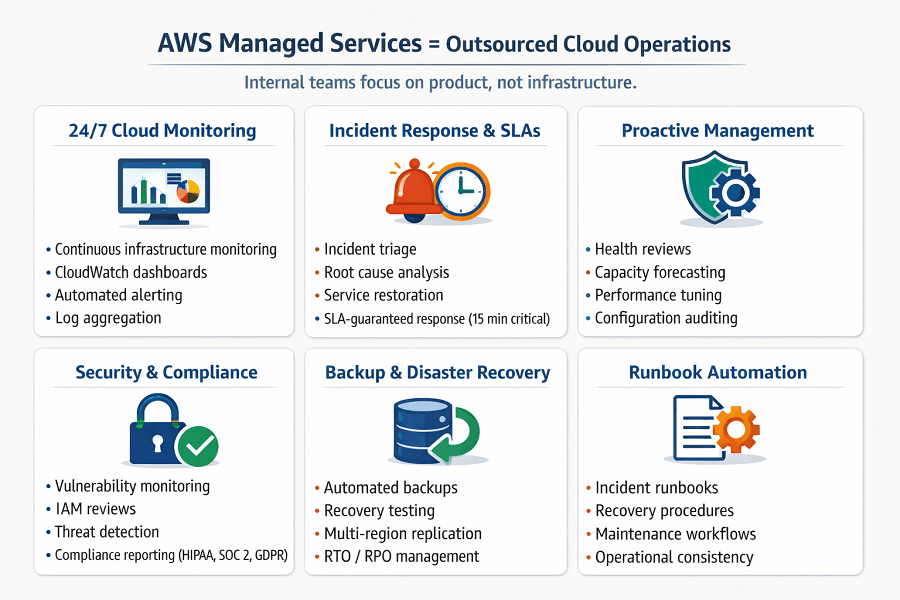
Many providers leverage services such as Amazon CloudWatch to create custom dashboards, alerts, and automated remediation workflows.
2. Incident Response & SLA Management
Managed service providers maintain dedicated operations teams that respond to alerts around the clock.
Services commonly include:
- Incident triage
- Root cause analysis
- Escalation management
- Service restoration
- Post-incident reporting
- Operational reviews
Providers typically offer incident response SLAs that define guaranteed response times based on severity levels.
For business-critical workloads, rapid response can significantly reduce downtime and revenue loss.
3. Proactive Cloud Management
Rather than simply reacting to issues, managed services focus on preventing them.
Proactive management may include:
- Infrastructure health reviews
- Security assessments
- Capacity forecasting
- Performance tuning
- Resource optimization
- Configuration auditing
This approach reduces operational risk and improves long-term cloud stability.
4. Security & Compliance Operations
Security remains one of the most common reasons organizations adopt managed cloud services.
Managed security functions often include:
- Vulnerability monitoring
- Identity and access management reviews
- Security policy enforcement
- Threat detection
- Compliance reporting
- Security event response
Industries subject to regulations such as HIPAA, PCI DSS, SOC 2, or GDPR often benefit from managed compliance support.
5. Backup & Disaster Recovery
Cloud outages, accidental deletions, ransomware events, and configuration errors can all threaten business continuity.
Managed providers typically implement:
- Automated backup policies
- Recovery testing
- Multi-region replication
- Disaster recovery planning
- Recovery runbooks
- Recovery time objective (RTO) management
- Recovery point objective (RPO) management
A mature disaster recovery strategy helps organizations restore services quickly after disruptions.
6. Runbook Documentation & Automation
Operational consistency improves when processes are standardized and automated.
Managed service teams frequently create:
- Incident response runbooks
- Recovery procedures
- Maintenance workflows
- Escalation paths
- Change management documentation
Automation reduces human error while accelerating routine operational tasks.
AWS Managed Services Pricing: What Does It Cost?
Managed service pricing varies significantly depending on infrastructure complexity, compliance requirements, and support expectations.
Common pricing models include:
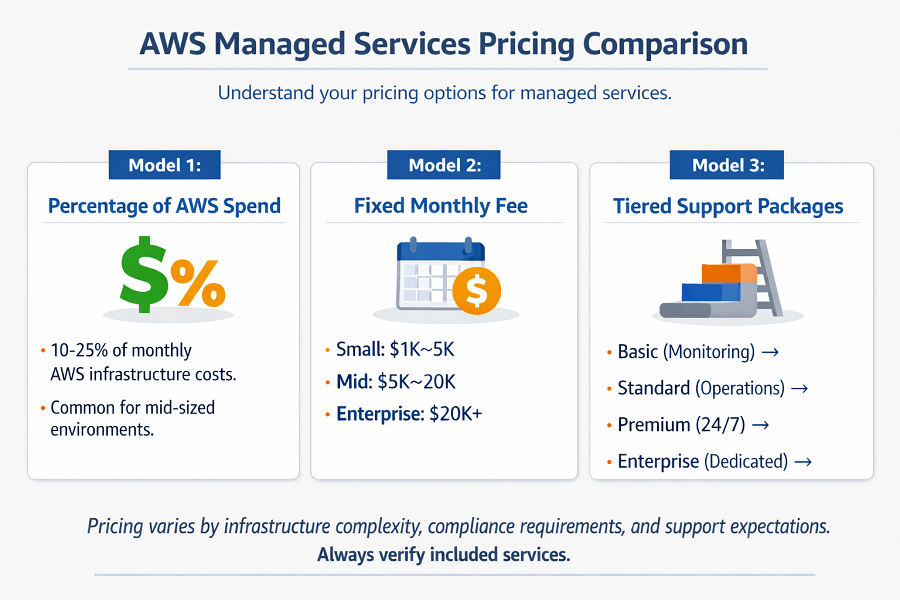
Percentage of AWS Spend
Many providers charge a percentage of monthly AWS infrastructure costs.
Typical range:
- 10%–25% of AWS monthly spend
This model is common for mid-sized environments.
Fixed Monthly Fee
AWS organizations with predictable infrastructure often prefer flat-rate pricing.
Typical monthly ranges:
Tiered Support Packages
Providers may offer:
- Basic monitoring
- Standard operations management
- Premium 24/7 support
- Enterprise managed operations
Higher tiers generally include faster SLAs, advanced security services, and dedicated account management.
AWS Managed Services vs. In-House DevOps
Many organizations evaluate whether building an internal operations team is more cost-effective than outsourcing.
In-House Team Advantages
- Direct organizational control
- Deep business knowledge
- Customized operational processes
Managed Services Advantages
- 24/7 coverage without shift staffing
- Access to specialized AWS expertise
- Faster implementation
- Lower hiring and training costs
- Established operational frameworks
For organizations that lack dedicated Site Reliability Engineering (SRE) or Cloud Operations teams, managed services often provide faster time-to-value.
Managed services reduce operational overhead. Cloud-native development reduces the operational burden in the first place.
Applications built with 12-factor principles (stateless processes, config in environment, disposable containers) are inherently easier to operate.
We help you:
- Build 12-factor cloud-native applications – Stateless, configurable, disposable
- Implement health checks and graceful shutdown – Enable automated monitoring and recovery
- Design for horizontal scaling – Applications that scale effortlessly with demand
- Reduce operational complexity – Fewer moving parts, easier to manage
When Does Your Business Need AWS Managed Services?
You Need Around-the-Clock Support
If applications generate revenue continuously, operational issues can occur outside normal business hours.
Managed services provide continuous monitoring and response capabilities.
Your Team Is Focused on Product Development
Engineering teams often deliver greater business value when focused on product innovation rather than infrastructure maintenance.
Managed operations reduce operational overhead.
Compliance Requirements Are Increasing
As businesses enter regulated industries, maintaining security controls and compliance reporting becomes more demanding.
Managed providers help maintain operational compliance processes.
Cloud Complexity Is Growing
Multiple AWS accounts, hybrid environments, Kubernetes clusters, and multi-region architectures introduce operational complexity.
Managed cloud operations can simplify administration and governance.
Downtime Has Become Expensive
For organizations where outages directly impact revenue, customer trust, or regulatory obligations, investing in proactive monitoring and incident response becomes increasingly valuable.
Questions to Ask Before Choosing an AWS Managed Service Provider
Before selecting a provider, evaluate:
- Do they provide true 24/7 monitoring and response?
- What incident response SLAs are guaranteed?
- How are security incidents handled?
- What compliance frameworks do they support?
- How are backups tested and validated?
- What reporting and visibility are included?
- What automation and runbook capabilities exist?
- Are cost optimization services included?
- What AWS certifications does the team maintain?
- How is onboarding performed?
A provider's operational maturity is often more important than simply choosing the lowest-cost option.
Final Thoughts
AWS managed services can significantly reduce operational burden while improving infrastructure reliability, security, and performance. Organizations that require 24/7 monitoring, structured incident response, disaster recovery planning, and proactive cloud management often find that managed services provide stronger operational outcomes than relying solely on internal resources.
While pricing varies based on environment size and support requirements, the right managed services partner can help businesses maintain cloud stability, improve security posture, and enable engineering teams to focus on strategic initiatives rather than day-to-day operations.
Frequently Asked Questions
1. What's the difference between AWS Managed Services (AMS) and a third-party MSP?
AMS is AWS's own managed service offering, focused primarily on enterprise-grade infrastructure operations with standardized processes. Third-party MSPs offer more flexibility, custom tooling, and often better pricing for SMBs. Third-party providers also support multi-cloud environments and can tailor services to your specific compliance needs.
2. How do I know if I should use managed services vs. hiring in-house?
If you need 24/7 coverage, managed services are often cheaper than hiring multiple shifts. If your cloud spend is under $50K/month, a managed provider typically delivers faster time-to-value than building an internal team. If you have complex compliance requirements (HIPAA, SOC 2), managed providers bring pre-built controls and audit-ready documentation.
3. What SLAs should I expect from a managed services provider?
Critical incidents (service down): 15-minute response, 1-hour resolution. High (degraded): 30-minute response, 4-hour resolution. Medium (non-urgent): 4-hour response, 24-hour resolution. Low (informational): 24-hour response. Always verify SLAs in writing and review their escalation paths before signing.
Summarize this post with: