DeepSeek vs GLM: Complete AI Model Comparison (2026)
Compare DeepSeek vs GLM across coding, reasoning, benchmarks, APIs, pricing, deployment, AI agents, and enterprise AI to choose the right model.
China's AI ecosystem has become one of the fastest-growing sources of advanced large language models, with several open-weight and enterprise-ready models now competing on the global stage. Among the most discussed are DeepSeek and GLM, two model families that have attracted attention for their reasoning capabilities, coding performance, and support for enterprise AI applications.
While both models originate from leading Chinese AI companies, they were developed with different priorities. DeepSeek, created by DeepSeek AI, has earned recognition for its strong reasoning models, competitive coding performance, and efficient open-weight deployments. GLM, developed by Zhipu AI, focuses on enterprise AI, intelligent agents, structured reasoning, and multimodal capabilities.
For organizations evaluating these models, the comparison goes far beyond benchmark rankings.
Common questions include:
- Is DeepSeek better than GLM?
- Which model performs better for coding?
- Which offers stronger reasoning capabilities?
- Which is more suitable for AI agents?
- Is GLM better for enterprise AI?
- Which model is easier to deploy on AWS or Kubernetes?
- Which provides better APIs?
- Which delivers the best long-term value?
The right answer depends on your workload, deployment strategy, and operational requirements.
A startup building an AI coding assistant may prioritize repository understanding and inference costs. A financial institution may require strong reasoning, governance, and secure private deployments. An enterprise knowledge platform may focus on multilingual support, Retrieval-Augmented Generation (RAG), and long-context document analysis.
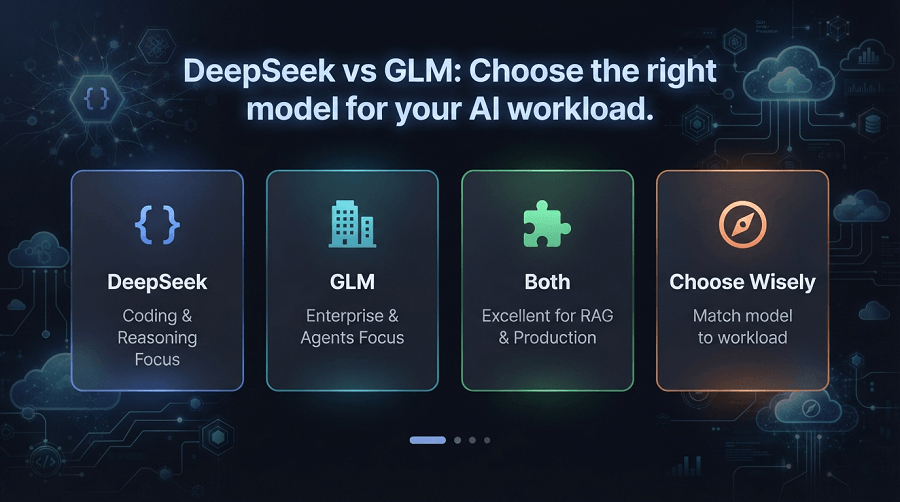
Choosing the right model therefore requires evaluating multiple factors together, including:
- Model architecture
- Coding capabilities
- Reasoning performance
- Enterprise readiness
- Deployment flexibility
- API ecosystem
- Infrastructure requirements
- Total Cost of Ownership (TCO)
What This Guide Covers
- Model families
- Coding benchmarks
- Reasoning benchmarks
- Mathematical performance
- Enterprise AI
- AI agents
- APIs
- Pricing models
- Local deployment
- Kubernetes support
- AWS infrastructure
- Production use cases
Rather than relying solely on benchmark leaderboards, we'll examine how these models perform in real-world enterprise environments and which types of organizations are likely to benefit most from each.
Whether you're an AI engineer, software architect, DevOps professional, CTO, startup founder, or enterprise decision-maker, this comparison will help you choose the model that best aligns with your AI strategy.
What Is DeepSeek?
DeepSeek is a family of open-weight large language models developed by DeepSeek AI. The company has quickly become one of the most influential contributors to the open AI ecosystem by releasing high-performing models optimized for reasoning, software engineering, and research-oriented workloads.
The DeepSeek family includes models designed for different tasks, including general-purpose language understanding, coding, and advanced reasoning.
Popular models include:
- DeepSeek V3
- DeepSeek R1
- DeepSeek Coder
- DeepSeek Math
These models have gained widespread adoption because they combine competitive benchmark performance with flexible deployment options.
Key Strengths
- Advanced reasoning
- Excellent coding performance
- Strong mathematical capabilities
- Open-weight deployment
- Efficient inference
- Long-context support
- Function calling
- Structured outputs
- Enterprise-ready APIs
DeepSeek is frequently used for AI coding assistants, research tools, software engineering platforms, enterprise automation, and intelligent agents.
What Is GLM?
GLM (General Language Model) is a family of foundation models developed by Zhipu AI, a leading Chinese AI company focused on enterprise-grade artificial intelligence and large language model research.
Over the past few years, GLM has evolved into a broad ecosystem of models optimized for reasoning, intelligent agents, multimodal interactions, and business applications.
Popular variants include:
- GLM-4
- GLM-4.5
- GLM-4-Air
- GLM-4-Flash
- GLM-Z1
GLM emphasizes balanced performance across reasoning, planning, language understanding, and enterprise deployment.
Key Strengths
- Strong reasoning
- AI agent capabilities
- Enterprise AI
- Tool calling
- Function calling
- Long-context understanding
- Multimodal support
- Structured generation
- Efficient deployment
These capabilities make GLM a strong candidate for enterprise knowledge systems, intelligent assistants, customer service platforms, and AI-powered workflow automation.
DeepSeek AI vs Zhipu AI
Understanding the organizations behind these models provides valuable context when evaluating long-term ecosystem maturity and enterprise support.
DeepSeek AI
DeepSeek AI has gained global recognition for releasing highly capable open-weight models that emphasize accessibility and research innovation.
Its development priorities include:
- Open-weight foundation models
- Advanced reasoning
- Coding performance
- Mathematical reasoning
- Efficient inference
- Community adoption
DeepSeek's rapid innovation cycle has made it a popular choice among developers and organizations seeking high-performance models that can be deployed privately.
Zhipu AI
Zhipu AI focuses heavily on enterprise AI and commercial deployment.
Its priorities include:
- Enterprise applications
- AI agents
- Multimodal AI
- Structured reasoning
- API services
- Intelligent assistants
The company continues to expand the GLM ecosystem with models designed for production-scale AI deployments.
DeepSeek vs GLM Model Family Comparison
Both ecosystems provide multiple specialized models optimized for different workloads.
| Category | DeepSeek | GLM |
|---|---|---|
| General Chat | ✅ | ✅ |
| Coding Models | ✅ | ✅ |
| Reasoning Models | ✅ | ✅ |
| Math Models | ✅ | Available in general models |
| Enterprise Models | ✅ | ✅ |
| Long Context | ✅ | ✅ |
| Function Calling | ✅ | ✅ |
| Tool Calling | ✅ | ✅ |
| Open‑Weight Models | ✅ | Available for selected variants |
| API Availability | Excellent | Excellent |
Instead of relying on a single flagship model, both DeepSeek and GLM offer specialized variants designed to balance performance, latency, and infrastructure requirements for different production environments.
Architecture Overview
Although both model families are based on transformer architectures, they have evolved with different design priorities.
DeepSeek Architecture Focus
DeepSeek places significant emphasis on:
- Reasoning efficiency
- Coding quality
- Mathematical problem solving
- Long-context processing
- Efficient inference
- Research-oriented workloads
- Open deployment flexibility
This makes it particularly attractive for organizations building AI coding tools, research assistants, and analytical platforms.
GLM Architecture Focus
GLM emphasizes:
- Structured reasoning
- AI agent workflows
- Enterprise automation
- Planning capabilities
- Tool integration
- Multimodal experiences
- Business-oriented deployments
Its architecture reflects a focus on enterprise AI systems that require reliable orchestration across multiple business processes.
Reasoning Philosophy
Although both models perform well on reasoning benchmarks, their design philosophies differ.
DeepSeek
DeepSeek prioritizes deep analytical reasoning and problem decomposition, making it particularly effective for:
- Mathematics
- Algorithm design
- Scientific analysis
- Software debugging
- Technical research
GLM
GLM focuses on structured planning and enterprise decision-making.
Typical strengths include:
- Workflow orchestration
- Agent planning
- Business reasoning
- Task decomposition
- Instruction following
- Enterprise assistants
Organizations should evaluate these differences against the specific reasoning patterns required by their applications.
Coding Focus
Coding remains one of the most demanding and commercially valuable AI use cases.
Both DeepSeek and GLM support modern software engineering tasks, including:
- Code generation
- Bug fixing
- Documentation
- Test creation
- Refactoring
- SQL generation
- API development
- DevOps scripting
DeepSeek
DeepSeek has built a strong reputation within the developer community for producing accurate, efficient, and well-structured code.
Its coding-focused models are widely used for AI-powered development environments and programming assistants.
GLM
GLM also supports software engineering workflows, particularly where coding is combined with planning, structured reasoning, or intelligent agent behavior.
We'll compare coding performance using HumanEval, SWE-bench, LiveCodeBench, and BigCodeBench in Part 2.
Context Window Comparison
Enterprise AI applications increasingly require models capable of processing large amounts of information within a single request.
Typical use cases include:
- Source code repositories
- Technical documentation
- Legal documents
- Financial reports
- Medical records
- Research papers
Both DeepSeek and GLM offer long-context capabilities suitable for these workloads.
However, organizations should remember that a larger context window does not automatically produce better answers. Effective Retrieval-Augmented Generation (RAG), efficient prompt engineering, and high-quality document retrieval remain equally important.
Enterprise Readiness
When evaluating AI platforms, enterprises look beyond raw model performance.
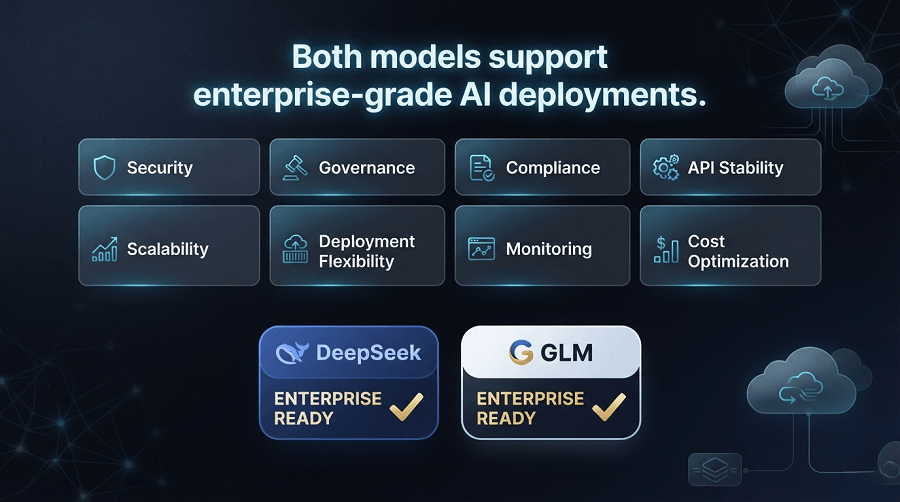
Key considerations include:
- Security
- Governance
- Compliance
- API stability
- Scalability
- Deployment flexibility
- Monitoring
- Cost optimization
Both DeepSeek and GLM provide capabilities that support enterprise adoption through managed APIs and self-hosted deployments.
The best choice often depends on existing infrastructure, regulatory requirements, and operational expertise.
EaseCloud Perspective
At EaseCloud, selecting between DeepSeek and GLM begins with understanding the business problem rather than comparing benchmark scores in isolation.
For example:
- Organizations building AI coding assistants often benefit from DeepSeek's strong software engineering capabilities and open-weight deployment flexibility.
- Businesses developing intelligent workflow automation or AI agents may find GLM's structured planning and orchestration capabilities better suited to their requirements.
- Enterprises operating in regulated industries should evaluate governance, deployment models, infrastructure costs, and compliance alongside model performance.
- Teams planning long-term AI adoption should benchmark both models using their own datasets and production workflows before making architectural decisions.
Our recommendation is to evaluate models based on measurable business outcomes, including productivity improvements, operational efficiency, infrastructure costs, and scalability rather than relying solely on public benchmark leaderboards.
DeepSeek vs GLM Feature Comparison
| Feature | DeepSeek | GLM |
|---|---|---|
| Coding Performance | Excellent | Very Good |
| Reasoning | Excellent | Excellent |
| Mathematical Reasoning | Excellent | Very Good |
| AI Agents | Excellent | Excellent |
| Function Calling | ✅ | ✅ |
| Tool Calling | ✅ | ✅ |
| Long Context | Excellent | Excellent |
| Enterprise APIs | Mature | Mature |
| Self‑Hosting | Supported | Supported |
| Kubernetes Deployment | Supported | Supported |
| RAG Applications | Excellent | Excellent |
| Research Workloads | Excellent | Very Good |
| Enterprise Automation | Very Good | Excellent |
Which Model Is Better for Coding?
AI-assisted software development has become one of the largest use cases for modern LLMs.
Common coding tasks include:
- Code generation
- Code completion
- Bug fixing
- Repository analysis
- Test generation
- Refactoring
- Documentation
- SQL generation
- Infrastructure as Code
- DevOps automation
Choose DeepSeek If You Need
- AI coding assistants
- Large repository analysis
- Backend development
- Code reviews
- Documentation generation
- API development
- Infrastructure automation
- Open-weight deployment
DeepSeek has earned a strong reputation among developers because of its excellent code quality, repository understanding, and reasoning during software engineering tasks.
Choose GLM If You Need
- Intelligent programming agents
- Multi-step engineering workflows
- Planning before implementation
- AI-assisted architecture design
- Enterprise software automation
GLM's reasoning-oriented architecture performs well when software development involves planning, orchestration, and structured problem solving.
EaseCloud Recommendation
At EaseCloud, we typically recommend DeepSeek for organizations building AI-powered developer tools, coding copilots, and engineering productivity platforms.
For enterprises combining software engineering with AI agents and workflow automation, GLM can be an excellent complementary model.
Which Model Is Better for AI Agents?
Agentic AI systems require much more than simple text generation.
Modern AI agents perform tasks such as:
- Planning
- Tool selection
- Function calling
- API orchestration
- Workflow execution
- Decision making
Both DeepSeek and GLM support:
- Function Calling
- Tool Calling
- Structured Outputs
- JSON Mode
- Multi-step reasoning
DeepSeek Strengths
DeepSeek performs particularly well for:
- Coding agents
- Engineering assistants
- Technical workflows
- Research automation
- Knowledge retrieval
GLM Strengths
GLM is especially strong for:
- Business workflow automation
- Enterprise assistants
- Task planning
- Sequential reasoning
- Intelligent orchestration
Organizations building sophisticated AI agents should benchmark both models using their actual workflows rather than relying solely on public benchmark results.
Which Model Is Better for Enterprise AI?
Enterprise AI platforms require more than technical capability.
Decision-makers evaluate:
- Security
- Governance
- Compliance
- Scalability
- Reliability
- API maturity
- Integration options
DeepSeek
Well suited for:
- Developer platforms
- AI coding assistants
- Enterprise search
- Knowledge management
- Research environments
- Technical documentation
GLM
Strong choice for:
- Enterprise assistants
- Customer service automation
- Internal productivity tools
- AI workflow orchestration
- Business process automation
Both models are capable of supporting enterprise-scale AI deployments when implemented with appropriate infrastructure and governance.
Which Model Is Better for Startups?
Startups generally prioritize:
- Fast development
- Lower costs
- Rapid iteration
- Minimal operational complexity
For early-stage teams, managed APIs are often the most practical starting point.
Benefits include:
- Faster time-to-market
- Reduced infrastructure management
- Lower initial investment
- Easier experimentation
As usage grows, organizations can evaluate whether transitioning to self-hosted deployments offers operational or cost advantages.
Which Model Is Better for RAG Applications?
Retrieval-Augmented Generation (RAG) has become one of the most common enterprise AI architectures.
Successful RAG systems require models that can:
- Process retrieved documents
- Maintain context
- Generate grounded responses
- Follow structured instructions
DeepSeek
Particularly effective for:
- Technical documentation
- Developer knowledge bases
- Internal engineering portals
- Code repositories
GLM
Strong for:
- Enterprise document analysis
- Business knowledge systems
- Policy documentation
- Intelligent decision support
The effectiveness of a RAG application depends not only on the language model but also on document retrieval quality, embeddings, chunking strategies, model quantization, and prompt engineering.
Which Model Is Better for Research?
Research teams require:
- Scientific reasoning
- Long-context understanding
- Mathematical accuracy
- Reliable citation workflows
DeepSeek's reasoning-focused models make it particularly attractive for technical and scientific research.
GLM also performs well for structured analysis, especially in enterprise research environments where planning and workflow integration are important.
Security & Governance
Security should be considered from the beginning of every enterprise AI project.
Important areas include:
- Identity management
- Access control
- Encryption
- Audit logging
- Private networking
- Compliance
- Data residency
- Secret management
These controls are essential regardless of whether DeepSeek or GLM is selected.
EaseCloud Insight
At EaseCloud, enterprise AI deployments are designed around a security-first architecture. We implement private networking, Kubernetes security, identity integration, observability, MLOps, and governance controls to ensure production AI systems remain secure, scalable, and compliant.
Licensing Considerations
Before deploying any foundation model in production, organizations should review:
- Commercial usage permissions
- Open-weight licensing
- Fine-tuning rights
- Redistribution policies
- Hosting requirements
- Regional restrictions
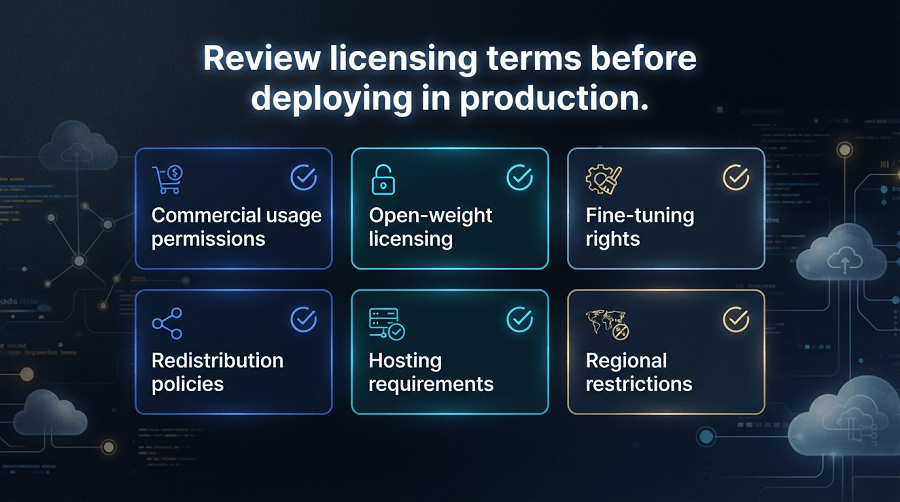
Because licensing terms may evolve over time, it's important to consult the latest documentation from the model provider before launching commercial applications.
Common Misconceptions
"The Highest Benchmark Score Always Wins"
Benchmark performance is only one part of the evaluation process.
Operational success also depends on:
- Infrastructure
- Cost
- Latency
- Reliability
- Monitoring
- User experience
"One Model Fits Every Use Case"
Different workloads benefit from different models.
Coding assistants, AI agents, multilingual customer support, and enterprise search systems all have distinct requirements.
"Larger Models Always Deliver Better ROI"
Larger models typically require:
- More GPUs
- Higher infrastructure costs
- Increased latency
Many organizations achieve better results using optimized mid-sized models deployed efficiently.
"Changing Models Solves AI Quality Problems"
Many production issues stem from:
- Poor prompts
- Weak retrieval pipelines
- Low-quality data
- Inadequate evaluation
- Missing observability
Replacing the model alone rarely addresses these underlying challenges.
Conclusion
Choosing between DeepSeek and GLM requires evaluating much more than benchmark rankings. Successful AI adoption depends on selecting a model that aligns with your business goals, deployment environment, governance requirements, and operational strategy.
By validating both models against real production workloads and designing a scalable AI platform, organizations can build solutions that deliver long-term value instead of short-term benchmark gains.
Frequently Asked Questions
Is DeepSeek better than GLM?
Neither model is universally better. DeepSeek is often preferred for software engineering, coding assistants, and research-oriented workloads, while GLM excels in enterprise AI, workflow automation, and intelligent agents.
Which model is better for coding?
DeepSeek generally has an advantage for code generation, debugging, repository analysis, and developer productivity.
Which model is better for AI agents?
Both support modern agent architectures with function calling and structured outputs. GLM is often stronger for workflow orchestration, while DeepSeek performs well for engineering-focused agents.
Can both models be self-hosted?
Yes.
Both support deployment using:
- Ollama
- vLLM
- Docker
- Kubernetes
- Hugging Face Transformers
Self-hosting enables greater control over security, compliance, and infrastructure optimization.
Should enterprises choose based only on benchmark scores?
No.
Enterprises should also evaluate:
- Deployment architecture
- Operational costs
- Infrastructure requirements
- Governance
- Vendor ecosystem
- Long-term scalability
Final Verdict
DeepSeek and GLM are both outstanding examples of how rapidly China's AI ecosystem is advancing.
Choose DeepSeek if your priorities include:
- AI coding assistants
- Software engineering
- Repository analysis
- Technical research
- Mathematical reasoning
- Open-weight deployments
- Developer productivity
Choose GLM if your priorities include:
- Enterprise AI
- Intelligent agents
- Workflow automation
- Business decision support
- Structured planning
- Enterprise knowledge assistants
For many organizations, the most effective approach is a multi-model AI architecture, where different workloads are routed to the model best suited for the task. This strategy maximizes performance, improves resilience, and helps optimize infrastructure costs.
How EaseCloud Helps Deploy Chinese LLMs
Deploying AI models at scale involves far more than selecting the right foundation model. Organizations need secure infrastructure, efficient inference, governance, monitoring, and ongoing optimization to achieve reliable production performance. At EaseCloud, we help businesses design, deploy, and manage enterprise AI platforms built on leading open-weight models such as DeepSeek and GLM.
Book Your Free LLM Deployment AssessmentSummarize this post with: