Qwen vs GLM: Complete AI Model Comparison (2026)
Compare Qwen vs GLM across coding, reasoning, benchmarks, APIs, pricing, multilingual AI, enterprise deployment, and real-world use cases.
China's open AI ecosystem has evolved rapidly over the past two years, producing several world-class large language models that now compete with leading global alternatives. Among them, Qwen and GLM have emerged as two of the most capable model families for software development, multilingual AI, enterprise automation, and advanced reasoning.
Although both are developed by leading Chinese AI companies, they are designed with different priorities. Qwen, developed by Alibaba Cloud, has become a popular choice for developers building coding assistants, AI agents, Retrieval-Augmented Generation (RAG) systems, and enterprise applications. GLM, created by Zhipu AI, focuses heavily on reasoning, agent capabilities, enterprise AI, and advanced multimodal experiences.
For organizations evaluating these models, the decision extends far beyond benchmark scores.
Common questions include:
- Is Qwen better than GLM?
- Which model performs better for coding?
- Which supports enterprise AI workloads more effectively?
- Is GLM more accurate than Qwen?
- Which model offers better APIs?
- Which is easier to deploy on AWS or Kubernetes?
- Which model provides better multilingual performance?
- Which delivers the best value for production AI systems?
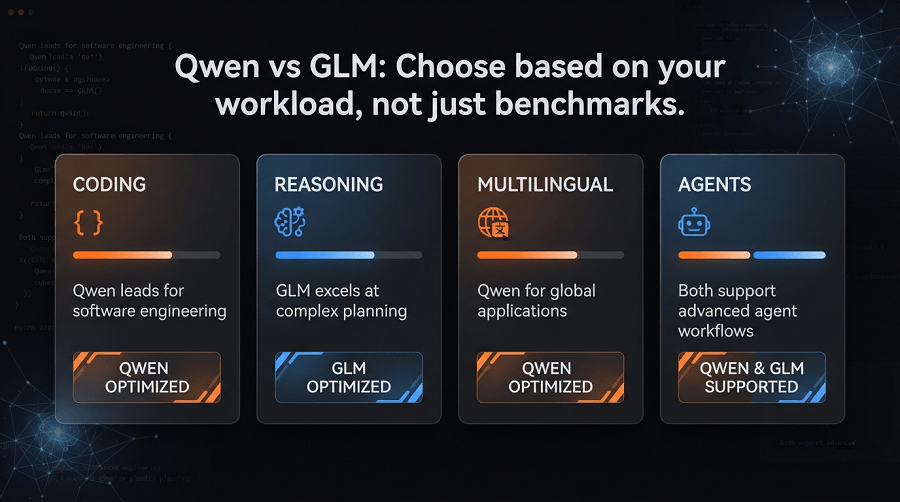
The answers depend on your workload, infrastructure, deployment strategy, and business objectives.
Some organizations prioritize coding performance and developer productivity. Others focus on multilingual customer support, AI agents, internal knowledge assistants, or long-context document analysis. Because of these differences, selecting the right model requires evaluating architecture, benchmarks, deployment flexibility, ecosystem maturity, and operational costs together.
What This Guide Covers
- Model architecture
- Coding performance
- Reasoning ability
- Mathematical problem solving
- Multilingual capabilities
- API ecosystem
- Enterprise deployment
- Benchmark results
- Pricing approaches
- Local deployment
- AI agent support
- Infrastructure requirements
- Real-world business use cases
Rather than relying solely on benchmark leaderboards, we'll also examine how these models perform in practical production environments.
Whether you're an engineering leader, AI architect, startup founder, DevOps engineer, or enterprise decision-maker, this guide will help you determine which model best fits your organization's AI strategy.
What Is Qwen?
Qwen is a family of large language models developed by Alibaba Cloud to support a broad range of AI applications, from conversational assistants to enterprise automation and software engineering.
Since its initial release, the Qwen ecosystem has expanded significantly with specialized models for reasoning, coding, multilingual understanding, vision, and long-context processing.
Popular variants include:
- Qwen 3
- Qwen Max
- Qwen Plus
- Qwen Turbo
- Qwen Coder
Together, these models serve startups, developers, enterprises, and cloud-native organizations seeking scalable AI solutions.
Key Strengths
- Strong coding capabilities
- Excellent multilingual understanding
- Enterprise-ready APIs
- Large context windows
- Structured outputs
- Function calling
- Tool use
- Broad cloud ecosystem
- Open-weight model availability
Qwen has become especially popular for building AI coding assistants, customer support platforms, enterprise search systems, and Retrieval-Augmented Generation (RAG) applications.
What Is GLM?
GLM (General Language Model) is a family of foundation models developed by Zhipu AI, one of China's leading AI research companies.
The GLM ecosystem has evolved rapidly with increasingly capable models focused on reasoning, enterprise AI, multimodal interactions, and intelligent agents.
Major releases include:
- GLM-4
- GLM-4.5
- GLM-4-Air
- GLM-4-Flash
- GLM-Z1 (where available)
GLM models are designed to balance reasoning quality, instruction following, tool usage, and enterprise deployment.
Key Strengths
- Advanced reasoning
- Strong agent workflows
- Function calling
- Long-context understanding
- Enterprise AI
- Multimodal capabilities
- Efficient inference
- Competitive API ecosystem
GLM has gained attention among organizations building AI assistants, enterprise knowledge systems, and intelligent automation platforms.
Alibaba Cloud vs Zhipu AI
Choosing between Qwen and GLM also means understanding the companies behind them.
Alibaba Cloud
Alibaba Cloud is one of the world's largest cloud service providers.
Advantages include:
- Mature cloud infrastructure
- Enterprise support
- AI platform ecosystem
- Global cloud regions
- Managed AI services
- Integrated security services
Organizations already using Alibaba Cloud often benefit from tighter integration with Qwen services.
Zhipu AI
Zhipu AI specializes in foundation model research and enterprise AI technologies.
The company focuses on:
- Large language models
- AI agents
- Multimodal AI
- Enterprise APIs
- Intelligent assistants
- Research-driven innovation
Its emphasis on advanced reasoning and agentic workflows has positioned GLM as a strong competitor within the Chinese AI ecosystem.
Qwen vs GLM Model Family Comparison
Both ecosystems provide multiple models optimized for different workloads.
| Category | Qwen | GLM |
|---|---|---|
| General Chat | ✅ | ✅ |
| Coding Models | ✅ | ✅ |
| Reasoning Models | ✅ | ✅ |
| Enterprise Models | ✅ | ✅ |
| Long Context | ✅ | ✅ |
| Function Calling | ✅ | ✅ |
| Tool Calling | ✅ | ✅ |
| Multimodal Support | ✅ | ✅ |
| Open‑Weight Models | ✅ | Available for selected variants |
| API Availability | Excellent | Excellent |
Rather than offering a single universal model, both ecosystems provide specialized variants tailored to different performance, latency, and cost requirements.
Architecture Overview
Although Qwen and GLM are both transformer-based large language models, their development priorities differ.
Qwen Architecture Focus
- Software engineering
- Instruction following
- Tool integration
- Enterprise scalability
- Long-context processing
- Multilingual AI
- Efficient deployment
GLM Architecture Focus
- Reasoning
- Agent workflows
- Structured planning
- Enterprise assistants
- Complex task decomposition
- Multimodal interaction
- Efficient inference
Both model families continue to evolve rapidly with each new release, introducing improvements in reasoning, efficiency, and deployment flexibility.
Supported Languages
Language support is an important consideration for global organizations.
Qwen
Qwen is designed for multilingual applications and supports a wide range of languages, including:
- English
- Chinese
- Japanese
- Korean
- German
- French
- Spanish
- Portuguese
- Arabic
- Hindi
- Russian
- Many additional languages
Its multilingual capabilities make it suitable for international customer support, localization, and multilingual knowledge management.
GLM
GLM also supports multiple languages, with strong performance in:
- Chinese
- English
- Japanese
- Korean
- European languages
- Additional multilingual tasks
GLM continues to improve multilingual reasoning and translation capabilities across newer model releases.
Context Window Comparison
Modern enterprise applications increasingly require models capable of processing large amounts of information in a single request.
Typical workloads include:
- Technical documentation
- Source code repositories
- Legal contracts
- Financial reports
- Research papers
- Knowledge bases
Both Qwen and GLM provide long-context variants suitable for these scenarios.
However, context size alone should not determine model selection.
Organizations should also evaluate:
- Retrieval quality
- Attention efficiency
- Long-context reasoning
- Memory utilization
- Response consistency
Large context windows are most effective when paired with well-designed Retrieval-Augmented Generation (RAG) pipelines.
Reasoning Capabilities
Reasoning has become one of the most important evaluation criteria for modern AI systems.
Tasks requiring reasoning include:
- Mathematical problem solving
- Scientific analysis
- Multi-step planning
- Business decision support
- Software debugging
- AI agents
Both Qwen and GLM have introduced dedicated reasoning-focused variants designed to improve performance on complex analytical tasks.
The differences become more apparent when evaluating standardized benchmarks and real-world enterprise workflows, which we'll explore in the next section. For a detailed benchmark comparison of similar models, see Qwen vs DeepSeek Benchmarks.
Coding Focus
Software engineering remains one of the most demanding use cases for large language models.
Organizations increasingly rely on AI to assist with:
- Code generation
- Bug fixing
- Code reviews
- Test creation
- Refactoring
- Documentation
- SQL generation
- DevOps automation
Qwen has established a strong reputation for developer-focused workflows through its coding-optimized models.
GLM also supports coding tasks and continues to improve its performance in software engineering, making it a viable option for teams building AI-powered development tools.
We'll compare their coding performance in detail using HumanEval, SWE-bench, LiveCodeBench, and BigCodeBench in Part 2.
Enterprise Adoption
Beyond technical performance, enterprises evaluate AI models based on operational readiness.
Key considerations include:
- API stability
- Security
- Governance
- Compliance
- Scalability
- Cloud integration
- Monitoring
- Deployment flexibility
Both Qwen and GLM provide enterprise-focused capabilities, allowing organizations to deploy AI using managed APIs or private infrastructure depending on their regulatory and operational requirements.
EaseCloud Perspective
At EaseCloud, selecting between Qwen and GLM starts with understanding the business problem rather than comparing benchmark scores alone.
For example:
- A multilingual customer support platform may benefit from Qwen's language capabilities.
- An enterprise AI assistant requiring advanced reasoning and structured planning may align well with GLM.
- Development teams building AI coding assistants should evaluate coding benchmarks alongside deployment costs and ecosystem maturity.
- Organizations with strict compliance requirements should compare self-hosting options, governance features, and infrastructure flexibility before choosing a model.
By evaluating architecture, deployment strategy, operational costs, and real-world workloads together, businesses can select the model that delivers the greatest long-term value rather than simply choosing the highest benchmark score.
Qwen vs GLM Feature Comparison
| Feature | Qwen | GLM |
|---|---|---|
| Coding Performance | Excellent | Very Good |
| Reasoning | Excellent | Excellent |
| Multilingual Support | Excellent | Excellent |
| AI Agents | Excellent | Excellent |
| Function Calling | ✅ | ✅ |
| Tool Calling | ✅ | ✅ |
| Long Context | Excellent | Excellent |
| Enterprise APIs | Mature | Mature |
| Self‑Hosting | Supported | Supported |
| Kubernetes Deployment | Supported | Supported |
| RAG Applications | Excellent | Excellent |
| Cloud Ecosystem | Strong Alibaba integration | Strong Zhipu ecosystem |
| Best For | Enterprise AI, coding, multilingual apps | Reasoning, AI agents, enterprise assistants |
Why AI Benchmarks Matter
Modern LLMs are evaluated using dozens of benchmark suites, each measuring different capabilities.
For example:
- HumanEval evaluates code generation.
- SWE-bench measures real software engineering.
- GPQA focuses on expert-level scientific reasoning.
- MMLU tests general knowledge.
- LongBench evaluates long-context understanding.
Organizations should select models based on the benchmarks most relevant to their workloads instead of chasing the highest overall score.
HumanEval Comparison
HumanEval is one of the most widely recognized coding benchmarks.
It measures a model's ability to generate correct Python functions from natural language prompts.
The benchmark evaluates:
- Algorithm implementation
- Function correctness
- Code quality
- Logical reasoning
- Programming syntax
Qwen Performance
Qwen consistently demonstrates excellent HumanEval performance.
Strengths include:
- Clean Python code
- Strong documentation
- Reliable function generation
- Well-structured outputs
- Excellent prompt following
Its coding-focused variants are particularly effective for day-to-day software engineering tasks.
GLM Performance
GLM also performs strongly on HumanEval.
Its strengths include:
- Accurate algorithm implementation
- Good logical reasoning
- Structured code generation
- Strong instruction following
Although coding has improved significantly across recent GLM releases, Qwen generally enjoys broader adoption among developers building coding assistants and IDE integrations.
EaseCloud Insight
At EaseCloud, HumanEval is treated as an indicator of code generation quality—not production software engineering. Enterprise teams should combine HumanEval with repository-level benchmarks before selecting a coding model.
SWE-bench Comparison
SWE-bench measures something much closer to real software development.
Instead of solving isolated coding exercises, models must:
- Understand repositories
- Identify bugs
- Modify existing code
- Pass automated tests
- Produce production-quality fixes
This benchmark better reflects enterprise development workflows.
Qwen
Qwen performs well because of:
- Strong repository comprehension
- High-quality code edits
- Clear documentation generation
- Reliable structured outputs
These strengths make it suitable for AI coding assistants integrated into CI/CD pipelines.
GLM
GLM demonstrates solid repository reasoning and code modification capabilities.
Its structured reasoning helps when debugging complex issues or planning multi-step code changes.
For teams emphasizing reasoning over rapid code generation, GLM remains a competitive option.
LiveCodeBench
Unlike static benchmarks, LiveCodeBench continuously evaluates models using newer programming challenges.
This helps reduce benchmark contamination and better reflects current coding ability.
It measures:
- Competitive programming
- Algorithm design
- Problem solving
- Execution accuracy
Qwen
Qwen performs consistently across a broad range of programming tasks.
Its strengths include:
- Practical software engineering
- Modern language support
- Stable coding quality
GLM
GLM performs well on analytical programming tasks that require deeper reasoning before generating solutions.
For highly complex algorithmic challenges, structured reasoning can provide an advantage.
BigCodeBench
BigCodeBench focuses on realistic software engineering rather than short programming exercises.
Tasks include:
- Multi-file projects
- APIs
- Libraries
- Software architecture
- Documentation
- Code organization
Qwen
Qwen excels at:
- Repository understanding
- Documentation generation
- API development
- Code explanation
- Enterprise software projects
GLM
GLM demonstrates strong architectural reasoning and systematic code generation.
Its structured planning is valuable for larger engineering tasks involving multiple components.
General Knowledge: MMLU & MMLU-Pro
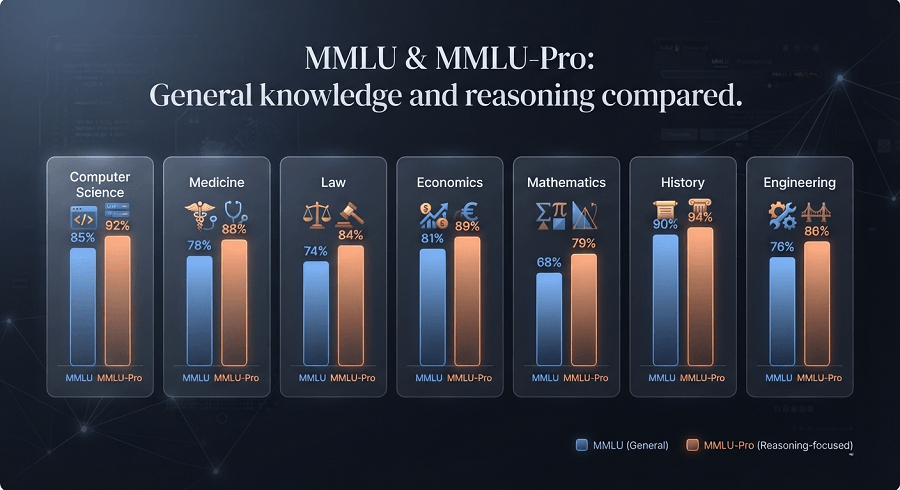
MMLU evaluates knowledge across dozens of academic disciplines, including:
- Computer science
- Medicine
- Law
- Economics
- Mathematics
- History
- Engineering
MMLU-Pro introduces more difficult reasoning challenges.
Qwen
Qwen demonstrates strong performance across technical and multilingual subjects.
Its balanced capabilities make it suitable for enterprise knowledge assistants and business applications.
GLM
GLM performs competitively, particularly on tasks requiring deeper reasoning and structured analysis.
Its performance reflects a focus on instruction following and logical problem solving.
GPQA
GPQA evaluates graduate-level reasoning in subjects such as:
- Physics
- Chemistry
- Biology
Unlike general knowledge benchmarks, GPQA emphasizes analytical thinking over memorization.
Both Qwen and GLM have significantly improved in this area, making them suitable for research-oriented and technical applications.
GSM8K & MATH-500
Mathematical reasoning remains an important capability for AI systems used in education, finance, engineering, and scientific computing.
GSM8K evaluates:
- Arithmetic
- Word problems
- Multi-step reasoning
MATH-500 evaluates:
- Advanced mathematics
- Symbolic reasoning
- Complex calculations
Qwen
Strengths include:
- Consistent reasoning
- Clear explanations
- Strong educational outputs
GLM
GLM often demonstrates particularly strong structured reasoning on mathematical tasks, making it attractive for analytical applications.
AIME
The American Invitational Mathematics Examination (AIME) benchmark measures high-level mathematical reasoning.
Strong AIME performance generally indicates:
- Logical planning
- Multi-step reasoning
- Problem decomposition
Both ecosystems continue improving through dedicated reasoning-focused model releases.
Chinese Benchmarks: CMMLU & C-Eval
Since both models originate in China, Chinese-language benchmarks provide additional insight.
CMMLU
Evaluates Chinese academic knowledge across numerous domains.
C-Eval
Measures:
- Chinese language understanding
- Professional knowledge
- Educational reasoning
- Domain expertise
Both Qwen and GLM perform exceptionally well on these benchmarks, making them strong choices for Chinese-language enterprise applications.
FLORES-200
FLORES-200 evaluates multilingual translation quality across hundreds of language pairs.
This benchmark is particularly relevant for:
- Global customer support
- International SaaS products
- Translation platforms
- Multilingual AI assistants
Qwen
Qwen has built a strong reputation for multilingual understanding and generation, making it an excellent option for organizations serving international audiences.
GLM
GLM also supports multilingual applications and continues to improve translation quality across newer releases.
LongBench & InfiniteBench
Modern AI systems increasingly process long documents rather than short prompts.
Long-context benchmarks evaluate:
- Document retrieval
- Memory retention
- Long-form reasoning
- Multi-document understanding
Typical workloads include:
- Legal analysis
- Research papers
- Enterprise documentation
- Source code repositories
Both model families support long-context use cases suitable for Retrieval-Augmented Generation (RAG) and enterprise search.
Coding Performance Comparison
| Capability | Qwen | GLM |
|---|---|---|
| Code Generation | Excellent | Very Good |
| Debugging | Excellent | Excellent |
| Documentation | Excellent | Very Good |
| Refactoring | Excellent | Very Good |
| API Development | Excellent | Very Good |
| SQL Generation | Excellent | Very Good |
| Repository Understanding | Excellent | Excellent |
| DevOps Scripts | Excellent | Very Good |
Overall Observation:
Qwen is generally stronger for everyday software engineering workflows, while GLM performs well on coding tasks that require structured reasoning and multi-step planning.
Reasoning Performance Comparison
| Reasoning Area | Qwen | GLM |
|---|---|---|
| Logical Reasoning | Excellent | Excellent |
| Scientific Reasoning | Excellent | Excellent |
| Mathematical Reasoning | Excellent | Excellent |
| Multi-Step Planning | Excellent | Excellent |
| Agent Workflows | Excellent | Excellent |
| Decision Support | Excellent | Excellent |
Neither model dominates every reasoning task. The better choice depends on the specific application and evaluation criteria.
API Ecosystem Comparison
A strong API ecosystem is essential for production deployments.
Qwen
Available through:
- Alibaba Cloud Model Studio
- OpenRouter
- Together AI
- Fireworks AI
- Hugging Face
- Self-hosted inference
Advantages:
- Mature cloud ecosystem
- Enterprise integrations
- Broad deployment options
GLM
Available through:
- Zhipu AI Platform
- OpenRouter
- Hugging Face
- Self-hosted deployments
Advantages:
- Enterprise APIs
- Agent-focused capabilities
- Growing developer ecosystem
Pricing Comparison
Pricing varies depending on:
- Provider
- Model variant
- Input tokens
- Output tokens
- Region
- Throughput tier
Instead of comparing list prices, organizations should estimate:
- Monthly token usage
- Infrastructure costs
- Operational overhead
- Engineering resources
- Total Cost of Ownership (TCO)
Local Deployment
Both Qwen and GLM support local deployment using modern inference frameworks.
Popular options include:
Self-hosting enables:
- Greater data privacy
- Custom integrations
- Compliance with regulatory requirements
- Reduced long-term inference costs for high-volume workloads
Kubernetes & Amazon EKS
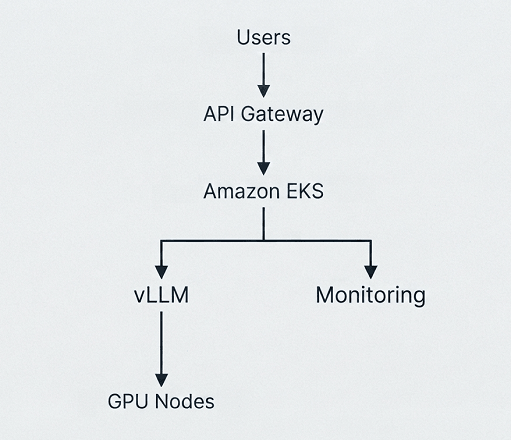
Large organizations often deploy AI models on Kubernetes for scalability and resilience.
A typical architecture includes:
Benefits include:
- Horizontal scaling
- High availability
- Rolling updates
- Resource optimization
- Centralized monitoring
At EaseCloud, we commonly deploy both Qwen and GLM on Amazon EKS with GPU-backed worker nodes, integrating observability, autoscaling, and LLMOps practices to support production-grade AI workloads.
Which Model Is Better for Coding?
Software development is one of the most common enterprise applications for large language models.
Typical coding tasks include:
- Code generation
- Code completion
- Debugging
- Refactoring
- Documentation
- Test generation
- SQL queries
- Infrastructure as Code
- DevOps automation
Choose Qwen If You Need
- AI coding assistants
- Repository documentation
- API development
- Backend engineering
- Frontend development
- DevOps scripting
- SQL generation
- Enterprise software development
Qwen's coding-focused models provide clean, structured, and production-friendly outputs that integrate well into modern development workflows.
Choose GLM If You Need
- Complex reasoning before implementation
- Multi-step programming workflows
- AI planning agents
- Structured engineering tasks
- Research-heavy software projects
GLM performs well when software development requires deeper analysis and sequential decision-making.
EaseCloud Recommendation
For most enterprise software engineering teams, Qwen is generally the stronger default choice due to its mature coding ecosystem, excellent documentation generation, and reliable repository understanding.
GLM becomes particularly valuable for applications requiring structured reasoning combined with software engineering workflows.
Which Model Is Better for AI Agents?
Modern AI applications increasingly rely on autonomous agents capable of:
- Planning
- Tool use
- Function calling
- API orchestration
- Memory
- Multi-step workflows
Both Qwen and GLM support:
- Function Calling
- Tool Calling
- Structured Output
- JSON Generation
- Workflow Automation
Qwen Strengths
- Reliable tool execution
- Strong API integrations
- Enterprise automation
- Coding agents
- Business workflows
GLM Strengths
- Task planning
- Sequential reasoning
- Agent orchestration
- Multi-step decision making
- Workflow decomposition
Organizations building sophisticated AI agents should evaluate both models using their own workflows rather than relying solely on benchmark scores.
Which Model Is Better for Enterprise AI?
Enterprise AI platforms typically prioritize:
- Security
- Governance
- Reliability
- Scalability
- API stability
- Integration
- Compliance
Qwen
Excels in:
- Enterprise search
- Customer support
- Knowledge assistants
- Documentation generation
- Internal copilots
- Multilingual business applications
GLM
Excels in:
- Enterprise reasoning
- Intelligent assistants
- Decision support
- Research workflows
- Planning systems
Both models are enterprise-ready when deployed with appropriate infrastructure and governance.
Which Model Is Better for Startups?
Startups usually prioritize:
- Faster development
- Lower operational costs
- Simpler deployment
- Rapid iteration
Recommended Strategy
Begin with managed APIs to validate your product before investing in private infrastructure.
This allows teams to:
- Reduce operational complexity
- Minimize upfront costs
- Focus on product-market fit
- Scale infrastructure only when needed
Both Qwen and GLM support this approach through managed API ecosystems.
Which Model Is Better for Retrieval-Augmented Generation (RAG)?
RAG systems require models capable of:
- Understanding retrieved documents
- Processing long context
- Generating grounded answers
- Producing structured outputs
Qwen
Particularly strong for:
- Documentation search
- Technical manuals
- Enterprise knowledge bases
- Internal support systems
- Customer documentation
GLM
Well suited for:
- Research platforms
- Analytical document processing
- Multi-document reasoning
- Decision-support systems
The success of a RAG system depends as much on retrieval quality, embeddings, prompt engineering, and model quantization as it does on the underlying language model.
Which Model Is Better for Multilingual Applications?
Organizations serving international users require strong multilingual performance.
Qwen
Strengths include:
- Translation
- Localization
- Customer support
- Global SaaS
- Multilingual documentation
GLM
Strong support for:
- Chinese-language applications
- International reasoning tasks
- Multilingual enterprise assistants
For globally distributed applications with extensive multilingual requirements, Qwen often has an advantage due to its broad language coverage and mature ecosystem.
Security & Enterprise Governance
Before selecting a model, enterprises should evaluate:
- Authentication
- Authorization
- Encryption
- Audit logging
- Data residency
- Compliance
- Role-based access control
- Private networking
Whether using Qwen or GLM, governance should be designed as part of the overall AI platform rather than added after deployment.
EaseCloud Insight
At EaseCloud, enterprise AI deployments are designed with security and governance from the beginning. We integrate identity management, private networking, monitoring, and policy controls into AI platforms to support secure production environments on AWS and Kubernetes.
Licensing Considerations
Licensing plays an important role in commercial AI adoption.
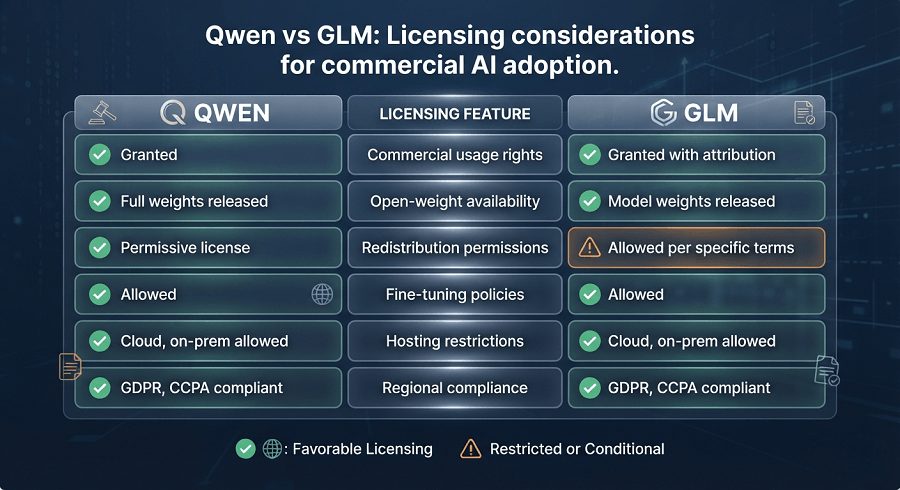
Before deploying any model, organizations should review:
- Commercial usage rights
- Open-weight availability
- Redistribution permissions
- Fine-tuning policies
- Hosting restrictions
- Regional compliance requirements
Licensing terms may change as new model versions are released, so always review the latest documentation from the model provider before production deployment.
Common Misconceptions
"One Model Is Better at Everything"
No modern LLM dominates every benchmark or workload.
Different models excel in different scenarios.
"Benchmark Leaders Always Win in Production"
Benchmarks measure capability—not operational success.
Production AI also depends on:
- Infrastructure
- Prompt engineering
- Retrieval quality
- Monitoring
- User experience
"The Largest Model Is Always Best"
Larger models often require:
- More GPUs
- Higher costs
- Greater latency
Smaller optimized models may deliver better ROI for many business applications.
"Switching Models Solves Performance Problems"
Many AI performance issues are caused by:
- Poor prompts
- Weak retrieval
- Low-quality data
- Inadequate architecture
Changing models without addressing these fundamentals rarely solves the underlying problem.
Conclusion
Selecting between Qwen and GLM requires balancing technical capability with operational requirements. While benchmark scores provide useful guidance, long-term success depends on deployment architecture, governance, infrastructure efficiency, and alignment with business objectives.
Organizations that evaluate models through the lens of real-world workloads—not just leaderboard positions—are better positioned to build scalable AI systems that deliver measurable business value.
Frequently Asked Questions
Is Qwen better than GLM?
Neither model is universally better. Qwen is often preferred for coding, multilingual applications, and enterprise knowledge systems, while GLM is well suited for reasoning-intensive workflows and AI agents.
Which model is better for coding?
Qwen generally has an advantage for production software engineering, documentation generation, and repository understanding.
Which model is better for enterprise AI?
Both are strong enterprise options. The best choice depends on workload requirements, deployment architecture, governance needs, and integration with your existing cloud environment.
Can I deploy both models locally?
Yes.
Both Qwen and GLM can be deployed using:
- Ollama
- vLLM
- Docker
- Kubernetes
- Hugging Face Transformers
Private deployment provides greater control over security, compliance, and infrastructure.
Which model is better for AI agents?
Both support modern agent architectures with function calling and structured outputs. The better choice depends on how your agents reason, plan, and interact with external tools.
Should I choose based on benchmark scores?
Benchmarks are useful indicators, but production decisions should also consider latency, infrastructure costs, scalability, governance, and developer productivity.
Final Verdict
Qwen and GLM represent two of the strongest AI model families to emerge from China's rapidly evolving AI ecosystem.
Choose Qwen if your priorities include:
- Software engineering
- AI coding assistants
- Multilingual applications
- Enterprise search
- Customer support
- Documentation generation
- Broad cloud integrations
Choose GLM if your priorities include:
- Advanced reasoning
- AI agents
- Structured planning
- Decision-support systems
- Research-focused workflows
- Analytical enterprise applications
For many organizations, the best strategy is not choosing one model exclusively but adopting a multi-model architecture that routes different tasks to the model best suited for each workload.
How EaseCloud Helps Deploy Chinese LLMs
Deploying foundation models successfully requires more than selecting the right model. Organizations also need secure infrastructure, scalable deployment patterns, and continuous operational optimization. At EaseCloud, we help businesses design and operate enterprise AI platforms built around modern open-weight langua
Book Your Free LLM Deployment AssessmentSummarize this post with: