AWS DevOps Consulting: CI/CD Pipelines, IaC, and Automated Deployments
Accelerate software delivery with AWS DevOps. Learn CI/CD (CodePipeline, GitHub Actions), IaC (Terraform vs CloudFormation), GitOps, and deployment strategies for faster, safer releases.
Modern software delivery demands speed, reliability, and scalability. Organizations that still rely on manual deployments and infrastructure management often struggle with slow release cycles, configuration drift, and increased operational risk.
AWS DevOps consulting helps businesses streamline software delivery through Continuous Integration and Continuous Deployment (CI/CD), Infrastructure as Code (IaC), GitOps workflows, and automated deployment strategies. By implementing DevOps best practices on AWS, companies can accelerate innovation, improve deployment frequency, and reduce downtime while maintaining security and compliance.
This guide explores how AWS DevOps consulting services enable organizations to build robust CI/CD pipelines, automate infrastructure provisioning, and optimize deployment processes for modern cloud-native applications.
TL;DR
- AWS DevOps = faster, safer software delivery through CI/CD, Infrastructure as Code, and automation.
- CI/CD tools: AWS CodePipeline (native, managed) or GitHub Actions (developer-friendly). Both automate build-test-deploy.
- IaC choices: Terraform (multi-cloud, flexible) vs CloudFormation (AWS-native, deep integration). Pick based on your cloud strategy.
- GitOps = Git as single source of truth – every change via PRs. Enables auditability and fast recovery.
- Deployment strategies: Blue-green (zero downtime, instant rollback) for critical apps. Canary (gradual traffic shift) for safer releases.
- Shift security left – automate vulnerability scanning in pipelines. DevSecOps catches issues early.
- Measure with DORA metrics: Deployment Frequency, Lead Time, Change Failure Rate, MTTR. Track to improve.
Why AWS DevOps Matters
DevOps combines development and operations practices to improve collaboration, automate workflows, and deliver software faster.
Organizations adopting AWS DevOps typically achieve:
- Faster software releases
- Improved deployment reliability
- Reduced operational overhead
- Better infrastructure consistency
- Enhanced scalability and security
- Increased developer productivity
By leveraging AWS-native tools and modern DevOps methodologies, teams can move from manual processes to automated, repeatable workflows.
What Is AWS DevOps Consulting?
AWS DevOps consulting focuses on designing, implementing, and optimizing cloud-native delivery pipelines and infrastructure automation.
Key areas include:
- CI/CD pipeline implementation
- Infrastructure as Code (IaC)
- GitOps adoption
- Automated testing and deployment
- Security automation
- Monitoring and observability
- Deployment strategy optimization
The goal is to create a repeatable and scalable software delivery framework that supports business growth.
Building CI/CD Pipelines on AWS
Continuous Integration and Continuous Deployment form the foundation of modern DevOps practices.
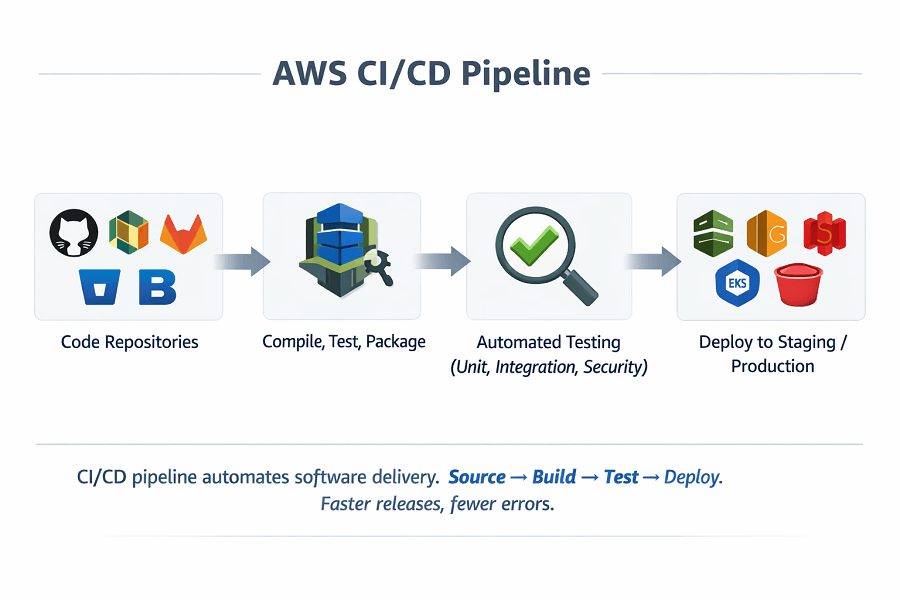
What Is CI/CD?
Continuous Integration (CI)
Developers frequently merge code changes into a shared repository where automated testing validates quality.
Continuous Deployment (CD)
Validated code is automatically deployed to staging or production environments without manual intervention.
Together, CI/CD enables rapid and reliable software delivery.
Benefits of CI/CD Pipelines
Organizations implementing CI/CD often experience:
- Shorter release cycles
- Fewer deployment failures
- Faster bug resolution
- Improved software quality
- Greater deployment confidence
Automation removes repetitive manual tasks and reduces the risk of human error.
AWS CodePipeline: Automating Software Delivery
AWS CodePipeline is a fully managed service that automates application release workflows.
Typical Pipeline Stages
Source
Code is pulled from repositories such as:
- GitHub
- AWS CodeCommit
- GitLab
- Bitbucket
Build
Code is compiled and tested using services such as AWS CodeBuild.
Test
Automated testing validates functionality, security, and performance.
Deploy
Applications are automatically deployed using deployment services and infrastructure automation tools.
Advantages of AWS CodePipeline
- Fully managed infrastructure
- Native AWS integration
- Scalable pipeline execution
- Reduced operational complexity
- Faster deployment cycles
For AWS-centric environments, CodePipeline provides a streamlined path to automation.
GitHub Actions and AWS Integration
Many organizations use GitHub as their primary development platform.
GitHub Actions integrates seamlessly with AWS to automate build, test, and deployment workflows.
Common Use Cases
Application Deployment
Automatically deploy applications after successful code commits.
Container Delivery
Build and publish Docker images to Amazon ECR.
Infrastructure Automation
Provision and update AWS resources through Infrastructure as Code workflows.
Security Validation
Run automated vulnerability and compliance scans before deployment.
Benefits of GitHub Actions
- Developer-friendly workflows
- Strong ecosystem support
- Flexible automation capabilities
- Simplified CI/CD management
For organizations already invested in GitHub, Actions often becomes the preferred automation platform.
Infrastructure as Code (IaC): Automating Cloud Infrastructure
Manual infrastructure provisioning creates inconsistency and slows down operations.
Infrastructure as Code solves this challenge by defining infrastructure using version-controlled configuration files.
What Is Infrastructure as Code?
IaC enables teams to:
- Provision resources automatically
- Standardize environments
- Track infrastructure changes
- Improve disaster recovery
- Eliminate configuration drift
Infrastructure becomes predictable, repeatable, and scalable.
Terraform vs CloudFormation
Two popular Infrastructure as Code solutions on AWS are Terraform and CloudFormation.
Terraform
Terraform is an open-source IaC platform widely used across multi-cloud environments.
Advantages
- Cloud-agnostic architecture
- Extensive provider ecosystem
- Reusable modules
- Strong community support
Ideal For
Organizations managing AWS alongside Azure, Google Cloud, or on-premises infrastructure.
AWS CloudFormation
AWS CloudFormation is AWS's native Infrastructure as Code service.
Advantages
- Deep AWS integration
- Managed service model
- Native support for AWS resources
- Built-in drift detection
Ideal For
Organizations operating exclusively within AWS environments.
Terraform vs CloudFormation Comparison
Many enterprises choose Terraform for flexibility, while AWS-focused organizations often prefer CloudFormation.
Managing Terraform Remote State in Amazon S3
Terraform state files contain critical infrastructure information.
Proper state management is essential for collaboration and security.
Best Practice Architecture
Store Terraform state using:
- Amazon S3 for state storage
- DynamoDB for state locking
- AWS KMS for encryption
Benefits include:
- Team collaboration
- State consistency
- Improved security
- Change tracking
A properly configured remote state backend reduces deployment risks and prevents conflicting infrastructure changes.
GitOps: Modern Infrastructure Management
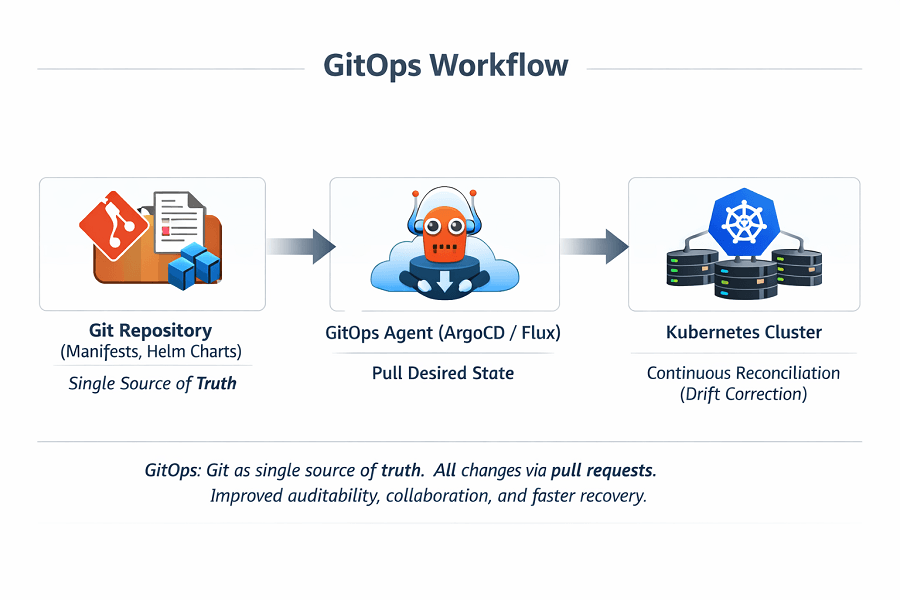
GitOps extends Infrastructure as Code by using Git repositories as the single source of truth.
Every infrastructure or application change originates through version-controlled pull requests.
Benefits of GitOps
Improved Auditability
All changes are tracked through Git history.
Better Collaboration
Teams review and approve changes before deployment.
Faster Recovery
Infrastructure can be restored from repository configurations.
Enhanced Consistency
Environments remain synchronized with repository definitions.
GitOps significantly improves governance and operational reliability.
Automated Deployment Strategies
Modern DevOps teams avoid high-risk deployment methods.
AWS supports advanced deployment patterns that minimize downtime and reduce release risk.
Blue-Green Deployments
Blue-Green deployment maintains two environments:
- Blue (Current Production)
- Green (New Version)
Traffic switches to the new environment after validation.
Benefits
- Near-zero downtime
- Fast rollback capability
- Reduced deployment risk
Best For
- Critical applications
- Customer-facing systems
- High-availability workloads
Canary Deployments
Canary deployments release updates to a small percentage of users before broader rollout.
Advantages
- Early issue detection
- Reduced customer impact
- Safer production releases
Ideal Use Cases
- SaaS applications
- Large-scale web platforms
- Continuous delivery environments
Blue-green (zero downtime) or canary (gradual rollout) – we implement safe deployment strategies.
Blue-green: two identical environments, instant rollback. Canary: release to small percentage first, monitor, then expand. Automated rollback on failure.
We help you:
- Implement blue-green deployments – Zero downtime, fast rollback capability
- Configure canary deployments – Gradual traffic shifting, metric validation
- Set up automated rollback – Failures trigger automatic rollback before user impact
- Integrate with CI/CD pipelines – Deployment strategies as part of automated workflow
Security Automation in DevOps
Security should be integrated throughout the development lifecycle rather than treated as a final checkpoint.
This approach is often called DevSecOps.
Automated Security Scanning
Integrate security checks into CI/CD pipelines to identify issues early.
Common automated scans include:
- Dependency vulnerability analysis
- Container image scanning
- Infrastructure security validation
- Secret detection
- Compliance checks
Benefits include:
- Faster remediation
- Reduced security risks
- Improved compliance readiness
Monitoring DevOps Performance with DORA Metrics
Successful DevOps programs rely on measurable outcomes.
DORA (DevOps Research and Assessment) metrics are industry-standard performance indicators.
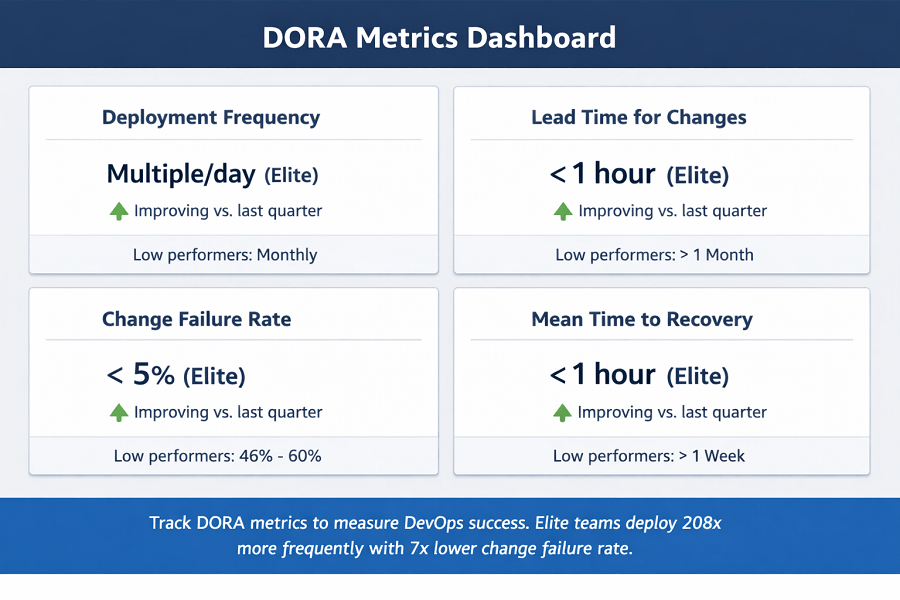
Key DORA Metrics
Deployment Frequency
How often code reaches production.
Lead Time for Changes
Time required for code to move from commit to production.
Change Failure Rate
Percentage of deployments causing incidents.
Mean Time to Recovery (MTTR)
Time required to restore service after failures.
Organizations that continuously monitor DORA metrics achieve more predictable and efficient software delivery.
Increasing Deployment Frequency
One of the primary goals of AWS DevOps consulting is improving deployment velocity without sacrificing stability.
Strategies include:
- CI/CD automation
- Infrastructure as Code adoption
- Automated testing
- GitOps workflows
- Progressive deployment strategies
- Automated rollback mechanisms
Higher deployment frequency enables faster innovation and quicker response to market demands.
AWS DevOps Best Practices
To maximize success, organizations should adopt the following practices:
Automate Everything Possible
Reduce manual intervention across development and operations processes.
Use Infrastructure as Code
Treat infrastructure with the same discipline as application code.
Implement GitOps
Use Git as the authoritative source for deployments and infrastructure.
Shift Security Left
Integrate security checks early within development workflows.
Monitor Performance Metrics
Track deployment efficiency through DORA metrics and operational dashboards.
Continuously Improve
Regularly evaluate pipelines, deployment processes, and infrastructure automation.
Conclusion
AWS DevOps consulting enables organizations to accelerate software delivery through automation, Infrastructure as Code, CI/CD pipelines, and modern deployment practices. By leveraging tools such as AWS CodePipeline, GitHub Actions, Terraform, CloudFormation, and GitOps workflows, businesses can improve deployment frequency, enhance reliability, and reduce operational complexity.
The most successful cloud-native organizations treat DevOps as a continuous improvement journey. With the right AWS DevOps strategy, teams can deliver software faster, maintain high availability, strengthen security, and create a scalable foundation for future growth.
Frequently Asked Questions
1. CodePipeline vs GitHub Actions – which should I choose?
CodePipeline if you want a fully managed AWS-native service with deep integration across AWS services.
GitHub Actions if your team already uses GitHub and you prefer developer-friendly YAML workflows with a massive ecosystem of actions. Many organizations use both: GitHub Actions for CI (build/test) and CodePipeline for CD (deploy orchestration).
2. Terraform vs CloudFormation – when to use each?
Terraform for multi-cloud environments (AWS + Azure/GCP), when you need reusable modules, or want to avoid vendor lock-in.
CloudFormation for AWS-only environments where native integration, drift detection, and managed service benefits are valuable. Many enterprises use Terraform for flexibility, AWS-focused teams prefer CloudFormation.
3. What's the difference between blue-green and canary deployments?
Blue-green switches all traffic at once between two identical environments (old = blue, new = green). Instant rollback by switching back. Best for critical systems where zero downtime is required.
Canary gradually shifts traffic to the new version (e.g., 5% → 20% → 100%), monitoring for errors at each step. Best for SaaS and large-scale platforms where you want early issue detection with limited user impact.
Summarize this post with: