Qwen vs DeepSeek Pricing: API Costs, Self-Hosting & Total Cost Comparison
Compare Qwen vs DeepSeek pricing, API costs, token rates, self-hosting expenses, GPU requirements, and total cost of ownership for AI projects.
As organizations increasingly integrate AI into software development, customer support, enterprise search, and business automation, one question consistently rises to the top:
Which AI model delivers the best value for money?
For engineering leaders, startups, and enterprises, choosing between Qwen and DeepSeek isn't simply about benchmark scores or coding performance. The long-term cost of deploying and operating an AI model can significantly influence project success.
A model with lower API pricing may require more powerful hardware for self-hosting. Another model may cost slightly more per million tokens but reduce infrastructure expenses through higher efficiency or faster inference. These trade-offs mean that evaluating pricing requires a broader perspective than comparing token rates alone.
Today, both Qwen and DeepSeek offer flexible deployment options. Organizations can consume them through managed APIs, deploy them on cloud GPU infrastructure, or run them privately using open-source inference frameworks. Each approach has different cost implications depending on traffic volume, latency requirements, compliance needs, and operational complexity.
Questions that buyers frequently ask include:
- Is Qwen cheaper than DeepSeek?
- Which API has lower token costs?
- Is self-hosting more affordable than managed APIs?
- How much does it cost to run these models on AWS?
- Which model provides better ROI for startups?
- Which option is most cost-effective for enterprise AI?
These questions become even more important as AI usage scales from a few thousand requests per month to millions of API calls across multiple applications.
Rather than focusing solely on published pricing tables, this guide examines the Total Cost of Ownership (TCO) of both ecosystems. We'll compare API pricing, GPU infrastructure costs, deployment strategies, operational overhead, and optimization techniques to help organizations make informed financial decisions. For detailed guidance on deploying these models in production, see our guide on Deploy LLMs on AWS.
Whether you're building an AI coding assistant, an enterprise chatbot, a Retrieval-Augmented Generation (RAG) platform, or an internal AI agent, understanding the economics of Qwen and DeepSeek is just as important as understanding their technical capabilities.
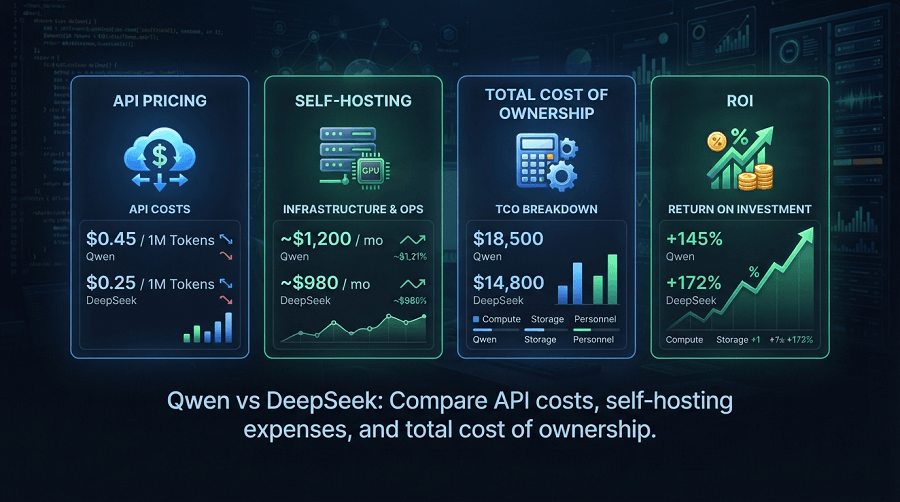
What This Guide Covers
- API pricing models
- Token costs
- Long-context pricing
- Self-hosting expenses
- GPU requirements
- Cloud deployment costs
- Cost optimization strategies
- Infrastructure planning
- Enterprise ROI
- Total Cost of Ownership (TCO)
By the end of this comparison, you'll have a practical framework for selecting the most cost-effective AI solution based on your organization's workload, growth plans, and infrastructure strategy.
Why AI Pricing Matters
Many organizations begin evaluating AI models by comparing benchmark scores.
However, once a model moves into production, financial considerations quickly become just as important as technical performance.
For example, an AI coding assistant used by 20 developers has very different cost dynamics than a customer support platform processing millions of requests every month.
Even small differences in token pricing or infrastructure efficiency can result in substantial cost variations at scale.
AI pricing affects:
- Monthly operating expenses
- Product profitability
- Infrastructure planning
- Customer pricing strategies
- Return on investment (ROI)
- Scalability
As AI adoption grows, controlling inference costs becomes an essential component of long-term business planning.
The Four Components of AI Costs
Many buyers assume API pricing is the only expense associated with Large Language Models.
In reality, organizations should evaluate four major cost categories.
| Cost Category | Examples |
|---|---|
| API Costs | Input tokens, output tokens, cached tokens |
| Infrastructure Costs | GPUs, cloud instances, storage, networking |
| Operational Costs | Monitoring, logging, security, DevOps |
| Engineering Costs | Deployment, maintenance, optimization, support |
A model with lower token pricing may ultimately cost more if it requires additional engineering effort or expensive GPU infrastructure.
EaseCloud Insight
At EaseCloud, we encourage organizations to evaluate AI projects using Total Cost of Ownership (TCO) rather than API pricing alone. Hidden operational costs—such as infrastructure management, monitoring, autoscaling, and maintenance—often exceed the savings gained from choosing the cheapest API.
Understanding How LLM Pricing Works
Large Language Models are priced differently from traditional cloud services.
Instead of charging by CPU time or storage alone, providers typically bill based on tokens, which represent pieces of text processed by the model. For a comparison of managed ML platforms, see SageMaker vs Azure ML vs Vertex AI.
Every request consists of two primary components:
- Input tokens
- Output tokens
Some providers also charge separately for cached tokens or long-context processing.
Understanding these pricing models is essential before comparing Qwen and DeepSeek.
What Are Tokens?
Tokens are the units AI models use to process text.
A token may represent:
- A word
- Part of a word
- A punctuation mark
- A number
- A symbol
For example, a short paragraph may contain several hundred tokens, while a lengthy technical document can contain tens of thousands.
Every API request consumes tokens during:
- Prompt submission
- Context processing
- Response generation
Higher token usage directly increases operating costs.
Input Tokens vs Output Tokens
Most AI providers price these separately.
Input Tokens
Input tokens include everything sent to the model.
Examples:
- User prompts
- System prompts
- Previous conversation history
- Retrieved documents
- Programming code
- Knowledge base content
Applications with long prompts or extensive Retrieval-Augmented Generation (RAG) pipelines often consume a significant number of input tokens.
Output Tokens
Output tokens represent the text generated by the AI model.
Examples include:
- Generated code
- Chat responses
- Reports
- Summaries
- Documentation
- SQL queries
Applications that require long-form responses generally incur higher output token costs.
Why This Matters
Two models with identical input pricing may have very different output pricing, leading to noticeable differences in monthly expenses depending on the application's response length.
Cached Tokens
Many enterprise AI platforms optimize costs by reusing portions of previous prompts.
These reused sections are referred to as cached tokens.
Common examples include:
- Repeated system prompts
- Company policies
- Product documentation
- Shared instructions
- AI agent configurations
Because cached content doesn't require the same level of processing, some providers apply discounted pricing to these tokens.
For organizations with repetitive workflows, prompt caching can significantly reduce overall API expenses.
Context Window Pricing
Modern LLMs support increasingly large context windows, allowing them to process:
- Large code repositories
- Technical documentation
- Research papers
- Contracts
- Enterprise knowledge bases
- Financial reports
While longer context windows enable more sophisticated applications, they also increase the number of input tokens processed per request.
Organizations designing Retrieval-Augmented Generation (RAG) systems should balance context size with cost efficiency rather than assuming the largest context window is always the best option.
Qwen Pricing Overview
Qwen is available through multiple deployment models, giving organizations flexibility based on their technical and financial requirements. For deploying Qwen on AWS SageMaker with auto-scaling, see our guide on Deploy Qwen with SageMaker Auto-Scaling.
Common deployment options include:
- Managed APIs
- Alibaba Cloud Model Studio
- OpenRouter
- Together AI
- Fireworks AI
- Self-hosted deployments
Pricing varies depending on:
- Model variant
- Provider
- Region
- Context length
- Token volume
- Service-level agreements (SLAs)
This flexibility allows teams to choose between fully managed services and private infrastructure depending on workload requirements.
DeepSeek Pricing Overview
DeepSeek also supports a broad range of deployment strategies.
Organizations can access DeepSeek through:
- Managed APIs
- DeepSeek Platform
- OpenRouter
- Together AI
- Fireworks AI
- Self-hosted inference servers
DeepSeek has gained attention for offering highly competitive pricing while maintaining strong reasoning and coding capabilities.
However, as with Qwen, total cost depends on more than API rates alone. Infrastructure choices, inference optimization, and operational efficiency all contribute to long-term expenses.
Comparing Pricing Models
Although both ecosystems provide flexible pricing options, their cost structures are influenced by several common factors.
| Pricing Factor | Qwen | DeepSeek |
|---|---|---|
| API Availability | Excellent | Excellent |
| Self-Hosting | Supported | Supported |
| Multiple Providers | Yes | Yes |
| Long-Context Support | Yes | Yes |
| Enterprise Deployment | Excellent | Excellent |
| Open-Weight Models | Yes | Yes |
The most cost-effective option depends on:
- Monthly API usage
- Concurrent users
- Latency requirements
- Compliance obligations
- Cloud infrastructure
- Engineering resources
Organizations should evaluate these factors together rather than focusing on a single pricing metric.
How to Calculate the Total Cost of Ownership (TCO)
API pricing is only one part of an AI budget. A more accurate assessment considers all expenses associated with deploying and operating AI at scale.
A practical TCO framework includes:
| Cost Area | Typical Expenses |
|---|---|
| API Usage | Input and output token charges |
| Compute | GPU instances, CPU resources, storage |
| Networking | Data transfer and bandwidth |
| Platform Operations | Monitoring, logging, backups |
| Engineering | Deployment, optimization, maintenance |
| Security & Governance | Access control, auditing, compliance |
For startups with modest traffic, managed APIs often provide the lowest upfront cost.
For enterprises processing millions of requests each month, self-hosting may reduce long-term expenses—provided the organization has the expertise to manage infrastructure effectively.
EaseCloud Cost Evaluation Framework
At EaseCloud, we assess AI pricing using five key dimensions before recommending a deployment model:
1. Workload Volume
We estimate expected API requests, token usage, and growth projections.
2. Infrastructure Strategy
We determine whether managed APIs, private GPU clusters, hybrid deployments, or multi-cloud architectures provide the best balance of cost and performance.
3. Performance Requirements
We evaluate latency, throughput, concurrency, and regional availability to ensure infrastructure aligns with business objectives.
4. Governance & Security
Compliance, data residency, and access controls often influence deployment decisions as much as pricing.
5. Long-Term ROI
Rather than minimizing short-term expenses, we focus on reducing the overall cost of operating AI over the lifecycle of the application.
This framework helps organizations avoid choosing an AI model based solely on published token prices while overlooking infrastructure complexity or operational overhead.
API Pricing Comparison
Organizations typically consume Qwen and DeepSeek through managed APIs before considering self-hosting.
Although providers use different pricing structures, most charge based on:
- Input tokens
- Output tokens
- Cached tokens (where supported)
- Context length
- Premium model variants
- Rate limits
- Throughput tiers
The actual price you pay depends not only on the model, but also on the provider you select.
Qwen API Pricing
Qwen models are available from multiple providers, including:
- Alibaba Cloud Model Studio
- OpenRouter
- Together AI
- Fireworks AI
- Hugging Face Inference Endpoints
- Community inference platforms
Pricing can differ because providers include:
- Different infrastructure
- Different GPUs
- Various service-level agreements
- Regional hosting
- Enterprise support
Advantages
- Multiple deployment choices
- Flexible pricing options
- Enterprise cloud ecosystem
- Strong regional availability
- Mature infrastructure
Considerations
- Costs vary by provider
- Premium models may have separate pricing
- Regional availability affects pricing
DeepSeek API Pricing
DeepSeek models are available through:
- DeepSeek Platform
- OpenRouter
- Together AI
- Fireworks AI
- Self-hosted inference
DeepSeek has gained significant attention because its APIs are often positioned as cost-effective while delivering strong reasoning performance.
Advantages
- Competitive pricing
- Strong reasoning models
- Excellent coding capability
- Open-weight deployment options
Considerations
- Provider pricing differs
- Enterprise SLAs vary
- Heavy demand may occasionally affect public endpoints
EaseCloud Insight
When evaluating AI APIs, EaseCloud recommends comparing providers rather than models alone. Two organizations using the same model may experience very different costs due to provider-specific pricing, throughput limits, and infrastructure optimizations.
Cost Per Million Tokens
Most AI providers express pricing as the cost per million input and output tokens.
Understanding token consumption is more useful than memorizing price tables because it allows organizations to estimate expenses across different workloads.
Typical workloads include:
| Workload | Token Usage Pattern |
|---|---|
| Chatbot | Low input, medium output |
| AI Coding Assistant | High input, high output |
| RAG System | Very high input, medium output |
| Document Summarization | High input, low output |
| Translation | Medium input, medium output |
| AI Agents | Variable input and output |
Applications processing large code repositories or enterprise documents generally consume significantly more input tokens than conversational chatbots.
Long Context Pricing
One of the biggest cost drivers is the context window.
Modern applications increasingly process:
- Large codebases
- Technical documentation
- Research papers
- Contracts
- Knowledge bases
- Multi-file repositories
Larger context windows increase:
- Input tokens
- Memory usage
- GPU utilization
- Inference time
Organizations should avoid automatically sending the maximum context with every request.
Instead, implement intelligent retrieval strategies that provide only the most relevant information.
EaseCloud Recommendation
For Retrieval-Augmented Generation (RAG) systems, EaseCloud recommends optimizing document retrieval before increasing context size. Efficient retrieval pipelines often reduce token consumption while improving answer quality.
Batch Processing Costs
Organizations serving thousands of requests simultaneously often reduce costs through batch inference.
Benefits include:
- Higher GPU utilization
- Lower cost per request
- Improved throughput
- Better infrastructure efficiency
Batch inference is particularly valuable for:
- AI document processing
- Report generation
- Offline analytics
- Bulk summarization
- Code analysis
Inference frameworks such as vLLM support dynamic batching, allowing organizations to maximize GPU efficiency.
API Rate Limits
Pricing is only one consideration.
Organizations should also evaluate:
- Requests per Minute (RPM)
- Tokens per Minute (TPM)
- Concurrent requests
- Burst limits
- Regional quotas
Higher throughput may justify slightly higher API costs for enterprise applications with strict performance requirements.
Example Monthly AI Costs
The following examples illustrate how workload characteristics influence overall AI spending.
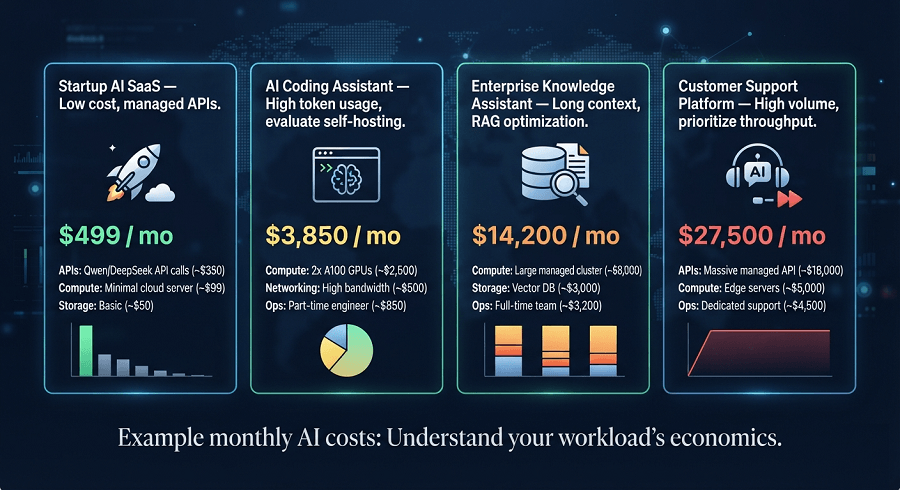
Startup AI SaaS
Typical usage:
- Internal chatbot
- Product documentation
- Customer support
- 20–30 employees
Primary cost drivers:
- API usage
- Minimal infrastructure
- Development environment
Managed APIs often provide the lowest total cost at this stage.
AI Coding Assistant
Typical usage:
- Large repositories
- Continuous code generation
- Long prompts
- Multiple developers
Primary cost drivers:
- Input tokens
- Output tokens
- Long context
- Repository analysis
Organizations should evaluate whether API pricing or private deployment offers better long-term value.
Enterprise Knowledge Assistant
Typical usage:
- Internal documentation
- HR policies
- Technical manuals
- Compliance documents
Primary cost drivers:
- Long-context processing
- Retrieval pipelines
- Concurrent users
- GPU infrastructure
Optimizing retrieval quality often has a greater impact on cost than switching between models.
Customer Support Platform
Typical usage:
- Thousands of conversations daily
- Short prompts
- Moderate responses
Primary cost drivers:
- High request volume
- API availability
- Response latency
Here, API stability and throughput are often more important than benchmark differences.
Self-Hosting Costs
Many organizations eventually consider self-hosting to reduce API expenses and improve data privacy.
However, private deployments introduce additional costs.
These include:
- GPU infrastructure
- Storage
- Networking
- Monitoring
- Security
- Maintenance
- Software updates
- Engineering resources
Self-hosting becomes increasingly attractive as AI usage scales, but only if the organization has the expertise to manage production infrastructure.
AWS Deployment Costs
AWS is one of the most popular platforms for enterprise AI deployments.
Typical architecture includes:
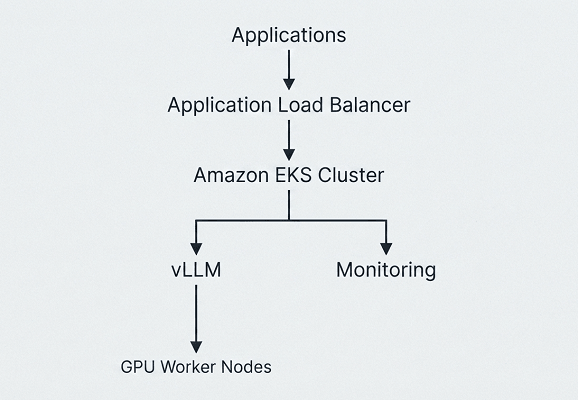
Common AWS services include:
- Amazon EKS
- Amazon EC2 GPU instances
- Elastic Load Balancing
- Amazon CloudWatch
- Amazon S3
- IAM
- Amazon ECR
This architecture supports scalable, highly available AI deployments.
GPU Infrastructure Comparison
GPU selection has a major impact on operational costs.
| GPU | Typical Use Case |
|---|---|
| NVIDIA H100 | Large enterprise inference |
| NVIDIA A100 | Production AI workloads |
| NVIDIA L40S | Cost-efficient enterprise deployments |
| RTX 4090 | Local development and prototyping |
| RTX 6000 Ada | Professional workstation inference |
Organizations should select GPUs based on expected throughput rather than choosing the largest available hardware.
Ollama
Ollama is one of the easiest ways to run Qwen and DeepSeek locally.
Ideal for:
- Developers
- Local experimentation
- Offline coding assistants
- Small internal tools
Advantages:
- No API charges
- Simple installation
- Local privacy
- Rapid experimentation
Limitations:
- Limited scalability
- Hardware constraints
- Not intended for large production deployments
vLLM
vLLM has become a leading inference engine for enterprise deployments.
Benefits include:
- High throughput
- Dynamic batching
- Efficient GPU memory usage
- OpenAI-compatible APIs
- Excellent production performance
Organizations running millions of requests often choose vLLM to reduce infrastructure costs while improving response times.
Docker
Docker simplifies deployment by packaging inference servers into portable containers.
Advantages include:
- Consistent environments
- Simplified updates
- Easy testing
- CI/CD integration
Containerized deployments also improve operational reliability across development, staging, and production environments.
Kubernetes
Large-scale deployments typically rely on Kubernetes.
Benefits include:
- Horizontal scaling
- Automatic recovery
- Rolling updates
- Resource scheduling
- High availability
- Multi-region deployment
At EaseCloud, Kubernetes deployments are commonly built on Amazon EKS to support enterprise AI platforms requiring scalability, security, and operational resilience.
Hidden Infrastructure Costs
Many organizations underestimate the ongoing expenses associated with operating AI systems.
Common hidden costs include:
- GPU idle time
- Monitoring and observability
- Security and compliance
- Data transfer
- Storage
- Logging
- Backup systems
- CI/CD pipelines
- Engineering support
- Disaster recovery
These operational expenses can represent a significant portion of the overall AI budget, particularly for self-hosted environments.
EaseCloud Cost Optimization Perspective
When helping organizations deploy Qwen or DeepSeek, EaseCloud focuses on reducing cost per successful inference rather than simply lowering token prices.
Our optimization approach includes:
- Selecting the right model for the workload
- Right-sizing GPU infrastructure
- Implementing intelligent prompt caching
- Optimizing Retrieval-Augmented Generation (RAG)
- Deploying dynamic batching with vLLM
- Autoscaling Kubernetes clusters
- Applying FinOps practices to monitor and control AI spending
By combining infrastructure optimization with workload-specific tuning, organizations can often achieve greater savings than by switching models alone.
API vs Self-Hosting: Which Is More Cost-Effective?
One of the biggest decisions organizations face is whether to use a managed API or deploy AI models on their own infrastructure.
There is no universal answer. The best option depends on workload size, compliance requirements, engineering resources, and long-term growth plans.
The table below summarizes the trade-offs.
| Factor | Managed API | Self-Hosting |
|---|---|---|
| Initial Cost | Low | High |
| Infrastructure Management | None | Full responsibility |
| Scalability | Provider-managed | Organization-managed |
| Data Privacy | Provider dependent | Full control |
| Maintenance | Minimal | Continuous |
| GPU Investment | Not required | Required |
| Customization | Limited | Extensive |
| Long-Term Cost | Higher at scale | Lower at large scale |
When Managed APIs Make Sense
Managed APIs are often the best choice when:
- Building an MVP
- Launching quickly
- Limited engineering resources
- Low or moderate request volume
- Rapid experimentation
- Short development timelines
Benefits include:
- No GPU management
- Automatic updates
- High availability
- Simple integration
- Faster deployment
When Self-Hosting Makes Sense
Self-hosting becomes attractive when organizations require:
- Complete data privacy
- Regulatory compliance
- High request volumes
- Custom fine-tuning
- Internal AI platforms
- Lower long-term inference costs
Self-hosting also enables tighter integration with existing cloud infrastructure and security controls.
EaseCloud Recommendation
At EaseCloud, we often recommend a phased strategy:
Phase 1
Start with managed APIs to validate business value and estimate usage.
Phase 2
As workloads grow, evaluate private deployment on AWS using GPU instances, Amazon EKS, and vLLM.
Phase 3
Optimize infrastructure through autoscaling, intelligent routing, and FinOps practices to reduce long-term operating costs.
This approach minimizes upfront investment while providing a clear path toward scalable enterprise AI.
Cost Optimization Strategies
Reducing AI costs is about improving efficiency rather than simply choosing the lowest-priced model. For a comprehensive framework on reducing AWS cloud costs, see our AWS Cost Optimization Guide.
Below are several proven strategies used in production environments.
Quantization
Quantization reduces model memory requirements without significantly impacting output quality.
Common formats include:
- INT8
- INT4
- FP16
- GGUF
- GPTQ
- AWQ
Benefits include:
- Lower VRAM requirements
- Faster inference
- Reduced GPU costs
- Improved hardware compatibility
For many production workloads, quantized models provide an excellent balance between performance and cost.
Prompt Optimization
Many organizations unknowingly waste tokens.
Common causes include:
- Excessively long system prompts
- Duplicate instructions
- Irrelevant context
- Repeated examples
- Poor Retrieval-Augmented Generation (RAG)
Improving prompt design often reduces monthly AI spending without changing the model.
Best practices:
- Remove unnecessary instructions.
- Keep prompts task-specific.
- Use structured outputs where appropriate.
- Retrieve only relevant documents.
Intelligent RAG
Large context windows do not automatically improve accuracy.
Instead, implement Retrieval-Augmented Generation (RAG) that retrieves only the most relevant information.
Advantages:
- Lower token usage
- Better response quality
- Faster inference
- Reduced API costs
This is one of the highest-impact optimizations for enterprise knowledge assistants. To understand when to use RAG versus fine-tuning, see our guide.
Prompt Caching
Many enterprise applications repeatedly send identical system prompts.
Examples include:
- Company policies
- Coding standards
- AI assistant instructions
- Brand guidelines
Prompt caching reduces repeated processing and can lower costs while improving response times where supported.
Batch Inference
Organizations processing thousands of requests can improve GPU efficiency through batching.
Benefits include:
- Higher GPU utilization
- Lower infrastructure cost
- Increased throughput
- Better scalability
Batching is particularly valuable for offline processing and document analysis workloads.
GPU Sharing
Many GPU deployments operate far below full capacity.
GPU sharing allows multiple applications to use the same hardware, increasing utilization and reducing idle time.
Typical workloads include:
- AI chatbots
- Internal copilots
- Document summarization
- Translation services
Autoscaling
Static GPU clusters often waste money during periods of low demand.
Autoscaling enables infrastructure to expand and contract automatically based on workload.
Benefits:
- Lower operational costs
- Better resource utilization
- Improved availability
- Reduced idle infrastructure
Spot Instances
Cloud providers offer discounted compute capacity through spot instances.
Advantages:
- Significant cost savings
- Suitable for batch inference
- Ideal for model evaluation
- Cost-effective experimentation
However, because spot instances can be interrupted, they are generally best suited for fault-tolerant workloads. For more on using Spot instances, see AWS Fargate Spot Cost Optimization.
Reserved Capacity
Organizations with predictable workloads may benefit from reserved GPU capacity.
Benefits include:
- Lower hourly costs
- Budget predictability
- Long-term savings
Reserved capacity is commonly used for production AI platforms with stable traffic patterns. To understand the trade-offs between AWS purchasing models, see our guide on Reserved vs Spot vs On-Demand.
Multi-Model Routing
Not every request requires the most capable—or most expensive—model.
Multi-model routing directs requests to different models based on complexity.
For example:
- Simple FAQs → Smaller model
- Coding tasks → Qwen Coder
- Advanced reasoning → DeepSeek R1
This strategy improves overall cost efficiency while maintaining response quality.
Which Model Is More Affordable?
The answer depends on your deployment strategy.
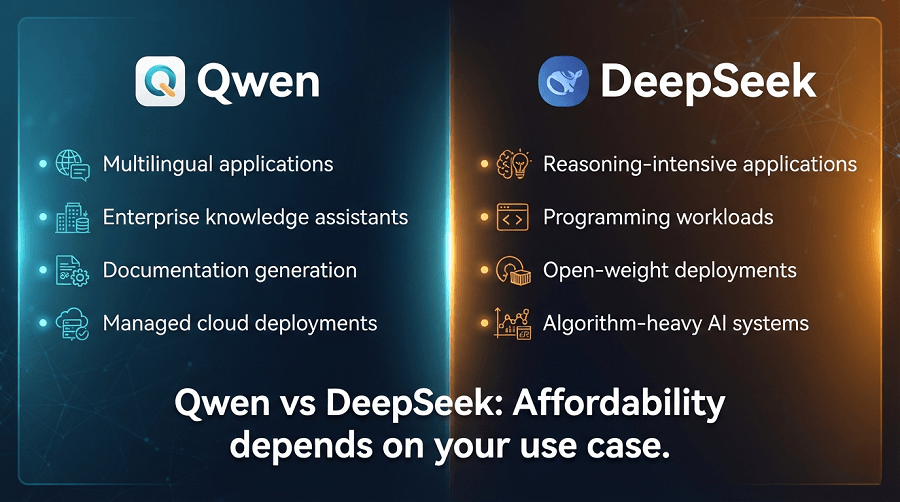
Qwen May Offer Better Value When:
- Building multilingual applications
- Creating enterprise knowledge assistants
- Prioritizing documentation quality
- Leveraging Alibaba Cloud services
- Using managed cloud deployments
DeepSeek May Offer Better Value When:
- Building reasoning-intensive applications
- Running competitive programming workloads
- Deploying open-weight models privately
- Optimizing algorithm-heavy AI systems
Neither ecosystem is universally cheaper. Total operating costs depend on API provider, infrastructure choices, optimization techniques, and workload characteristics.
Which Delivers Better ROI?
Return on Investment (ROI) should consider more than infrastructure costs.
A useful evaluation framework includes:
| Business Metric | Questions to Ask |
|---|---|
| Productivity | Does the model save developer time? |
| Infrastructure | How much compute does it require? |
| Quality | Does it reduce manual corrections? |
| Scalability | Can it support future growth? |
| Reliability | Does it remain stable in production? |
| Security | Does it meet compliance requirements? |
Organizations should evaluate ROI over months or years rather than comparing short-term API expenses.
Recommendations by Organization Type
For Startups
Recommended approach:
- Begin with managed APIs.
- Track monthly token usage.
- Validate product-market fit before investing in infrastructure.
- Optimize prompts before scaling.
For SaaS Companies
Recommended approach:
- Monitor cost per active user.
- Implement caching and batching.
- Consider hybrid deployments as usage grows.
For Large Enterprises
Recommended approach:
- Evaluate Total Cost of Ownership.
- Deploy on Kubernetes.
- Optimize GPU utilization.
- Implement governance and FinOps practices.
- Benchmark models using internal workloads.
Common AI Pricing Mistakes
Many organizations overspend because of avoidable mistakes.
Choosing Based Only on API Prices
Infrastructure, engineering effort, and maintenance often exceed token costs.
Ignoring Prompt Efficiency
Long prompts significantly increase recurring expenses.
Optimize prompts before upgrading infrastructure.
Over-Provisioning GPUs
Buying larger GPUs than necessary increases operating costs without improving application quality.
Deploying Without Monitoring
Without usage analytics, organizations cannot identify inefficient workloads or opportunities for optimization.
Skipping Cost Reviews
AI workloads evolve rapidly.
Regularly review:
- Token usage
- GPU utilization
- Infrastructure costs
- API performance
- Monthly ROI
Conclusion
Pricing is only one part of the AI decision-making process. Organizations that focus exclusively on token costs risk overlooking the larger factors that influence long-term success, including infrastructure efficiency, operational complexity, scalability, and developer productivity.
By evaluating Total Cost of Ownership, optimizing deployment strategies, and aligning infrastructure with business goals, teams can build AI platforms that remain both technically effective and financially sustainable.
Frequently Asked Questions
Is Qwen cheaper than DeepSeek?
It depends on the provider, deployment method, and workload. Managed API pricing and self-hosting costs vary across platforms, so organizations should compare the total operating cost rather than token prices alone.
Which API is more affordable?
Both Qwen and DeepSeek are available through multiple providers with different pricing models. The most affordable option depends on expected token usage, response length, and required service levels.
Can I run both models locally?
Yes.
Both ecosystems support local deployment using tools such as:
- Ollama
- vLLM
- Docker
- Kubernetes
- Hugging Face
- LM Studio
Is self-hosting always cheaper?
Not necessarily.
For low-volume applications, managed APIs are often more economical.
Self-hosting generally becomes attractive as usage increases and organizations have the expertise to operate AI infrastructure efficiently.
Which model is better for startups?
Managed APIs are typically the best starting point, regardless of whether you choose Qwen or DeepSeek. They reduce operational complexity and allow teams to focus on product development.
Which model offers better enterprise value?
Both ecosystems are strong enterprise candidates. The best choice depends on governance requirements, deployment strategy, multilingual needs, reasoning workloads, and existing cloud infrastructure.
Final Verdict
Qwen and DeepSeek both provide excellent value, but the most cost-effective choice depends on how you plan to deploy and scale AI.
Choose Qwen if you prioritize:
- Enterprise software development
- Multilingual applications
- Managed cloud ecosystems
- Documentation generation
- Business automation
Choose DeepSeek if you prioritize:
- Advanced reasoning
- Research-focused workloads
- Algorithm-heavy coding
- Open-weight deployments
- Mathematical problem solving
For many organizations, the winning strategy is not choosing one model over the other but adopting an architecture that allows each model to be used where it delivers the greatest value.
How EaseCloud Helps Organizations Reduce AI Costs
Choosing the right AI model is only part of building a cost-efficient AI platform. Sustainable savings come from designing the right architecture, optimizing inference, and continuously monitoring operational performance. At EaseCloud, we help organizations reduce AI infrastructure costs while maintaining performance and scalability.
Book Your Free AI Cost AssessmentSummarize this post with: