AWS Cost Optimization: The Complete Guide to Reducing Your AWS Cloud Costs
Reduce AWS costs with rightsizing, Savings Plans, Spot Instances, S3 optimization, and FinOps. Identify waste, automate scheduling, and maximize cloud ROI.

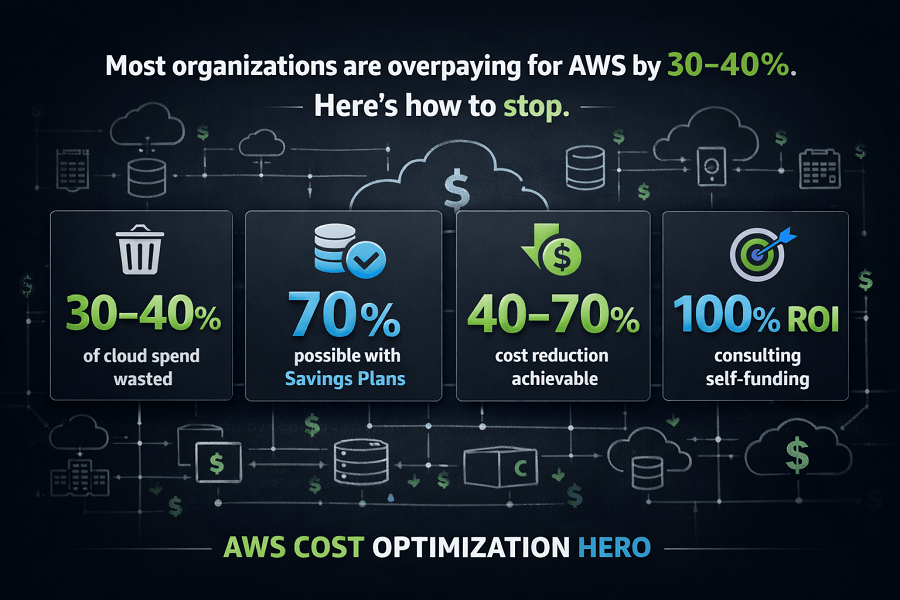
Cloud computing allows businesses to scale quickly, but without proper governance, AWS costs can increase faster than expected. Many organizations overspend not because AWS is expensive, but because cloud resources are often overprovisioned, left running unnecessarily, or lack continuous monitoring.
AWS Cost Optimization is the process of improving cloud efficiency while maintaining performance, security, and reliability. It involves analyzing usage patterns, eliminating waste, selecting the right pricing models, and continuously monitoring cloud spending.
At EaseCloud, we help organizations optimize AWS environments by combining cloud architecture best practices with FinOps principles, enabling businesses to reduce unnecessary spending without compromising application performance.
What this guide covers:
- What AWS Cost Optimization is
- Why AWS bills increase unexpectedly
- Common causes of cloud overspending
- AWS services that help control costs
- Proven optimization strategies
- How AWS consulting can reduce long-term cloud expenses
What Is AWS Cost Optimization?
AWS Cost Optimization is the practice of continuously reducing cloud expenditure while ensuring workloads remain reliable, secure, and scalable.
Unlike traditional cost-cutting, cloud optimization focuses on maximizing business value from every AWS resource.
It includes:
- Eliminating unused resources
- Rightsizing infrastructure
- Choosing the correct pricing model
- Automating resource scheduling
- Monitoring cloud spending
- Forecasting future costs
The objective is simple:
Spend only on resources that deliver business value.
Why Do AWS Costs Increase?
Most organizations don't intentionally overspend.
Instead, cloud environments grow over time, resulting in unused or oversized infrastructure.
Common reasons include:
Idle EC2 Instances
Virtual machines continue running after projects end.
Oversized Compute Resources
Applications use only a small percentage of allocated CPU or memory.
Unattached EBS Volumes
Storage volumes remain active even after instances are deleted.
Old Snapshots
Backups accumulate over months or years.
Unused Load Balancers
Load balancers continue generating charges after environments are retired.
Over-Provisioned Databases
Amazon RDS instances are frequently larger than required.
Inefficient Storage Classes
Data that should move to Glacier or Intelligent-Tiering remains in expensive storage.
Lack of Monitoring
Without visibility, organizations cannot identify cost anomalies until the monthly invoice arrives.
Why AWS Cost Optimization Matters
Effective cost optimization provides benefits beyond reducing invoices.
Organizations can:
- Improve cloud ROI
- Increase operational efficiency
- Scale applications confidently
- Reduce infrastructure waste
- Improve sustainability
- Align engineering and finance teams through FinOps
Key AWS Services Used for Cost Optimization
AWS Cost Explorer
Provides historical spending trends, forecasts, and service-level cost analysis.
Use it to:
- Analyze monthly spending
- Identify expensive services
- Track cost changes over time
AWS Budgets
Allows organizations to define spending thresholds.
Features include:
- Budget alerts
- Forecast notifications
- Cost tracking
- Usage tracking
AWS Compute Optimizer
Analyzes compute workloads and recommends better EBS, EC2 and Lambda configurations based on actual utilization.
AWS Trusted Advisor
Trusted Advisor continuously checks AWS accounts for optimization opportunities.
Cost checks include:
- Idle Load Balancers
- Underutilized EC2
- Idle Elastic IPs
- Unused Reserved Instances
AWS Pricing Calculator
Helps estimate infrastructure costs before deployment.
Useful during:
- Migration planning
- New projects
- Architecture reviews
Cost and Usage Report (CUR)
Provides the most detailed billing data available.
Large enterprises use CUR for:
- FinOps dashboards
- Cost analytics
- Business reporting
Core AWS Cost Optimization Strategies
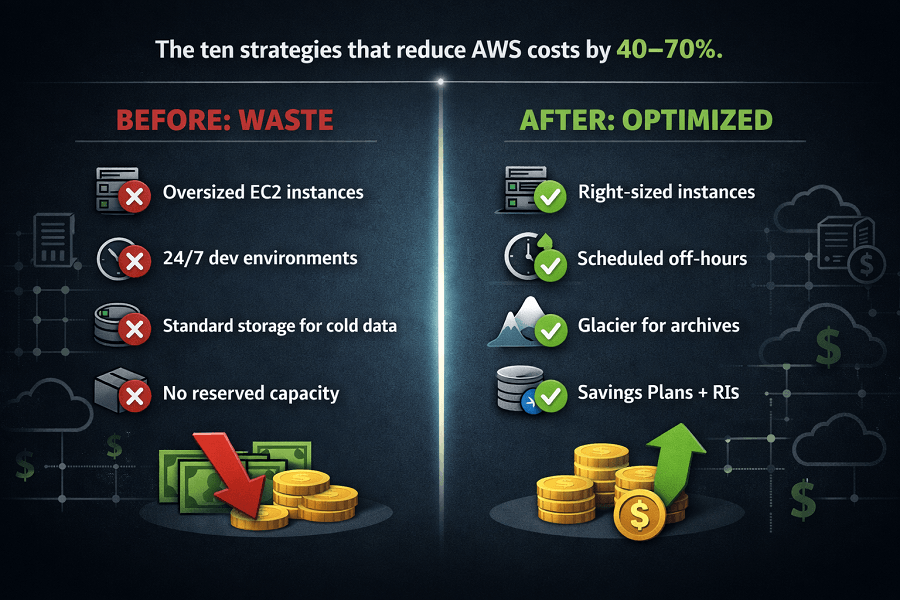
1. Rightsizing Resources
Analyze CPU, memory, and network utilization.
Replace oversized instances with appropriately sized alternatives.
Example:
m6i.2xlarge → m6i.large
without affecting performance.
2. Purchase Savings Plans
Savings Plans offer significant discounts compared to On-Demand pricing when you commit to consistent usage.
Best for predictable workloads.
3. Reserved Instances
Reserved Instances provide long-term pricing discounts for stable workloads running continuously.
Ideal for:
- Databases
- Production servers
- Long-running applications
4. Use Spot Instances
Spot Instances utilize unused AWS capacity at significantly reduced prices.
Suitable for:
- Batch processing
- CI/CD
- Testing
- Data analytics
Not recommended for workloads requiring guaranteed availability.
5. Optimize Amazon S3 Storage
Move infrequently accessed data to lower-cost storage classes.
Examples include:
- S3 Intelligent-Tiering
- S3 Glacier Instant Retrieval
- S3 Glacier Flexible Retrieval
- S3 Deep Archive
6. Automate Instance Scheduling
Development and testing environments rarely need to run 24/7.
Automatically stopping resources outside business hours can significantly reduce costs.
7. Delete Idle Resources
Regularly remove:
- Old snapshots
- Unattached EBS volumes
- Unused Elastic IPs
- Idle Load Balancers
- Orphaned security groups
8. Enable Auto Scaling
Instead of running large instances continuously, Auto Scaling adjusts capacity based on demand.
Benefits include:
- Lower costs
- Improved availability
- Better performance
9. Apply Cost Allocation Tags
Tagging resources enables spending analysis by:
- Department
- Application
- Customer
- Project
- Environment
This improves financial accountability and reporting.
10. Adopt FinOps Practices
FinOps combines engineering, finance, and operations to optimize cloud spending continuously.
It focuses on:
- Cost visibility
- Budget accountability
- Forecasting
- Continuous optimization
Common AWS Cost Optimization Mistakes
Organizations frequently:
- Leave development servers running overnight
- Ignore Trusted Advisor recommendations
- Forget unattached storage volumes
- Purchase oversized EC2 instances
- Skip tagging resources
- Avoid regular architecture reviews
These issues can collectively add thousands of dollars to annual cloud expenses.
AWS Well-Architected and Cost Optimization
AWS Cost Optimization is one of the six pillars of the AWS Well-Architected Framework.
During a AWS Well-Architected Review, architects evaluate:
- Resource utilization
- Pricing models
- Storage efficiency
- Compute optimization
- Operational practices
The review identifies opportunities to improve efficiency without impacting application performance.
When Should You Hire an AWS Cost Optimization Consultant?
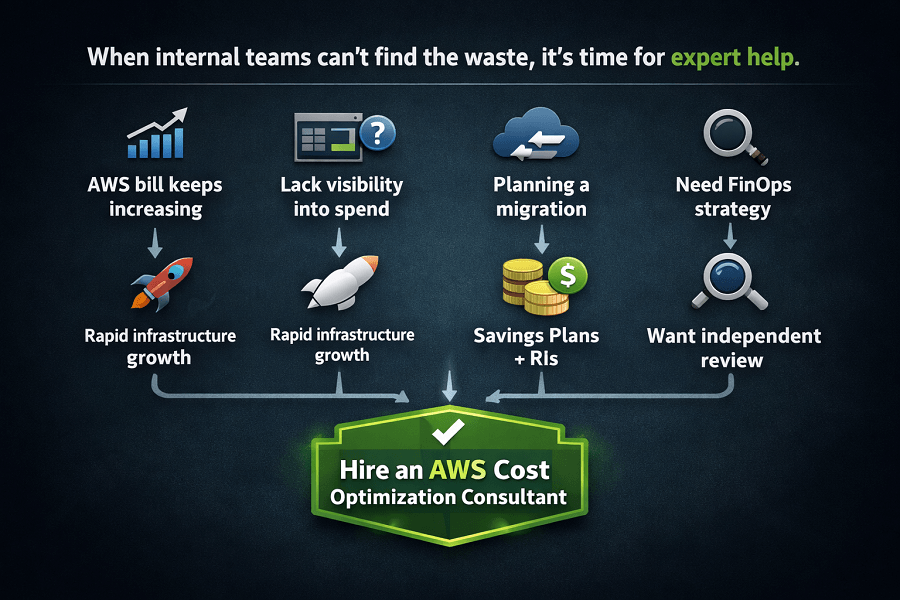
Consider working with an AWS consulting partner if:
- Your AWS bill continues increasing
- You lack visibility into cloud spending
- Your infrastructure has grown rapidly
- You are planning a migration
- You need a FinOps strategy
- You want an independent architecture review
An experienced AWS consultant can identify optimization opportunities that internal teams may overlook.
How EaseCloud Helps Reduce AWS Costs
EaseCloud combines cloud architecture expertise with cost optimization best practices to help organizations maximize the value of their AWS investment.
Our AWS Cost Optimization services include:
- Infrastructure assessment
- AWS Well-Architected Reviews
- Rightsizing recommendations
- Savings Plan analysis
- Reserved Instance planning
- Storage optimization
- FinOps advisory
- Continuous cost monitoring
- Performance optimization
The objective is not simply to reduce spending, but to ensure every cloud resource delivers measurable business value.
Conclusion
AWS Cost Optimization is an ongoing discipline rather than a one-time task. By combining visibility, automation, governance, and architectural best practices, organizations can reduce unnecessary cloud spending while maintaining performance and scalability.
Whether you're looking to control rising AWS bills, improve resource efficiency, or implement a long-term FinOps strategy, a structured cost optimization approach can deliver measurable financial and operational benefits.
Frequently Asked Questions
How much can AWS Cost Optimization save?
Savings vary by environment, but organizations commonly reduce cloud costs by addressing idle resources, right-sizing infrastructure, and adopting optimized pricing models.
Is AWS Cost Optimization only for large enterprises?
No. Startups, SMBs, and enterprise organizations can all benefit from cost optimization practices, especially as cloud usage grows.
Which AWS service helps identify unnecessary spending?
AWS Cost Explorer, AWS Compute Optimizer, AWS Trusted Advisor, and Cost and Usage Reports are key services for identifying inefficiencies.
Is FinOps part of AWS Cost Optimization?
Yes. FinOps provides an operational framework that helps organizations continuously manage and optimize cloud financial performance.