Qwen vs DeepSeek for Coding: Which AI Model Is Better for Developers in 2026?
Compare Qwen vs DeepSeek for coding across benchmarks, IDE support, APIs, debugging, pricing, local deployment, and enterprise developer workflows.
The rise of open-source Large Language Models (LLMs) has transformed modern software development. Developers are no longer limited to proprietary coding assistants, as powerful models such as Qwen, DeepSeek, and GLM now deliver advanced capabilities for code generation, debugging, documentation, and AI-assisted software engineering.
Among these models, Qwen and DeepSeek have emerged as two of the strongest choices for developers. Both are capable of generating production-ready code, understanding large codebases, solving complex programming problems, and integrating with modern AI coding tools. However, they are designed with different strengths, making the choice less straightforward than simply comparing benchmark scores.
For individual developers, the decision often comes down to productivity and coding accuracy. For startups, factors such as API pricing, latency, and deployment flexibility play a larger role. Enterprise engineering teams must also consider governance, security, scalability, licensing, and integration with existing development platforms.
Organizations working with cloud and AI consulting partners such as EaseCloud frequently evaluate these factors before adopting an AI coding model across engineering teams. Beyond raw benchmark performance, successful enterprise adoption depends on infrastructure compatibility, operational cost, developer experience, and long-term maintainability.
This guide provides a comprehensive comparison of Qwen and DeepSeek specifically for software development. Rather than focusing only on benchmark numbers, we'll evaluate how both models perform in real-world engineering workflows.
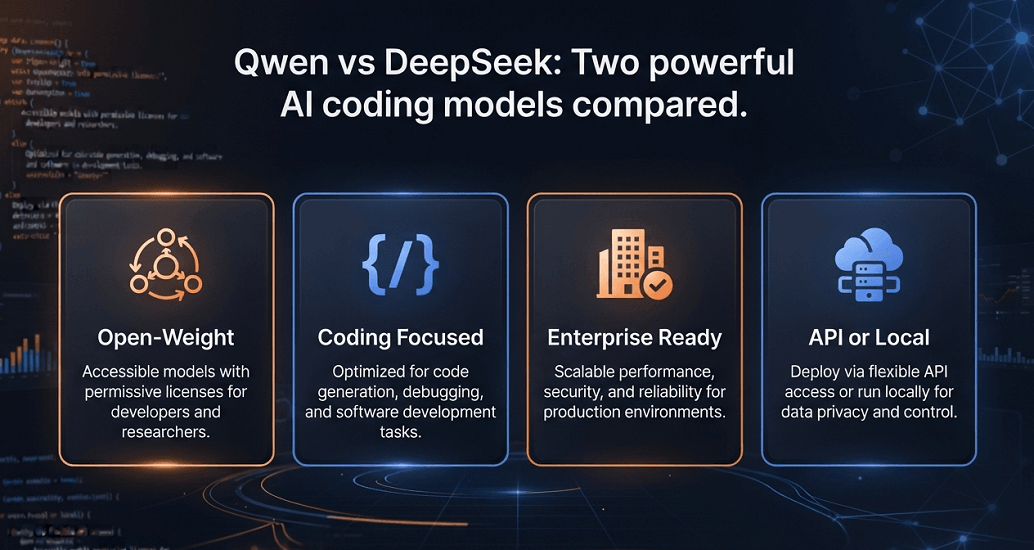
What This Guide Covers
- The architectural differences between Qwen and DeepSeek
- Which model performs better for coding tasks
- Programming language support
- Performance on coding benchmarks
- IDE and AI coding assistant compatibility
- Optimizing API performance and pricing
- Local deployment options
- Enterprise development use cases
- Which model is best for different types of developers
Whether you're building web applications, enterprise software, AI agents, or cloud-native platforms, this guide will help you determine which model best fits your development workflow.
Why Developers Compare Qwen and DeepSeek
Artificial Intelligence has become an essential part of modern software engineering. Developers increasingly rely on AI to automate repetitive tasks, improve code quality, accelerate debugging, and reduce development time.
Today's AI coding assistants can help with:
- Writing production-ready code
- Explaining unfamiliar codebases
- Refactoring legacy applications
- Creating unit tests
- Fixing bugs
- Writing SQL queries
- Generating documentation
- Building APIs
- Creating infrastructure templates
- Automating DevOps workflows
Because of these capabilities, developers are looking beyond proprietary solutions and comparing high-performing open models that provide greater flexibility and lower operating costs.
Qwen and DeepSeek are two of the most frequently evaluated options because they offer:
- Strong reasoning capabilities
- High-quality code generation
- Open-weight model availability
- Commercial deployment options
- Large context windows
- Support for modern developer tooling
- Competitive benchmark performance
Rather than asking "Which model has the highest benchmark score?", engineering teams are increasingly asking more practical questions:
- Which model writes cleaner production code?
- Which performs better on large projects?
- Which integrates best with Cursor or VS Code?
- Which model produces fewer hallucinations?
- Which offers better value for API costs?
- Which can be deployed securely inside enterprise infrastructure?
These are the questions that matter when selecting an AI coding assistant for real-world software development.
What Are Qwen and DeepSeek?
Although both models belong to the new generation of open AI models, they originate from different organizations and have distinct design philosophies.
Understanding these differences provides important context before comparing their coding performance.
What Is Qwen?
Qwen is a family of large language models developed by Alibaba Cloud as part of its broader AI ecosystem.
The Qwen family includes general-purpose language models, reasoning models, multimodal models, and coding-focused variants designed for software development tasks.
Key characteristics include:
- Strong multilingual capabilities
- Excellent code generation
- Long-context processing
- Enterprise deployment options
- Open-weight model availability
- Support for fine-tuning
- Commercial API access
- Integration with Alibaba Cloud services
Recent Qwen models have consistently ranked among the strongest open-weight LLMs for software engineering, mathematics, reasoning, and multilingual understanding.
Because of their flexibility, Qwen models are widely used in:
- AI coding assistants
- Enterprise software development
- Cloud-native applications
- AI agents
- Knowledge assistants
- Research platforms
- Customer support systems
For organizations adopting AI at scale, Qwen provides an attractive balance between performance, openness, and deployment flexibility.
What Is DeepSeek?
DeepSeek is a family of open-weight AI models developed by DeepSeek AI, with a strong emphasis on reasoning and software engineering.
The company gained significant attention by releasing models that demonstrated exceptional coding capabilities while remaining highly cost-effective compared to many proprietary alternatives.
The DeepSeek ecosystem includes:
- DeepSeek V3
- DeepSeek R1
- DeepSeek Coder
- Specialized reasoning models
DeepSeek models are recognized for:
- Advanced logical reasoning
- High coding accuracy
- Competitive benchmark performance
- Efficient inference
- Strong mathematics capabilities
- Open deployment options
- API accessibility
- Active developer adoption
These strengths have made DeepSeek a popular choice among developers building AI-powered coding tools, automation workflows, and engineering assistants.
Qwen Model Family Explained
The Qwen ecosystem includes several specialized models optimized for different workloads.
Qwen 3
The latest flagship family designed for general-purpose reasoning, coding, multilingual tasks, and enterprise AI applications.
Best suited for:
- Software development
- Knowledge assistants
- AI agents
- Long-context reasoning
- Business automation
Qwen Coder
Purpose-built for software engineering.
Optimized for:
- Code generation
- Debugging
- Code completion
- Repository understanding
- Refactoring
- Test generation
- Documentation
This model is particularly relevant for developers comparing Qwen against DeepSeek.
Qwen Multimodal Models
Designed for applications that combine text with images, documents, or other input types.
Although not primarily intended for coding, they support developer workflows involving document analysis, UI interpretation, and technical diagrams.
DeepSeek Model Family Explained
DeepSeek also offers specialized models targeting different engineering use cases.
DeepSeek V3
A general-purpose language model optimized for:
- Coding
- Content generation
- Research
- Technical writing
- Enterprise AI applications
DeepSeek R1
Designed specifically for advanced reasoning.
Excels at:
- Mathematical reasoning
- Algorithm design
- Multi-step problem solving
- Competitive programming
- Complex debugging
Developers working on highly analytical tasks often evaluate R1 alongside Qwen's reasoning-focused models.
DeepSeek Coder
DeepSeek Coder is optimized specifically for software development.
Key strengths include:
- Production code generation
- Multi-language support
- Repository understanding
- Bug detection
- Code explanation
- Refactoring assistance
- Test creation
Because of its specialization, DeepSeek Coder is frequently compared directly with Qwen Coder by professional developers.
Qwen vs DeepSeek: High-Level Comparison
Before diving into detailed benchmarks, it's helpful to compare both model families across the areas developers care about most.
| Feature | Qwen | DeepSeek |
|---|---|---|
| Primary Developer | Alibaba Cloud | DeepSeek AI |
| Model Types | General, Coding, Reasoning, Multimodal | General, Coding, Reasoning |
| Coding Quality | Excellent | Excellent |
| Reasoning | Excellent | Excellent (especially R1) |
| Multilingual Support | Outstanding | Very Strong |
| Long Context Handling | Excellent | Excellent |
| Open-Weight Availability | Yes | Yes |
| Commercial API | Yes | Yes |
| Fine-Tuning Support | Yes | Yes |
| Local Deployment | Yes | Yes |
| Enterprise Adoption | Strong | Rapidly Growing |
At a high level, both ecosystems are highly capable. The right choice depends less on overall quality and more on your specific development workflow, infrastructure requirements, and deployment preferences.
Where Qwen and DeepSeek Fit in Modern Development Workflows
AI-assisted coding has evolved far beyond autocomplete.
Today, developers use models like Qwen and DeepSeek throughout the software development lifecycle:
- Planning application architecture
- Writing boilerplate code
- Building REST and GraphQL APIs
- Generating database schemas
- Creating infrastructure with Terraform
- Writing Kubernetes manifests
- Automating CI/CD pipelines
- Debugging production issues
- Reviewing pull requests
- Refactoring legacy applications
- Generating technical documentation
- Building AI agents and MCP-enabled tools
For organizations modernizing their engineering workflows, consulting partners such as EaseCloud often evaluate AI coding models alongside cloud architecture, DevOps pipelines, and enterprise governance requirements. This ensures that the selected model aligns not only with developer productivity but also with scalability, security, and operational best practices.
Coding Benchmark Comparison
Industry-standard benchmarks provide a useful baseline for evaluating AI coding models. While no benchmark perfectly reflects day-to-day software engineering, together they offer insight into code generation quality, reasoning ability, debugging skills, and problem-solving performance.
Below are the most relevant coding benchmarks developers should consider.
HumanEval
HumanEval measures a model's ability to generate correct Python functions based on natural language prompts.
The benchmark focuses on:
- Algorithm implementation
- Function correctness
- Python syntax
- Logical reasoning
- Problem-solving
Qwen
Qwen demonstrates consistently strong HumanEval performance, generating clean, readable code with good adherence to prompt requirements. It performs particularly well on common programming patterns and produces code that generally requires minimal post-editing.
Strengths include:
- Readable implementations
- Clear variable naming
- Good documentation
- Reliable syntax
- Stable function generation
DeepSeek
DeepSeek also performs exceptionally well on HumanEval and is especially effective at solving algorithmically complex tasks. DeepSeek R1 frequently demonstrates stronger multi-step reasoning when prompts involve advanced logic.
Strengths include:
- Strong algorithm design
- Better handling of edge cases
- Efficient implementations
- Excellent mathematical reasoning
- High correctness rates
EaseCloud Insight
For enterprise application development, EaseCloud recommends evaluating HumanEval alongside real-world engineering tasks rather than relying solely on benchmark rankings. Production software often requires maintainability, security, and integration with existing systems—factors that benchmarks alone cannot fully capture.
SWE-bench
Unlike HumanEval, SWE-bench evaluates whether an AI model can resolve real issues from open-source software repositories.
This benchmark measures:
- Repository understanding
- Bug fixing
- Multi-file editing
- Dependency awareness
- Pull request generation
Because it reflects actual software engineering workflows, SWE-bench is one of the most valuable benchmarks for professional developers.
Qwen Performance
Qwen performs well on repository-level tasks, especially when provided with sufficient project context. Its large context window helps it analyze multiple files and understand relationships across larger codebases.
Strengths include:
- Repository navigation
- Code explanation
- Documentation updates
- Configuration management
- API implementation
DeepSeek Performance
DeepSeek generally excels in issue resolution and debugging workflows. Its reasoning-focused architecture often helps it identify root causes faster when working with complex bugs.
Developers commonly report strong performance for:
- Bug localization
- Stack trace analysis
- Logic correction
- Test failure investigation
- Refactoring suggestions
LiveCodeBench
LiveCodeBench evaluates AI models using continuously updated programming challenges rather than static datasets.
It measures:
- General coding ability
- Adaptability
- Competitive programming
- Fresh problem solving
- Reasoning under unseen conditions
Because tasks are updated regularly, LiveCodeBench reduces the possibility of benchmark memorization.
Both Qwen and DeepSeek consistently rank among the strongest open-weight models, making either a capable choice for software development.
MBPP (Mostly Basic Python Problems)
MBPP focuses on beginner-to-intermediate programming tasks.
Examples include:
- String manipulation
- Lists
- Dictionaries
- Sorting
- Searching
- Loops
- Functions
Qwen
Produces clean, highly readable Python solutions suitable for educational environments.
DeepSeek
Often generates slightly more optimized implementations while maintaining correctness.
BigCodeBench
BigCodeBench measures large-scale software engineering rather than isolated coding questions.
It evaluates:
- Project understanding
- Software architecture
- Dependency management
- Multi-file projects
- Engineering workflows
This benchmark more closely reflects enterprise development than traditional algorithmic evaluations.
MultiPL-E
Most developers work in multiple programming languages rather than Python alone.
MultiPL-E evaluates coding ability across languages including:
- Python
- JavaScript
- TypeScript
- Java
- Go
- Rust
- C#
- PHP
- C++
- Kotlin
Both Qwen and DeepSeek demonstrate broad multilingual coding capabilities, though their strengths vary depending on the language and task.
Programming Language Performance
Different programming languages present unique challenges for AI coding models.
Below is a practical comparison based on common development workflows.
| Language | Qwen | DeepSeek | Best For |
|---|---|---|---|
| Python | ⭐⭐⭐⭐⭐ | ⭐⭐⭐⭐⭐ | Tie |
| JavaScript | ⭐⭐⭐⭐⭐ | ⭐⭐⭐⭐☆ | Qwen |
| TypeScript | ⭐⭐⭐⭐⭐ | ⭐⭐⭐⭐☆ | Qwen |
| Java | ⭐⭐⭐⭐☆ | ⭐⭐⭐⭐⭐ | DeepSeek |
| Go | ⭐⭐⭐⭐☆ | ⭐⭐⭐⭐⭐ | DeepSeek |
| Rust | ⭐⭐⭐⭐☆ | ⭐⭐⭐⭐⭐ | DeepSeek |
| C++ | ⭐⭐⭐⭐☆ | ⭐⭐⭐⭐⭐ | DeepSeek |
| PHP | ⭐⭐⭐⭐⭐ | ⭐⭐⭐⭐☆ | Qwen |
| SQL | ⭐⭐⭐⭐⭐ | ⭐⭐⭐⭐☆ | Qwen |
| Bash | ⭐⭐⭐⭐⭐ | ⭐⭐⭐⭐☆ | Qwen |
Key Takeaway
- Qwen tends to excel in web development, scripting, SQL generation, and documentation-heavy workflows.
- DeepSeek often has an advantage in systems programming, algorithm-intensive tasks, and lower-level languages such as Rust, Go, and C++.
For organizations working across diverse technology stacks, EaseCloud typically recommends evaluating models against your own repositories and primary programming languages before standardizing on one solution.
Code Generation Quality
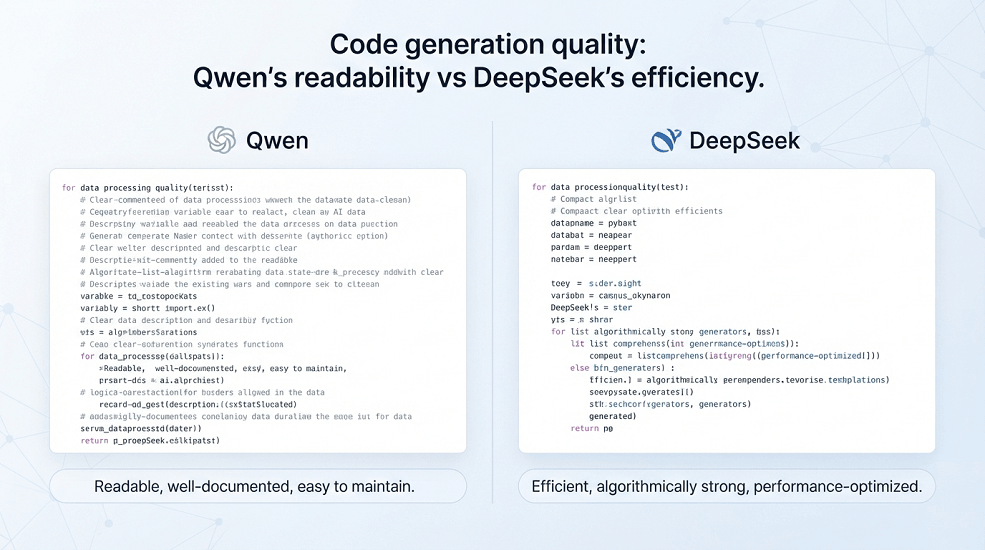
Generating syntactically correct code is only part of the challenge. High-quality AI models should also produce maintainable, readable, and production-ready implementations.
Qwen
Qwen typically generates code that is:
- Well structured
- Easy to read
- Consistently formatted
- Well commented
- Suitable for collaborative projects
It often follows modern framework conventions and produces code that aligns with common development practices.
DeepSeek
DeepSeek focuses more heavily on solving the problem efficiently.
Its generated code is often:
- Compact
- Highly optimized
- Algorithmically strong
- Performance oriented
- Less verbose
For experienced developers, this can be an advantage, although beginners may find the output slightly harder to understand.
Bug Fixing and Debugging
Debugging is one of the most valuable applications of AI coding assistants.
Developers increasingly rely on LLMs to:
- Explain exceptions
- Analyze stack traces
- Locate logical errors
- Suggest fixes
- Improve error handling
Qwen
Qwen performs well when debugging:
- REST APIs
- Frontend applications
- Infrastructure code
- SQL queries
- CI/CD pipelines
Its explanations are generally detailed and educational, making it a strong choice for developers who want to understand why an issue occurred.
DeepSeek
DeepSeek frequently demonstrates stronger analytical reasoning during debugging.
It excels at:
- Recursive logic
- Concurrency issues
- Complex algorithms
- Memory-related bugs
- Multi-step execution paths
Its reasoning-first approach can lead to more accurate diagnoses in technically demanding scenarios.
Code Refactoring
Refactoring improves maintainability without changing functionality.
Both models support:
- Removing duplicated logic
- Improving readability
- Applying design patterns
- Modularizing code
- Renaming variables
- Simplifying complex functions
Qwen
Often produces cleaner, more readable refactored code that follows modern coding conventions.
DeepSeek
Usually focuses on optimization and efficiency, sometimes suggesting more advanced architectural changes.
Unit Test Generation
Automated test generation significantly accelerates software delivery.
Both models can generate:
- Unit tests
- Integration tests
- Mock objects
- Edge case tests
- API tests
Qwen
Produces highly readable tests with descriptive naming and clear assertions.
DeepSeek
Often generates more comprehensive edge-case coverage, particularly for algorithmic functions and complex business logic.
Documentation Generation
Maintaining documentation is essential for long-term software quality.
AI models can generate:
- API documentation
- Function comments
- README files
- Technical guides
- Architecture explanations
- Deployment instructions
Qwen
Documentation is one of Qwen's strongest areas.
It consistently produces:
- Clear explanations
- Structured Markdown
- Developer-friendly examples
- Well-organized documentation
DeepSeek
Documentation is technically accurate but generally more concise and less instructional than Qwen.
Repository Understanding
Modern software development involves navigating entire repositories rather than isolated files.
Key capabilities include:
- Understanding project structure
- Identifying dependencies
- Cross-file reasoning
- Explaining architecture
- Suggesting improvements
Qwen
Performs well in enterprise repositories with extensive documentation and modular architectures, making it useful for onboarding and knowledge sharing.
DeepSeek
Excels at tracing logic across interconnected files and identifying relationships that affect runtime behavior, particularly in complex backend systems.
AI Coding Assistant Compatibility
Developers increasingly interact with models through IDE extensions and coding agents rather than standalone chat interfaces.
| Tool | Qwen | DeepSeek |
|---|---|---|
| Cursor | ✅ Excellent | ✅ Excellent |
| Visual Studio Code | ✅ Excellent | ✅ Excellent |
| GitHub Copilot Alternative | ✅ Strong | ✅ Strong |
| Windsurf | ✅ Supported | ✅ Supported |
| Continue.dev | ✅ Excellent | ✅ Excellent |
| Cline | ✅ Compatible | ✅ Compatible |
| OpenHands | ✅ Supported | ✅ Supported |
| Roo Code | ✅ Supported | ✅ Supported |
Both models integrate well with modern AI-assisted development workflows through APIs and compatible providers such as OpenRouter or self-hosted inference servers.
Context Window, Latency, and API Performance
Beyond coding quality, production adoption depends on operational characteristics.
Context Window
Large context windows enable models to:
- Analyze large repositories
- Understand multiple files simultaneously
- Maintain long conversations
- Process extensive documentation
Both Qwen and DeepSeek offer models with long-context capabilities, though available limits vary by provider and deployment option.
Latency
Developers expect near real-time responses while coding.
Performance depends on:
- Hosting provider
- Model size
- Hardware
- Quantization
- Network conditions
Smaller distilled variants typically offer faster response times, while larger reasoning models may trade speed for higher-quality outputs.
Function Calling and Structured Outputs
For agentic coding workflows and enterprise automation, support for function calling and structured JSON outputs is increasingly important.
Both ecosystems provide capabilities that integrate well with modern development frameworks, enabling AI-powered tools to trigger APIs, automate workflows, and produce machine-readable responses.
Qwen vs DeepSeek for Coding
API Pricing Comparison
Pricing is one of the biggest factors when choosing an AI coding model, especially for startups, SaaS platforms, AI coding assistants, and enterprises processing millions of tokens every day.
Although API pricing changes frequently, developers should evaluate models using these criteria rather than focusing only on the cost per million tokens.
Compare the Following Factors
- Input token pricing
- Output token pricing
- Long-context pricing
- Rate limits
- Throughput
- Latency
- Availability
- Enterprise SLAs
- Regional deployment options
- API stability
Qwen API
Qwen APIs are available through several providers including:
- Alibaba Cloud Model Studio
- OpenRouter
- Together AI
- Fireworks AI
- Community inference providers
Advantages include:
- Multiple deployment providers
- Enterprise cloud ecosystem
- Stable API infrastructure
- Flexible deployment options
- Strong multilingual support
Potential considerations:
- Pricing varies between providers.
- Some advanced models are available only through selected platforms.
- Regional availability may differ.
DeepSeek API
DeepSeek APIs are available through:
- DeepSeek Platform
- OpenRouter
- Together AI
- Fireworks AI
- Self-hosted deployments
Advantages include:
- Competitive pricing
- Excellent reasoning performance
- Strong coding capabilities
- Active open-source ecosystem
Potential considerations:
- Demand spikes can occasionally affect response times on public endpoints.
- Performance depends on the chosen provider or hosting infrastructure.
EaseCloud Recommendation
For enterprise projects, EaseCloud recommends evaluating the total cost of ownership (TCO) rather than API pricing alone. Infrastructure expenses, latency requirements, security controls, engineering productivity, and operational overhead often have a greater business impact than the difference in token pricing.
Local Deployment Comparison
One of the biggest advantages of Qwen and DeepSeek is that many models can be deployed privately.
This is particularly important for:
- Financial institutions
- Healthcare organizations
- Government agencies
- SaaS companies
- Enterprises with strict compliance requirements
Local deployment provides:
- Complete data privacy
- Reduced API costs
- Lower latency
- Custom fine-tuning
- Greater operational control
Running with Ollama
Ollama has become one of the simplest ways to run open-weight language models locally.
Both ecosystems support deployment through Ollama, enabling developers to:
- Run models offline
- Build private coding assistants
- Experiment without API costs
- Integrate with IDE extensions
- Power local AI agents
Typical use cases include:
- Personal coding assistants
- Internal developer tools
- Prototype applications
- Secure enterprise environments
Running with vLLM
Organizations requiring high-throughput inference often deploy models using vLLM.
Benefits include:
- High token throughput
- Efficient GPU memory usage
- Dynamic batching
- OpenAI-compatible APIs
- Production scalability
vLLM is commonly used for:
- AI SaaS products
- Internal enterprise platforms
- Coding assistants
- Multi-user AI services
LM Studio
LM Studio provides a desktop interface for developers who want to experiment locally.
Advantages include:
- Simple installation
- No cloud dependency
- Easy model management
- API compatibility
- Fast prototyping
It is particularly useful for testing prompts before deploying production systems.
Docker and Kubernetes
For production deployments, organizations often package inference servers using Docker and orchestrate them with Kubernetes.
Typical architecture:
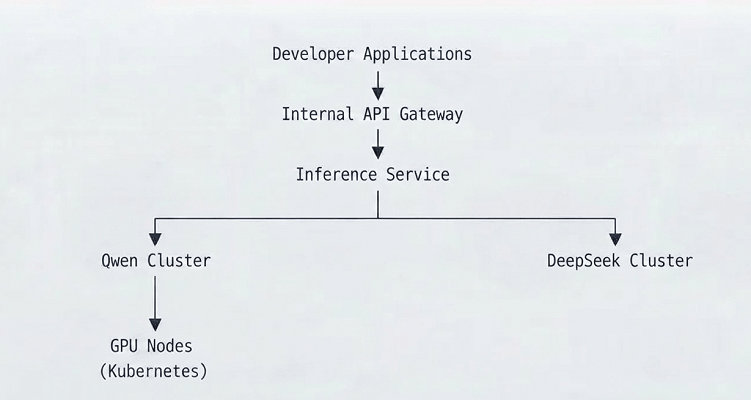
This architecture provides:
- Horizontal scaling
- High availability
- Load balancing
- Rolling updates
- Automated recovery
- Enterprise-grade operations
Organizations implementing this approach often integrate monitoring, autoscaling, and security policies into their AI infrastructure. At EaseCloud, these deployment patterns are commonly used when designing scalable AI platforms on AWS with Amazon EKS, GPU-enabled compute, and MLOps workflows.
Fine-Tuning and Customization
Most organizations eventually require models tailored to their own codebases, documentation, and engineering standards.
Both Qwen and DeepSeek support customization techniques such as:
- LoRA (Low-Rank Adaptation)
- QLoRA
- Supervised Fine-Tuning (SFT)
- Domain adaptation
- Retrieval-Augmented Generation (RAG)
- Instruction tuning
Common enterprise use cases include:
- Internal coding standards
- Proprietary frameworks
- Company APIs
- Infrastructure templates
- Security guidelines
- Technical documentation
For many organizations, combining a foundation model with a high-quality RAG pipeline is more cost-effective than full fine-tuning.
Quantization
Quantization reduces memory requirements while maintaining acceptable performance.
Popular formats include:
- GGUF
- INT8
- INT4
- FP16
- AWQ
- GPTQ
Benefits include:
- Lower VRAM usage
- Faster inference
- Reduced infrastructure costs
- Consumer GPU compatibility
This makes local deployment practical even for development workstations.
Enterprise Readiness
Selecting an AI coding model for enterprise use extends beyond benchmark scores.
Decision-makers should evaluate:
- Authentication
- Access controls
- Audit logging
- API stability
- Deployment flexibility
- Data residency
- Compliance
- Monitoring
- Governance
- Vendor ecosystem
Qwen
Strengths include:
- Mature cloud ecosystem
- Strong multilingual support
- Broad enterprise integration
- Flexible deployment options
- Extensive model family
DeepSeek
Strengths include:
- Exceptional reasoning
- Competitive coding quality
- Strong open-weight community
- Efficient inference
- Excellent research momentum
Both ecosystems are suitable for enterprise adoption when deployed with appropriate security controls and governance frameworks.
Open-Source Licensing
Licensing is often overlooked but can have significant implications for commercial deployments.
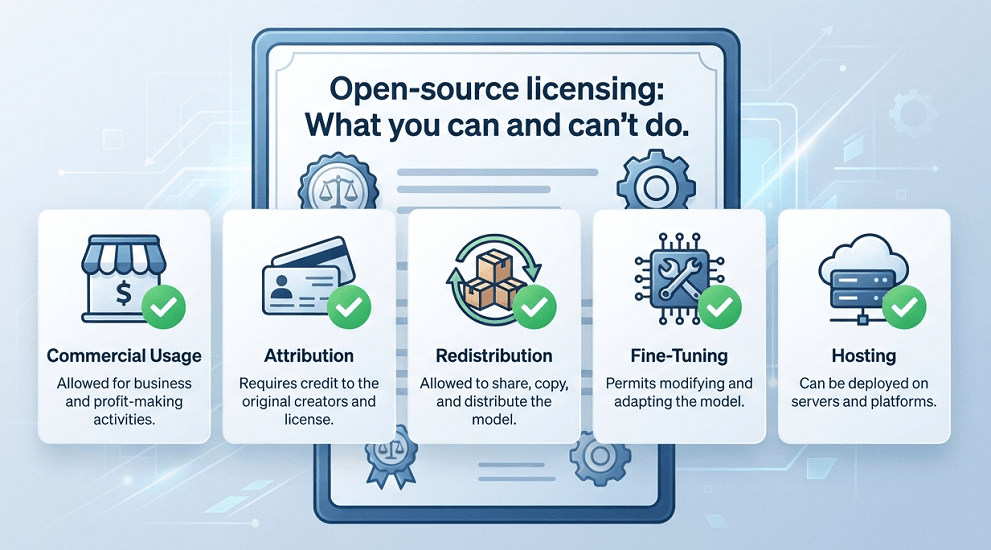
Before integrating any model into production systems, organizations should review:
- Commercial usage rights
- Attribution requirements
- Redistribution permissions
- Fine-tuning restrictions
- Hosting limitations
- Model modification policies
Because licensing terms evolve over time, always verify the latest documentation from the model provider before deployment.
Security Considerations
AI-generated code should always undergo the same review process as human-written code.
Recommended practices include:
- Static application security testing (SAST)
- Dependency scanning
- Secret detection
- Manual code review
- OWASP validation
- CI/CD security gates
- Infrastructure scanning
Neither Qwen nor DeepSeek should replace secure software engineering practices.
Instead, they should enhance developer productivity while operating within established governance frameworks.
Which Model Is Best for Different Developers?
Every engineering team has different priorities.
The table below summarizes which model may be a better fit depending on your primary use case.
| Developer Type | Recommended Model | Why |
|---|---|---|
| Beginner Developers | Qwen | Easier-to-read explanations and well-documented code. |
| Students | Qwen | Strong educational responses and clear guidance. |
| Front-End Developers | Qwen | Excellent JavaScript, TypeScript, HTML, and CSS support. |
| Backend Developers | Tie | Both perform well across APIs, databases, and services. |
| Full-Stack Developers | Qwen | Balanced support across frontend, backend, and documentation. |
| DevOps Engineers | Qwen | Strong Terraform, Kubernetes, Bash, and infrastructure generation. |
| AI/ML Engineers | DeepSeek | Advanced reasoning for research, algorithms, and experimentation. |
| Competitive Programmers | DeepSeek | Excels at algorithmic problem solving and logical reasoning. |
| Enterprise Engineering Teams | Tie | Evaluate based on deployment, governance, and business requirements. |
| Cost-Conscious Startups | Depends | Compare provider pricing, hosting strategy, and expected usage. |
Common Mistakes When Choosing an AI Coding Model
Many teams focus only on leaderboard rankings.
This often leads to poor long-term decisions.
Avoid these common mistakes:
Choosing Based Only on Benchmarks
Benchmark performance does not always reflect production software engineering.
Evaluate models using your own repositories and workflows.
Ignoring Infrastructure Costs
API pricing is only one part of the equation.
Consider:
- GPU costs
- Hosting
- Monitoring
- Scaling
- Engineering effort
- Maintenance
Skipping Security Reviews
Never merge AI-generated code directly into production.
Maintain the same testing and review standards used for human-written code.
Not Testing with Real Projects
Run pilot projects using:
- Existing repositories
- CI/CD pipelines
- Internal frameworks
- Business applications
Real-world testing provides more meaningful insights than isolated prompts.
Conclusion
The competition between Qwen and DeepSeek reflects how quickly open AI models are advancing. Both provide exceptional coding capabilities and offer organizations the flexibility to build powerful AI-assisted development workflows without relying solely on proprietary solutions.
Rather than selecting a model based on benchmark rankings alone, evaluate how it performs within your team's programming languages, repositories, deployment model, and business objectives. By aligning technical performance with operational requirements, you can choose a solution that delivers long-term value for developers and the organization alike.
Frequently Asked Questions
Is Qwen better than DeepSeek for coding?
It depends on your workflow. Qwen is an excellent choice for general software engineering, documentation, web development, and multilingual projects. DeepSeek often has an advantage in reasoning-intensive tasks, competitive programming, and complex debugging.
Which model writes cleaner code?
Qwen generally produces more readable and well-documented code, making it suitable for collaborative teams and long-term maintenance.
Which model is better for debugging?
DeepSeek's reasoning capabilities often help it identify complex logical issues more effectively, particularly in algorithm-heavy applications.
Can both models run locally?
Yes. Both ecosystems support local deployment using tools such as Ollama, vLLM, LM Studio, Docker, and Kubernetes, depending on the model variant.
Which model works best with Cursor or VS Code?
Both integrate well through compatible APIs and local inference servers. The better choice depends on the coding tasks, latency requirements, and deployment strategy.
Which model is better for enterprise development?
Both are viable enterprise options. The right decision depends on governance, licensing, deployment preferences, compliance requirements, infrastructure, and integration with existing engineering workflows.
Final Verdict
Qwen and DeepSeek represent two of the strongest open-weight AI ecosystems available for developers today.
Choose Qwen if you prioritize:
- Web development
- Developer experience
- Readability
- Documentation generation
- Multilingual projects
- Enterprise integration
- Infrastructure automation
Choose DeepSeek if you prioritize:
- Advanced reasoning
- Competitive programming
- Complex debugging
- Algorithm optimization
- Research-oriented software engineering
For most organizations, there is no universally "better" model. The best approach is to evaluate both against your own repositories, workflows, and operational requirements before standardizing across engineering teams.
How EaseCloud Helps Organizations Adopt AI Coding Models
Choosing the right coding model is only the first step. Successful adoption requires secure deployment, governance, infrastructure optimization, and seamless integration into the software development lifecycle. At EaseCloud, we help startups and enterprises build production-ready AI engineering platforms using leading open-weight models such as Qwen and DeepSeek.
Book Your Free AI Platform AssessmentSummarize this post with: