Best Open-Source AI Models for Coding in 2026
Compare the best open-source coding AI models in 2026, including Qwen, DeepSeek and GLM for coding agents, benchmarks, local use and cost.
The open AI coding landscape has changed significantly.
Developers now have access to coding-focused models that can do far more than autocomplete a line of code. Modern open-weight models can analyze repositories, fix bugs, generate tests, use tools, operate terminals, and work through long software-engineering tasks.
That makes choosing the right coding model more difficult.
A developer looking for the best open-source AI model for coding may encounter:
- Qwen3-Coder
- DeepSeek V4
- GLM-4.7
- GLM-5
- Llama-based coding models
- Mistral coding models
- Smaller local coding models
- Specialized multimodal coding models
But the model with the highest benchmark score isn't automatically the best coding assistant.
TL;DR
- Qwen3-Coder – best for agentic and repository-level coding. 256K context, smaller variants for local use. Strong starting point for coding agents.
- DeepSeek V4 – best for coding + reasoning + long context (1M tokens). Strong FIM completion and tool calling. Ideal when you need both coding and complex reasoning.
- GLM-4.7 – terminal-agent specialist. Strong SWE-bench (73.8%) and Terminal-Bench (41%) results. Best for terminal-heavy agentic workflows.
- GLM-5 – large-scale, long-horizon agentic engineering. 744B parameters, requires multi-GPU infrastructure. Only for teams with substantial GPU budgets.
- Don't trust leaderboards – benchmark on your own repositories. Measure: task success, latency, cost per successful task. Test code generation, debugging, repository understanding, and agent reliability.
- For most teams: start with Qwen3-Coder + DeepSeek + GLM-4.7. Add GLM-5 only when workload and infrastructure justify it.
How to Choose the Right Coding Model
- Code generation
- Code completion
- Debugging
- Refactoring
- Repository understanding
- AI coding agents
- Tool calling
- Context handling
- Programming-language coverage
- Latency
- Cost
- Local deployment
This guide compares the leading open-weight options and helps you choose the right model for your coding workflow.
What Does "Open-Source Coding Model" Mean?
The terminology is important.
Not every downloadable AI model is technically open source in the same way that software such as Linux is open source.
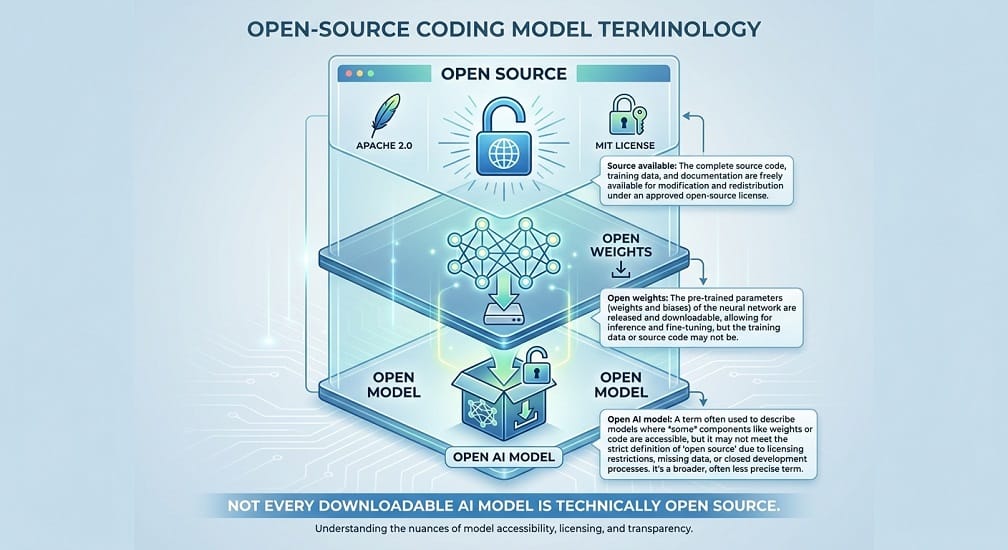
You will encounter terms such as:
- Open source
- Open weights
- Source available
- Open model
- Open AI model
For practical developer purposes, this article focuses primarily on models whose weights are available for developers to download, run, or integrate privately, within an internal developer platform, while noting that license terms differ by model and release.
That distinction matters for commercial use, fine-tuning, redistribution, and enterprise deployment.
Our existing guide on Chinese Open-Source AI Model Licenses covers these differences in more detail.
What Makes a Good Open-Source Coding Model?
A strong coding model should not be judged by code generation alone.
Consider this workflow:
Developer Request
       ↓
Understand Repository
       ↓
Plan Change
       ↓
Write Code
       ↓
Run Tests
       ↓
Read Errors
       ↓
Fix Code
       ↓
Review Changes
The best model is the one that performs reliably across the whole workflow, including DevOps integration.
The Best Open-Source Coding Models in 2026
For this comparison, the most important models to evaluate are:
| Model | Main Strength | Best For |
|---|---|---|
| Qwen3‑Coder | Agentic coding | Coding agents, repositories |
| DeepSeek V4 | Coding + reasoning | Complex coding and long context |
| GLM‑4.7 | Agentic engineering | Coding agents and terminal workflows |
| GLM‑5 | Large‑scale agentic engineering | Complex long‑horizon tasks |
| Smaller Qwen Coder variants | Efficiency | Local development |
| Other open coding models | Specialized workloads | Budget or niche deployments |
This is not a fixed leaderboard.
Model releases change quickly, so performance should always be verified against the exact version you plan to deploy.
1. Qwen3-Coder
Why Qwen3-Coder Is One of the Best Options
Qwen's coding ecosystem is strongly focused on agentic software engineering.
The current Qwen Coder family includes models such as:
- Qwen3-Coder Plus
- Qwen3-Coder Flash
- Qwen3-Coder Next
- Qwen3-Coder 30B-A3B-Instruct
- Qwen3-Coder 480B-A35B-Instruct
Alibaba Cloud describes Qwen3-Coder models as designed for coding and agentic workflows, including repository-level tasks, tool interaction, and environment interaction.
Best For
- AI coding agents
- Large repositories
- Multi-file coding
- Automated debugging
- Software engineering workflows
- Private coding infrastructure
Main Advantage
Agentic coding
Qwen3-Coder is one of the first models I would test when the goal is to build an AI system that can actually modify and test software rather than simply answer coding questions.
2. DeepSeek V4
DeepSeek remains one of the strongest open-model choices for developers.
The current DeepSeek V4 family includes:
- DeepSeek V4-Flash
- DeepSeek V4-Pro
DeepSeek's current API documentation lists:
- 1M-token context
- Tool calls
- JSON output
- Reasoning modes
- FIM completion
for the current V4 API.
DeepSeek also recently launched V4 Pro, with Reuters reporting that its independently measured performance improved substantially over V4 Flash, including stronger coding, tool-use, and scientific reasoning performance. For more technical details on benchmarking, see our Qwen vs DeepSeek API breakdown.
Best For
- Complex reasoning
- Coding
- Large context
- Code completion
- AI agents
- Research-heavy software development
Main Advantage
Strong combination of reasoning + coding + long context
3. GLM-4.7
GLM has become increasingly competitive in coding and agentic engineering.
The official Z.ai repository describes GLM-4.7 as a coding-focused model with stronger multilingual agentic coding and terminal-task performance than earlier GLM releases. It reports gains on SWE-bench and Terminal-Bench 2.0 and highlights compatibility with agent frameworks such as Claude Code, Cline, Kilo Code, and Roo Code.
Best For
- Agentic coding
- Terminal workflows
- Software engineering
- Multilingual development
- Coding agents
Main Advantage
Strong agentic software engineering
GLM-4.7 is particularly interesting if your coding workflow involves terminal interaction and long-running agent sessions.
4. GLM-5
GLM-5 represents a much larger deployment category.
The official GLM repository describes GLM-5 as designed for complex systems engineering and long-horizon agentic tasks. It scales to 744B total parameters with 40B active parameters and is available in BF16 and FP8 variants.
The repository also documents local serving through:
- vLLM
- SGLang
- xLLM
- KTransformers
with multi-GPU infrastructure required for the largest variants.
Best For
- Large-scale coding agents
- Complex systems engineering
- Long-horizon tasks
- Enterprise research
- Multi-GPU infrastructure
Main Disadvantage
Infrastructure cost
This is not the first model I would recommend for a developer running a single workstation.
Qwen vs DeepSeek vs GLM for Coding
The strongest models increasingly overlap in capabilities.
| Capability | Qwen3‑Coder | DeepSeek V4 | GLM‑4.7 / GLM‑5 |
|---|---|---|---|
| Code generation | Excellent | Excellent | Excellent |
| Debugging | Excellent | Excellent | Excellent |
| Repository work | Excellent | Excellent | Excellent |
| Coding agents | Excellent | Excellent | Excellent |
| Tool use | Excellent | Excellent | Excellent |
| Long context | Excellent | Excellent | Excellent |
| Local deployment | Yes | Model‑dependent | Yes |
| Multi‑GPU deployment | Yes | Yes | Yes |
| Best for | Agentic coding | Coding + reasoning | Agentic engineering |
This is why the decision increasingly comes down to workflow and infrastructure, not raw coding ability. You can explore deeper metrics in our DeepSeek vs GLM Comparison and Qwen vs GLM Comparison reports.
Best Model for Coding Agents
If you're specifically building an AI coding agent, prioritize:
- Tool calling
- Repository understanding
- Terminal interaction
- Long-context handling
- Error recovery
- Multi-step planning
- Cost per completed task
My starting shortlist
- Qwen3-Coder
- GLM-4.7
- DeepSeek V4
All three deserve real-world testing.
GLM-4.7's official documentation specifically emphasizes terminal and agentic coding performance, while Qwen3-Coder is positioned around coding-agent workflows and repository-level interaction.
Best Model for Code Completion
Autocomplete is different from agentic coding.
The important metrics are:
- Latency
- Completion acceptance
- FIM quality
- Context awareness
- Token usage
DeepSeek V4 currently supports FIM completion through its API. Qwen also provides dedicated coding-completion capabilities.
For an IDE product, benchmark these models directly inside:
- VS Code
- JetBrains IDEs
- Neovim
- Custom developer environments
Best Model for Large Codebases
For large repositories, prioritize:
- Context size
- Retrieval (RAG)
- File selection
- Repository reasoning
- Tool use
DeepSeek V4 currently supports a 1M-token context.
Qwen3-Coder Plus also supports 1M-token context, while Qwen3-Coder Next provides a smaller context window but focuses heavily on repository-level agentic coding.
GLM's newer models also target long-context engineering workloads.
Winner
There isn't one.
Test repository completion, not advertised context size.
Best Open-Source Coding Model for Local Use
Local use changes the ranking.
A model can be excellent but unusable if it requires a large GPU cluster.
For local developers, consider:
- Qwen3-Coder smaller variants
- Smaller DeepSeek-compatible checkpoints
- GLM Flash models
- Quantized versions
GLM's ecosystem, for example, includes GLM-4.7-Flash, a lighter model designed to balance performance and efficiency.
For local experiments, I would prioritize:
Model quality per GB of memory
rather than benchmark score alone.
Best Model for Enterprise Coding
Enterprise teams need to evaluate:
- Security
- Licensing
- Private deployment
- GPU economics
- Monitoring
- MLOps
- Access control
- API stability
- Developer productivity
There isn't one model that wins every enterprise workload.
A good enterprise shortlist is:
Qwen3-Coder
For coding agents and private software engineering systems.
DeepSeek V4
For coding + reasoning + long-context workloads.
GLM-4.7 / GLM-5
For advanced agentic engineering and complex enterprise workflows.
Best Coding Model by Budget
Small Budget
Start with:
Smaller Qwen Coder or other efficient open models
Use quantization where appropriate.
Medium Budget
Evaluate:
Qwen3-Coder Next / DeepSeek V4-Flash / GLM Flash-class models
Large Budget
Evaluate:
Qwen3-Coder Plus / DeepSeek V4-Pro / GLM-5
At this level, GPU architecture and FinOps management become a major part of the decision.
Best Model by Workflow
| Workflow | First Model to Test |
|---|---|
| IDE autocomplete | DeepSeek V4 / Qwen Coder |
| Code generation | Qwen3‑Coder / DeepSeek V4 |
| Debugging | Qwen3‑Coder / DeepSeek V4 |
| Repository changes | Qwen3‑Coder |
| Coding agents | Qwen3‑Coder / GLM‑4.7 |
| Terminal agents | GLM‑4.7 |
| Long‑context coding | DeepSeek V4 / Qwen3‑Coder Plus |
| Local coding | Smaller Qwen / GLM variants |
| Enterprise private AI | Qwen / DeepSeek / GLM |
| Huge multi‑GPU workloads | GLM‑5 / DeepSeek V4‑Pro / large Qwen |
How to Choose the Right Coding Model
Don't start by asking:
“Which model is #1?”
Start with:
What coding problem am I solving?
Then evaluate:
Use Case
   ↓
Required Context
   ↓
Required Tool Use
   ↓
Quality Target
   ↓
Latency Target
   ↓
GPU / API Budget
   ↓
License Requirements
   ↓
Final Model
This prevents a common problem: adopting an unnecessarily large model for a task that a smaller model could handle.
A Practical Coding Benchmark
Before selecting your production model, create a test set containing:
- 5 code-generation tasks
- 5 debugging tasks
- 5 refactoring tasks
- 5 repository tasks
- 5 coding-agent tasks
Then score:
| Metric | Weight |
|---|---|
| Correctness | 25% |
| Task completion | 20% |
| Repository understanding | 15% |
| Agent reliability | 15% |
| Code quality | 10% |
| Latency | 5% |
| Cost | 5% |
| Tool efficiency | 5% |
This produces a much more useful ranking than relying on a public leaderboard.
HumanEval Is No Longer Enough
HumanEval is still useful for basic function generation, but modern coding agents need much more.
A software-engineering benchmark should answer questions such as:
- Can the model understand an existing repository?
- Can it modify multiple files?
- Can it run tests?
- Can it recover from errors?
- Can it complete a GitHub issue?
That is why SWE-bench and terminal-based evaluations have become much more important.
SWE-bench evaluates language models on real-world GitHub issues, and SWE-bench Verified is a 500-problem subset that was reviewed by software engineers for solvability.
SWE-bench: Repository-Level Coding
SWE-bench is much closer to actual software engineering than isolated function-generation tests.
A typical workflow is:
GitHub Issue
     ↓
Repository Search
     ↓
Understand Existing Code
     ↓
Plan Fix
     ↓
Modify Files
     ↓
Run Tests
     ↓
Analyze Failure
     ↓
Fix Again
This is exactly the type of workflow that modern coding agents are designed to automate.
Qwen3-Coder on Repository Tasks
Qwen3-Coder is designed around repository-level and agentic coding workflows.
The project also maintains its own evaluation material around SWE-bench-style tasks, which reinforces that the intended workload is broader than isolated code completion.
For an enterprise coding assistant, this is important because the actual objective is usually:
resolve the issue, not simply generate code.
Qwen3-Coder should therefore be evaluated with an agent harness rather than only a single-turn coding prompt.
DeepSeek on Repository Tasks
DeepSeek is also a strong candidate for repository-level coding, particularly when reasoning and long context are important.
The current DeepSeek ecosystem is increasingly focused on long-context and tool-driven workloads, which are directly relevant to software engineering agents.
However, the final score depends heavily on the agent framework, tools, and model configuration.
A DeepSeek model with:
Repository search
+
Terminal
+
Tests
+
Iteration
is a fundamentally different system from the same model answering a coding question in chat.
GLM-4.7: Strong Agentic Coding
GLM-4.7 is particularly interesting because its official documentation reports improvements in:
- Multilingual agentic coding
- Terminal-based tasks
- SWE-bench
- SWE-bench Multilingual
- Terminal-Bench 2.0
The GLM-4.7 documentation reports 73.8% on SWE-bench, 66.7% on SWE-bench Multilingual, and 41% on Terminal-Bench 2.0 under its stated evaluation setup.
Those numbers make GLM-4.7 a serious coding-agent candidate rather than merely a general-purpose language model.
GLM-5: Long-Horizon Engineering
GLM-5 moves further toward autonomous software engineering.
The official GLM repository describes GLM-5 as targeting:
- Complex systems engineering
- Long-horizon agentic tasks
- Coding
- Planning
- Tool use
The same repository says GLM-5 improves substantially over GLM-4.7 on its internal coding and long-horizon evaluations.
This matters because some coding problems don't finish after one or two model turns.
They require:
Plan
 ↓
Implement
 ↓
Test
 ↓
Investigate
 ↓
Change Strategy
 ↓
Test Again
 ↓
Finish
Long-horizon behavior is therefore becoming a separate model capability.
Terminal-Bench: Testing the Agent, Not Just the Model
Terminal-Bench evaluates whether an agent can perform tasks through a real terminal environment.
That includes:
- Running commands
- Inspecting files
- Installing dependencies
- Executing programs
- Debugging
- Managing the environment
This is highly relevant to coding agents.
The Terminal-Bench infrastructure records complete execution trajectories and task outcomes, making it possible to evaluate not only the final answer but also how the agent arrived there.
Why Terminal Tasks Matter
Consider these two models:
Model A
Writes excellent code in a chat response.
Model B
Can:
Open terminal
 ↓
Inspect repository
 ↓
Install dependency
 ↓
Run test
 ↓
See error
 ↓
Modify code
 ↓
Run test again
 ↓
Finish
For an autonomous coding system, Model B is often more useful.
That is why Terminal-Bench-style evaluation is becoming increasingly important.
GLM-4.7 on Terminal-Bench
GLM's official GLM-4.7 documentation reports 41% on Terminal-Bench 2.0, a significant improvement over its previous generation under the model's reported evaluation setup.
This reinforces GLM-4.7's positioning as a coding-agent model.
Comparing Terminal-Bench Results
Third-party benchmark aggregations currently show materially different results across agent frameworks and model versions, which is exactly why you should not copy a single leaderboard number into the article and call it a universal ranking.
For example, one current Terminal-Bench analysis lists results for GLM-5, GLM-4.7, DeepSeek, and Qwen models with substantial differences depending on the agent harness.
That means the article should report:
model + agent + benchmark + configuration
rather than simply:
model = score
Coding Performance: Practical Comparison
| Capability | Qwen3‑Coder | DeepSeek V4 | GLM‑4.7 | GLM‑5 |
|---|---|---|---|---|
| Code generation | Excellent | Excellent | Excellent | Excellent |
| Debugging | Excellent | Excellent | Excellent | Excellent |
| Repository tasks | Excellent | Excellent | Excellent | Excellent |
| Agentic coding | Excellent | Excellent | Excellent | Excellent |
| Terminal workflows | Strong | Strong | Excellent | Excellent |
| Long‑horizon work | Strong | Strong | Strong | Excellent |
| Local deployment | Yes | Depends on model | Yes | Yes, large infrastructure |
| Best positioning | Coding agents | Coding + reasoning | Agentic coding | Complex agentic engineering |
This is a capability-oriented comparison, not a universal benchmark ranking.
Code Completion vs Agentic Coding
These should not be mixed together.
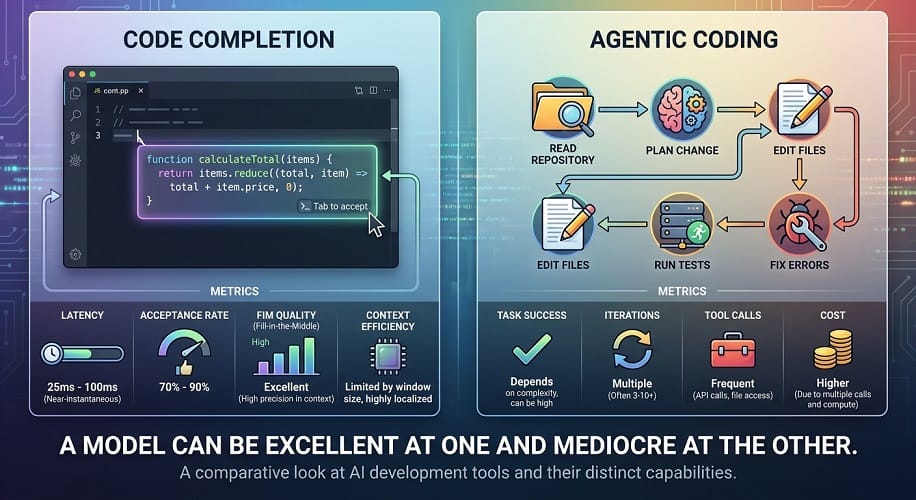
Code completion
The model suggests:
next()or completes a function.
Important metrics:
- Latency
- Acceptance rate
- FIM quality
- Context efficiency
Agentic coding
The model:
Reads repository
 ↓
Plans change
 ↓
Edits files
 ↓
Runs tests
 ↓
Fixes errors
Important metrics:
- Task success
- Number of iterations
- Tool calls
- Cost
- Time to completion
- Regression rate
A model can be excellent at one and mediocre at the other.
Best Open Model for Coding Agents
If your main goal is a coding agent, the strongest shortlist is:
Qwen3-Coder
Particularly attractive for repository-level coding and dedicated coding-agent workflows.
GLM-4.7
Especially attractive for terminal-based and multilingual agentic coding.
GLM-5
Best suited to organizations capable of supporting much larger infrastructure and complex long-horizon workloads.
DeepSeek V4
Strong candidate when coding is combined with reasoning, long context, and tool-based workflows.
Best Model for Local Coding
Local deployment changes the comparison.
A model can rank highly on benchmarks but be impractical on a developer workstation.
For local use, evaluate:
- Parameter count
- Quantization
- VRAM
- Context
- Tokens/sec
- Startup time
This usually makes smaller variants of Qwen, DeepSeek, or GLM more attractive than the largest flagship models.
Best Model for Enterprise Coding
Enterprise teams should look beyond benchmark scores.
Evaluate:
- License
- Security
- Data privacy
- Private deployment
- GPU economics
- Observability
- API reliability
- LLMOps
- Model update strategy
For a private software-engineering platform, Qwen3-Coder, DeepSeek, and GLM all deserve technical evaluation, but the exact model version should be selected only after testing the company's own repositories.
Best Model for Large Codebases
There are two separate requirements:
Context capacity
How much information can the model technically accept?
Retrieval quality
How well does the system identify the information that actually matters?
A 1M-token context window is useful, but feeding a model an entire repository on every request may be:
- Expensive
- Slow
- Noisy
- Inefficient
A better architecture often combines:
Repository
   ↓
Code Index
   ↓
Relevant Files
   ↓
Model Context
   ↓
Coding Agent
This is particularly important for enterprise coding platforms.
Coding Cost: Benchmarks Don't Show the Whole Picture
A model can have an excellent benchmark score while being expensive to operate.
For an agent, calculate:
Total Cost
=
Input Tokens
+
Output Tokens
+
Tool Calls
+
Retries
+
Infrastructure
Then:
Cost per Successful Task
=
Total Cost
÷
Successful Tasks
This is a much stronger metric for business decisions.
Qwen vs DeepSeek vs GLM: Which Model Should You Pick?
Pick Qwen3-Coder when:
You want a dedicated coding-model ecosystem with strong repository and agentic-development positioning.
Pick DeepSeek when:
You want coding combined with strong reasoning and long-context capabilities.
Pick GLM-4.7 when:
Terminal and agentic software engineering are major priorities. Its official evaluation reports strong results on SWE-bench and Terminal-Bench.
Pick GLM-5 when:
You're building complex, long-horizon coding agents and have the GPU infrastructure to support a very large model.
Best Open-Source Coding Model for Individual Developers
For a developer working alone, the best model is usually not the biggest model available.
You want a combination of:
- Good coding quality
- Reasonable latency
- Low infrastructure requirements
- Strong local tooling
- Affordable inference
Best starting choice: Qwen3-Coder
Qwen3-Coder has smaller variants, including Qwen3-Coder Next and Qwen3-Coder 30B-A3B-Instruct, alongside larger models. The official repository lists 256K context for these current open-weight coding models.
This makes Qwen especially attractive for developers who want to experiment locally and still have access to agentic coding capabilities.
Strong alternative: DeepSeek
DeepSeek is particularly attractive when you want coding combined with more general reasoning and a very large context window through its current API ecosystem.
Best for terminal-heavy workflows: GLM
GLM-4.7 is worth testing when your workflow relies heavily on terminal commands and long-running coding-agent sessions. Its published evaluation results include SWE-bench and Terminal-Bench performance.
Best Model for Students
Students usually care about:
- Easy setup
- Low cost
- Clear explanations
- Code generation
- Debugging
- Learning
A smaller Qwen or DeepSeek model is usually a better fit than a huge multi-GPU model.
For learning, the model should be used as a coding tutor and reviewer, not simply as a code generator.
A good workflow is:
Student
  ↓
Attempt Code
  ↓
AI Review
  ↓
Explain Error
  ↓
Student Fixes It
  ↓
AI Verifies
This is much better for learning than asking the model to solve every assignment from scratch.
Best Model for Startups
Startups usually care about:
- Development speed
- API availability
- Cost
- Ease of integration
- Scaling
For an early-stage startup, begin with hosted inference rather than immediately building a GPU cluster.
A sensible progression is:
Hosted API
   ↓
Product Validation
   ↓
Usage Measurement
   ↓
Cost Analysis
   ↓
Private / Dedicated Inference
Strong shortlist
- Qwen3-Coder
- DeepSeek V4
- GLM-4.7
Then benchmark them against your actual application.
Best Model for SaaS Companies
A SaaS company should focus on:
- Cost per user
- Latency
- Availability
- Concurrency
- Model quality
- Scaling
For example, an AI documentation product may not need the same model as an autonomous coding platform.
Use routing where practical:
Simple Task
   ↓
Smaller Model
Coding Task
   ↓
Qwen / DeepSeek
Complex Agent Task
   ↓
High-End Model
This can reduce infrastructure and API costs without forcing every customer request through the most expensive model.
Best Model for Enterprise Software Teams
Enterprise teams have additional requirements:
- Private repositories
- Security
- Governance
- Access controls
- Auditability
- Reliability
- Cost optimization
A strong enterprise shortlist is:
Qwen3-Coder
Especially attractive for coding agents and repository-level engineering.
DeepSeek
Strong candidate for coding combined with reasoning and long-context workloads.
GLM-4.7 / GLM-5
Particularly interesting for advanced agentic software engineering.
GLM-5 is a much larger infrastructure proposition: the official project lists 744B total parameters and 40B active parameters, with BF16 and FP8 variants and local serving through frameworks such as vLLM, SGLang, xLLM, and KTransformers.
That makes GLM-5 more appropriate for organizations able to operate substantial GPU infrastructure.
Best Model for AI Coding Agents
This is where the comparison becomes most competitive.
A coding agent needs:
- Planning
- Repository search
- Tool calls
- Terminal access
- File editing
- Test execution
- Error recovery
- Long-horizon reasoning
Qwen3-Coder
The Qwen3-Coder project explicitly targets agentic coding and provides tool-calling support for vLLM and SGLang. Its current model list includes 256K-context coding models.
DeepSeek
DeepSeek is a strong candidate for coding agents when long context, reasoning, and tool use matter.
GLM-4.7
GLM-4.7 is especially interesting for terminal and agentic workflows. Its current published evaluation includes 73.8% SWE-bench, 66.7% SWE-bench Multilingual, and 41% Terminal-Bench 2.0, under the stated evaluation setup.
GLM-5
GLM-5 moves into a much larger category, focusing on complex systems engineering and long-horizon agentic tasks.
Verdict
For a coding-agent platform, I'd start a benchmark with:
Qwen3-Coder + DeepSeek + GLM-4.7
and evaluate GLM-5 when the infrastructure budget and task complexity justify its scale.
Best Model for Large Repositories
There are three separate questions:
- Can the model accept the repository?
- Can it retrieve the right files?
- Can it make the correct changes?
A large context window only answers the first question.
Current Qwen3-Coder models list 256K context, with Qwen's coding ecosystem also offering larger managed-context options.
GLM-5's current vLLM recipe documents a context length of about 202,752 tokens for the open model recipe.
DeepSeek's current API ecosystem offers very large context options.
But in practice, a good repository architecture should combine the model with:
- Code indexing
- Semantic search
- Symbol search
- File retrieval
- Dependency analysis
- Git history
That can make a moderately sized context much more useful.
Best Model for Local Development
Local deployment introduces a hard constraint:
memory.
For local use, a smaller model that runs comfortably can be more useful than a much stronger model that takes several minutes per response.
Good local-first candidates
- Qwen3-Coder Next
- Qwen3-Coder 30B-A3B-Instruct
- Smaller DeepSeek-compatible models
- Smaller GLM variants
Qwen's current repository also lists GGUF and FP8 versions for some Qwen3-Coder releases, which makes the ecosystem more flexible for different local inference setups.
Best Model for Self-Hosting
For self-hosting, evaluate:
- Model size
- Quantization
- VRAM
- Context
- Throughput
- Runtime compatibility
- License
- Cost
Qwen, DeepSeek, and GLM all have viable private-deployment paths, but the infrastructure scale can be dramatically different between their smaller and flagship models.
GLM-5 is a good example: its official documentation shows eight-GPU vLLM serving for its large FP8 variant.
Best Model for AWS
For AWS-based private AI, the model should be selected together with the hardware.
A practical architecture is:
Developer Tools
      ↓
AI Gateway
      ↓
Model Router
      ↓
Qwen / DeepSeek / GLM
      ↓
vLLM / SGLang
      ↓
Amazon EKS
      ↓
GPU Nodes
For smaller models, lower-cost GPU infrastructure may make sense.
For large models, high-memory multi-GPU systems become necessary.
This is why the best model on paper can be the wrong choice economically.
Best Model for Enterprise Coding Agents
For an enterprise coding-agent deployment, use this decision framework:
| Requirement | Strong Starting Candidate |
|---|---|
| Repository coding | Qwen3‑Coder |
| Tool‑driven coding | Qwen3‑Coder |
| FIM / completion | DeepSeek |
| Coding + reasoning | DeepSeek |
| Terminal‑heavy agent | GLM‑4.7 |
| Long‑horizon engineering | GLM‑5 |
| Local development | Smaller Qwen / DeepSeek / GLM |
| Multi‑GPU production | Large Qwen / DeepSeek / GLM |
| Cost‑sensitive deployment | Benchmark smaller variants |
This isn't a permanent leaderboard. The exact winner should be re-evaluated as models are updated.
How to Evaluate the Best Model for Your Business
Don't copy a benchmark table and deploy the top-ranked model.
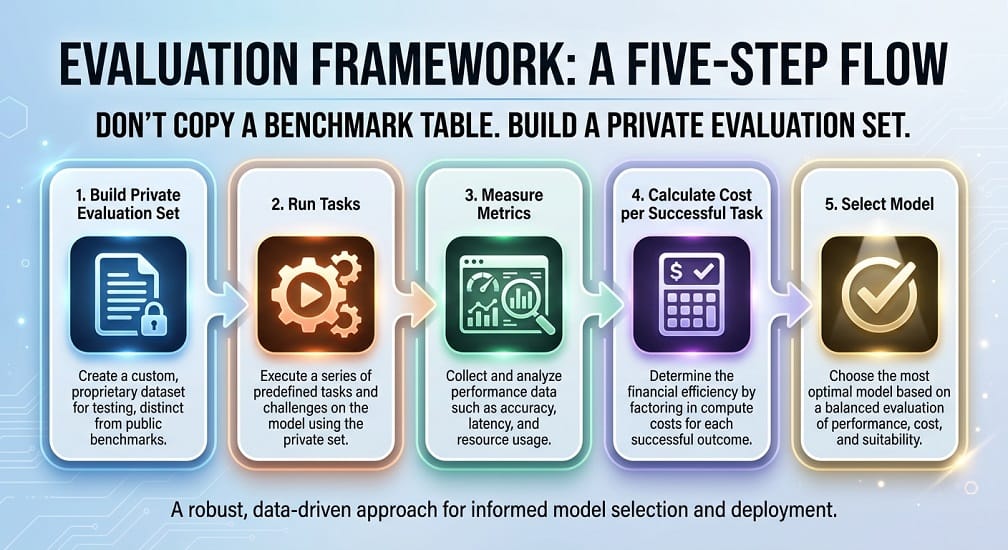
Build a private evaluation set.
Coding tasks
Use:
- Feature requests
- Bug reports
- Refactoring tasks
- Test generation
- Code review
- SQL
- DevOps
- Infrastructure as a code
Agent tasks
Use:
- Repository navigation
- Terminal tasks
- Multi-file edits
- Test-and-fix loops
- Dependency updates
Production metrics
Measure:
- Task success
- Code correctness
- Latency
- Retry rate
- Tool calls
- Tokens
- Cost
- Human review time
Then calculate:
Cost per Successful Task
=
Total AI Cost
÷
Successfully Completed Tasks
This becomes your real model score.
A Strong 2026 Coding Model Stack
For many organizations, there is no reason to use one model for everything.
A practical architecture might be:
                   AI Coding Platform
                           │
                       Router
                           │
            ┌──────────────┼───────────────┐
            ↓              ↓               ↓
       Autocomplete    Coding Agent     Code Review
            ↓              ↓               ↓
       Fast Model      Qwen / GLM       DeepSeek
                           │
                           ↓
                     Large Agent
                           ↓
                    DeepSeek / GLM-5
This can optimize:
- Speed
- Cost
- Quality
- Reliability
Common Mistakes When Choosing an Open Coding Model
Choosing the largest model
Bigger isn't automatically better for your workload.
Comparing old and new generations
A 2025 coding model should not be treated as equivalent to a current 2026 flagship.
Comparing API models with local models without noting the setup
The hosted version may use different infrastructure, context, quantization, or system prompts.
Ignoring the agent harness
A model's coding-agent score depends heavily on:
- Tools
- Prompts
- Repository retrieval
- Terminal environment
- Test feedback
Ignoring licensing
“Open weights” does not mean every use case has identical legal terms.
Final Ranking by Use Case
| Use Case | Recommended First Choice |
|---|---|
| Coding agents | Qwen3‑Coder |
| Repository engineering | Qwen3‑Coder |
| Terminal agents | GLM‑4.7 |
| Complex long‑horizon agents | GLM‑5 |
| Coding + reasoning | DeepSeek |
| FIM completion | DeepSeek |
| Local coding | Qwen3‑Coder Next / smaller variants |
| Enterprise private coding | Benchmark Qwen + DeepSeek + GLM |
| Large‑scale infrastructure | Choose based on TCO |
Final Verdict
There is no single best open-source AI coding model in 2026.
The strongest choices are increasingly specialized.
Qwen3-Coder
Best starting point for agentic coding and repository-level software engineering. Its current open-weight family includes 256K-context models and explicit tool-calling support for modern inference runtimes.
DeepSeek
Best candidate when you want coding combined with reasoning, long context, and flexible API workflows.
GLM-4.7
A strong choice for terminal-based and agentic coding, with published SWE-bench and Terminal-Bench results showing significant coding improvements.
GLM-5
A candidate for large-scale, long-horizon agentic engineering, but it comes with a much larger infrastructure footprint. The official project lists 744B total parameters and 40B active parameters.
For most teams, my practical recommendation is:
Start by benchmarking Qwen3-Coder, DeepSeek, and GLM-4.7 on your own repositories. Add GLM-5 only when the workload justifies its infrastructure requirements.
The best model isn't the one with the most impressive leaderboard.
It's the one that gives your developers the highest successful-task rate at an acceptable cost and latency.
How EaseCloud Can Help
Once an organization moves beyond experimenting with coding models, the hard problem becomes infrastructure.
A production platform may need:
- Model evaluation
- GPU planning
- AWS deployment
- Amazon EKS
- Kubernetes
- vLLM
- SGLang
- AI gateways
- Model routing
- LLMOps
- Observability
- Cost optimization
At EaseCloud, this is where the model-selection work connects with the infrastructure work.
The goal is to help engineering teams move from:
Model Experiment
      ↓
Benchmark
      ↓
Production Selection
      ↓
Private Inference
      ↓
AWS / EKS
      ↓
LLMOps
without overbuilding the infrastructure too early.
Frequently Asked Questions
What is the best open-source AI model for coding?
For agentic coding, Qwen3-Coder is one of the strongest starting choices. DeepSeek and GLM-4.7 should also be benchmarked because they are strong in coding, reasoning, and agentic workflows.
Is Qwen better than DeepSeek for coding?
For coding-agent and repository workflows, Qwen3-Coder is a particularly strong candidate. DeepSeek can be preferable when coding is combined with reasoning, long-context processing, and API-based workflows.
Is DeepSeek better than Qwen for coding?
Not universally. Compare the exact Qwen Coder and DeepSeek models against your repository and coding tasks.
Which open-source model is best for AI coding agents?
Start with Qwen3-Coder, DeepSeek, and GLM-4.7. GLM-5 is particularly relevant for complex long-horizon engineering but requires substantially larger infrastructure.
Which model is best for local coding?
Smaller Qwen3-Coder variants are a strong starting point because the current family includes smaller open-weight models and GGUF/FP8 options.
Which open-source coding model is best for enterprise use?
There is no universal answer. Evaluate Qwen, DeepSeek, and GLM based on security, licensing, repository performance, infrastructure cost, and developer productivity.
Summarize this post with: