Private LLM vs API: Which Is Better for Enterprise AI?
Compare private LLMs vs APIs for cost, security, privacy, latency, scalability and control. Learn when enterprises should self-host or use an API.

TL;DR
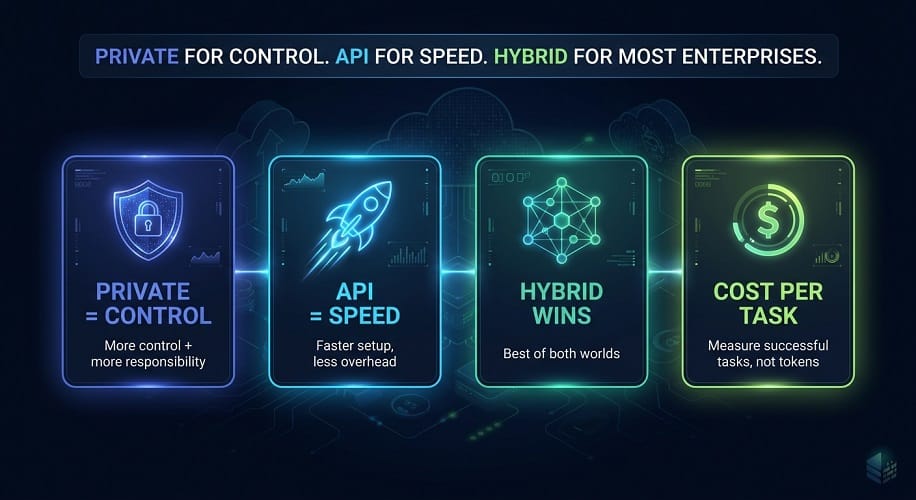
- Private = more control + more responsibility. You manage GPUs, security, scaling, and operations. API = faster setup, less overhead, but less control over data and infrastructure.
- Three factors decide: data sensitivity, workload volume, and infrastructure capacity. Neither is universally better.
- Private wins for: sensitive data (source code, financials), predictable high-volume usage, custom inference, and network isolation.
- API wins for: unpredictable traffic, rapid development, small teams, early-stage products, and avoiding GPU management.
- Cost isn't token price vs GPU bill – private includes GPU + storage + networking + engineering. The real metric: cost per successful task. Private becomes cheaper at high, predictable utilization (70%+ GPU). Idle GPUs make it expensive.
- Hybrid is often best – private for sensitive/high-volume workloads, APIs for experimentation and variable traffic. Start with APIs, measure usage, then selectively move workloads that justify private inference.
For most businesses, the choice between a private LLM and a managed API depends on three things:
data sensitivity, workload volume, and infrastructure requirements.
A managed API is usually easier to launch and maintain.
A private LLM gives you more control over data, infrastructure, model configuration, and deployment.
Neither option is automatically better.
The right choice depends on the workload.
| Factor | Private LLM | Managed API |
|---|---|---|
| Initial setup | More complex | Very easy |
| Time to launch | Longer | Shorter |
| Data control | High | Provider‑dependent |
| GPU management | Required | Not required |
| Infrastructure control | High | Lower |
| Customization | High | Limited |
| Scaling | Your responsibility | Provider‑managed |
| Initial cost | Higher | Low |
| Variable traffic | Can be inefficient | Usually attractive |
| Predictable high usage | Can become attractive | May become expensive |
| Maintenance | Your team | Provider |
| Vendor lock‑in | Lower | Higher |
| Privacy control | High | Depends on provider |
The important point is that private inference is not simply a cheaper version of an API.
It is a different operating model.
What Is a Private LLM?
A private LLM is a model that runs inside infrastructure controlled by your organization or by a trusted private hosting environment.
That infrastructure could be:
- A local workstation
- A dedicated GPU server
- A private cloud environment
- Amazon EC2
- Amazon EKS
- Kubernetes
- An enterprise data center
Common open-weight models that can be evaluated for private deployment include:
- Qwen
- DeepSeek
- GLM
- Llama
- Mistral
- Gemma
The exact model license and deployment rights must be checked before production use.
What Is a Managed LLM API?
A managed API lets your application send requests to a model provider without operating the underlying model infrastructure yourself.
Your application handles:
- API authentication
- Request construction
- Response handling
- Application logic
The provider handles most of the model-serving infrastructure.
This is attractive because your team doesn't need to manage:
- GPUs
- CUDA environments
- Model loading
- Inference servers
- Capacity planning
- GPU scaling
For an early product, this simplicity can be extremely valuable.
Private LLM vs API: The Real Difference
The biggest difference is who controls the inference infrastructure.
With an API, the provider controls most of the serving layer.
With a private deployment, your organization controls that layer.
That affects:
- Cost
- Security
- Deployment speed
- Customization
- Scaling
- Reliability
- Operations
This is why the decision should be made at the architecture level rather than based only on model quality.
When a Managed API Is Better
A managed API is usually the better starting point when:
Your traffic is unpredictable
You may have 100 requests today and 100,000 next month.
Buying GPUs for an uncertain workload can create unnecessary costs.
You need to launch quickly
A team can integrate an API without becoming an AI infrastructure team.
Your team is small
Managing GPU servers, inference engines, monitoring, and scaling can require significant engineering effort.
You are still validating the product
It is often better to prove that customers want the product before investing in private inference.
You need access to multiple providers
A managed API can make it easier to test several models before committing to one infrastructure stack.
When a Private LLM Is Better
Private inference becomes more attractive when:
Your data is highly sensitive
Examples include:
- Proprietary source code
- Internal financial information
- Customer records
- Confidential research
- Internal security data
Your usage is large and predictable
If GPUs can remain highly utilized, private inference can become economically attractive.
You need infrastructure control
You may need to control:
- Model version
- Network
- Logging
- Memory
- Inference parameters
- Deployment location
You need custom inference
Private deployment gives you more flexibility around:
- Quantization
- Batching
- GPU configuration
- Context settings
- Serving frameworks
You need network isolation
Some enterprises want inference to happen entirely inside a private network.
When a Hybrid Model Makes Sense
Many enterprises should not choose only one option.
A hybrid architecture can use private models for sensitive or high-volume workloads and managed APIs for other workloads.
For example:
| Workload | Possible Choice |
|---|---|
| Internal source code | Private LLM |
| Customer support | Managed API |
| High‑volume classification | Private model |
| Complex research | Managed frontier model |
| Sensitive RAG | Private LLM |
| Development experimentation | API |
This can reduce infrastructure costs without giving up flexibility.
Private LLM vs API for Data Privacy
Privacy is one of the strongest reasons organizations consider private inference.
But private deployment does not automatically mean perfect privacy.
You still need to control:
- Network access
- Logs
- Authentication
- Storage
- Backups
- Developer access
- Monitoring
- Model endpoints
A private LLM should therefore be part of a broader security architecture.
For example, an enterprise may keep GPU inference inside a private VPC and restrict model access to authenticated internal applications.
Data Residency
Data residency can also influence the decision.
Businesses may need to know:
- Where inference occurs
- Where prompts are processed
- Where logs are stored
- Where model artifacts are stored
- Whether data crosses regions
A private deployment can make this easier to control, but the final architecture still needs to be reviewed carefully.
Private LLM vs API for Security
A managed API can provide strong security controls, but you are still using an external service.
With private inference, your organization controls more of the environment.
That gives you additional responsibility.
You must manage:
- GPU servers
- Operating systems
- Containers
- Network security
- Model-serving software
- Secrets
- Certificates
- Monitoring
So private deployment usually means:
more control + more responsibility
Private LLM vs API for Customization
Private inference wins when customization matters.
You can control:
- Model weights
- Quantization
- Context limits
- Batch size
- GPU placement
- Inference engine
- Serving configuration
You can also test different runtimes such as:
- vLLM
- SGLang
- TensorRT-LLM
- llama.cpp
This can be important when optimizing a Qwen, DeepSeek, or GLM deployment for a specific workload.
Private LLM vs API for Scaling
Managed APIs make scaling easy from the customer's perspective.
You request more capacity and the provider handles the infrastructure.
Private inference requires your organization to handle scaling.
This can include:
- Additional GPU nodes
- Autoscaling
- Kubernetes
- Load balancing
- Capacity planning
- Model replication
For large enterprise systems, Amazon EKS or another Kubernetes platform can be useful for managing multiple inference workloads.
Private LLM vs API for Latency
Latency depends on the entire request path.
A hosted API may introduce:
- Network latency
- Provider queueing
- Cross-region traffic
A private model can provide a shorter network path when the application and model are in the same environment.
However, private inference can also be slower if the GPU is underpowered or overloaded.
So the correct comparison is:
end-to-end latency
not simply API latency versus GPU inference speed.
Private LLM vs API for Reliability
Managed APIs can provide high availability without requiring your team to design the underlying infrastructure.
Private infrastructure requires you to plan for:
- GPU failure
- Node failure
- Model crashes
- Deployment issues
- Capacity exhaustion
- Regional failures
For enterprise workloads, reliability becomes an architectural responsibility.
Private LLM vs API for Vendor Lock-In
APIs can create vendor dependency through:
- Provider-specific APIs
- Prompt formats
- Tool schemas
- Model-specific behavior
- Hosted-only features
Private open-weight models can reduce this dependence.
However, self-hosting creates a different dependency:
- Inference framework
- GPU vendor
- Cloud provider
- Kubernetes platform
So private deployment reduces some types of lock-in rather than eliminating lock-in completely.
The Most Important Question
Before choosing between a private LLM and an API, calculate:
How predictable is your workload?
For example:
1,000 requests per month
and:
100 million requests per month
are completely different infrastructure problems.
At low or unpredictable usage, APIs are often simpler.
At high and predictable usage, private inference may become more attractive.
Private LLM vs API: Preliminary Recommendation
Use a managed API when:
You need speed, flexibility, low operational overhead, or you're still validating the product.
Use private inference when:
You need stronger infrastructure control, sensitive-data isolation, predictable high-volume usage, or custom serving.
Use both when:
Different applications have different security, cost, or performance requirements.
The next section should examine the part most businesses care about after the architecture decision:
private LLM vs API cost, including GPU economics, utilization, Qwen and DeepSeek deployment costs, self-hosting break-even factors, and when the additional infrastructure actually pays off.
Private LLM vs API: Which Is Cheaper?
There is no fixed break-even point where private inference suddenly becomes cheaper than an API.
The answer depends on:
- Monthly token volume
- Model size
- GPU utilization
- API pricing
- Required context
- Concurrency
- Engineering cost
- Availability requirements
- Monitoring and platform costs
The correct comparison is:
Total API cost
versus
Total private-inference cost
for the same workload.
Managed API Cost
For an API-based deployment, the main costs generally come from:
- Input tokens
- Output tokens
- Cached input
- Additional model calls
- Tool calls
- Retries
For agentic applications, one user request can generate many model calls.
A request that looks inexpensive at the application level can become expensive when the agent performs several iterations.
Private LLM Cost
Private inference has a different cost structure.
| Cost | Private Deployment |
|---|---|
| GPU | Major cost |
| Storage | Model weights and caches |
| Networking | Internal and external traffic |
| Inference | vLLM, SGLang or another runtime |
| Kubernetes | Optional but common at scale |
| Monitoring | Metrics, logs and tracing |
| Engineering | Deployment and maintenance |
| Scaling | Additional GPU capacity |
| Availability | Redundant infrastructure |
This means private deployment has higher operational overhead, especially at low utilization.
The Biggest Private-LLM Cost: Idle GPUs
Suppose a GPU costs money continuously but your application only needs it for a few hours each day.
You are paying for the remaining capacity without producing useful inference.
This makes utilization one of the most important variables in the API-versus-private decision.
A private model becomes more attractive when:
traffic is high + traffic is predictable + GPUs remain well utilized
Example Break-Even Calculation
Imagine a private deployment costs:
$8,000 per month
for GPU and supporting infrastructure.
Your hosted API costs:
$0.80 per completed task
At:
5,000 tasks per month
the API costs about:
$4,000
Private inference is more expensive.
At:
15,000 tasks per month
the API costs about:
$12,000
Now private inference becomes potentially more attractive.
This is only an illustration.
Real calculations must include all infrastructure and operational costs.
Engineering Cost Changes the Calculation
A common mistake is comparing:
API bill
against:
GPU bill
and ignoring engineering.
Private inference may require:
- DevOps
- ML infrastructure
- Kubernetes
- Security
- Monitoring
- Model upgrades
- Troubleshooting
- Capacity planning
That labor has a financial value.
A better model is:
Private LLM TCO = GPU + platform + engineering + operations + networking + storage
Qwen API vs Private Qwen
Qwen can be accessed through managed APIs, while open-weight Qwen models can also be deployed privately.
The API route is attractive when:
- Traffic is unpredictable
- You want rapid integration
- You need the latest managed model
- GPU operations aren't part of your core team
Private Qwen becomes more attractive when:
- Source code is sensitive
- Usage is high
- You need custom inference
- You want internal network control
- You need predictable performance
The decision should be based on the specific Qwen model rather than the entire Qwen family.
DeepSeek API vs Private DeepSeek
The same principle applies to DeepSeek.
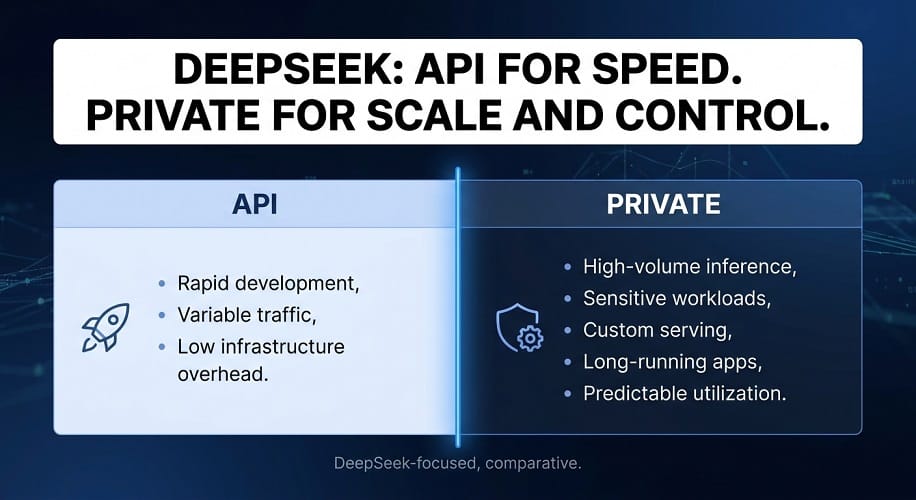
A managed DeepSeek API is attractive for:
- Rapid development
- Variable traffic
- Low infrastructure overhead
Private DeepSeek can become attractive for:
- High-volume inference
- Sensitive workloads
- Custom serving
- Long-running internal applications
- Predictable GPU utilization
For larger DeepSeek models, infrastructure planning becomes especially important because memory and multi-GPU requirements can become substantial.
GLM API vs Private GLM
GLM is another example where model size can dramatically affect the economics.
A smaller GLM model may be practical on one server.
A large flagship model may require a multi-GPU architecture.
That means the economic question isn't:
“Is private GLM cheaper?”
It is:
“Is this exact GLM model cheaper to operate privately at our expected utilization?”
Self-Hosted LLM Break-Even Factors
Before moving from an API to private inference, calculate these numbers:
Monthly request volume
How many requests are actually being generated?
Average input tokens
How much context does each request contain?
Average output tokens
How long are the responses?
Peak concurrency
How many requests need to run simultaneously?
GPU utilization
How much of the available GPU capacity will be used?
Required availability
Do you need one server or redundant infrastructure?
Engineering cost
How much time will the team spend operating the system?
These variables determine whether self-hosting is economically sensible.
High-Volume Predictable Workloads
Private inference becomes particularly interesting when:
- Requests are frequent
- Traffic patterns are predictable
- GPU utilization is high
- The model is stable
- The company can operate the infrastructure
Examples include:
- Internal coding assistants
- Enterprise RAG
- Document processing
- High-volume classification
- Customer-support automation
- Batch inference
Low-Volume Unpredictable Workloads
Managed APIs generally become more attractive when:
- Traffic is low
- Traffic changes sharply
- The model is used occasionally
- The company wants minimal infrastructure
Examples include:
- Early-stage SaaS
- Internal prototypes
- Development experiments
- Small business applications
Hybrid Deployment Can Improve Economics
A business doesn't have to choose one deployment model for every workload.
For example:
| Workload | Deployment |
|---|---|
| Internal source code | Private |
| High‑volume classification | Private |
| Experimental feature | API |
| Complex external research | API |
| Sensitive RAG | Private |
| Customer‑facing low‑volume workload | API |
This can provide a better balance between cost and flexibility.
Private LLM Cost Optimization
Once the model is self-hosted, optimization does not stop.
You can reduce cost through:
- Quantization
- Smaller models
- Better GPU selection
- Prefix caching
- Continuous batching
- Context reduction
- Better retrieval
- Model routing
- Autoscaling
These techniques can change the economics significantly.
Quantization and Cost
Quantization can allow the same model to use fewer or smaller GPUs.
For example:
| Configuration | Relative Memory |
|---|---|
| FP16 | High |
| BF16 | High |
| FP8 | Lower |
| INT8 | Lower |
| INT4 | Much lower |
A lower-memory configuration can improve economics, but quality needs to remain acceptable.
For production, benchmark the quantized model against the full-precision baseline.
vLLM and Private LLM Economics
The serving layer can have a major impact on infrastructure efficiency.
vLLM provides production capabilities around:
- Batching
- KV-cache management
- Prefix caching
- Metrics
- Routing
- Scaling
Better serving efficiency means the same GPU fleet can potentially handle more useful work.
That can reduce the effective cost per request without changing the model.
Context Optimization
A model does not need to process every piece of available information.
For RAG, remove irrelevant documents.
For coding assistants, retrieve only relevant repository files.
For agents, trim unnecessary conversation history.
Reducing context can lower:
- Input processing
- Memory usage
- Latency
- Cost
Cost Per Successful Task
This is one of the most useful metrics for comparing private inference and APIs.
Suppose:
Private Qwen
Monthly operating cost:
$10,000
Successful tasks:
100,000
Cost per task:
$0.10
DeepSeek API
Monthly API cost:
$7,500
Successful tasks:
60,000
Cost per task:
$0.125
The API has the smaller total bill, but the private system produces the lower cost per successful task.
This is why business value matters more than the infrastructure invoice alone.
Security vs Cost
Businesses sometimes assume private inference is always more secure.
The reality is more nuanced.
Private infrastructure gives greater control, but your organization is responsible for securing it.
That includes:
- Network security
- Authentication
- Authorization
- Secrets
- Logging
- Patch management
- Storage
- Backups
A poorly secured private LLM can be worse than a well-managed enterprise API.
The correct comparison is:
provider security controls + contractual protections
versus
your own security architecture and operational maturity
Performance Comparison
Private inference can reduce latency when the model is deployed close to the application.
For example:
Application and model in the same AWS region
can avoid some network distance associated with an external API.
But performance still depends on:
- GPU
- Model size
- Quantization
- Batch
- Context
- Queueing
A well-configured API can outperform an under-sized private GPU server.
Vendor Lock-In
Managed APIs can create dependency through:
- Provider-specific endpoints
- Model-specific prompts
- Tool formats
- Hosted-only features
Private deployment reduces some of this dependency but creates other infrastructure dependencies.
You may become dependent on:
- GPU ecosystem
- Kubernetes
- Cloud provider
- Inference engine
A model abstraction layer can reduce application-level lock-in.
The Best Architecture for Most Enterprises
Many organizations will benefit from a hybrid strategy.
Use APIs when:
- Speed matters
- Volume is unpredictable
- A managed model has a major capability advantage
Use private inference when:
- Data is sensitive
- Usage is predictable
- Infrastructure control matters
- GPU economics are favorable
This gives the business flexibility instead of forcing every workload into one architecture.
Private LLM vs API for Enterprise Security
Security is often the strongest reason an enterprise considers private inference.
But the decision should not be reduced to:
Private = secure
and:
API = insecure
Both approaches can be secure when properly designed.
The real difference is the amount of infrastructure and data-flow control your organization has.
With a private LLM, you control more of:
- Network location
- GPU infrastructure
- Model access
- Storage
- Logs
- Authentication
- Deployment configuration
With a managed API, much of the serving infrastructure is controlled by the provider.
That can reduce operational responsibility, but it also means you must evaluate the provider's security, privacy, contractual, and regional controls.
Data Residency
For enterprises operating across countries or regions, establish where data is processed.
Questions to answer include:
- Where is the model hosted?
- Where are requests processed?
- Where are logs stored?
- Where are backups stored?
- Can traffic cross regional boundaries?
- Can the organization choose a specific region?
Private deployment can make regional placement easier to control, but the entire supporting architecture must also remain within the required boundary.
Network Isolation
A private LLM should generally remain behind controlled network boundaries.
For AWS, this can include:
- Amazon VPC
- Private subnets
- Security groups
- IAM
- Private load balancing
- Network policies
- Controlled egress
The inference endpoint should not be exposed directly to the public internet simply because the model itself is private.
Authentication and Authorization
Every private inference deployment should define:
- Who can call the model
- Which applications can access it
- Which models each team can use
- Which data sources can be accessed
- What usage limits apply
For larger environments, an AI gateway can centralize these controls.
Logging and Auditability
Enterprise AI systems should maintain appropriate audit information.
Depending on the workload, record:
- Application identity
- Model used
- Model version
- Request metadata
- Token usage
- Latency
- Errors
- Administrative changes
Be careful about storing the full content of sensitive prompts and responses unless there is a clear business and compliance reason to do so.
Private LLM vs API for Compliance
Compliance requirements vary by:
- Industry
- Country
- Data type
- Contract
- Internal policy
A private deployment can make certain controls easier to implement, but it does not automatically satisfy regulatory requirements.
The organization still needs:
- Access controls
- Retention policies
- Encryption
- Audit processes
- Incident response
- Governance
The compliance question should therefore be:
Which architecture allows us to implement and demonstrate the required controls?
AWS vs On-Premises Private LLM
Private inference does not necessarily mean a company-owned data center.
There are two common approaches.
On-premises
Advantages:
- Maximum physical infrastructure control
- Existing hardware can be reused
- Useful for strict internal environments
Challenges:
- GPU procurement
- Capacity planning
- Hardware maintenance
- Power and cooling
- Faster hardware refresh requirements
Private cloud
Advantages:
- Flexible capacity
- Faster access to modern GPUs
- Easier scaling
- Managed networking components
- Easier geographic deployment
Challenges:
- Ongoing cloud costs
- GPU availability
- Cloud architecture complexity
AWS can therefore be a useful middle ground between public APIs and traditional on-premises infrastructure.
EC2 vs EKS for Private LLMs
Use EC2 when the deployment is relatively simple.
Examples:
- One model
- Small internal team
- Predictable traffic
- Limited infrastructure complexity
Use Amazon EKS when you need:
- Multiple models
- Multiple teams
- GPU scheduling
- Autoscaling
- Model routing
- Independent model deployments
- Shared AI infrastructure
Kubernetes adds operational complexity, so it should be introduced because the organization needs those capabilities rather than simply because the workload uses GPUs.
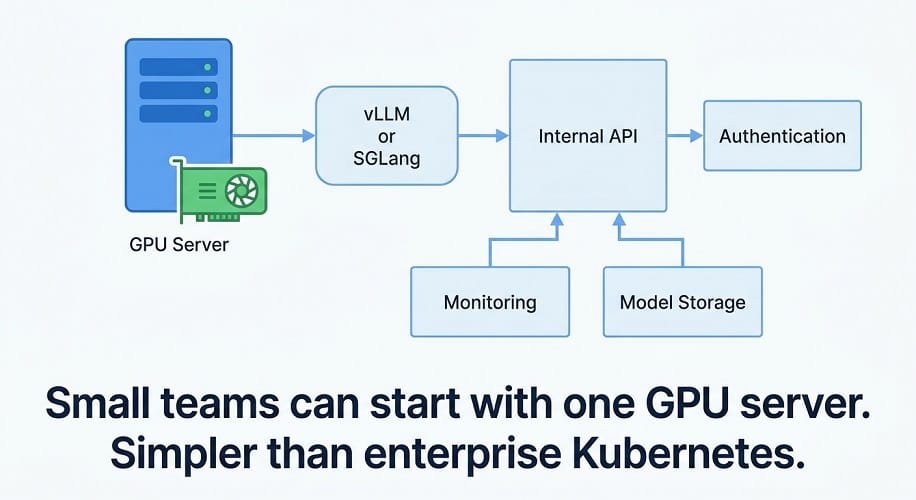
Private LLM Architecture for a Small Team
A small internal deployment may only need:
- One GPU server
- vLLM or SGLang
- Internal API
- Authentication
- Monitoring
- Model storage
This can be far simpler than a full enterprise Kubernetes platform.
Private LLM Architecture for an Enterprise
A larger organization may need:
- AI gateway
- Model router
- Amazon EKS
- Multiple GPU pools
- vLLM or SGLang
- Model registry
- Observability
- Autoscaling
- Access control
- Cost allocation
The architecture should grow with the workload.
When Should You Switch From API to Private LLM?
There are several strong signals.
Consider switching when API spend becomes material
If monthly API costs are consistently high, calculate whether private inference can deliver lower total cost at your actual utilization.
Consider switching when traffic becomes predictable
Predictability makes GPU planning much easier.
Consider switching when data sensitivity increases
If proprietary or regulated data requires more control, private deployment becomes more attractive.
Consider switching when latency requirements tighten
Running the model closer to the application can reduce network-related latency.
Consider switching when custom inference matters
Private infrastructure allows more control over:
- Quantization
- Context
- Batching
- Model serving
- GPU topology
When You Should Stay With an API
Don't migrate simply because self-hosting sounds more advanced.
Stay with a managed API when:
- Traffic is low
- Usage is unpredictable
- The product is still changing
- Infrastructure isn't a core competency
- GPU utilization would remain low
- The engineering cost isn't justified
A managed API can be the more efficient business decision.
When Hybrid Is the Best Answer
A hybrid approach can separate workloads by:
- Sensitivity
- Cost
- Latency
- Model capability
- Volume
For example:
| Workload | Recommended Approach |
|---|---|
| Internal confidential RAG | Private |
| High‑volume classification | Private |
| Development experiments | API |
| Low‑volume customer feature | API |
| Specialized reasoning | API or private |
| High‑volume coding assistant | Private |
| Disaster‑recovery fallback | API |
This gives the company more flexibility.
Enterprise LLM Governance
Once multiple models are deployed, establish a model inventory.
Record:
- Model
- Version
- License
- Owner
- Deployment location
- Environment
- Data classification
- Evaluation status
- Retirement date
This becomes especially important when an organization operates Qwen, DeepSeek, GLM, Llama, Mistral, or other models simultaneously.
Model Version Management
Never treat model upgrades as simple package updates.
A new model can change:
- Output quality
- Tool behavior
- Prompt behavior
- Token usage
- Latency
- Memory requirements
- Costs
Before production rollout, evaluate the new model against a fixed test set.
Private LLM Disaster Recovery
Private inference creates availability responsibilities.
Prepare for:
- GPU failure
- Node failure
- Model corruption
- Deployment failure
- Region failure
- Capacity shortages
Store reproducible:
- Infrastructure configuration
- Model metadata
- Container versions
- Kubernetes manifests
- Secrets references
- Evaluation results
The model weights may be large, but the deployment itself should remain reproducible.
Common Private LLM Mistakes
Buying too many GPUs
Start with measured workload requirements.
Choosing the largest model
A smaller model may provide much better economics.
Ignoring utilization
Low GPU utilization can eliminate the financial advantage of self-hosting.
Exposing the inference endpoint
Keep model-serving infrastructure behind proper authentication and network controls.
Building Kubernetes too early
A single EC2 GPU server may be enough for the first production stage.
Ignoring model licenses
Private hosting does not remove license obligations.
Forgetting operational costs
Engineering and maintenance belong in the TCO calculation.
Private LLM vs API Decision Table
| Situation | Recommended Direction |
|---|---|
| New product | API |
| Small internal project | API |
| Unpredictable usage | API |
| Sensitive source code | Private |
| High predictable volume | Private |
| Strict network isolation | Private |
| Need custom inference | Private |
| Multiple model providers | Hybrid |
| Large enterprise platform | Hybrid or private |
| Uncertain economics | Start with API, benchmark before migrating |
Final Decision Framework
Before making the decision, answer these questions:
1. How much do we use the model?
Measure actual monthly usage.
2. How predictable is that usage?
Stable workloads are much easier to self-host.
3. How sensitive is the data?
This determines how much control you may need.
4. What latency is required?
Measure real end-to-end latency.
5. How much engineering capacity do we have?
Self-hosting requires operational ownership.
6. Which exact model are we deploying?
Qwen, DeepSeek, and GLM each contain models with very different hardware requirements.
7. What is the full TCO?
Include:
- GPU
- Storage
- Networking
- Platform
- Monitoring
- Engineering
- Maintenance
8. What is the cost per successful task?
This should be one of the final decision metrics.
EaseCloud Recommendation
At EaseCloud, the API-versus-private decision should begin with a workload assessment rather than an infrastructure purchase.
For organizations that move toward private inference, the architecture can include:
- AWS GPU infrastructure
- Amazon EC2
- Amazon EKS
- Kubernetes
- vLLM
- SGLang
- AI gateways
- Model routing
- Autoscaling
- Monitoring
- LLMOps
- Cost optimization
The objective is not to replace every API request with a private GPU.
The objective is to put each workload in the architecture that provides the best combination of:
security + performance + control + reliability + cost
Frequently Asked Questions
Is a private LLM cheaper than an API?
Sometimes. Private inference becomes more attractive when usage is high and predictable enough to keep GPU infrastructure well utilized.
Is a private LLM more secure?
It provides greater control, but security still depends on how the infrastructure is designed and operated.
Should I self-host Qwen?
Consider self-hosting when Qwen usage is high, predictable, sensitive, or requires custom inference. Otherwise, an API may be simpler.
Should I self-host DeepSeek?
The same principle applies. Large DeepSeek workloads can justify private infrastructure when usage and GPU utilization support the economics.
Is self-hosting GLM worth it?
It depends heavily on the exact GLM model because infrastructure requirements can vary significantly between model sizes.
When should an enterprise move from API to private inference?
Usually when one or more of these become significant:
- Data-control requirements
- Predictable high usage
- API cost
- Latency requirements
- Customization needs
- Network isolation
Is hybrid deployment better than choosing one?
For many enterprises, yes. Different workloads can have different security, cost, and performance requirements.
Final Verdict
Use an API when simplicity and speed matter most.
Use private inference when control, privacy, predictable high volume, or custom infrastructure justify the additional operational work.
Use a hybrid strategy when the enterprise has different requirements across applications.
The most important mistake to avoid is making the decision based on GPU price or API price alone.
Compare:
total cost + successful task rate + security + latency + operational effort
For many organizations, the right path is to start with an API, collect real workload data, and then move only the workloads that benefit from private inference.
For companies that reach that stage, EaseCloud can help design and operate the AWS, GPU, Kubernetes, inference, security, observability, and LLMOps layers required to run private Qwen, DeepSeek, GLM, and other open-weight models in production.