Best Chinese Open-Source LLMs to Use in 2026
Compare the best Chinese open-source LLMs in 2026, including Qwen, DeepSeek and GLM for coding, reasoning, agents, local AI and enterprise use.
TL;DR
- Qwen – best all-rounder. Broad ecosystem: coding, reasoning, agents, multilingual (201+ languages), and local deployment. Strongest starting point for most projects.
- DeepSeek – best for reasoning + coding. 1M-token context, tool calls, JSON output. Ideal for technical, analytical, and complex coding workloads.
- GLM – best for agentic engineering. GLM-4.7 (terminal agents, 73.8% SWE-bench) and GLM-5 (long-horizon, 744B parameters, multi-GPU). Strong for software engineering agents.
- Kimi – long-context research. MiniMax M2.7 – complex productivity agents. Yi / InternLM – smaller local deployments.
- Licensing matters – check exact terms. Apache 2.0 (Yi, GLM-5) vs custom restrictions (MiniMax requires authorization).
- For most teams: benchmark Qwen + DeepSeek + GLM on your actual workload. Measure cost per successful task, not token price.
What Makes a Chinese LLM Worth Using?
China's open-model ecosystem has expanded far beyond a few well-known names.
Developers can now choose from models focused on:
- General-purpose AI
- Coding
- Reasoning
- Multimodal workloads
- Long-context tasks
- AI agents
- Local deployment
- Enterprise applications
But a model being developed in China doesn't automatically make it a good fit for every workload.
For this comparison, the important factors are:
| Factor | Why It Matters |
|---|---|
| Coding | Developer productivity |
| Reasoning | Complex problem solving |
| Context | Large documents and repositories |
| Agents | Tool use and autonomous workflows |
| Local deployment | Privacy and control |
| Cost | Production economics |
| Licensing | Commercial use |
| Ecosystem | APIs, runtimes and tooling |
| Enterprise readiness | Security and scalability |
The goal is not to produce a permanent leaderboard. Model releases are moving quickly, so the useful question is:
Which Chinese open model is best for a particular job?
Open-Source vs Open-Weight Chinese LLMs
Before comparing models, one distinction is important.
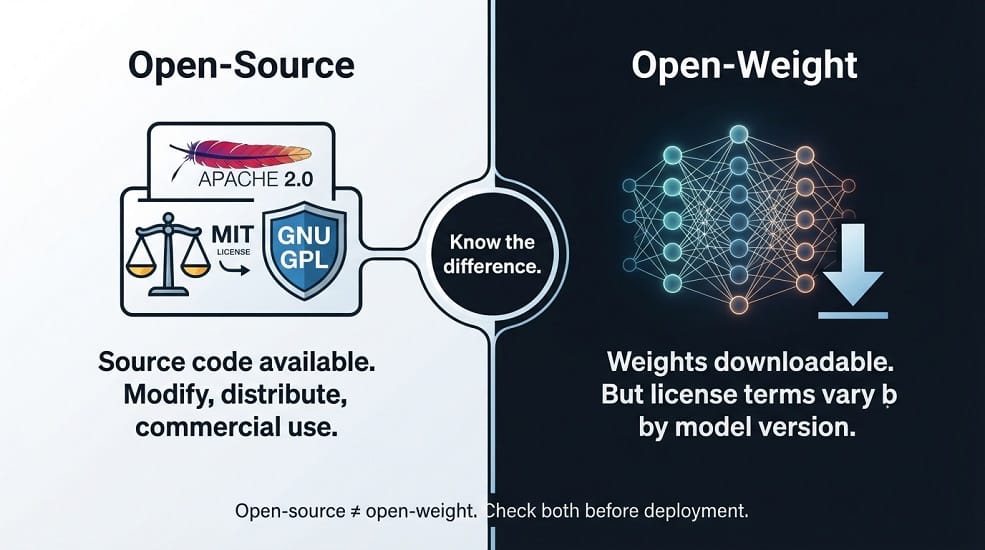
Some AI models are described as:
- Open source
- Open weight
- Open model
- Source available
These terms are not necessarily interchangeable.
For example, Yi's official repository states that its Yi-1.5 code and weights are distributed under Apache 2.0. It also documents local deployment, quantization, and commercial use.
Meanwhile, other model families may have separate licenses for code and model weights.
That is why this article should evaluate both:
technical capability + actual licensing terms
rather than assuming every downloadable model has the same rights.
For more detail, see our guide to Chinese Open-Source AI Model Licenses.
How We Compare Chinese Open Models
A useful comparison should cover the same core capabilities for every model:
General intelligence
Can it handle everyday knowledge and instructions?
Coding
Can it generate, debug, refactor, and understand software?
Reasoning
Can it solve difficult multi-step problems?
Agents
Can it use tools and complete multi-step workflows?
Context
Can it work with large documents or repositories?
Multilingual performance
How well does it handle Chinese, English, and other languages?
Deployment
Can developers run it locally or privately?
Ecosystem
Are there APIs, inference engines, SDKs, and community tools?
Enterprise fit
Can organizations operate it securely and economically?
1. Qwen
Overview
Qwen, developed by Alibaba, is one of the broadest model ecosystems in the Chinese open-model landscape.
The current Qwen ecosystem includes:
- General models
- Reasoning models
- Coding models
- Multimodal models
- Smaller local variants
- Large models
- Agent-oriented models
The Qwen3 ecosystem is particularly important because it combines general language capabilities with reasoning, tool use, and multiple deployment options.
The official Qwen3 documentation also covers local and production inference through tools such as Ollama, llama.cpp, LM Studio, vLLM, SGLang, and TensorRT-LLM.
Best known for
Broad model selection + coding + reasoning + deployment flexibility
Qwen for Coding
Qwen has one of the strongest dedicated coding ecosystems among Chinese open models.
The current Qwen3-Coder family includes models such as:
- Qwen3-Coder Next
- Qwen3-Coder 30B-A3B-Instruct
- Qwen3-Coder 480B-A35B-Instruct
- Managed Qwen coding variants
Qwen3-Coder is specifically positioned around:
- Repository-level understanding
- Tool calling
- Coding agents
- Multi-step software engineering
This makes Qwen particularly attractive for:
- AI coding assistants
- Autonomous coding agents
- Code review
- Repository automation
- Internal developer copilots
Qwen for Reasoning
Qwen is no longer only a coding or chat ecosystem.
Recent Qwen generations include reasoning-oriented models designed for:
- Mathematics
- Technical analysis
- Planning
- Research
- Multi-step problem solving
This makes Qwen a strong general-purpose choice for teams that don't want separate models for every workload.
Qwen for Local Deployment
Qwen is also attractive for local deployment because the ecosystem offers models in multiple sizes.
Developers can use:
- Ollama
- llama.cpp
- LM Studio
- vLLM
- SGLang
- TensorRT-LLM
That creates options ranging from:
developer laptop → workstation → private GPU server → enterprise GPU cluster
Qwen: Main Strengths
| Area | Assessment |
|---|---|
| Coding | Excellent |
| Reasoning | Excellent |
| AI agents | Excellent |
| Context | Excellent |
| Local deployment | Excellent |
| Model variety | Excellent |
| Enterprise use | Excellent |
Best fit: Organizations that want one broad ecosystem covering coding, reasoning, agents, and private deployment.
2. DeepSeek
Overview
DeepSeek has become one of the most influential Chinese model families because of its combination of:
- Strong reasoning
- Coding
- Long context
- Open-model availability
- Competitive inference economics
The current DeepSeek ecosystem has expanded beyond the earlier DeepSeek Coder and R1 generations into newer V4 models.
DeepSeek's current API documentation lists DeepSeek-V4-Flash and DeepSeek-V4-Pro, with 1M-token context, tool calls, JSON output, and reasoning/non-reasoning modes.
DeepSeek for Coding
Coding is one of DeepSeek's strongest use cases.
Developers commonly use DeepSeek for:
- Code generation
- Debugging
- Code completion
- Software engineering
- Algorithm development
- Coding agents
The current V4 API also supports FIM-style completion for supported workflows, which makes it relevant to IDE and developer-tool integrations.
DeepSeek for Reasoning
Reasoning remains a major differentiator.
DeepSeek models are particularly relevant for:
- Mathematics
- Science
- Algorithmic problems
- Complex analysis
- Multi-step planning
This makes DeepSeek attractive when the same model needs to combine reasoning + coding.
DeepSeek for Local and Private AI
DeepSeek also has a strong private-deployment ecosystem.
Depending on the model and checkpoint, organizations can use:
- vLLM
- SGLang
- Ollama-compatible ecosystems
- Custom inference servers
- Kubernetes
The exact hardware requirement varies significantly by model.
That distinction becomes important later in this guide.
DeepSeek: Main Strengths
| Area | Assessment |
|---|---|
| Coding | Excellent |
| Reasoning | Excellent |
| AI agents | Excellent |
| Context | Excellent |
| Local deployment | Strong |
| Model variety | Strong |
| Enterprise use | Excellent |
Best fit: Teams that want strong reasoning and coding in the same ecosystem, especially for technical and analytical workloads.
3. GLM
Overview
GLM is the model family developed by Zhipu AI and has evolved from the GLM-4 generation into increasingly agentic models.
The current ecosystem includes:
- GLM-4.7
- GLM-5
- GLM-5.1
- GLM-5.2
- Smaller and specialized variants
Current GLM materials increasingly position the family around agentic engineering, coding, and long-horizon tasks. The GLM-5.1 documentation describes it as a next-generation flagship for agentic engineering, while current GLM-5.2 materials emphasize long-horizon work and large context.
GLM for Coding
GLM has become a serious coding-model family.
Recent generations focus on:
- Coding agents
- Terminal tasks
- Repository work
- Tool use
- Long-horizon engineering
GLM-4.7 is particularly relevant for developers building terminal-based coding agents.
GLM-5 and later generations move further toward complex software-engineering workflows.
GLM for Reasoning
GLM also provides strong reasoning capabilities.
Typical use cases include:
- Planning
- Research
- Analysis
- Mathematical reasoning
- Complex business workflows
Its biggest recent differentiation is the connection between reasoning + tool use + long-horizon execution.
GLM for Local Deployment
GLM has a growing deployment ecosystem.
Current GLM repositories document serving through:
- vLLM
- SGLang
- xLLM
- KTransformers
Large GLM checkpoints can require substantial multi-GPU infrastructure. Current GLM-5 documentation, for example, lists 744B-A40B models and provides multi-GPU serving configurations.
So GLM ranges from relatively manageable variants to very large enterprise deployments.
GLM: Main Strengths
| Area | Assessment |
|---|---|
| Coding | Excellent |
| Reasoning | Excellent |
| AI agents | Excellent |
| Context | Excellent |
| Local deployment | Strong |
| Model variety | Strong |
| Enterprise use | Excellent |
Best fit: Organizations focused on agentic engineering, terminal workflows, and complex long-horizon AI tasks.
4. Kimi
Kimi is another major Chinese AI model family worth including because of its strong focus on reasoning, long context, and agent-style workloads.
The most important Kimi models should be evaluated by exact generation rather than treating the entire Kimi family as one model.
For this article, focus on the current open-weight releases available from Moonshot AI and the specific capabilities they expose.
Best known for
- Long-context workloads
- Reasoning
- Agentic use cases
- Research
- Coding
Kimi is particularly relevant for users who need models capable of handling large amounts of context.
For enterprise applications, evaluate:
- Context performance
- Tool use
- API availability
- Local deployment
- License terms
before choosing it over Qwen or DeepSeek.
5. MiniMax
MiniMax has become increasingly important in the open-model ecosystem through its M-series models.
The current MiniMax GitHub organization lists newer releases including MiniMax-M2.7, while the MiniMax-M2 repository is MIT licensed with a specific additional condition for very large commercial products above defined MAU or ARR thresholds.
That licensing detail is worth highlighting.
It shows why a “best open model” comparison should never treat licensing as a footnote.
Best known for
- Coding
- Agentic workflows
- General intelligence
- Large-context applications
- Developer tooling
MiniMax is particularly worth evaluating for organizations that want another alternative to the Qwen/DeepSeek/GLM trio.
6. Yi
Yi comes from 01.AI and was one of the earlier major Chinese open-model families to gain international attention.
The official Yi repository describes the family as bilingual and multilingual, with models trained on a large corpus and available in multiple sizes. It also provides local deployment, Docker, llama.cpp, and quantization guidance.
The repository states that the Yi-1.5 code and weights are distributed under Apache 2.0 and can be used for commercial purposes.
Best known for
- Chinese-English bilingual tasks
- Local deployment
- Smaller model options
- Fine-tuning
- Flexible open-model tooling
Yi remains relevant for organizations specifically interested in relatively mature Chinese open-model infrastructure.
7. Baichuan
Baichuan is another important Chinese model family, especially historically in the development of open Chinese LLMs.
It is useful to include in the broader ecosystem discussion because it helps explain the evolution of China's open-model landscape.
For a 2026 model-selection article, however, Baichuan should be positioned carefully.
Rather than presenting it as automatically competitive with the newest Qwen, DeepSeek, or GLM releases, evaluate the current maintained model and use case before recommending it for a new production deployment.
Best fit
- Existing Baichuan environments
- Research
- Chinese-language applications
- Legacy model deployments
8. InternLM
InternLM is developed by the Shanghai AI Laboratory ecosystem.
The current InternLM organization describes InternLM3-8B-Instruct as an open 8B instruction model designed for general-purpose use and advanced reasoning. It also maintains broader multilingual and multimodal model families such as InternVL.
This makes InternLM interesting for:
- Local deployment
- Research
- Chinese-language applications
- Smaller-model experimentation
- Multimodal AI
InternLM can be especially useful when the priority is running a capable model with relatively manageable infrastructure.
Chinese Open-Source LLM Landscape
At this point, the ecosystem can be grouped broadly:
| Model Family | Main Strength |
|---|---|
| Qwen | Broad ecosystem + coding |
| DeepSeek | Reasoning + coding |
| GLM | Agentic engineering |
| Kimi | Long context + reasoning |
| MiniMax | Coding + agents |
| Yi | Bilingual + local deployment |
| Baichuan | Chinese‑language ecosystem |
| InternLM | Research + efficient local models |
This isn't a permanent ranking.
It is a way to understand what each ecosystem is most useful for.
Which Chinese LLM Should You Start With?
For a new project, the strongest initial shortlist is generally:
Qwen
Start here when you need broad capabilities, coding, agents, and flexible deployment.
DeepSeek
Start here when reasoning and coding are both high priorities.
GLM
Start here when agentic engineering and long-horizon workflows matter.
Kimi
Evaluate when very long-context and reasoning-heavy workloads are important.
MiniMax
Evaluate for agentic and coding workloads where its current models fit the task and licensing requirements.
Yi
Consider for bilingual applications and local deployments where its model sizes and Apache 2.0 licensing are a good fit.
InternLM
Consider for smaller local deployments and research-oriented applications.
Model Comparison
| Model | Coding | Reasoning | Agents | Local Deployment | Best Known For |
|---|---|---|---|---|---|
| Qwen | Excellent | Excellent | Excellent | Excellent | Broad ecosystem |
| DeepSeek | Excellent | Excellent | Excellent | Strong | Reasoning + coding |
| GLM | Excellent | Excellent | Excellent | Strong | Agentic engineering |
| Kimi | Strong | Excellent | Strong | Depends on model | Long context |
| MiniMax | Excellent | Strong | Excellent | Strong | Coding + agents |
| Yi | Strong | Strong | Moderate | Excellent | Bilingual/local |
| Baichuan | Moderate/Strong | Strong | Moderate | Strong | Chinese ecosystem |
| InternLM | Strong | Strong | Moderate | Excellent | Efficient local/research |
Best Chinese LLM for Coding
For coding, the strongest shortlist is:
- Qwen3-Coder
- DeepSeek
- GLM
- MiniMax
- Yi / InternLM for more specialized or smaller deployments
Qwen3-Coder
Qwen is one of the strongest choices when coding is the primary workload.
The current Qwen ecosystem includes dedicated Coder models and explicitly supports repository-level coding, agentic workflows, tool use, and large-context development. The Qwen3 project also documents local inference and production deployment through Ollama, LM Studio, vLLM, SGLang, and related runtimes.
Best for:
- Coding agents
- Repository work
- Code generation
- Refactoring
- Tool-assisted development
DeepSeek
DeepSeek is particularly attractive when coding is combined with reasoning.
That makes it useful for:
- Debugging
- Algorithmic programming
- Complex code generation
- Software engineering
- Reasoning-heavy coding tasks
The current DeepSeek ecosystem should be evaluated model-by-model rather than assuming every older DeepSeek Coder release is equivalent to the current generation.
Best for:
- Coding + reasoning
- Complex debugging
- Large-context development
GLM
GLM's recent generations have moved strongly toward agentic software engineering.
The official GLM-5 project describes GLM-5.1 as its next-generation flagship for agentic engineering and says it is designed to remain productive across much longer task horizons, including repeated experimentation and tool use.
Best for:
- Coding agents
- Terminal workflows
- Long-running software tasks
- Complex system engineering
MiniMax
MiniMax is worth including because its current M2.7 release is heavily focused on agentic productivity and complex tool use.
The official repository says M2.7 can build complex agent harnesses, use Agent Teams and dynamic tool search, and complete elaborate productivity tasks. It also provides local deployment through SGLang, vLLM, Transformers, and ModelScope.
Best for:
- Agentic coding
- Productivity agents
- Tool-driven workflows
- Multi-step tasks
Best Chinese LLM for Reasoning
For reasoning, the strongest first choices are:
DeepSeek
DeepSeek remains a natural candidate for reasoning-heavy workloads.
Use it for:
- Mathematics
- Science
- Complex analysis
- Multi-step programming
- Research tasks
Qwen
Qwen3 and later Qwen generations also emphasize reasoning, mathematics, science, and coding, with the official Qwen3 project describing improved reasoning and thinking capabilities.
GLM
GLM's newer models increasingly combine reasoning with long-horizon execution rather than treating reasoning as an isolated answer-generation task.
Practical recommendation
For a reasoning benchmark, start with:
DeepSeek + Qwen + GLM
and test the exact model variants on your own tasks.
Best Chinese LLM for AI Agents
This is one of the fastest-moving areas.
The strongest candidates are:
- Qwen3-Coder / Qwen3
- GLM-4.7 / GLM-5.x
- DeepSeek
- MiniMax M2.7
Qwen's ecosystem is particularly interesting because the official Qwen3 documentation describes agent capabilities, tool use, and framework support for RAG and agents.
GLM-5.1 is designed explicitly around longer-horizon agentic engineering and thousands of tool-call interactions.
MiniMax M2.7 also emphasizes complex agent harnesses, Agent Teams, skills, and dynamic tool search.
Best starting shortlist
| Agent Requirement | Model to Test First |
|---|---|
| Coding agent | Qwen3‑Coder |
| Long‑horizon engineering | GLM‑5.1 |
| Tool‑heavy productivity agent | MiniMax M2.7 |
| Reasoning + agents | DeepSeek |
| General agent platform | Qwen / GLM |
Best Chinese LLM for Long Context
Long context is useful for:
- Large code repositories
- Research papers
- Contracts
- Enterprise documentation
- RAG
- Long conversations
Qwen's current model documentation describes 256K context with extension to 1M tokens in the Qwen3 family.
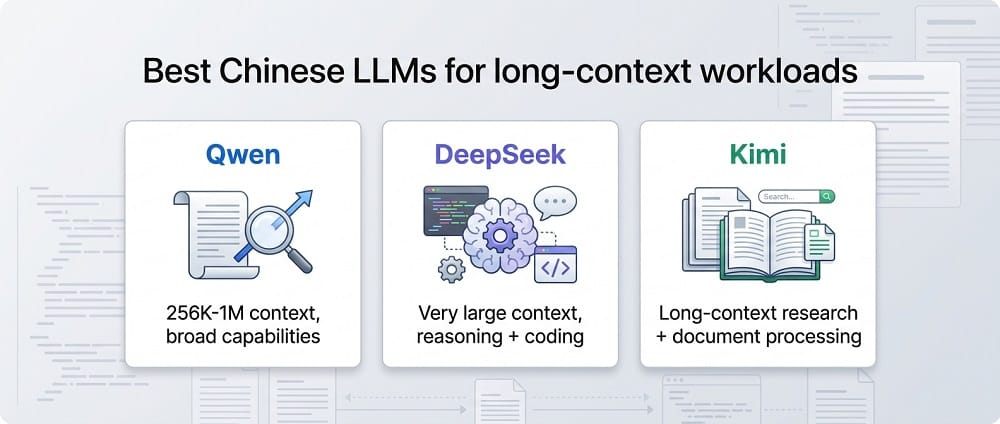
Qwen's newer model family has also continued expanding in 2026, with Qwen3.5 and Qwen3.6 releases adding newer model sizes and capabilities.
GLM's newer models also emphasize long-horizon work and large context, while current DeepSeek models provide very large context capabilities through their API ecosystem.
Practical recommendation
Don't rank models by context window alone.
Test:
- Retrieval accuracy
- Information retention
- Long-context reasoning
- Latency
- Cost
- Relevant-context selection
A 1M-token context is useful only when the application can use it effectively.
Best Chinese LLM for RAG
For Retrieval-Augmented Generation, focus on:
- Document understanding
- Retrieval quality
- Grounded generation
- Citation behavior
- Structured responses
- Long-context reasoning
Qwen
A strong general choice for enterprise RAG and multilingual knowledge bases.
DeepSeek
Attractive for analytical and reasoning-heavy RAG.
GLM
Useful for structured enterprise workflows and long-horizon document tasks.
Kimi
Worth evaluating when the application depends heavily on long-context research and document processing.
The model is only one part of the RAG system.
Also test:
- Chunking
- Embeddings
- Retrieval
- Reranking
- Context construction
Best Chinese LLM for Multilingual AI
Qwen has an especially broad multilingual focus. The Qwen3 project states support for 100+ languages and dialects, including multilingual instruction following and translation.
That makes Qwen particularly attractive for:
- Global SaaS
- Multilingual support
- Translation
- International documentation
- Cross-language search
Other Chinese model families also support multilingual workloads, but the exact language coverage and quality should be tested against the languages your business actually uses.
Best Chinese LLM for Local Deployment
Local deployment changes the decision because hardware becomes a constraint.
For a developer workstation, prioritize:
- Model size
- Quantization
- VRAM
- Tokens per second
- Runtime compatibility
Qwen has particularly broad local-serving documentation, including Ollama, llama.cpp, LM Studio, vLLM, SGLang, and TensorRT-LLM.
InternLM also remains relevant for smaller local deployments and research workflows.
Yi remains another useful option for organizations interested in bilingual models and established local-serving paths.
Best Chinese LLM for Developers With Limited Hardware
A common mistake is choosing the strongest model and discovering it cannot fit on the available machine.
A better metric is:
Capability per GB of memory
For example:
| Hardware Situation | Better Strategy |
|---|---|
| Laptop | Small / quantized model |
| 16–24 GB GPU | Small‑to‑mid model |
| 48 GB GPU | Larger single‑GPU model |
| 80–96 GB GPU | Large model or stronger quantization |
| Multi‑GPU | Large expert / reasoning models |
This is why Qwen's range of model sizes can be valuable: its official Qwen3 family includes models from 0.6B through much larger dense and MoE variants.
Best Chinese LLM for APIs
For API-based development, consider:
- Model selection
- OpenAI compatibility
- Streaming
- Tool calling
- Structured output
- Context
- Rate limits
- Pricing
- Regional availability
Qwen has a broad managed API ecosystem through Alibaba Cloud.
DeepSeek has a strong API ecosystem focused around reasoning and coding.
GLM provides Z.ai APIs and other integrations.
MiniMax also provides its own API platform and agent ecosystem. The M2.7 repository links directly to its API, agent platform, and MCP resources.
Best Chinese LLM for Enterprise AI
Enterprise buyers should evaluate more than benchmark scores.
Focus on:
- Security
- Licensing
- Data privacy
- Data residency
- Private deployment
- Scalability
- Monitoring
- Total Cost of Ownership
Qwen
Strong all-around enterprise candidate.
DeepSeek
Strong for reasoning, coding, and analytical enterprise workloads.
GLM
Strong for agentic enterprise applications.
MiniMax
Worth evaluating for complex agentic and productivity use cases.
The exact choice should come from a business-specific benchmark.
Best Chinese LLM for AI Coding Agents
For coding agents, I'd narrow the list to:
Qwen3-Coder
Best first candidate for repository-level coding and agentic development.
GLM-4.7 / GLM-5.1
Strong options for terminal and long-horizon engineering. The current GLM-5 repository emphasizes long-horizon agentic engineering and repeated tool interaction.
DeepSeek
Strong candidate for reasoning-heavy coding tasks.
MiniMax M2.7
Worth testing for complex productivity and agentic workflows. Its official release highlights complex agent harnesses, Agent Teams, dynamic tool search, and long-running self-evaluation.
Best Chinese LLM by Use Case
| Use Case | First Models to Test |
|---|---|
| Coding | Qwen3‑Coder, DeepSeek |
| Coding agents | Qwen3‑Coder, GLM |
| Terminal agents | GLM‑4.7 / GLM‑5.x |
| Reasoning | DeepSeek, Qwen |
| Long‑context research | Qwen, Kimi, DeepSeek |
| RAG | Qwen, DeepSeek, GLM |
| Multilingual | Qwen |
| Local development | Qwen, InternLM, Yi |
| Enterprise AI | Qwen, DeepSeek, GLM |
| Productivity agents | MiniMax, Qwen, GLM |
Licensing Must Be Part of the Decision
A model can be technically excellent and still be unsuitable for your commercial use case.
Check:
- Exact model
- Exact version
- Weight license
- Code license
- Commercial rights
- Redistribution
- Fine-tuning
- Derivative models
- Acceptable-use terms
This matters particularly when comparing newer releases from fast-moving model families.
For example, the current GLM-5 repository is Apache-2.0 licensed, while MiniMax-M2.7 has its own repository license and the MiniMax ecosystem also provides specific licensing information.
Your existing Chinese Open-Source AI Model Licenses article should be linked here.
Best Model for AWS Deployment
If you're planning private deployment on AWS, the decision also depends on model size.
Smaller models
Consider:
- EC2 GPU
- Docker
- vLLM
- Single-node inference
Larger models
Consider:
- Amazon EKS
- Multi-GPU nodes
- vLLM
- SGLang
- Tensor parallelism
- Expert parallelism
Very large models
Evaluate:
- H100
- H200
- Blackwell GPUs
- Multi-node inference
GLM-5 is a good example of the upper end: its official deployment documentation uses an eight-GPU vLLM configuration for the FP8 model.
Which Model Is Cheapest?
There is no permanent answer.
Model pricing, API prices, context tiers, and infrastructure requirements change.
Instead of:
“Which model has the lowest token price?”
calculate:
Cost per successful task
For a production AI system:
Total Cost
=
API / GPU Cost
+
Retries
+
Tool Calls
+
Infrastructure
+
Operations
Then compare the cost against completed tasks.
This is especially important for AI agents.
Which Model Should You Start With?
For most new projects, I recommend beginning with:
Qwen
Because the ecosystem is broad and covers coding, reasoning, agents, local inference, and enterprise deployment.
DeepSeek
Add it when reasoning or complex coding is central.
GLM
Add it when agentic engineering and terminal workflows are important.
Kimi / MiniMax
Add one of these when your workload has a specific reason to require them, such as long-context research or advanced productivity agents.
The Three-Model Shortlist
For most organizations, the practical first benchmark should be:
| Model | Why Test It |
|---|---|
| Qwen | Broad ecosystem |
| DeepSeek | Reasoning + coding |
| GLM | Agentic engineering |
Then add:
Kimi for long-context research
or
MiniMax for complex productivity agents.
This keeps the evaluation manageable while still covering the most important Chinese model families.
Best Chinese LLM for Developers
Winner: Qwen
For a developer who wants one ecosystem covering coding, general AI, agents, APIs, and local deployment, Qwen is the safest starting point.
The current Qwen3.5/3.6 ecosystem includes multiple model sizes and is explicitly expanding multimodal, coding, agent, and multilingual capabilities. Qwen's current official material also provides API compatibility with OpenAI and Anthropic formats and continues to support Qwen Code for terminal-based development.
Best for:
- Software developers
- Coding assistants
- AI agents
- Local AI
- Multilingual applications
- Broad enterprise experimentation
Best Chinese LLM for Reasoning
Winner: DeepSeek
For reasoning-heavy applications, DeepSeek remains one of the strongest first choices.
The current DeepSeek V4 family is available through its API, with V4-Pro positioned above V4-Flash for capability. Reuters reports that the current V4-Pro release improved on V4-Flash across coding, tool use, and scientific reasoning evaluations, although the exact price and performance depend on the model and workload.
Best for:
- Mathematics
- Research
- Scientific reasoning
- Complex coding
- Multi-step analysis
Best Chinese LLM for Coding Agents
Winner: Qwen3-Coder, with GLM and MiniMax as strong alternatives
Qwen remains one of the best starting points for coding-agent development because its current ecosystem is designed around repository understanding, tool use, and agentic coding.
But it is no longer alone.
GLM's newer generations are heavily focused on agentic engineering, while MiniMax M2.7 explicitly targets complex agent harnesses, Agent Teams, skills, dynamic tool search, and long-running productivity tasks.
Recommended shortlist
Qwen3-Coder → coding and repository work
GLM → terminal and long-horizon engineering
MiniMax M2.7 → complex productivity and agent workflows
DeepSeek → reasoning-heavy agents
Best Chinese LLM for Multilingual Applications
Winner: Qwen
Qwen's current ecosystem places significant emphasis on multilingual coverage. The Qwen3.6 project states support for 201 languages and dialects, which makes the latest Qwen family particularly relevant for globally distributed applications.
This makes Qwen a strong candidate for:
- Global SaaS
- International customer support
- Translation
- Multilingual enterprise search
- Localization
- Cross-language coding and documentation
Best Chinese LLM for Long-Context Work
Best shortlist: Qwen, DeepSeek and Kimi
Long context is useful for:
- Large repositories
- Legal documents
- Research
- Enterprise knowledge bases
- Long conversations
- RAG
- Agent memory
But context length should never be the only metric.
Measure:
- Retrieval quality
- Reasoning quality
- Cost
- Latency
- Information retention
A model that accepts 1M tokens but performs poorly on the relevant information is less useful than a smaller-context model with better retrieval and reasoning.
Best Chinese LLM for Local Deployment
Winner: Qwen
Qwen has one of the broadest deployment ecosystems, covering smaller models through large models and supporting tools such as Ollama, llama.cpp, LM Studio, vLLM, and SGLang.
This gives developers flexibility across:
- Laptop
- Workstation
- Single-GPU server
- Multi-GPU server
- Kubernetes
Yi and InternLM also remain useful for smaller local deployments and research environments. The Yi repository, for example, documents local deployment and Apache 2.0 licensing for Yi-1.5.
Best Chinese LLM for Low-Cost Inference
There is no permanent winner here.
The model with the lowest token price is not necessarily the least expensive model to operate.
Calculate:
cost per successful task
rather than:
cost per million tokens
For an agent:
Total cost
=
Model calls
+
Retries
+
Tool calls
+
Infrastructure
Then compare successful task completion.
For example, a slightly more expensive model that finishes a coding task in fewer attempts may have a lower effective cost.
Best Chinese LLM for Enterprise AI
Strongest starting shortlist: Qwen, DeepSeek and GLM
Qwen
Best overall breadth.
DeepSeek
Strong reasoning and technical workloads.
GLM
Strong agentic and workflow-oriented applications.
For enterprise selection, also evaluate:
- Security
- Licensing
- Private deployment
- Data residency
- API stability
- GPU requirements
- TCO
- Governance
Model quality is only one part of enterprise AI adoption.
Best Chinese LLM for AI Agents
The current market is increasingly competitive.
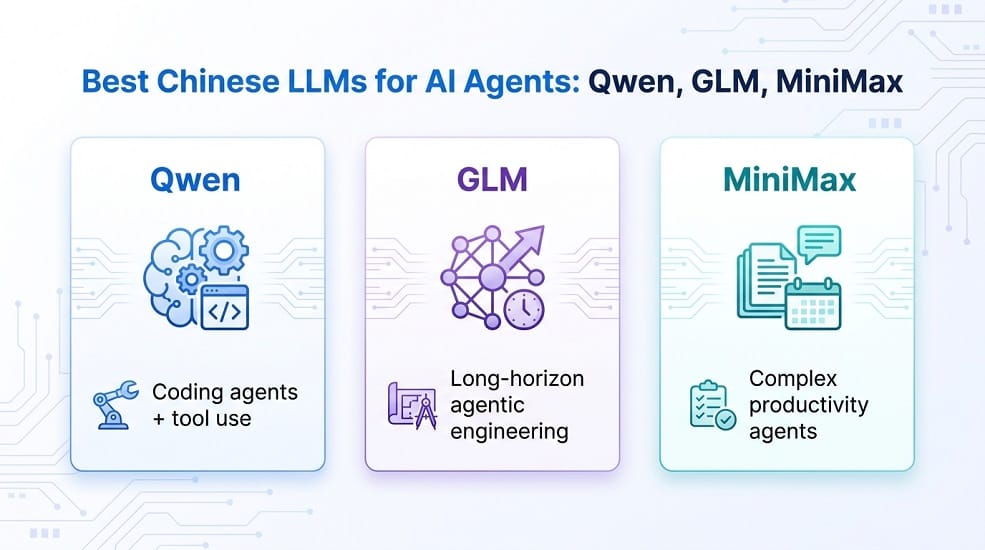
Qwen
Strong coding-agent and tool-use ecosystem.
GLM
Strong long-horizon agentic engineering.
MiniMax M2.7
A particularly interesting agent model because its official release emphasizes complex agent harnesses, Agent Teams, dynamic tool search, and self-improvement workflows.
DeepSeek
Strong when the agent requires substantial reasoning before acting.
Recommendation
Start with:
Qwen + DeepSeek + GLM
Then evaluate MiniMax when complex productivity agents are part of the workload.
Best Chinese LLM for Businesses With Limited GPU Capacity
Don't start with the largest model.
Instead, prioritize:
- Small parameter count
- Quantization
- Good tokens/sec
- Low memory use
- Good task success
A smaller model that solves 90% of your workload may provide much better ROI than a huge model that solves 95% at ten times the infrastructure cost.
This is particularly important for:
- Startups
- Small engineering teams
- Internal tools
- Local AI
- Proofs of concept
Best Chinese LLM for Very Large Enterprise Workloads
At the upper end, infrastructure becomes a major factor.
Large model deployments may require:
- Multi-GPU servers
- Tensor parallelism
- Expert parallelism
- High-bandwidth GPU networking
- vLLM or SGLang
- Kubernetes
- Autoscaling
- Model routing
GLM-5 is a good example of this category, while the current DeepSeek and Qwen ecosystems also include substantially larger models than the lightweight local variants.
The right model in this category is the one that delivers the best quality per dollar of GPU infrastructure.
Qwen vs DeepSeek vs GLM: Final Selection
Here is the practical recommendation:
| Goal | Best Starting Choice |
|---|---|
| General‑purpose Chinese LLM | Qwen |
| Coding | Qwen / DeepSeek |
| Coding agents | Qwen3‑Coder |
| Deep reasoning | DeepSeek |
| Agentic engineering | GLM |
| Multilingual AI | Qwen |
| Local deployment | Qwen |
| Enterprise shortlist | Qwen + DeepSeek + GLM |
| Long‑context research | Qwen / DeepSeek / Kimi |
| Productivity agents | MiniMax |
| Smaller local models | Qwen / Yi / InternLM |
These are starting recommendations, not permanent rankings.
Qwen vs DeepSeek vs GLM: Which One Should You Actually Choose?
Choose Qwen when:
You want the broadest ecosystem and need coding, agents, multilingual capabilities, local deployment, and general enterprise AI in one family.
Choose DeepSeek when:
Reasoning, technical analysis, and coding are the most important parts of the workload.
Choose GLM when:
You are building sophisticated agents, terminal workflows, or longer-running software-engineering systems.
Choose Kimi when:
Long-context research and document-heavy workflows are the main priority.
Choose MiniMax when:
You want to investigate newer agentic productivity and tool-use workloads.
Choose Yi or InternLM when:
You need smaller local models, research flexibility, or an established lightweight deployment path.
How to Benchmark Chinese LLMs Before Production
Before selecting any model, create a test set containing your real tasks.
For example:
| Test Category | Suggested Count |
|---|---|
| Coding | 10 |
| Reasoning | 10 |
| RAG | 10 |
| Agent workflows | 10 |
| Document tasks | 10 |
Then measure:
- Accuracy
- Task completion
- Hallucination rate
- Latency
- Token usage
- Retry rate
- Cost
- Human review time
Finally calculate:
Cost per successful task
This is a much stronger business metric than a public leaderboard.
Licensing Can Change the Winner
The technically strongest model may not be the best commercial choice.
Before deploying any model, check:
- Exact release
- Weight license
- Code license
- Commercial-use rights
- Fine-tuning terms
- Redistribution
- Derivative-model rules
- Acceptable-use restrictions
This is particularly important with newer model families.
For example, MiniMax-M2.7's current license explicitly states that commercial use requires prior written authorization, which makes licensing a material part of the model-selection decision for commercial deployments.
That's exactly why the license article in this cluster should be linked prominently from this page.
EaseCloud Perspective
For enterprises, selecting a Chinese LLM should ultimately connect to deployment economics.
The decision typically involves:
Model quality → deployment model → GPU requirements → security → TCO
At EaseCloud, the relevant infrastructure layer includes:
- AWS GPU infrastructure
- Amazon EKS
- Kubernetes
- vLLM
- SGLang
- AI gateways
- Model routing
- Private inference
- LLMOps
- Observability
- GPU optimization
- Cloud cost optimization
The best model is the one you can operate reliably and economically at the required scale.
Frequently Asked Questions
What is the best Chinese open-source LLM in 2026?
For most new projects, Qwen is the strongest overall starting point, while DeepSeek and GLM are the first alternatives to benchmark for reasoning and agentic workloads.
Is Qwen better than DeepSeek?
Not universally. Qwen has a broader ecosystem, while DeepSeek is particularly strong for reasoning and technical workloads.
Is DeepSeek better than Qwen for coding?
It can be, depending on the exact model and task. For coding-agent workflows, Qwen3-Coder is an especially strong candidate.
Which Chinese LLM is best for AI agents?
Start with Qwen, GLM, and DeepSeek. Add MiniMax for complex agentic productivity workloads.
Which Chinese LLM is best for local use?
Qwen is generally the easiest starting point because of its broad model-size range and extensive local inference support.
Which Chinese LLM is best for enterprise AI?
Shortlist Qwen, DeepSeek, and GLM, then evaluate them against your actual workloads, security requirements, licensing, and TCO.
Which Chinese model is best for coding?
Start with Qwen3-Coder and DeepSeek, then add GLM if agentic or terminal-heavy development is important.
Final Verdict
There is no single “best Chinese LLM” for every application in 2026.
The most useful way to think about the market is:
- Qwen = best all-rounder
- DeepSeek = strongest reasoning + coding candidate
- GLM = strongest agentic-engineering candidate
- Kimi = long-context research candidate
- MiniMax = strong agentic productivity candidate
- Yi / InternLM = useful local and research-oriented options
The broader lesson is more important than the ranking:
Choose the model based on the workload, then choose the infrastructure based on the model.
For a developer, that may mean Qwen running locally.
For a research team, it may mean DeepSeek or Kimi through an API.
For an enterprise coding platform, it may mean Qwen, DeepSeek, or GLM deployed privately on AWS with vLLM and Kubernetes.
And for a complex agent platform, a multi-model architecture may provide better results than choosing one model for everything.
Summarize this post with: