Chinese Open-Source AI Model Licenses Explained: Apache 2.0, MIT & Custom Terms
Understand Qwen, DeepSeek and GLM AI licenses, including Apache 2.0, MIT, commercial use, redistribution, fine-tuning, hosting and enterprise risks.
“Open-source AI model” does not always mean the same thing as “free to use for anything.”
This matters when you are choosing a model for a commercial application, internal enterprise software, an AI coding assistant, a hosted API, or a private inference platform.
Popular Chinese AI models such as Qwen, DeepSeek, and GLM use different licensing approaches across different model generations. Some releases use well-known software licenses such as Apache 2.0 or MIT, while others use a separate model-specific license with additional conditions.
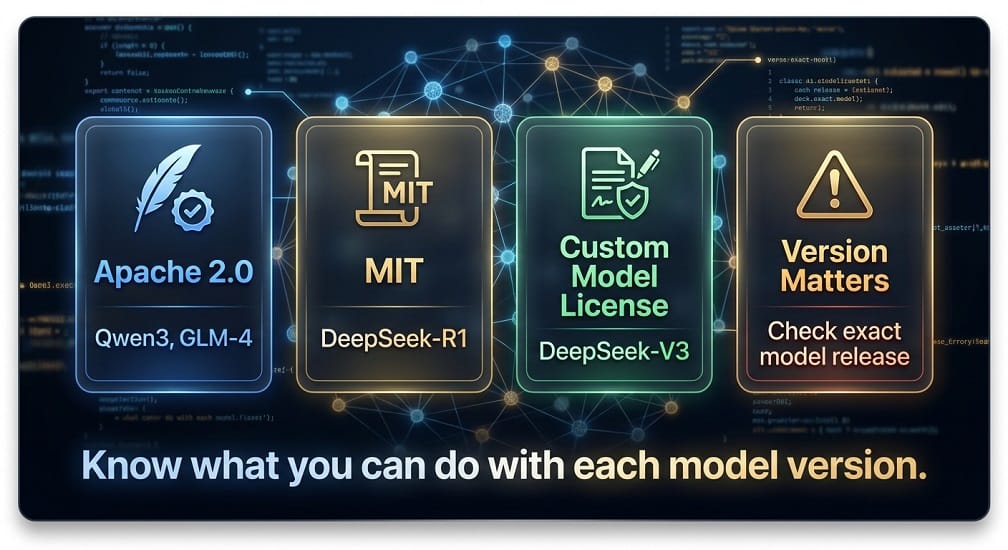
For example, the Qwen3 repository says its open-weight models are licensed under Apache 2.0. DeepSeek-R1 states that its code repository and model weights are licensed under MIT and explicitly supports commercial use, modifications, and derivative works. DeepSeek-V3 is more complicated: its repository code is MIT licensed, while use of the model weights is subject to a separate DeepSeek Model License.
That distinction is exactly why businesses should examine the license attached to the specific model version they plan to deploy.
What This Guide Covers
- What “open source” means for AI models
- Open-source vs open-weight models
- Apache 2.0 vs MIT
- Qwen licensing
- DeepSeek licensing
- GLM licensing
- Commercial use
- Fine-tuning
- Redistribution
- SaaS and hosted APIs
- Derivative models
- Enterprise licensing risks
- What companies should check before production deployment
Open Source vs Open Weight: What Is the Difference?
One of the most common mistakes is assuming that every downloadable AI model is automatically open source.
The terms are related, but they are not identical.
Open-Source Software
A traditional open-source software license generally gives users rights to:
- Use the software
- Inspect the source code
- Modify it
- Distribute it
- Create derivative works
The exact rights and obligations depend on the license.
Apache 2.0 and MIT are two well-known permissive open-source licenses, often evaluated in a Qwen vs DeepSeek API comparison.
Open-Weight AI Models
An open-weight model makes trained model parameters available for download.
Those weights can often be:
- Downloaded
- Run locally
- Fine-tuned
- Integrated into applications
- Hosted privately
But the rights associated with those weights depend on the model's license.
So:
Downloadable weights ≠ automatically unrestricted use.
A model can be publicly downloadable while still having specific rules around redistribution, derivatives, acceptable use, or commercial deployment, especially if you want to run Qwen, DeepSeek, or GLM locally.
Why AI Model Licensing Is More Complicated
An AI release can contain several separate components.
For example:
AI Model Release
│
├── Model weights
├── Source code
├── Inference code
├── Training code
├── Tokenizer
├── Dataset
├── Documentation
├── Model card
└── Generated outputs
These components do not necessarily have identical licensing terms.
This is particularly important with DeepSeek-V3.
Its repository uses the MIT license for the code, but the repository states that use of the DeepSeek-V3 Base and Chat models is subject to a separate Model License.
Therefore, saying “DeepSeek-V3 is MIT licensed” without qualification can be misleading.
The correct approach is to identify which component and which rights you are talking about.
Apache 2.0 Explained
Apache License 2.0 is a permissive open-source license widely used by software and AI projects.
It generally permits:
- Commercial use
- Modification
- Distribution
- Private use
- Creation of derivative works
- Sublicensing
It also contains an explicit patent license from contributors, subject to the license's conditions.
The license includes requirements around notices, copyright information, and redistribution.
This makes Apache 2.0 attractive for businesses that want to build commercial products on top of an open model.
However, there is an important AI-specific point:
The Apache 2.0 license of one component does not automatically license every component associated with an AI model.
Always inspect the actual model release.
MIT License Explained
The MIT License is another permissive open-source software license.
It generally allows:
- Commercial use
- Modification
- Distribution
- Private use
- Sublicensing
The main requirement is generally to preserve the copyright and license notice.
The MIT license is intentionally short and simple compared with Apache 2.0.
However, the same AI-specific warning applies:
An MIT license on repository code does not automatically mean that model weights, datasets, or other assets are governed by MIT.
DeepSeek-V3 demonstrates this distinction because its code is MIT licensed while its model is subject to a separate model license.
Apache 2.0 vs MIT
| Feature | Apache 2.0 | MIT |
|---|---|---|
| Commercial use | Yes | Yes |
| Modification | Yes | Yes |
| Distribution | Yes | Yes |
| Private use | Yes | Yes |
| Sublicensing | Yes | Yes |
| Patent terms | Explicit patent grant | Different / less detailed |
| Attribution | Required through notices | Copyright/license notice |
| NOTICE file | May apply | No equivalent requirement |
| Complexity | More detailed | Simpler |
For ordinary software, both are highly permissive.
For AI models, however, the model-specific terms can be more important than the name of the underlying software license.
Qwen AI Model Licensing
Qwen is a good example of why model generation matters.
The official Qwen3 repository states:
All Qwen3 open-weight models are licensed under Apache 2.0.
This applies to the open-weight Qwen3 models described in that repository.
That makes Qwen3 attractive for businesses that want to:
- Self-host models
- Fine-tune models
- Build commercial applications
- Integrate models into internal systems
- Create customized AI solutions
However, organizations should not assume that every historical Qwen release has identical terms.
Before deployment, check:
- Exact model name
- Exact model version
- Official model repository
- License file
- Model card
- Associated tokenizer or code licenses
- Any additional acceptable-use terms
Can Qwen Be Used Commercially?
For Qwen3's open-weight models, the official repository states that the models are licensed under Apache 2.0.
That generally provides broad commercial rights, making them some of the best open-source AI models for coding.
A company could therefore consider Qwen3 for applications such as:
- SaaS applications
- Internal enterprise assistants
- Coding tools
- RAG systems
- AI agents
- Private inference
- Fine-tuned models
But the exact model should still be checked before production deployment.
A commercial deployment may involve additional components whose licenses need separate review.
Can You Fine-Tune Qwen?
Fine-tuning is one of the major reasons organizations choose open-weight models.
The Qwen3 project documents fine-tuning support using frameworks including:
- Axolotl
- Unsloth
- Swift
- Llama-Factory
and supports techniques such as SFT, DPO, and GRPO.
The important licensing question is not only:
“Can I fine-tune the model?”
It is also:
“What license applies when I distribute the resulting model or product?”
For a commercial deployment, review the exact license and any terms inherited from components used in the model.
DeepSeek AI Model Licensing
DeepSeek requires more careful explanation because different DeepSeek releases can have materially different licensing structures.
DeepSeek-R1
The official DeepSeek-R1 repository states that the code repository and model weights are licensed under the MIT License.
It also explicitly states that the DeepSeek-R1 series supports:
- Commercial use
- Modifications
- Derivative works
- Distillation for training other LLMs
This makes DeepSeek-R1 particularly attractive for developers who want to experiment with derivative models and commercial applications.
DeepSeek-V3 Licensing
DeepSeek-V3 needs a more careful explanation.
Its GitHub repository is licensed under MIT for the code, but the repository explicitly says that use of the DeepSeek-V3 Base and Chat models is subject to the DeepSeek Model License.
The model license grants broad rights, including rights covering reproduction, derivative models, distribution, and remote access such as SaaS, but it also contains specific use-based restrictions and redistribution requirements.
For example, distributors of the model or derivatives must carry forward specified use-based restrictions and provide required notices and license information.
So a business should not treat DeepSeek-V3 as simply:
“MIT = no restrictions.”
The model license must also be reviewed.
Why DeepSeek's Code License and Model License Matter
Consider this simplified structure:
DeepSeek-V3
│
├── Repository code
│      └── MIT
│
├── Model weights
│      └── DeepSeek Model License
│
└── Your application
       └── Your own applicable terms
This is a much more accurate way to think about the release.
It also shows why developers should read the license files instead of relying on a model card summary or a third-party blog post.
Can DeepSeek Be Used Commercially?
For DeepSeek-R1, the official repository explicitly supports commercial use.
DeepSeek-V3 also states that its Base and Chat models support commercial use, but that use remains subject to its separate Model License.
Therefore:
Yes, commercial use can be permitted, but the exact model's conditions still matter.
This distinction is especially important when:
- Redistributing weights
- Offering a hosted API
- Creating derivatives
- Building a commercial SaaS product
- Fine-tuning a model
- Giving customers access to the model
GLM Licensing
GLM provides another useful example of why the exact model release should be identified.
The official GLM-4 repository contains the Apache License 2.0.
The GLM-4.5 repository currently presents an Apache-2.0 license at the repository level as well.
There has also been public discussion in the GLM-4.5 repository about confusion between MIT language in the README and the Apache 2.0 license file. That is another reason production teams should inspect the actual license file and release documentation rather than relying only on summaries.
Why You Should Never Say “GLM Is MIT” or “GLM Is Apache” Without a Version
A safer statement is:
“The licensing terms depend on the specific GLM release and artifact. Check the official repository and license file for the version you intend to deploy.”
This approach avoids accidentally applying the terms of one GLM generation to another.
The same rule applies to Qwen and DeepSeek.
Qwen vs DeepSeek vs GLM: License Comparison
| Model | License / Terms | Commercial Use | Key Point |
|---|---|---|---|
| Qwen3 open‑weight models | Apache 2.0 | Yes | Official Qwen3 repository states Apache 2.0 |
| DeepSeek‑R1 | MIT | Yes | Official repository explicitly permits commercial use and derivatives |
| DeepSeek‑V3 (code) | MIT | Yes | Code license is separate from model license |
| DeepSeek‑V3 (model) | DeepSeek Model License | Yes, subject to terms | Additional use and redistribution conditions apply |
| GLM‑4 | Apache 2.0 | Broad permissive rights | Check exact release |
| GLM‑4.5 | Apache‑2.0 repository license currently shown | Check exact model terms | Verify the exact release and files before deployment |
What Does “Commercial Use” Actually Mean?
Commercial use can cover many different activities.
For example:
Internal Enterprise Use
A company runs a model internally to help employees write code.
SaaS Product
A company offers an application that uses the model behind the scenes.
AI API
A company hosts the model and sells API access.
AI Coding Assistant
A company builds a commercial coding assistant around the model.
Fine-Tuned Model
A company fine-tunes the model for a specific business task.
Model Redistribution
A company distributes model weights to customers.
These scenarios can have different licensing implications.
A license that permits one does not necessarily mean every other scenario is automatically unrestricted, which is a key principle in FinOps for managing AI spend.
Can You Host an Open Model as an API?
Sometimes yes, but the exact license matters.
DeepSeek-V3's model license explicitly addresses remote access, including software-as-a-service, while imposing conditions on distribution and downstream use.
For any model, check whether the license permits:
- Remote hosting
- API access
- Commercial inference
- Redistribution
- Derivative models
- Customer access
This is especially important if you are building an LLM API business.
Can You Redistribute Model Weights?
Redistribution is another area where licenses differ.
With a permissive software license such as Apache 2.0 or MIT, redistribution is generally allowed subject to the license requirements.
But AI model licenses can add conditions.
DeepSeek-V3's model license, for example, includes requirements for downstream redistribution, including carrying forward specified use-based restrictions and providing recipients with the relevant license and notices.
Therefore:
Never assume that downloading a model means you can upload the same weights to your own marketplace or model hub without checking the license.
What About Fine-Tuned Models?
Fine-tuning creates another layer of complexity.
Suppose you start with:
- Base Model
- Fine-Tuning Dataset
- Fine-Tuned Model
You need to consider the rights attached to:
- The base model
- The training data
- Your fine-tuning code
- The resulting weights
- Any third-party material included in the training data
The base model license alone does not solve every legal question.
This becomes especially important for enterprise teams creating proprietary fine-tuned models.
What About Distillation?
Distillation means using one model to help train another model.
DeepSeek-R1 explicitly states that its series allows derivative works, including distillation for training other LLMs.
This can make DeepSeek-R1 attractive for researchers and AI companies building smaller specialized models.
However, the licensing of the resulting model still needs to be reviewed carefully, particularly when other base models or datasets are involved.
Open Model Licensing for Enterprise Deployment
For enterprise teams, licensing should be treated as part of the model-selection process.
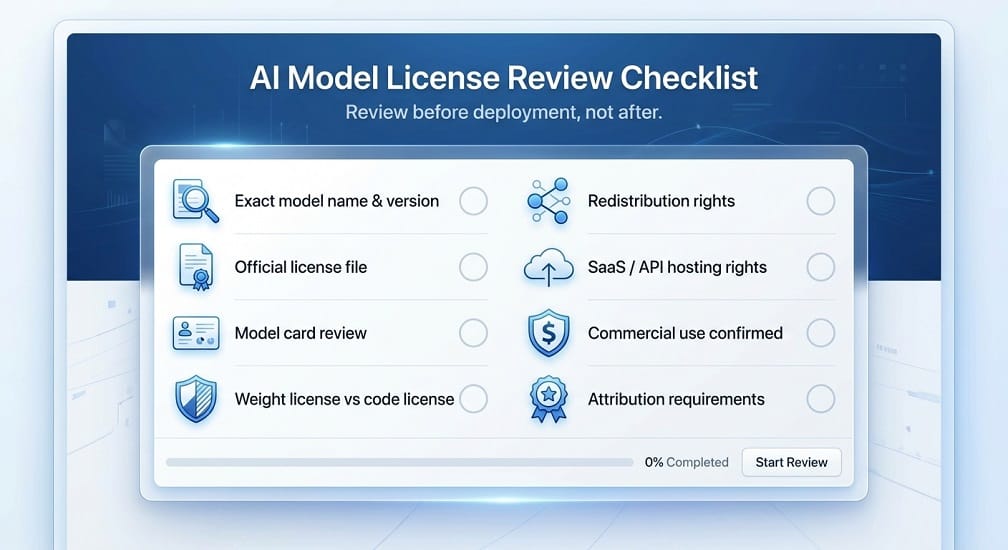
Before deploying Qwen, DeepSeek, GLM, or another open model, create a simple review checklist:
- Exact model name
- Exact version
- Model repository
- License file
- Model card
- Weight license
- Code license
- Dataset license
- Commercial-use terms
- Redistribution terms
- Derivative-model terms
- Fine-tuning terms
- API hosting terms
- Use restrictions
- Attribution requirements
This can prevent a common mistake:
Choosing a model first and discovering licensing restrictions after building the product.
The Simple Rule for AI Model Licensing
If you remember only one thing from this article, remember this:
Do not ask only “Is this AI model open source?” Ask “What exactly can I do with this specific model version under its specific license?”
That question is much more useful.
Can You Sell a Product Built With Qwen?
Generally, if the specific Qwen model you use permits commercial use, you can build a commercial product around it.
For example, the Qwen3 repository states that its open-weight models are released under Apache 2.0.
Potential commercial applications include:
- AI SaaS
- Coding assistants
- Internal enterprise tools
- Customer-support applications
- RAG applications
- AI agents
- Private copilots
- Model-powered APIs
However, separate components still need review.
For example, your application may contain:
Qwen Model
   +
Your Application Code
   +
Third-Party Libraries
   +
Training / RAG Data
   +
Customer Data
Each layer can have different legal and licensing requirements.
Can You Build a SaaS Around DeepSeek?
Potentially, yes.
This is particularly important because DeepSeek-V3's model license explicitly addresses remote access, including software-as-a-service use, while also imposing conditions on downstream use and redistribution.
So a company could potentially build:
- AI writing SaaS
- Coding platforms
- Enterprise assistants
- Research applications
- AI agents
- Developer APIs
But the business should comply with the exact model license.
The important distinction is:
“Commercial use allowed” does not mean “no license obligations.”
Can You Host Qwen or DeepSeek as an API?
Yes, where the applicable model terms permit it.
A typical architecture could look like:
- Customers
- Your API
- Authentication
- Inference Gateway
- Qwen / DeepSeek
- GPU Infrastructure
For a production deployment, you should also consider:
- Authentication
- Rate limiting
- Usage monitoring
- Logging
- Data retention
- GPU scaling
- Model updates
- License compliance
This is where private AI infrastructure becomes important.
A company running its own inference infrastructure has more control over:
- Customer data
- Source code
- Model access
- Network security
- Infrastructure costs
- Deployment policies
Can You Redistribute a Fine-Tuned Model?
This is one of the questions businesses should examine before starting fine-tuning.
Suppose you have:
- Qwen
- Company Dataset
- Fine-Tuning
- Custom Model
- Customer Distribution
You need to check the license of the original model and the rights associated with the dataset and other training material.
The question is not simply:
“Can I fine-tune it?”
You also need to ask:
“Can I distribute the resulting weights?”
And:
“What obligations must I pass to downstream users?”
Some model licenses explicitly address derivative models and redistribution. DeepSeek-V3, for example, contains downstream requirements for derivatives and redistribution.
What Happens When Model and Dataset Licenses Conflict?
This is an area many AI teams overlook.
Imagine:
- Open Model
- Restricted Dataset
- Fine-Tuned Model
The model may allow commercial use while the dataset does not.
For example, a dataset might have:
- Non-commercial restrictions
- Attribution requirements
- Research-only terms
- Restrictions on redistribution
Therefore:
A permissive model license does not automatically make your training data commercially usable.
For enterprise AI, particularly when trying to reduce cloud costs, review:
- Base model license
- Dataset license
- Data ownership
- Third-party content rights
- Fine-tuning framework license
- Resulting model distribution terms
Apache 2.0 vs MIT: Which Is Better for AI Businesses?
There is no universal winner.
Both are permissive licenses.
Apache 2.0
Apache 2.0 can be attractive when organizations want a clearly defined patent license and more detailed legal terms.
It is common in enterprise software ecosystems.
MIT
MIT is extremely simple and permissive.
Its short license makes it easy for developers and companies to understand and incorporate into software projects.
For AI Models
The most important question is not:
It is:
“What license applies to the actual model weights?”
A repository's code license may not be the same as the model-weight license.
Qwen vs DeepSeek vs GLM: Which Has the Most Permissive License?
There is no responsible one-word answer because the comparison depends on the exact model release.
For example:
| Model | Licensing Situation |
|---|---|
| Qwen3 open‑weight models | Apache 2.0 |
| DeepSeek‑R1 | MIT |
| DeepSeek‑V3 code | MIT |
| DeepSeek‑V3 model | Separate DeepSeek Model License |
| GLM‑4 | Apache 2.0 |
| GLM‑4.5 | Check exact repository/release terms |
Qwen3's official repository identifies Apache 2.0 for its open-weight models, while DeepSeek-R1's official repository uses MIT. DeepSeek-V3 separates its code license from its model license.
So the best model for your company should be selected based on both licensing and technical requirements.
AI Model License Compliance Checklist
Before putting an open model into production, use this checklist.
1. Identify the Exact Model
Don't write:
“We're using Qwen.”
Write:
“We're using [exact model name and version].”
The same principle applies to DeepSeek and GLM.
2. Download the Official License
3. Check the Model Card
Look for:
- License information
- Intended use
- Restrictions
- Training information
- Known limitations
- Responsible-use requirements
4. Check the Weight License
This is particularly important.
The license governing repository code may not govern the model weights.
5. Check Redistribution
Ask:
Can we distribute the original weights?
Then ask:
Can we distribute modified or fine-tuned weights?
6. Check SaaS Rights
If you are building a hosted application, verify whether remote access and API-based use are permitted.
7. Check Commercial Rights
Confirm that your exact use case qualifies as permitted commercial use.
8. Check Dataset Rights
If you're fine-tuning the model, review the training data separately.
9. Preserve Required Notices
Depending on the license, your product may need:
- Copyright notices
- License text
- NOTICE files
- Attribution
- Model information
AI Model License Review for Enterprises
Large organizations should consider adding AI licensing to their existing software-governance process.
A simple workflow integrated with DevOps is:
- Model Selection
- Technical Evaluation
- License Review
- Security Review
- Data Review
- Architecture Review
- Production Approval
- Deployment
This is better than selecting a model purely because it has a high benchmark score, and aligns with the AWS Well-Architected Framework.
License Compliance Should Continue After Deployment
Licensing is not a one-time decision.
Models can receive:
- New versions
- New repositories
- New licenses
- New restrictions
- Updated model cards
- Updated acceptable-use policies
Your team should therefore maintain a model inventory.
For example:
| Model | Version | License | Environment | Owner |
|---|---|---|---|---|
| Qwen | Exact version | Apache 2.0 | Production | AI Team |
| DeepSeek | Exact version | Model‑specific | Production | AI Team |
| GLM | Exact version | Verify release | Testing | ML Team |
This creates a basic AI software bill of materials.
What Developers Should Check Before Downloading a Model
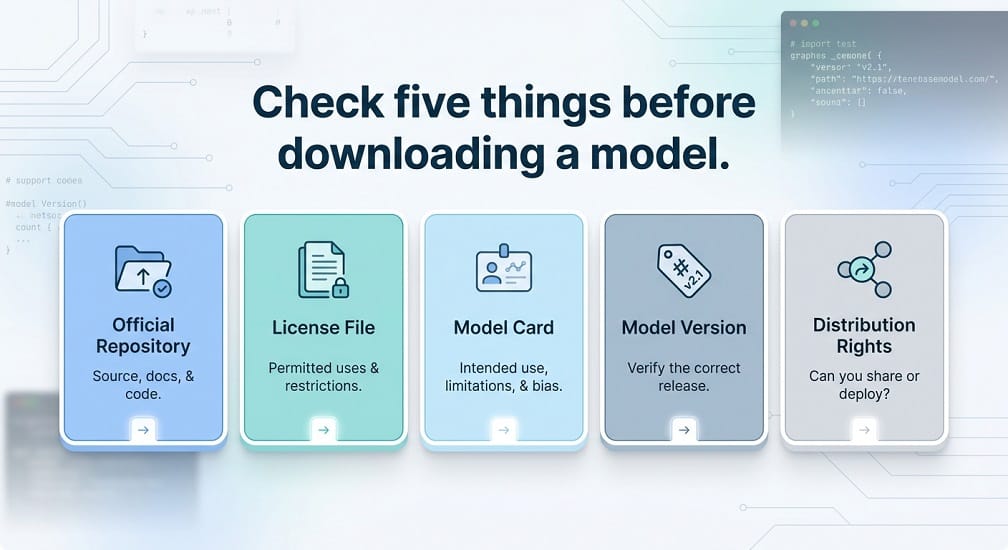
Before clicking Download, check five things:
1. Official Repository
Prefer the official project repository.
2. License File
Read the actual license.
3. Model Card
Check intended use and restrictions.
4. Model Version
Don't assume all generations have the same terms.
5. Distribution Rights
Especially if you're building a commercial product.
What Enterprises Should Check Before Self-Hosting
Self-hosting adds infrastructure responsibilities.
For Qwen, DeepSeek, GLM, or another open model running on Kubernetes, evaluate:
- GPU memory
- Inference engine
- Kubernetes
- Networking
- Authentication
- Secrets management
- Logging
- Monitoring
- Autoscaling
- Model storage
- Data retention
- Backup
- Disaster recovery
- License compliance
A typical private AI deployment could use:
Enterprise Users
       ↓
Internal AI Gateway
       ↓
Authentication
       ↓
AI Agent / RAG Layer
       ↓
Inference Server
       ↓
Qwen / DeepSeek / GLM
       ↓
GPU Nodes
       ↓
Kubernetes / AWS
For organizations that want private model infrastructure, EaseCloud can help with the infrastructure side of this process, including cloud architecture, Kubernetes, GPU deployment, inference infrastructure, monitoring, and cost optimization.
Open-Source AI Model Licensing: Common Mistakes
Mistake 1: Assuming Every Qwen Model Uses the Same License
Model families evolve.
Always check the exact release.
Mistake 2: Calling DeepSeek-V3 “MIT”
This is incomplete.
The repository code is MIT licensed, but DeepSeek-V3 model use is governed by a separate Model License.
Mistake 3: Ignoring the Dataset
A permissive model does not automatically give you rights to every dataset.
Mistake 4: Ignoring Redistribution
Building an internal application and distributing model weights to customers are different scenarios.
Mistake 5: Assuming Open Source Means No Restrictions
Some AI model releases have additional acceptable-use or downstream requirements.
Mistake 6: Relying on a Third-Party Blog
Licensing can change.
For production decisions, go back to:
- Official repository
- Official model card
- Official license
- Exact model version
Frequently Asked Questions
Is Qwen open source?
Qwen has released multiple open-weight model families under different licensing arrangements. The official Qwen3 repository states that its open-weight Qwen3 models are licensed under Apache 2.0.
Always verify the exact model version.
Is Qwen Apache 2.0?
For the open-weight Qwen3 models covered by the official Qwen3 repository, yes.
That does not mean every historical Qwen release should automatically be treated as Apache 2.0.
Is DeepSeek MIT licensed?
It depends on what you mean.
DeepSeek-R1's official repository uses MIT licensing, while DeepSeek-V3 separates its MIT-licensed code from a separate model license.
Can I use DeepSeek commercially?
For DeepSeek-R1, the official repository explicitly permits commercial use. DeepSeek-V3 also permits commercial use subject to its Model License.
Can I fine-tune Qwen?
The Qwen3 project supports fine-tuning workflows. Whether and how you can distribute a resulting model depends on the applicable license and the rights attached to other training components.
Can I build a SaaS product with DeepSeek?
Potentially yes. DeepSeek-V3's model license explicitly addresses remote access and SaaS, but downstream conditions still apply.
Which is better for commercial AI: Qwen or DeepSeek?
Licensing alone should not determine the decision.
Evaluate:
- Model quality
- Coding performance
- Context length
- Latency
- GPU requirements
- Inference cost
- License terms
- Data requirements
- Deployment architecture
For coding and agentic workloads, you can also compare the models directly in our Qwen vs DeepSeek for Coding article.
Final Verdict
The biggest lesson from Qwen, DeepSeek, and GLM licensing is simple:
Never evaluate an AI model's license from its name alone.
- Check the exact model.
- Check the exact release.
- Check the actual license file.
- Check the model card.
Then check whether those terms match your intended use.
For the current open-weight Qwen3 models, Apache 2.0 provides a permissive foundation. DeepSeek-R1 uses MIT and explicitly permits commercial use and derivative work, while DeepSeek-V3 requires additional attention because its code and model weights are governed by different licensing terms. GLM should likewise be evaluated by the exact release rather than by the GLM name alone.
For businesses, the safest workflow is:
Choose Model
     ↓
Verify Exact Version
     ↓
Read License
     ↓
Review Model Card
     ↓
Check Dataset Rights
     ↓
Check Commercial Use
     ↓
Check Redistribution
     ↓
Security Review
     ↓
Production Deployment
And when the model will run inside private AWS or Kubernetes infrastructure, licensing should be evaluated alongside security, GPU capacity, inference performance, scalability, and total operating cost.
That is where EaseCloud can fit naturally into the next stage: helping businesses move from model selection → license-aware architecture → private deployment → production AI infrastructure.
Summarize this post with: