Qwen vs DeepSeek API: Pricing, Performance & Which to Choose?
Compare Qwen vs DeepSeek API pricing, performance, coding, latency, context, deployment and features to choose the right API for your app.
Qwen API vs DeepSeek API: What Has Changed in 2026?
The API landscape is more flexible than a simple “Qwen versus DeepSeek” comparison suggests.
For Qwen, Alibaba Cloud Model Studio currently provides official Qwen APIs, OpenAI-compatible Chat Completions, an OpenAI-compatible Responses API, Anthropic-compatible Messages, and the native DashScope interface. It also exposes third-party models through Model Studio, including DeepSeek and GLM.
That means a developer can build against an OpenAI-style interface while changing the underlying model.
For example:
Your Application
       ↓
OpenAI SDK
       ↓
Compatible API
       ↓
Qwen Model
The same general architecture can be used with other compatible providers.
This makes API compatibility an important part of the Qwen vs DeepSeek decision.
TL;DR
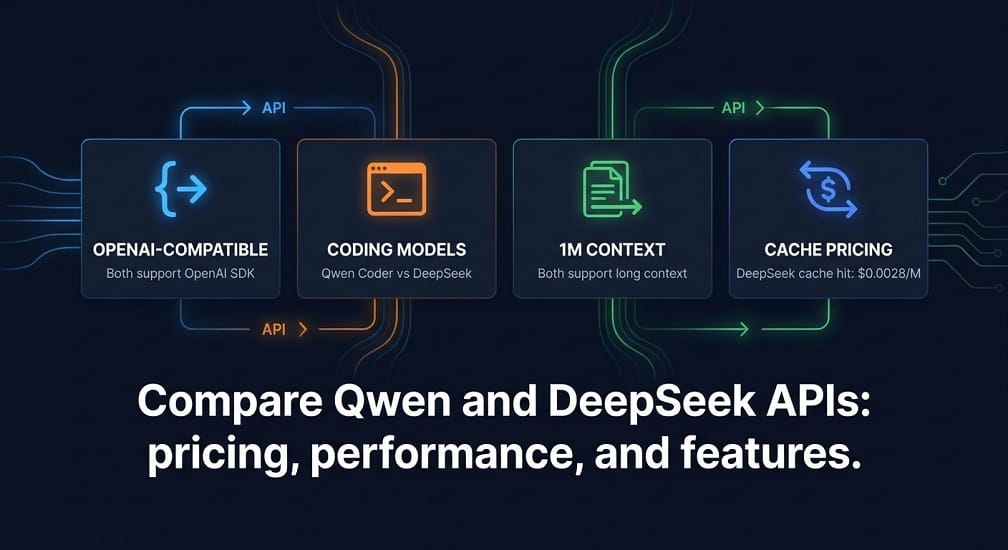
- Compare specific models, not providers. DeepSeek V4-Flash is very cheap ($0.14/M input, $0.28/M output, with cache as low as $0.0028/M). Qwen offers a broader range (general, coding, multimodal).
- Track cost per successful task, not token price. A cheap model that fails often costs more after retries. Benchmark on your real workload.
- Both support OpenAI-compatible APIs – easy to switch by changing key, base URL, and model. DeepSeek also offers Anthropic compatibility.
- For coding: Qwen Coder vs DeepSeek FIM – benchmark your own code tasks. For agents: both support tool calls; measure cost per completed workflow.
- Choose Qwen for model variety; choose DeepSeek for aggressive pricing and caching. The right answer comes from your own benchmark, not generic scores.
Qwen API: What Is It?
The Qwen API is Alibaba Cloud's hosted interface for accessing Qwen models through Model Studio.
Developers can obtain an API key and call Qwen through OpenAI-compatible endpoints or Alibaba Cloud's native DashScope interface.
Current Model Studio documentation lists multiple Qwen generations and variants, including models such as:
- Qwen3.7 Max
- Qwen3.7 Plus
- Qwen3.6 Flash
- Qwen3.5
- Qwen3 Coder
- Qwen3 Coder Flash
- Qwen3 Coder Plus
Availability varies by region and model.
This gives developers a fairly broad model selection instead of forcing every application onto one Qwen endpoint.
DeepSeek API: What Is It?
The DeepSeek API provides hosted access to DeepSeek's models through an API interface.
For developers, the important point is that the API can be integrated into applications without managing the GPU infrastructure required to run the model yourself.
A typical workflow is:
Application
    ↓
API Request
    ↓
DeepSeek API
    ↓
Model Inference
    ↓
API Response
This can be attractive for startups and development teams that want to test DeepSeek without immediately investing in GPU infrastructure.
Qwen API vs DeepSeek API: Quick Comparison
| Feature | Qwen API | DeepSeek API |
|---|---|---|
| Hosted API | Yes | Yes |
| OpenAI‑style integration | Yes | Yes |
| Coding models | Yes | Yes |
| Reasoning models | Yes | Yes |
| Multiple model choices | Yes | Yes |
| Streaming | Supported | Supported |
| Tool/agent workflows | Supported | Supported depending on model/API |
| Self‑hosting alternative | Yes | Yes |
| Enterprise deployment options | Strong | Strong |
| API‑only usage required | No | No |
The exact capabilities depend on the specific model and endpoint, so this table should not be treated as a promise that every Qwen or DeepSeek model supports every feature.
Qwen API OpenAI Compatibility
One of Qwen's biggest advantages for developers is compatibility with the OpenAI API format.
Alibaba Cloud's current documentation says developers can migrate existing OpenAI applications by changing the:
- API key
- Base URL
- Model name
The Qwen service supports OpenAI-compatible Chat Completions.
For example:
from openai import OpenAI
client = OpenAI(
    api_key="YOUR_QWEN_API_KEY",
    base_url="YOUR_QWEN_BASE_URL"
)
response = client.chat.completions.create(
    model="qwen3.7-plus",
    messages=[
        {
            "role": "user",
            "content": "Explain Kubernetes autoscaling."
        }
    ]
)
print(response.choices[0].message.content)
This is useful if your application already uses the OpenAI SDK.
Qwen Responses API
Qwen's API ecosystem has also moved beyond basic Chat Completions.
Alibaba Cloud currently documents an OpenAI-compatible Responses API for Qwen.
The Responses API is designed to simplify agent-style applications and can provide built-in capabilities such as web search, web scraping, code interpretation, and image-related tools for supported models.
This is important for developers building:
- AI agents
- Research assistants
- Coding agents
- Tool-using applications
- Multi-step workflows
So when comparing Qwen and DeepSeek APIs, don't look only at token prices.
API capabilities can be just as important as model pricing.
Qwen API for Coding
Qwen has a dedicated coding-model family.
Alibaba Cloud's current documentation lists models such as:
qwen3-coder-plusqwen3-coder-flashqwen3-coder-next
among its supported models.
There is also a dedicated Completions API for supported Qwen Coder models. Alibaba Cloud documents code completion and fill-in-the-middle workflows for qwen-coder-turbo.
That makes Qwen particularly interesting for:
- Code generation
- Code completion
- Repository assistants
- Coding agents
- Software engineering automation
DeepSeek API for Coding
DeepSeek has also built a strong reputation around coding and reasoning workloads.
For a developer, the practical comparison should therefore be:
Qwen Coder vs DeepSeek's current coding/reasoning models, rather than comparing the entire Qwen family with the entire DeepSeek family.
This distinction matters because model selection can have a larger effect on results than the provider itself.
For example:
General Qwen
     vs
DeepSeek Reasoning
is not necessarily a useful coding comparison.
A better evaluation is:
Qwen Coder
     vs
DeepSeek Coding / Reasoning Model
using the same prompts, repository context, tools, and output requirements.
Qwen API vs DeepSeek API for AI Agents
This is becoming one of the most important use cases.
A modern AI agent may need to:
- Understand the request
- Plan the task
- Call tools
- Read external information
- Generate structured output
- Execute actions
- Review results
- Retry when necessary
Qwen's current Responses API explicitly targets agent-style functionality and provides built-in tools for supported models.
A basic agent architecture looks like:
User
 ↓
AI Agent
 ↓
Qwen / DeepSeek
 ↓
Tool Call
 ↓
External System
 ↓
Tool Result
 ↓
Model
 ↓
Final Response
For this workload, the cheapest API is not necessarily the cheapest solution.
If one model completes a task in one attempt while another needs several retries, the actual cost can be very different.
API Pricing: What You Should Compare
The most common mistake when comparing Qwen pricing with DeepSeek pricing is looking at only one number.
You should compare:
- Input token price
- Output token price
- Cached input price, if offered
- Reasoning-token billing, where applicable
- Context size
- Batch pricing
- Free credits
- Minimum commitments
- Rate limits
- Regional pricing
Then calculate:
Cost per completed task
rather than simply:
Cost per million tokens
Token Pricing Is Not Your Total AI Cost
Suppose Model A costs less per million tokens.
That does not automatically make Model A cheaper.
Consider:
Model A
$1 / task
80% success rate
Model B
$1.40 / task
95% success rate
If failed requests require human review or multiple retries, Model B may have a better effective cost.
For production applications, measure:
Effective Cost
=
API Cost
+
Retry Cost
+
Tool Cost
+
Infrastructure Cost
+
Human Review Cost
This is especially important for AI agents.
Qwen API vs DeepSeek API for Startups
For an early-stage startup, API access is usually the easiest way to validate an AI product.
You avoid DevOps hurdles like:
- GPU procurement
- GPU scaling
- Kubernetes operations
- Model serving
- Driver management
- Capacity planning
The basic architecture becomes:
Startup Application
       ↓
Qwen / DeepSeek API
       ↓
Model Provider
This lets the team focus on:
- Product
- UX
- Prompting
- Evaluation
- Customer feedback
Instead of infrastructure.
When API Access Makes More Sense
Choose a hosted API when:
- You are still validating the product
- Traffic is unpredictable
- You have a small engineering team
- You want rapid deployment
- GPU operations are not your core competency
- You need access to the latest hosted models
When Self-Hosting Starts Making Sense
Self-hosting becomes more attractive when:
- API usage becomes large
- Traffic becomes predictable
- Data sensitivity increases
- You require network isolation
- You need custom inference settings
- You need greater control over latency
- Long-term GPU economics become favorable
The architecture then changes:
Application
     ↓
Internal API Gateway
     ↓
Inference Server
     ↓
Qwen / DeepSeek
     ↓
GPU Cluster
For larger deployments, that may become:
Applications
     ↓
API Gateway
     ↓
Kubernetes / EKS
     ↓
vLLM
     ↓
GPU Nodes
     ↓
Qwen / DeepSeek
This is where an infrastructure partner such as EaseCloud can become relevant.
Qwen API vs DeepSeek API: Which Should You Choose?
At this stage, the decision is fairly simple.
Choose Qwen API when you want:
- A broad Qwen model portfolio
- Dedicated coding models
- OpenAI-compatible integration
- Responses API support
- Agent-oriented capabilities
- Multimodal model options
- Multiple regional endpoints
Alibaba Cloud's current Model Studio documentation shows broad Qwen model availability and multiple API compatibility options.
Choose DeepSeek API when you want:
- DeepSeek's reasoning/coding capabilities
- A simple hosted API workflow
- Strong performance for software-related workloads
- A model alternative to Qwen for your evaluation set
But don't choose based on brand alone.
The correct choice should come from your own benchmark.
The Best Way to Benchmark Qwen vs DeepSeek API
Create a test set using your actual workload.
For example:
Coding
- 20 code-generation tasks
- 20 debugging tasks
- 10 refactoring tasks
Reasoning
- 20 reasoning tasks
- 10 structured-data tasks
Business
- 10 summarization tasks
- 10 extraction tasks
Qwen vs DeepSeek API Pricing
API pricing changes frequently, so the safest comparison is to use the current official pricing pages rather than older benchmark articles.
As of the latest official documentation, DeepSeek's API lists:
| Model | Cache Hit Input / 1M | Cache Miss Input / 1M | Output / 1M |
|---|---|---|---|
| DeepSeek‑V4‑Flash | $0.0028 | $0.14 | $0.28 |
| DeepSeek‑V4‑Pro | $0.003625 | $0.435 | $0.87 |
Both models currently list a 1M-token context length, with maximum output of up to 384K tokens.
Qwen pricing varies significantly by model and deployment region. For example, Alibaba Cloud currently lists Qwen3.7-Plus at $0.276 per 1M input tokens and $1.101 per 1M output tokens for the global pricing shown in its Model Studio documentation, for requests up to 256K input tokens. Higher input-token tiers have different prices.
This immediately shows why comparing only the brand names is misleading.
You need to compare:
Qwen model ↔ DeepSeek model
rather than:
Qwen provider ↔ DeepSeek provider
DeepSeek Has a Major Cache-Pricing Advantage
One of the most interesting differences is cached input.
DeepSeek's current pricing lists cache-hit input at only:
- $0.0028/M for DeepSeek-V4-Flash
- $0.003625/M for DeepSeek-V4-Pro
compared with:
- $0.14/M cache miss for V4-Flash
- $0.435/M cache miss for V4-Pro.
That matters for applications that repeatedly send the same context.
Examples include:
- Long system prompts
- Large documentation sets
- Repeated repository context
- Multi-turn conversations
- Agent workflows
- Repeated RAG context
If your application repeatedly sends the same prefix, caching can significantly reduce the effective input cost for RAG and multi-turn workflows.
Qwen Also Supports Context Caching
Qwen's Model Studio pricing documentation also supports context caching for supported models.
Alibaba Cloud notes that cached input can receive a different price from standard input, and some models support both explicit and implicit caching.
This means the correct production calculation is not simply:
Input tokens × standard input price
Instead:
Total Input Cost
=
Cache Hit Tokens × Cache-Hit Price
+
Cache Miss Tokens × Standard Price
For applications with large repeated contexts, this can make a major difference.
Example: 1 Million Input + 200K Output Tokens
Suppose your application uses:
- 1M input tokens
- 200K output tokens
- No caching
Using the current DeepSeek prices:
DeepSeek-V4-Flash
Input:
1M × $0.14 = $0.14
Output:
0.2M × $0.28 = $0.056
Total:
$0.196
DeepSeek-V4-Pro
Input:
1M × $0.435 = $0.435
Output:
0.2M × $0.87 = $0.174
Total:
$0.609
These are simple list-price calculations and don't include other possible discounts or deployment-specific arrangements.
The same calculation should be performed for the specific Qwen model and region you intend to use.
Why Qwen Pricing Is More Complicated
Alibaba Cloud's current pricing page contains multiple Qwen generations and deployment scopes.
Pricing can change based on:
- Model
- Region
- Input length
- Thinking/non-thinking mode
- Batch inference
- Context caching
- Deployment scope
For example, Qwen3.7-Plus has different pricing tiers depending on whether the request is below or above 256K input tokens.
Therefore, publishing one number such as:
“Qwen API costs $X per million tokens”
can quickly become inaccurate.
The article should always identify the model + region + pricing tier.
Qwen vs DeepSeek API: Context Window
Context length is increasingly important for modern applications.
DeepSeek's current V4 API documentation lists a 1M-token context length for both DeepSeek-V4-Flash and DeepSeek-V4-Pro.
Qwen's current API portfolio also includes models supporting very large contexts.
For example, the current Model Studio pricing page lists Qwen3.7-Max with up to 1M input tokens, while other Qwen models have smaller context limits.
So neither provider can simply be called the “long-context winner.”
Instead, compare the exact models.
Why Context Length Matters
A large context window is useful for:
- Large repositories
- Long documents
- Legal documents
- Technical manuals
- RAG applications
- Multi-turn conversations
- Agent memory
- Code analysis
For a coding agent, this could mean putting more repository information into one request.
For example:
Repository
├── frontend/
├── backend/
├── database/
├── tests/
├── infrastructure/
└── documentation/
             ↓
       AI Coding Agent
             ↓
       Qwen / DeepSeek
But more context does not automatically mean better results.
Sending unnecessary information can increase:
- Cost
- Latency
- Processing requirements
- Complexity
The best system retrieves relevant context, rather than blindly sending the entire repository.
Qwen vs DeepSeek API for Coding
For coding applications, the comparison should focus on:
- Code generation
- Code completion
- Debugging
- Refactoring
- Repository understanding
- Tool use
- Agentic coding
- Structured output
- FIM completion
- Test-driven workflows
DeepSeek's current API supports FIM completion in beta for DeepSeek-V4-Pro, which is particularly relevant to IDE-style code completion.
Qwen also maintains dedicated coding models in its API portfolio.
That makes both providers relevant for developer tools.
Which API Is Better for Coding?
There is no universal winner.
For IDE completion, evaluate:
- Completion accuracy
- FIM quality
- Latency
- Tokens per second
- Context handling
For AI coding agents, evaluate:
- Tool calling
- Repository reasoning
- Multi-step success rate
- Test execution
- Retry rate
- Cost per completed issue
For example:
Developer Issue
      ↓
AI Agent
      ↓
Read Repository
      ↓
Plan
      ↓
Edit Files
      ↓
Run Tests
      ↓
Analyze Failure
      ↓
Fix
      ↓
Success
The model that completes the entire workflow most reliably may be cheaper even if its token price is higher.
Qwen vs DeepSeek API for Tool Calling
Both current APIs support tool-oriented workflows.
DeepSeek's current V4 documentation lists Tool Calls and JSON output for both V4-Flash and V4-Pro.
DeepSeek's thinking mode also supports tool calls and multi-step tool interaction.
Qwen's API ecosystem similarly supports tool-oriented and agent workflows, particularly through its Responses API for supported models.
For an agent, this is more important than simple text generation.
Qwen vs DeepSeek API for Structured Output
Structured output is useful when your model response feeds another system.
For example:
{
  "customer_intent": "refund",
  "priority": "high",
  "confidence": 0.94
}
Instead of:
The customer appears to want a refund and seems quite frustrated.Structured output is useful for:
- Workflow automation
- Data extraction
- CRM systems
- Classification
- API orchestration
- AI agents
DeepSeek's current V4 models explicitly list JSON output support.
When comparing Qwen, use the same schema and evaluate:
- Valid JSON rate
- Schema compliance
- Retry rate
- Extraction accuracy
Qwen vs DeepSeek API Latency
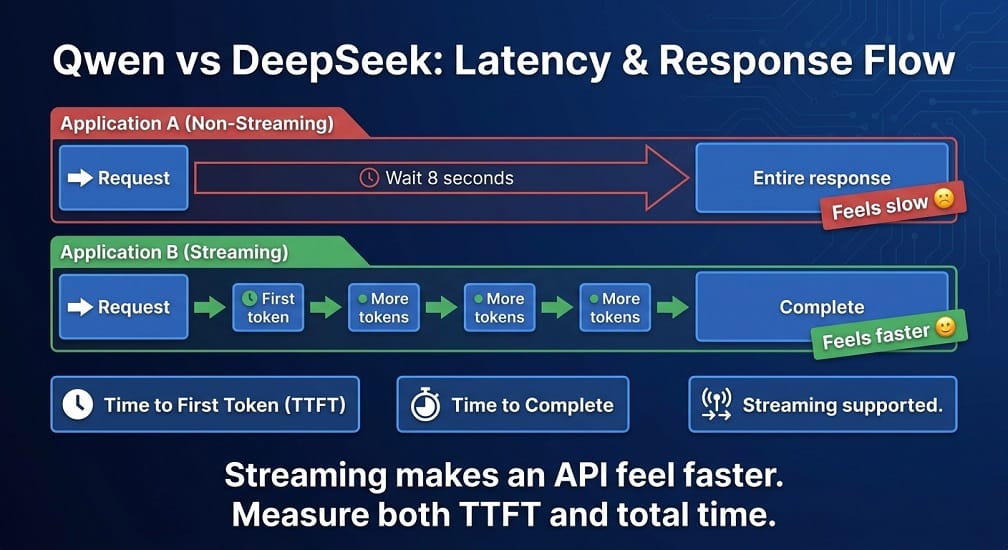
Latency should be measured in two parts:
Time to First Token
How quickly the first part of the response arrives.
Time to Complete
How long the entire response takes.
For interactive applications, first-token latency can be extremely important.
For batch processing, total completion time may matter more.
DeepSeek's documentation supports streaming responses, and its FAQ explains that streaming allows output to be returned incrementally rather than waiting for the entire response.
Streaming Makes an API Feel Faster
Consider two applications.
Application A
Request
   ↓
Wait 8 seconds
   ↓
Entire response
Application B
Request
   ↓
First token
   ↓
More tokens
   ↓
More tokens
   ↓
Complete
Even if both take roughly the same total time, Application B can feel much faster.
For chatbots, coding assistants, and customer-facing AI applications, streaming should therefore be part of your evaluation.
DeepSeek API Concurrency
Current DeepSeek documentation lists account-level concurrency limits of:
- 500 for DeepSeek-V4-Pro
- 2,500 for DeepSeek-V4-Flash
DeepSeek also says customers can request higher capacity when needed.
This matters when your application moves beyond a prototype.
For example:
10 users
    ↓
100 requests/minute
is very different from:
10,000 users
       ↓
50,000 concurrent operations
At larger scale, concurrency becomes an architecture problem—not simply an API pricing problem.
What About Qwen API Throughput?
Qwen's Model Studio documentation provides both pay-as-you-go and dedicated model deployment options.
For dedicated deployments, Alibaba Cloud documents throughput-oriented purchasing based on TPM and provides subscription and pay-as-you-go deployment options for supported models.
This gives enterprises another option when predictable capacity becomes important.
Instead of:
Application
   ↓
Shared API
you can move toward:
Application
   ↓
Dedicated Model Capacity
   ↓
Qwen
That can be useful for workloads requiring predictable throughput.
API vs Dedicated Deployment
This creates an important decision point.
Hosted API
Best when you want:
- Simplicity
- Rapid launch
- No GPU management
- Flexible usage
- Easy experimentation
Dedicated Model Capacity
Better when you need:
- Predictable throughput
- Capacity planning
- More control
- Consistent performance
Self-Hosted Model
Best when you need:
- Private infrastructure
- Maximum control
- Custom inference
- Data isolation
- Potential infrastructure optimization at high volume
Qwen vs DeepSeek: Which Is Cheaper?
There is no single answer.
At the current published prices, DeepSeek-V4-Flash has very low token pricing, particularly for cached input.
Qwen, meanwhile, offers a wide range of models with significantly different pricing. Some smaller Qwen models are inexpensive, while higher-end models cost considerably more.
So the useful question is:
Which model gives the lowest cost for my required level of quality?
Not:
Which provider has the lowest token price?
The Better Cost Metric: Cost per Successful Task
For production systems, calculate:
Cost per Successful Task
=
Total API Spend
÷
Successfully Completed Tasks
Suppose:
Qwen
$100 API spend
1,000 successful tasks
Cost:
$0.10 per successful task
DeepSeek
$70 API spend
500 successful tasks
Cost:
$0.14 per successful task
Even though DeepSeek used less money overall, Qwen produced the lower cost per successful task.
This is the metric an enterprise should care about.
Practical Qwen vs DeepSeek API Verdict
At this point, the decision looks like this:
Qwen is attractive when you need:
- Multiple model choices
- Strong coding-model options
- OpenAI-compatible APIs
- Agent-oriented interfaces
- Large-context models
- Flexible Alibaba Cloud deployment options
DeepSeek is attractive when you need:
- Very competitive token economics
- Strong reasoning/coding capabilities
- Large context
- Tool calling
- JSON output
- High concurrency on supported models
- OpenAI and Anthropic API compatibility
DeepSeek's current V4 API documentation lists 1M context, JSON output, tool calls, and both OpenAI and Anthropic-compatible endpoints.
One Important Warning Before Choosing
Do not publish or rely on a fixed Qwen-vs-DeepSeek price table without a “last checked” date.
Both providers can change:
- Model names
- Prices
- Regional availability
- Context limits
- Rate limits
- API features
- Deprecation schedules
DeepSeek explicitly states that its product prices can change and recommends checking the pricing page regularly.
For your published article, add:
Pricing and model availability checked: August 2026.
Then update the table whenever the providers change their pricing.
Qwen vs DeepSeek API: Which One Should You Choose?
After comparing pricing, context, API features, coding support, caching, and concurrency, the answer is not simply “Qwen” or “DeepSeek.”
The better choice depends on what you are building.
For the current API landscape, DeepSeek's V4 API offers 1M context, JSON output, tool calls, OpenAI-compatible and Anthropic-compatible interfaces, while Qwen's Model Studio provides a much broader portfolio of Qwen models and multiple API interfaces.
Here is the practical breakdown.
Best API for Startups: Qwen or DeepSeek?
For a startup building its first AI product, prioritize:
- Simple integration
- Low initial cost
- Reliable API access
- Good coding/reasoning quality
- Easy model switching
- Flexible scaling
Both can work.
Choose DeepSeek when:
You want to test a strong model at very competitive token prices.
DeepSeek-V4-Flash currently lists $0.14 per 1M cache-miss input tokens and $0.28 per 1M output tokens, while V4-Pro lists $0.435 and $0.87 respectively.
Choose Qwen when:
You want a larger selection of model variants, including general, coding, multimodal, and smaller models.
Alibaba Cloud's current pricing catalog includes Qwen models ranging from smaller Qwen3 variants to large-context Qwen3.7 models and specialized multimodal and coding models.
Startup verdict
Start with the model that performs best on your own workload, then optimize cost after you have real usage data.
Best API for Coding
This is one of the most important comparisons for your existing search cluster because your GSC data already shows strong interest in:
- DeepSeek vs Qwen for coding
- Qwen vs DeepSeek coding
- Qwen or DeepSeek for coding
- Qwen vs DeepSeek coding performance
For coding, test dedicated coding models where available rather than comparing generic chat models.
Qwen's API catalog includes dedicated Qwen Coder models, while DeepSeek-V4-Pro currently supports FIM completion in beta.
For IDE autocomplete
Measure:
- Time to first token
- Completion acceptance rate
- Fill-in-the-middle accuracy
- Number of irrelevant suggestions
- Context handling
For coding agents
Measure:
- Repository understanding
- Tool calls
- Code changes
- Test success
- Debugging
- Number of retries
- Cost per completed issue
The winner for autocomplete may not be the winner for autonomous coding.
Best API for AI Agents
AI agents need more than text generation.
They need:
- Tool calling
- Structured output
- Long context
- Multi-step reasoning
- Reliable API responses
- Good latency
- Caching
DeepSeek's current V4 API supports tool calls and JSON output. Its API also provides strict-mode options for tool-call schemas.
Qwen's Model Studio provides OpenAI-compatible interfaces and a Responses API for supported Qwen models, making it suitable for agent-oriented applications.
Agent verdict
Don't choose based on token price alone.
Benchmark:
Agent Task
   ↓
Planning
   ↓
Tool Call
   ↓
Tool Result
   ↓
Reasoning
   ↓
Second Tool Call
   ↓
Final Answer
Then calculate the cost per successful workflow.
Best API for Large Documents
Both providers now have models with very large context windows.
DeepSeek-V4-Pro and V4-Flash list a 1M-token context length and up to 384K maximum output in the current API documentation.
Alibaba Cloud's current Model Studio catalog also includes Qwen models supporting up to 1M-token input contexts.
This makes both suitable candidates for:
- Large document analysis
- Repository analysis
- Research
- Long conversations
- Enterprise RAG
But don't automatically send a million tokens.
A good RAG system should retrieve the most relevant information, not the maximum amount of information.
Best API for High-Volume Applications
At scale, concurrency becomes critical.
DeepSeek currently lists account-level concurrency limits of:
- 2,500 for V4-Flash
- 500 for V4-Pro
DeepSeek says businesses can request higher capacity, with no additional cost for capacity expansion.
This is useful for applications with large parallel workloads.
But concurrency isn't the same as throughput.
You still need to measure:
- Requests per second
- Tokens per second
- Time to first token
- Completion latency
- Error rate
- Retry rate
Qwen vs DeepSeek API for Enterprise
Enterprise buyers should add several factors that individual developers may ignore.
1. Data Handling
Alibaba Cloud's Model Studio FAQ says data transmitted when building applications or training models is encrypted with AES-256 and states that Alibaba Cloud does not use customer data for model training.
DeepSeek's API documentation also provides mechanisms such as user_id isolation for content safety, KV-cache isolation, and scheduling isolation.
However, enterprise teams should always review the current provider terms, privacy documentation, contractual commitments, and applicable regional requirements before sending sensitive information.
2. Data Residency
Data residency can become more important than model price.
Ask:
- Where does the request go?
- Where is inference performed?
- Where are logs stored?
- Where are caches stored?
- Can data remain in a specific region?
- Are cross-border transfers involved?
For regulated or sensitive workloads, these questions should be answered before production deployment.
3. Security
At minimum, evaluate:
- API-key management
- Network security
- Access control
- Logging
- Encryption
- Data retention
- Abuse controls
- Tenant isolation
Never put an API key directly into frontend JavaScript.
Use:
User
 ↓
Your Backend
 ↓
Secure API Key
 ↓
Qwen / DeepSeek
Not:
Browser
 ↓
API Key
 ↓
Qwen / DeepSeek
Qwen vs DeepSeek API: Vendor Lock-In
OpenAI-compatible APIs make migration easier, but compatibility does not mean zero lock-in.
Your application may eventually depend on:
- Model-specific prompts
- Tool schemas
- Context behavior
- Reasoning behavior
- Tokenization
- Structured-output behavior
- Provider-specific features
Therefore, build a model abstraction layer when practical.
For example:
Your Application
       ↓
LLM Gateway
       ↓
 ┌─────┼─────┐
 ↓     ↓     ↓
Qwen DeepSeek Other
This lets you switch models without rewriting the entire application.
Qwen API vs DeepSeek API: API Compatibility
Qwen's Model Studio supports OpenAI-compatible API calls. Alibaba Cloud's documentation says migration from OpenAI can involve changing the API key, base URL, and model name.
DeepSeek also provides OpenAI-compatible Chat Completions and an Anthropic-compatible API.
This is a major advantage for developers.
You can often reuse existing SDK patterns:
OpenAI SDK
     ↓
Change Provider
     ↓
Change Base URL
     ↓
Change Model
     ↓
Test Prompts
     ↓
Validate Output
But always test the application after migration.
API compatibility does not guarantee identical model behavior.
Qwen vs DeepSeek API: API or Self-Hosting?
This is the next major decision.
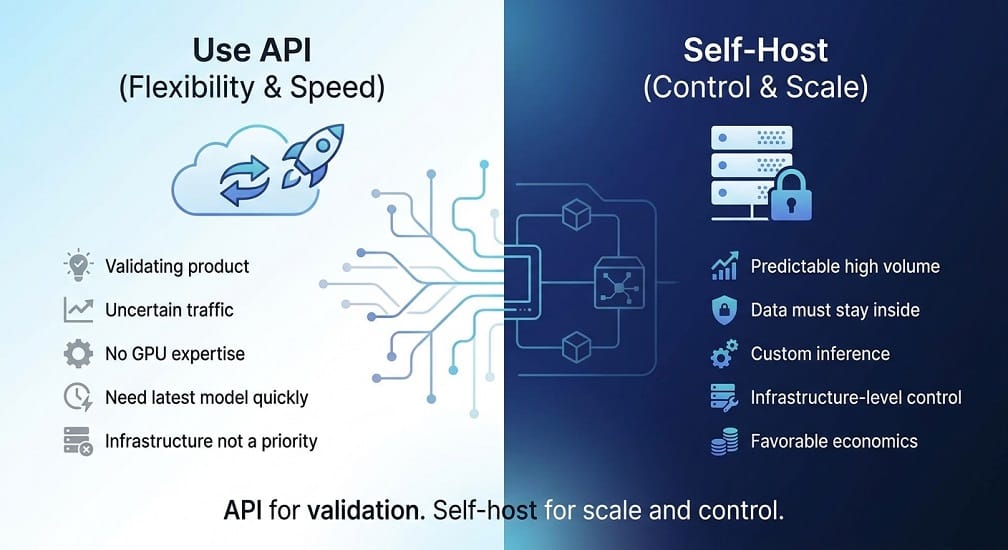
Use an API if:
- You're validating a product
- Traffic is still uncertain
- You don't have GPU expertise
- You need the latest hosted model quickly
- Infrastructure management isn't your priority
Self-host if:
- You have predictable high volume
- Data needs to stay inside your environment
- You need custom inference
- You need network isolation
- You want infrastructure-level control
- Your economics support GPU ownership or dedicated capacity
When Does Self-Hosting Become Cheaper?
There is no universal request volume at which self-hosting suddenly becomes cheaper.
Calculate your total Cloud Costs:
Hosted API Cost
=
Input Tokens
+
Output Tokens
+
Retries
+
Tool Calls
Then compare:
Self-Hosting Cost
=
GPU
+
Storage
+
Networking
+
Kubernetes
+
Inference Server
+
Monitoring
+
Engineering
+
Maintenance
A model may have cheap API pricing but still be the better choice if self-hosting requires a large GPU cluster.
Conversely, very high and predictable usage can make dedicated infrastructure attractive.
Qwen vs DeepSeek on AWS
If your organization already uses AWS, you have another option:
Application
    ↓
AWS
    ↓
EKS / Kubernetes
    ↓
Inference Layer
    ↓
Qwen / DeepSeek
    ↓
GPU Nodes
A private deployment can provide more control over:
- Networking
- Data flows
- Authentication
- Observability
- Scaling
- Model versions
- Infrastructure configuration
The trade-off is operational complexity.
EaseCloud's Role in the Deployment Decision
This is where EaseCloud should be positioned naturally rather than inserted as a generic advertisement.
If a company decides that a hosted Qwen or DeepSeek API is no longer the best architecture, the next question becomes:
How do we run the model reliably in our own cloud environment?
That can involve:
- AWS architecture
- GPU infrastructure
- Kubernetes
- Amazon EKS
- vLLM
- Model serving
- Autoscaling
- Monitoring
- Cost optimization
- Security
- LLMOps
EaseCloud can support that transition from API experimentation to private AI infrastructure.
A Practical Qwen vs DeepSeek Decision Matrix
| Use Case | Better Starting Point |
|---|---|
| Quick prototype | Either |
| Lowest API cost | DeepSeek V4‑Flash is highly competitive |
| Large model portfolio | Qwen |
| Coding | Benchmark Qwen Coder vs DeepSeek |
| AI agents | Benchmark both |
| Long context | Both have strong options |
| OpenAI‑compatible integration | Both |
| Anthropic‑compatible integration | DeepSeek |
| Private deployment | Evaluate model‑by‑model |
| Enterprise workloads | Evaluate security + residency + cost |
| High‑volume workloads | Compare concurrency and total cost |
| Maximum infrastructure control | Self‑hosting |
This is a starting recommendation, not a universal ranking.
How to Actually Choose Between Qwen and DeepSeek
Use this five-step process.
Step 1: Pick the Top Two Models
Don't benchmark ten models.
Start with:
Qwen candidate
vs
DeepSeek candidate
Step 2:
Don't rely only on public benchmarks.
Use:
- Real customer questions
- Real coding tasks
- Real documents
- Real agent workflows
Step 3:
Track:
- Accuracy
- Task completion
- Hallucination rate
- Code correctness
- Structured-output validity
Step 4: Measure Economics
Track:
- Input tokens
- Output tokens
- Cache hits
- Retries
- Tool calls
- Cost per successful task
Step 5: Test Production Behavior
Measure:
- Latency
- Concurrency
- Error rate
- Rate-limit behavior
- Streaming
- Failure recovery
Then choose the winner.
Final Verdict: Qwen or DeepSeek API?
Choose Qwen if your priority is:
Model variety + coding options + flexible Alibaba Cloud model infrastructure + OpenAI-compatible integration.
Qwen's current Model Studio catalog covers a wide range of general, coding, multimodal, and long-context models.
Choose DeepSeek if your priority is:
Competitive API economics + strong reasoning/coding capabilities + large context + tool calling + OpenAI/Anthropic compatibility.
DeepSeek-V4-Flash and V4-Pro currently provide 1M context, tool calls, JSON output, and both OpenAI and Anthropic API formats.
For serious production workloads:
Benchmark both before committing.
That is the most defensible recommendation.
Qwen vs DeepSeek API FAQ
Is Qwen API cheaper than DeepSeek API?
It depends on the exact models, region, context tier, and caching.
Current Qwen pricing varies considerably across its model portfolio, while DeepSeek currently lists V4-Flash at $0.14/M cache-miss input and $0.28/M output, with even lower cache-hit input pricing.
Which is better for coding, Qwen or DeepSeek?
Both are strong candidates.
Compare a Qwen Coder model against the specific DeepSeek model you intend to use, using your own repository and coding tasks.
Which is better for AI agents?
Both can work well.
DeepSeek currently supports tool calls and JSON output, while Qwen provides agent-oriented API capabilities through supported Model Studio interfaces.
Does DeepSeek support OpenAI API format?
Yes. DeepSeek provides an OpenAI-compatible API. It also currently provides an Anthropic-compatible interface.
Does Qwen support OpenAI API format?
Yes. Alibaba Cloud Model Studio provides an OpenAI-compatible interface for Qwen models.
Which has a larger context window?
Current DeepSeek V4-Flash and V4-Pro list 1M-token context. Qwen's current portfolio also contains models with up to 1M-token input contexts.
Should I use Qwen or DeepSeek for a SaaS product?
Either can be appropriate.
Start with the API that gives you the best combination of:
- Quality
- Price
- Latency
- Reliability
- Data handling
- Required features
Then keep your architecture flexible enough to change models.
Should I self-host Qwen or DeepSeek?
Whether you should self-host makes more sense when you need greater infrastructure control, predictable high-volume economics, or private deployment.
For smaller or unpredictable workloads, a hosted API is usually simpler.
Final Recommendation
For most teams, the best path is:
Start with the API → benchmark real workloads → measure cost per successful task → scale → consider private deployment when the economics or security requirements justify it.
For Qwen and DeepSeek specifically, don't choose based on a generic benchmark or a single token-price number.
Choose the specific model that performs best for your workload at an acceptable total cost.
And if that workload eventually moves from API calls to private GPU infrastructure, that's the point where an AWS/Kubernetes/LLMOps architecture becomes worth evaluating with EaseCloud.
Summarize this post with: