Qwen Coder vs DeepSeek Coder: Which AI Model Is Better in 2026?
Compare Qwen Coder vs DeepSeek Coder for code generation, benchmarks, AI agents, pricing, deployment, and enterprise software development.
AI coding models are rapidly changing how software teams write, review, debug, and maintain code. Developers can now use large language models for tasks ranging from simple code completion to repository-level analysis, bug fixing, test generation, refactoring, and autonomous coding agents.
Two of the most important open-weight model families in this space are Qwen Coder and DeepSeek Coder.
Both model families are designed for software engineering workloads, but they come from different ecosystems and have evolved through different approaches to code generation, reasoning, long-context understanding, and agentic development.
For developers and businesses, the question is not simply:
Which model has the highest benchmark score?
The more important questions are:
- Which model generates better production-ready code?
- Which is better at debugging and refactoring?
- Which handles large codebases more effectively?
- Which model is better for coding agents?
- Which offers better deployment flexibility?
- Which is more cost-effective to run?
- Should you use an API or self-host the model?
- Which model is the better choice for an enterprise development environment?
This guide compares Qwen Coder and DeepSeek Coder across the factors that matter most for real-world software engineering.
What This Guide Covers
- Model families and variants
- Coding capabilities
- Programming language support
- Repository-level understanding
- Context and codebase analysis
- Coding benchmarks
- AI coding agents
- APIs and pricing
- Local deployment
- Ollama and vLLM
- Kubernetes and AWS deployment
- Enterprise software development
The goal is to help developers, engineering leaders, CTOs, and businesses choose the right model based on their actual development workflows rather than relying on a single benchmark leaderboard.
What Is Qwen Coder?
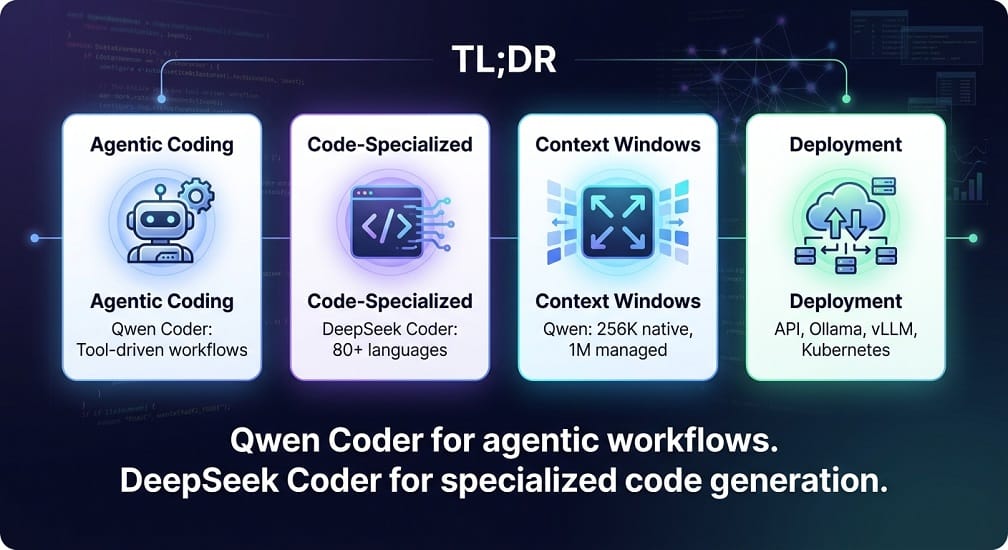
Qwen Coder is a key player in the Open Source vs Proprietary LLMs landscape and the coding-focused branch of the Qwen model ecosystem. Its latest generation, Qwen3-Coder, is designed specifically for software engineering, agentic coding, tool use, and large-scale development workflows.
The Qwen team describes Qwen3-Coder as its most agentic code model family, with models including Qwen3-Coder-480B-A35B-Instruct, Qwen3-Coder-30B-A3B-Instruct, and Qwen3-Coder-Next. The open-weight models support a native context length of 256K tokens, while Qwen's managed coding offerings provide additional long-context options and coding-focused tooling.
Unlike a traditional code-completion model, Qwen Coder is designed to handle broader software engineering workflows.
For teams building an Internal Developer Platform, typical use cases include:
- Code generation
- Code completion
- Bug fixing
- Refactoring
- Repository analysis
- Test generation
- API development
- DevOps automation
- Infrastructure as Code
- Tool calling
- Agentic coding workflows
One important part of the Qwen ecosystem is Qwen Code, a command-line coding agent designed to work with Qwen models and developer workflows. This makes Qwen Coder particularly relevant for teams building autonomous or semi-autonomous coding systems rather than simple autocomplete tools.
Key Strengths of Qwen Coder
- Strong agentic coding capabilities
- Large-context codebase analysis
- Function and tool calling
- Repository-level tasks
- Open-weight deployment options
- Local development support
- Integration with vLLM and other inference frameworks
- Dedicated Qwen Code tooling
- Support for structured outputs and coding workflows
Qwen3-Coder's current open model lineup also includes smaller and more deployable options alongside its large Mixture-of-Experts model, giving engineering teams flexibility when balancing capability, latency, and infrastructure requirements.
What Is DeepSeek Coder?
DeepSeek Coder is a family of code language models developed by DeepSeek AI and trained specifically for programming and software development tasks.
The original DeepSeek Coder family was trained from scratch on 2 trillion tokens, with training data consisting of approximately 87% code and 13% natural language in English and Chinese. The family included models ranging from approximately 1B to 33B parameters and was designed for code generation, project-level completion, and code infilling.
A notable part of DeepSeek Coder's original design was its focus on project-level code understanding. The models used a 16K context window and were trained with an additional fill-in-the-blank objective to improve code completion and infilling tasks.
Key Strengths of DeepSeek Coder
- Code generation
- Code completion
- Code infilling
- Project-level programming tasks
- Algorithm implementation
- Debugging
- Mathematical and logical programming
- Multi-language code support
- Flexible model sizes
DeepSeek Coder was trained across more than 80 programming languages, including Python, JavaScript, TypeScript, Java, C, C++, Go, Rust, PHP, SQL, Solidity, Shell, Dockerfile, and many others.
This makes DeepSeek Coder particularly useful for organizations that work across multiple technology stacks.
Qwen Coder vs DeepSeek Coder: Core Difference
The biggest difference between the two is their overall approach to AI-assisted software development.
Qwen Coder
Qwen Coder is increasingly focused on agentic software engineering.
The model family is designed not only to generate code but also to interact with tools, execute multi-step tasks, work across development environments, and support coding-agent workflows.
Its strengths are particularly relevant for:
- Coding agents
- Tool use
- Repository-wide tasks
- Long-context code analysis
- Multi-step engineering workflows
- Automated development environments
Qwen's official Qwen3-Coder release specifically emphasizes agentic coding and tool use, and the ecosystem includes dedicated Qwen Code tooling.
DeepSeek Coder
DeepSeek Coder was built with a stronger traditional focus on code-specialized language modeling.
Its training emphasizes code-heavy data, broad programming language coverage, project-level completion, and fill-in-the-middle tasks.
This makes the DeepSeek Coder lineage particularly relevant for:
- Code generation
- Code completion
- Infilling
- Algorithm development
- Multi-language programming
- Local and self-hosted coding assistants
The key takeaway is:
Qwen Coder is increasingly positioned around agentic coding and tool-driven software engineering, while DeepSeek Coder's original specialized family focused heavily on code generation, completion, and project-level programming tasks.
That distinction becomes important when choosing a model for a modern development environment.
Qwen Coder vs DeepSeek Coder Model Families
Both ecosystems offer different model sizes and generations.
Qwen Coder Model Family
The current Qwen3-Coder family includes:
- Qwen3-Coder-Next
- Qwen3-Coder-Next-Base
- Qwen3-Coder-30B-A3B-Instruct
- Qwen3-Coder-480B-A35B-Instruct
The larger 480B model uses a Mixture-of-Experts architecture with 35B active parameters, while the model family provides a native 256K context window in its open-weight releases.
Qwen also provides managed coding models such as qwen3-coder-plus, with current documentation listing a context window of up to 1 million tokens for that API offering.
This gives Qwen a significant advantage for workflows involving very large repositories or long development sessions.
DeepSeek Coder Model Family
The original DeepSeek Coder lineup includes model sizes such as:
- 1.3B
- 5.7B
- 6.7B
- 33B
These variants allow developers to select a model based on available hardware and workload requirements.
Smaller models can be useful for:
- Local development
- Lightweight coding assistants
- Lower-cost inference
- Resource-constrained environments
Larger models are better suited for:
- Complex code generation
- Repository analysis
- More advanced debugging
- Enterprise software development
Architecture and Development Approach
The two model families also differ in how their ecosystems have evolved.
Qwen Coder's Approach
Qwen3-Coder builds on the broader Qwen model ecosystem while emphasizing coding and agentic capabilities.
The architecture and tooling are designed around:
- Coding
- Tool calling
- Environment interaction
- Agentic workflows
- Large-context analysis
- Software engineering tasks
Qwen's documentation also highlights dedicated support for function calling and integration with inference frameworks such as vLLM and SGLang.
This makes Qwen Coder a strong option for teams building systems where the AI model needs to do more than generate a block of code.
For example:
- Analyze a repository
- Identify the relevant files
- Create a plan
- Call external tools
- Modify code
- Run tests
- Fix errors
That type of workflow is increasingly becoming the standard for AI coding agents.
DeepSeek Coder's Approach
DeepSeek Coder was trained as a specialized code language model with a heavily code-oriented training corpus.
Its development approach emphasizes:
- Large-scale code training
- Broad programming language coverage
- Project-level understanding
- Code completion
- Fill-in-the-middle tasks
- Instruction-tuned coding
The model's additional fill-in-the-blank training objective is particularly useful for editing existing code rather than only generating code from scratch.
For traditional IDE-style coding assistance, this is an important capability.
Coding Capabilities
Both Qwen Coder and DeepSeek Coder can perform core software engineering tasks.
| Capability | Qwen Coder | DeepSeek Coder |
|---|---|---|
| Code Generation | Excellent | Excellent |
| Code Completion | Excellent | Excellent |
| Code Infilling | Supported | Strong specialized focus |
| Bug Fixing | Excellent | Excellent |
| Refactoring | Excellent | Very Strong |
| Repository Analysis | Excellent | Strong |
| Tool Calling | Strong focus | Supported through broader ecosystems |
| Coding Agents | Strong focus | Strong with modern DeepSeek-based workflows |
| Long-Context Code Analysis | Excellent | Depends on model generation |
| Local Deployment | Supported | Supported |
| Self‑Hosting | Supported | Supported |
The important point is that neither model should be selected based on one capability alone.
A company building an autonomous coding agent may prioritize Qwen's agentic tooling and long-context capabilities.
A development team looking for a specialized model for code completion, infilling, and multi-language programming may find DeepSeek Coder highly attractive.
Programming Language Support
Modern software teams rarely work with only one language.
A practical coding model should handle:
- Backend languages
- Frontend frameworks
- Databases
- Infrastructure configuration
- DevOps tools, such as those discussed in Terraform vs Pulumi
- Scripting languages
DeepSeek Coder's original documentation explicitly lists support across more than 80 programming languages and related formats, covering major languages such as Python, Java, JavaScript, TypeScript, C/C++, Go, Rust, PHP, SQL, Solidity, Shell, and Dockerfiles.
Qwen Coder is designed for broad software engineering tasks and modern development environments, but the exact performance can vary depending on the specific model generation and workload. For enterprise evaluation, it is better to benchmark both models against the languages and frameworks used in your own codebase rather than assuming one will win across every stack.
Repository-Level Understanding
Repository-level understanding is becoming more important than isolated code generation.
Advanced implementations often rely on RAG to improve codebase context.
Real-world software engineering requires a model to understand:
- File structures
- Dependencies
- APIs
- Existing functions
- Database schemas
- Configuration files
- Tests
- Documentation
Qwen Coder
Qwen3-Coder's large context capabilities and agentic focus make it particularly suitable for workflows involving large codebases and multi-step repository tasks. The open-weight Qwen3-Coder models support 256K native context, while some managed Qwen coding models support up to 1 million tokens.
This can be valuable when an AI coding system needs to maintain awareness across a large number of files.
DeepSeek Coder
DeepSeek Coder was explicitly trained using project-level code data and a fill-in-the-blank objective designed to support project-level completion and infilling.
This gives the model a strong foundation for:
- Editing existing code
- Completing partially written files
- Understanding local code relationships
- Making targeted modifications
However, for modern repository-scale evaluation, you should test the exact current model you intend to deploy rather than comparing only the original DeepSeek Coder specifications with newer Qwen3-Coder releases.
Context Window and Codebase Analysis
Context length can have a major impact on coding workflows.
A larger context window can help when working with:
- Large repositories
- Monorepos
- Multiple services
- Long documentation
- Complex API specifications
- Large pull requests
The current Qwen3-Coder open-weight family supports 256K native context, while Qwen's managed qwen3-coder-plus offering lists up to 1 million tokens of context.
The original DeepSeek Coder models used a 16K context window and were optimized for project-level completion and infilling.
This means a direct comparison must account for model generation.
Comparing a modern Qwen3-Coder model with the original DeepSeek Coder family is not always an apples-to-apples comparison. For production decisions, teams should compare current DeepSeek coding-capable models against the specific Qwen3-Coder model they plan to deploy.
Developer Ecosystem
A strong coding model is not useful in isolation.
Developers also need:
- APIs
- SDKs
- IDE integrations
- CLI tools
- Inference support
- Self-hosting options
- Community tools
Qwen Ecosystem
Qwen provides a dedicated coding workflow through Qwen Code, alongside open model releases and integration support for modern inference systems. The Qwen3-Coder documentation specifically references vLLM and SGLang for function calling and inference.
This creates a relatively complete ecosystem for organizations building:
- Coding agents
- CLI-based developer assistants
- Internal engineering tools
- Self-hosted AI development platforms
DeepSeek Ecosystem
DeepSeek Coder has a strong open-source presence through its model releases and developer community. The availability of multiple model sizes also makes it attractive for local experimentation and different infrastructure budgets.
Its code-focused training and broad language support make it particularly useful as a foundation for custom developer tools.
EaseCloud Perspective
At EaseCloud, the choice between Qwen Coder and DeepSeek Coder should start with the software engineering workflow you are trying to improve.
Qwen Coder may be the stronger option when you need:
- AI coding agents
- Tool-driven development workflows
- Large codebase analysis
- Multi-step engineering automation
- Long-context coding
- Self-hosted agentic development systems
DeepSeek Coder may be a strong option when you need:
- Specialized code generation
- Code completion
- Code infilling
- Broad programming language support
- Flexible model sizes
- Local coding assistants
For enterprise deployments, we recommend testing both options against your own repositories, pull requests, bug-fixing tasks, and development workflows.
The best benchmark is ultimately not a public leaderboard.
It is whether the model can reliably improve:
- Developer productivity
- Code quality
- Bug resolution time
- Test coverage
- Engineering costs
Qwen Coder vs DeepSeek Coder: Feature Comparison
| Feature | Qwen Coder | DeepSeek Coder |
|---|---|---|
| Primary Focus | Agentic coding and software engineering | Code-specialized generation and completion |
| Code Generation | Excellent | Excellent |
| Code Completion | Excellent | Excellent |
| Code Infilling | Supported | Strong focus |
| Repository Analysis | Excellent | Strong |
| Tool Calling | Strong native focus | Depends on implementation/model |
| AI Coding Agents | Excellent | Strong ecosystem potential |
| Programming Languages | Broad support | 80+ languages in original Coder training |
| Context | Up to 256K native for current open Coder models | 16K in original DeepSeek Coder family |
| Managed Long Context | Up to 1M for current Qwen coding offerings | Depends on newer DeepSeek model used |
| Local Deployment | Yes | Yes |
| vLLM Deployment | Supported | Supported through standard ecosystem tooling |
| Enterprise Self‑Hosting | Yes | Yes |
How to Evaluate AI Coding Models
No single benchmark can determine whether an AI model is the best choice for software engineering.
For a deep dive into methodologies, refer to Qwen vs DeepSeek Benchmarks.
Different benchmarks measure different capabilities.
| Benchmark | What It Evaluates |
|---|---|
| HumanEval | Function-level code generation |
| MBPP | Basic programming problems |
| LiveCodeBench | Modern and less‑contaminated coding tasks |
| BigCodeBench | Practical software engineering |
| SWE‑bench | Real‑world GitHub issue resolution |
| SWE‑bench Verified | Validated software engineering tasks |
| Aider Polyglot | Code editing across programming languages |
| RepoBench | Repository‑level code understanding |
For example, a model may perform extremely well on HumanEval but struggle when it needs to understand a repository containing hundreds of files.
For this reason, SWE-bench, LiveCodeBench, BigCodeBench, and repository-level evaluations are often more useful for modern AI coding agents.
HumanEval: Code Generation Comparison
HumanEval evaluates whether a model can generate a correct Python function from a natural-language description.
It primarily measures:
- Algorithmic reasoning
- Python generation
- Syntax correctness
- Function implementation
- Instruction understanding
Qwen Coder
Qwen Coder is designed for advanced code generation and can handle tasks ranging from individual functions to larger software engineering workflows.
Its strengths include:
- Structured code generation
- Multi-step reasoning
- Complex implementations
- Instruction following
- Integration with tool-based workflows
For modern versions of Qwen Coder, function-level code generation is only one part of the broader model capability.
DeepSeek Coder
DeepSeek Coder was specifically trained as a code language model and has a strong foundation in:
- Function generation
- Algorithm implementation
- Code completion
- Code infilling
The code-heavy nature of its training makes it particularly suitable for traditional programming tasks.
Practical Takeaway
For simple code-generation tasks, both model families are highly capable.
However, HumanEval alone should not determine which model you deploy because modern development increasingly requires repository-level understanding and the ability to modify existing code.
LiveCodeBench: Modern Coding Performance
LiveCodeBench is valuable because it uses newer programming problems and is designed to reduce the risk of benchmark contamination.
It evaluates:
- Algorithmic reasoning
- Competitive programming
- Code execution
- Problem solving
- Current coding capabilities
Qwen Coder
Qwen Coder is designed to handle complex coding tasks that require planning before implementation.
This is especially useful for:
- Multi-step algorithms
- Complex data structures
- Systematic debugging
- Code generation involving multiple components
DeepSeek Coder
DeepSeek's coding-focused training makes it particularly effective at:
- Algorithm implementation
- Logical programming tasks
- Code completion
- Efficient code generation
Practical Takeaway
For algorithmic coding, both should be tested using your actual languages and frameworks. A benchmark involving Python problems may not accurately predict performance for a company primarily working with React, Java, Go, Rust, or enterprise .NET applications.
BigCodeBench: Practical Software Engineering
BigCodeBench is more relevant to real-world development than simple function-generation benchmarks.
It evaluates broader programming capabilities, including:
- API usage
- Library understanding
- Realistic programming tasks
- Multi-step implementation
- Practical software development
Qwen Coder
Qwen Coder's agentic approach is particularly relevant for complex tasks where the model needs to:
- Understand the requirement
- Analyze the existing environment
- Create an implementation plan
- Generate or modify code
- Validate the output
This makes it a strong candidate for AI development environments that go beyond autocomplete.
DeepSeek Coder
DeepSeek Coder's project-level training and code specialization make it well suited for:
- Existing code modification
- Library-based development
- Code completion
- Feature implementation
- Code infilling
Practical Takeaway
For development teams building an AI-powered IDE or coding assistant, both models should be evaluated using real pull requests and feature-development tasks.
SWE-bench: Real Software Engineering Tasks
SWE-bench is one of the most important benchmarks for modern coding models.
Instead of asking a model to write an isolated function, it requires the model to solve real issues from software repositories.
A typical task may require the model to:
- Read an issue
- Explore the repository
- Identify relevant files
- Understand existing code
- Modify the implementation
- Run tests
- Fix failures
This closely resembles the workflow of an AI coding agent.
Qwen Coder for SWE-bench-Style Tasks
Qwen3-Coder is particularly well aligned with these types of tasks because its development direction emphasizes:
- Agentic coding
- Tool use
- Repository exploration
- Multi-step workflows
- Long-context understanding
A model can use its context and external tools to progressively understand a codebase instead of attempting to solve the entire problem from a single prompt.
DeepSeek Coder for SWE-bench-Style Tasks
DeepSeek Coder provides a strong foundation for repository tasks because of its:
- Project-level code understanding
- Code completion
- Code infilling
- Multi-language support
However, when building a modern SWE-bench-style coding agent, the orchestration layer also matters.
Performance can depend heavily on:
- Repository search
- Tool design
- Agent architecture
- Prompting
- Test execution
- Iterative feedback
Therefore, the base model alone does not determine the final performance of an AI coding system.
Qwen Coder vs DeepSeek Coder for Code Generation
| Capability | Qwen Coder | DeepSeek Coder |
|---|---|---|
| Function Generation | Excellent | Excellent |
| Algorithm Implementation | Excellent | Excellent |
| Complex Code Generation | Excellent | Excellent |
| Multi‑file Development | Excellent | Strong |
| Instruction Following | Excellent | Strong |
| Tool‑Assisted Generation | Excellent | Depends on implementation |
| Agentic Workflows | Strong focus | Strong with external orchestration |
Winner: Depends on Workflow
For traditional code generation, both are strong options.
For tool-driven, multi-step coding workflows, Qwen Coder has a stronger positioning because modern Qwen Coder development focuses heavily on agentic software engineering.
Qwen Coder vs DeepSeek Coder for Debugging
Debugging requires more than generating code.
The model needs to:
- Read existing code
- Understand errors
- Identify root causes
- Propose a fix
- Avoid breaking other functionality
- Validate the solution
Qwen Coder
Qwen Coder is well suited to iterative debugging workflows where an AI agent can:
- Read the error
- Inspect relevant files
- Search the repository
- Modify the code
- Run tests
- Continue if the test fails
Its tool-use and agentic capabilities are especially useful in this environment.
DeepSeek Coder
DeepSeek Coder's code infilling and project-level understanding are particularly useful for targeted debugging and editing tasks.
It can be effective when the system already knows:
- Which file needs modification
- Which section contains the issue
- What type of change is required
Practical Verdict
- Complex iterative debugging: Qwen Coder
- Targeted code editing: DeepSeek Coder
Qwen Coder vs DeepSeek Coder for Refactoring
Refactoring requires a model to understand the existing structure before making changes.
Common tasks include:
- Renaming functions
- Simplifying logic
- Improving readability
- Removing duplicate code
- Modernizing frameworks
- Migrating APIs
- Restructuring components
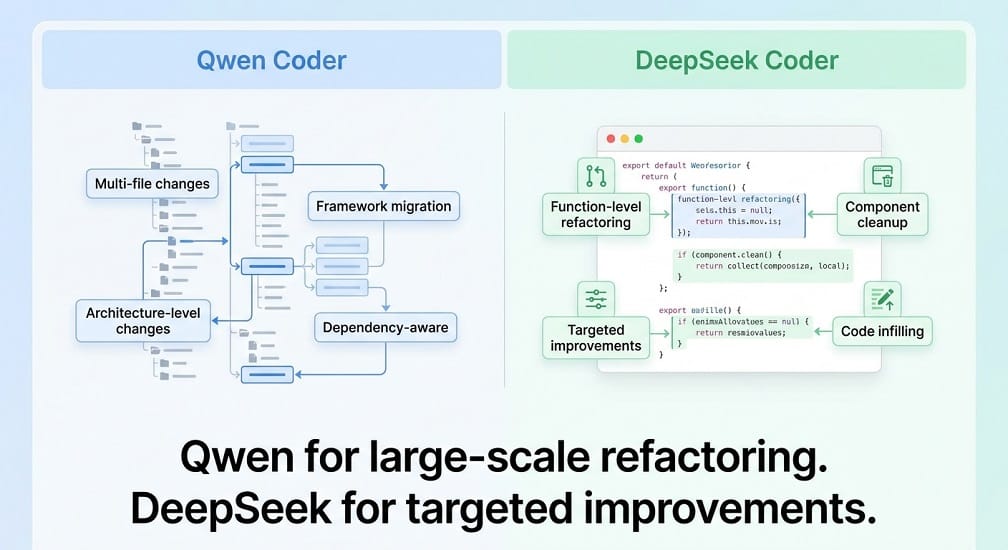
Qwen Coder
Qwen Coder's long context can be beneficial when refactoring large applications because the model can maintain visibility across more of the codebase.
It is particularly useful for:
- Repository-wide changes
- Multi-file refactoring
- Dependency-aware modifications
- Agent-driven migrations
DeepSeek Coder
DeepSeek Coder's code completion and infilling capabilities make it highly useful for:
- Local refactoring
- Existing code modification
- Targeted improvements
- Component-level changes
Winner
For large-scale repository refactoring, Qwen Coder may have an advantage.
For focused modifications inside existing code, DeepSeek Coder remains highly effective.
Qwen Coder vs DeepSeek Coder for AI Coding Agents
This is one of the most important comparisons in 2026.
Modern coding agents need to do more than generate code.
They may need to:
- Search repositories
- Read documentation
- Call APIs
- Execute shell commands
- Modify files
- Run tests
- Analyze errors
- Retry failed implementations
Qwen Coder
Qwen Coder is strongly positioned for this type of environment.
Its ecosystem increasingly focuses on:
- Tool calling
- Agentic workflows
- Multi-step execution
- Coding agents
- Environment interaction
A typical workflow could look like:
Developer Request
       ↓
   Qwen Coder
       ↓
 Analyze Task
       ↓
 Search Repository
       ↓
 Create Plan
       ↓
 Modify Files
       ↓
 Run Tests
       ↓
 Analyze Errors
       ↓
 Final Solution
This makes Qwen Coder particularly interesting for businesses developing:
- Internal coding agents
- AI developer platforms
- Autonomous bug-fixing systems
- DevOps automation agents
DeepSeek Coder
DeepSeek Coder can also power coding agents, particularly when combined with an external agent framework.
The model can provide the coding intelligence, while the surrounding system handles:
- Planning
- Tool execution
- File management
- Testing
- Iteration
This approach can be highly effective, but more of the agent behavior may depend on the orchestration layer.
Winner for AI Coding Agents: Qwen Coder
For teams specifically building agentic coding systems, Qwen Coder is the stronger starting point because agentic development is a core part of its current positioning.
API Comparison
API selection matters for teams that want to build quickly without managing GPU infrastructure.
See Qwen vs DeepSeek API for a more detailed pricing and performance analysis.
Important factors include:
- Model availability
- Context length
- Tool calling
- Structured outputs
- Rate limits
- Latency
- SDK support
- Regional availability
Qwen Coder API
Qwen provides managed coding model access through its ecosystem and API platforms.
This can be suitable for:
- Rapid prototyping
- SaaS applications
- Coding assistants
- Internal developer tools
The advantage of a managed API is that teams can begin testing without provisioning GPUs or managing inference infrastructure.
DeepSeek API
DeepSeek provides API access to its model ecosystem, making it easier for developers to integrate DeepSeek capabilities into applications without self-hosting.
For businesses evaluating APIs, the real comparison should include:
- Input and output token usage
- Actual latency
- Rate limits
- Model reliability
- Context requirements
- Expected monthly volume
EaseCloud Recommendation
At EaseCloud, we recommend starting with API-based testing when validating a coding use case.
Once usage grows, compare API costs against the cost of self-hosting using GPU infrastructure.
The correct decision depends on utilization.
A low-volume application may be cheaper with an API, while a high-volume enterprise workload may justify a dedicated inference platform.
Pricing and Total Cost of Ownership
API pricing is only one part of the equation.
A proper comparison should consider:
API Deployment
Costs include:
- Input tokens
- Output tokens
- API requests
Self-Hosted Deployment
Costs include:
- GPU instances
- Storage
- Networking
- Kubernetes infrastructure
- Monitoring
- Engineering operations
- Model upgrades
The actual business metric should be:
Total Cost of Ownership (TCO)
A model with a lower per-token price may still be more expensive if it requires more retries, produces lower-quality code, or consumes more engineering time.
Running Qwen Coder and DeepSeek Coder Locally
Both model ecosystems can support local or private deployment depending on the exact model and available weights.
Popular deployment options include:
- Ollama
- vLLM
- Docker
- Hugging Face Transformers
- Kubernetes
Why Run a Coding Model Locally?
Organizations may choose local deployment for:
- Source-code privacy
- Security
- Compliance
- Lower long-term inference costs
- Reduced dependency on external APIs
- Greater control over model configuration
This is particularly important for enterprises working with proprietary codebases.
Ollama Deployment
Ollama provides a relatively simple approach for experimenting with supported language models locally.
Typical workflow:
Developer
    ↓
Ollama
    ↓
Qwen / DeepSeek Model
    ↓
Local GPU or CPU
Ollama can be useful for:
- Developer experimentation
- Local coding assistants
- Proof of concepts
- Small internal tools
However, it is not necessarily the best architecture for large-scale enterprise inference.
vLLM Deployment
For production-scale inference, vLLM is often a stronger option.
It is designed for efficient LLM serving and can help organizations improve:
- GPU utilization
- Throughput
- Request handling
- Scalability
A typical architecture could be:
Developers / Applications
          ↓
      API Gateway
          ↓
       vLLM Server
          ↓
   Qwen Coder / DeepSeek
          ↓
       GPU Cluster
This architecture can support multiple internal applications using the same model infrastructure.
Kubernetes Deployment
Kubernetes becomes useful when an organization needs:
- High availability
- Autoscaling
- Multiple model deployments
- GPU scheduling
- Centralized monitoring
- Enterprise security controls
Both model ecosystems can be deployed within a Kubernetes-based architecture.
For best practices on infrastructure, see the AWS Well-Architected Framework Guide.
A simplified setup may look like:
Users
  ↓
Load Balancer
  ↓
Kubernetes Cluster
  ↓
Inference Service
  ↓
vLLM
  ↓
GPU Nodes
  ↓
Qwen Coder / DeepSeek
At EaseCloud, this type of architecture can be used to build a private AI coding platform where proprietary source code remains within the organization's controlled cloud environment.
AWS Deployment Considerations
AWS provides several options for deploying coding models.
A typical enterprise architecture may include:
- GPU-backed EC2 instances
- Amazon EKS
- Amazon S3
- Amazon VPC
- IAM
- CloudWatch
- Container Registry
A simplified architecture:
- Developers
- API Gateway / Internal API
- Amazon EKS
- vLLM Inference Pods
- GPU Worker Nodes
- Qwen Coder or DeepSeek
This approach can provide:
- Private networking
- Identity controls
- Monitoring
- Scalable inference
- Centralized deployment management
EaseCloud Deployment Recommendation
At EaseCloud, we recommend selecting the deployment model based on the maturity and scale of the AI development workflow.
Start with APIs when:
- You are testing a new product
- Usage is low or unpredictable
- You want rapid implementation
- You do not want to manage GPUs
Consider self-hosting when:
- You process proprietary code
- You have high and predictable usage
- Compliance requires private infrastructure
- You need full control over model deployment
- API costs become significant
For enterprise-scale coding platforms, Kubernetes-based inference using vLLM can provide a scalable foundation for running Qwen Coder or DeepSeek models.
Which Model Is Better for Code Generation?
Both Qwen Coder and DeepSeek Coder are capable of generating production-oriented code, but they are better suited to slightly different workflows.
Choose Qwen Coder for:
- Complex multi-step development tasks
- Large feature implementation
- Tool-assisted coding
- Agentic development
- Multi-file code generation
- Long-context projects
- Repository-wide tasks
Qwen Coder is particularly useful when code generation is part of a larger workflow. For example, the model may need to understand a requirement, inspect the repository, identify relevant files, generate code, run tests, and revise its implementation.
Choose DeepSeek Coder for:
- Function generation
- Algorithm implementation
- Code completion
- Code infilling
- Targeted code changes
- Multi-language development
Verdict
For simple and isolated code-generation tasks, both models are strong choices.
For complex, multi-step software engineering workflows, Qwen Coder has the stronger overall positioning.
Which Model Is Better for Code Completion?
Code completion is different from asking a model to generate an entire application.
A good completion model must understand:
- The current file
- Existing functions
- Variable names
- Coding style
- Dependencies
- The surrounding project
Qwen Coder
Qwen Coder can handle code completion as part of a broader repository-aware workflow.
Its large-context capabilities can be particularly valuable when the system provides additional project information alongside the current file.
DeepSeek Coder
DeepSeek Coder has a particularly strong foundation for code completion and infilling.
Its original training approach specifically included project-level code understanding and fill-in-the-middle objectives, making it highly suitable for editing and completing existing code.
Winner: DeepSeek Coder for targeted completion
If your primary use case is IDE-style completion and editing existing code, DeepSeek Coder is a strong option.
For completion combined with broader agentic workflows, Qwen Coder becomes more attractive.
Which Model Is Better for Debugging?
AI debugging involves more than finding an incorrect line.
The model may need to:
- Read the error
- Trace dependencies
- Inspect multiple files
- Identify the root cause
- Apply a fix
- Run tests
- Retry if the fix fails
Qwen Coder
Qwen Coder is particularly suited to this iterative process.
Its agentic approach can support workflows where the model interacts with development tools and receives feedback from test results.
This makes it useful for:
- Autonomous bug fixing
- CI/CD debugging
- Multi-file issues
- Repository-wide errors
- Iterative testing
DeepSeek Coder
DeepSeek Coder is highly effective for targeted debugging where the relevant code and error context are already available.
Examples include:
- Fixing a function
- Resolving syntax errors
- Correcting logic
- Modifying an existing code block
Winner
Qwen Coder for complex, iterative debugging.
DeepSeek Coder for focused debugging and code edits.
Which Model Is Better for Refactoring?
Refactoring becomes increasingly difficult as applications grow.
The model needs to understand:
- Existing architecture
- Dependencies
- APIs
- Shared components
- Database interactions
- Tests
Choose Qwen Coder for:
- Large repository refactoring
- Multi-file changes
- Framework migrations
- Architecture-level changes
- Dependency-aware modifications
Its long-context and agentic workflow support can help when the model needs to coordinate changes across multiple parts of an application.
Choose DeepSeek Coder for:
- Function-level refactoring
- Component cleanup
- Simplifying existing code
- Targeted improvements
- Code infilling
Winner: Qwen Coder for large-scale refactoring
Which Model Is Better for AI Coding Agents?
This is where the difference between the two becomes more significant.
Modern AI coding agents need capabilities such as:
- Planning
- Repository search
- Tool calling
- File editing
- Shell execution
- Test execution
- Error analysis
- Iterative reasoning
Qwen Coder
Qwen Coder is strongly aligned with agentic software engineering.
A typical workflow can look like this:
Developer Request
        ↓
    Qwen Coder
        ↓
   Analyze Task
        ↓
  Explore Repository
        ↓
    Create Plan
        ↓
    Modify Code
        ↓
     Run Tests
        ↓
   Analyze Results
        ↓
    Fix Problems
        ↓
   Final Output
This makes Qwen Coder particularly suitable for:
- Autonomous coding agents
- Internal developer agents
- AI software engineering platforms
- DevOps automation
- Automated bug fixing
DeepSeek Coder
DeepSeek Coder can also be used inside an agent architecture.
However, much of the agent behavior may depend on the external system responsible for:
- Tool execution
- Planning
- Memory
- Repository search
- Testing
Winner: Qwen Coder
For organizations specifically building AI coding agents, Qwen Coder is the better starting point.
Which Model Is Better for Enterprise Software Development?
Enterprise environments introduce additional requirements beyond coding quality.
Companies may need:
- Private deployment
- Source-code security
- Access controls
- Audit logs
- Data governance
- Monitoring
- Scalability
- High availability
Both Qwen and DeepSeek models can potentially be integrated into private AI infrastructure depending on the specific model, license, and deployment architecture.
Qwen Coder for Enterprise
A strong choice for enterprises building:
- Internal AI developer platforms
- Coding agents
- Large repository analysis systems
- Automated engineering workflows
- Kubernetes-based AI platforms
DeepSeek Coder for Enterprise
A strong choice for organizations that need:
- Coding assistants
- Code completion
- Local development tools
- Multi-language support
- Flexible model sizes
Enterprise Verdict
For a broader AI software engineering platform, Qwen Coder may provide more flexibility around agentic workflows.
For specialized coding assistance and targeted development tasks, DeepSeek Coder remains a strong option.
Which Model Is Better for Startups?
Startups usually have different priorities.
They may care more about:
- Development speed
- Infrastructure costs
- API availability
- Ease of integration
- Small engineering teams
For most startups, the best approach is not immediately deploying a large model on dedicated GPU infrastructure.
Instead:
Step 1: Test the Use Case
Start by evaluating the model through available APIs or smaller deployable variants.
Step 2: Measure Real Usage
Track:
- Requests
- Token consumption
- Latency
- Code acceptance rates
- Retry rates
- Developer productivity
Step 3: Evaluate Infrastructure
Only consider dedicated self-hosting when:
- Usage becomes predictable
- API costs become significant
- Data privacy requires private deployment
- Performance requirements justify dedicated GPUs
Startup Recommendation
Use the model that delivers the best results for your actual product—not simply the one with the largest parameter count.
Security Considerations
Using an AI coding model introduces a unique security challenge:
Your source code may become part of the model's input.
Proper governance should also include MLOps to ensure models are production-ready.
Organizations should evaluate:
- Where source code is processed
- Whether data is retained
- Access controls
- Encryption
- Network isolation
- Logging policies
- API security
- Secrets exposure
- Third-party dependencies
For highly sensitive codebases, private or self-hosted inference may be preferable.
Governance for AI Coding Systems
As AI becomes more integrated into software development, companies should establish controls around:
- Who can access AI coding tools
- Which repositories can be processed
- Logging and auditing
- Code review requirements
- Generated code validation
- Security scanning
- Dependency management
AI-generated code should still pass through existing engineering processes.
For example:
- AI Generates Code
- Automated Tests
- Security Scanning
- Code Review
- CI/CD Validation
- Production
An AI coding model should improve the development process rather than bypass engineering governance.
Licensing Considerations
Before deploying any coding model commercially, organizations should review the specific license for the exact model version they intend to use.
Important considerations include:
- Commercial use
- Redistribution rights
- Model modification
- Fine-tuning
- Hosting rights
- Attribution requirements
- Geographic restrictions
Licensing can differ between model generations and may change over time.
Therefore, businesses should always review the current official license before using a model in production.
Common Mistakes When Choosing an AI Coding Model
Choosing Based Only on Benchmarks
A benchmark score does not guarantee better performance on your codebase.
Your development stack may involve:
- React
- Next.js
- Python
- Java
- Go
- Kubernetes
- Terraform
- AWS
The best model should be evaluated against your own environment.
Choosing the Largest Model
A larger model may require:
- More GPU memory
- Higher inference costs
- More complex infrastructure
- Higher latency
A smaller model that solves most of your tasks may provide a better return on investment.
Ignoring the Agent Architecture
For coding agents, the model is only one part of the system.
You also need:
- Repository search
- Tool integration
- Planning
- Memory
- Test execution
- Error feedback
- Guardrails
A strong model with poor orchestration may perform worse than a slightly weaker model inside a well-designed agent system.
Ignoring Security
Sending proprietary source code to an external API without understanding the data flow can create security and compliance risks.
Organizations should evaluate their deployment architecture before rolling out AI coding tools across the company.
How to Test Qwen Coder vs DeepSeek Coder
Instead of relying entirely on public benchmarks, create an internal evaluation framework.
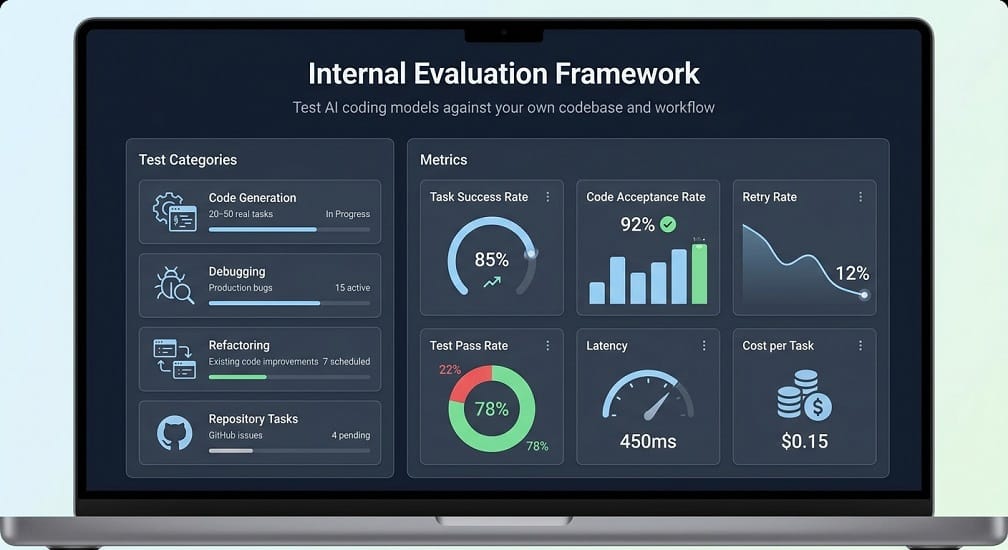
Test both models against at least 20–50 real tasks.
For example:
Code Generation
- Build a new API endpoint
- Create a database migration
- Generate unit tests
Debugging
- Fix a real production bug
- Resolve a failing test
- Identify a dependency issue
Refactoring
- Convert a component
- Remove duplicate code
- Update an API
Repository Tasks
- Implement a GitHub issue
- Modify multiple files
- Add a new feature
Then measure:
| Metric | What to Measure |
|---|---|
| Task Success Rate | How often the model solves the task |
| Code Acceptance Rate | How often developers accept the output |
| Retry Rate | Number of additional attempts required |
| Test Pass Rate | Whether generated code passes tests |
| Latency | Response and completion time |
| Cost per Task | Total cost to complete the task |
This gives your organization a far more useful comparison than selecting a model based solely on public benchmark results.
EaseCloud Approach to AI Coding Infrastructure
At EaseCloud, we help organizations evaluate and deploy AI models based on their actual technical and business requirements.
For AI coding platforms, the process can include:
- Evaluating Qwen Coder and DeepSeek models
- Testing models against real repositories
- Designing private inference architecture
- Deploying models on AWS
- Building Kubernetes-based AI platforms
- Optimizing GPU infrastructure
- Implementing vLLM inference
- Creating LLMOps workflows
- Adding monitoring and observability
- Implementing security and governance controls
- Optimizing AI infrastructure costs
A production architecture may include:
Developers / Engineering Teams
              ↓
       Internal AI Platform
              ↓
      Authentication & Access
              ↓
        AI Agent Layer
              ↓
       Qwen / DeepSeek Model
              ↓
        vLLM Inference
              ↓
       Kubernetes / EKS
              ↓
          GPU Nodes
              ↓
     Monitoring & Observability
This architecture allows organizations to build private AI coding environments while maintaining control over infrastructure and source-code access.
Frequently Asked Questions
Is Qwen Coder better than DeepSeek Coder?
Neither model is universally better.
Qwen Coder is generally a stronger choice for agentic coding, tool use, long-context analysis, and multi-step software engineering workflows.
DeepSeek Coder is highly capable for code generation, code completion, infilling, targeted debugging, and multi-language development.
Which is better for coding, Qwen or DeepSeek?
The answer depends on the model generation and task.
For modern AI coding agents and repository-wide workflows, Qwen Coder may be the better choice.
For specialized code completion and targeted code generation, DeepSeek Coder can be an excellent option.
Which model is better for AI coding agents?
Qwen Coder is the stronger choice when agentic coding is the primary requirement because of its focus on tool use and multi-step software engineering workflows.
Can Qwen Coder and DeepSeek Coder run locally?
Yes, supported model versions and compatible weights can be deployed locally or within private infrastructure using tools such as Ollama, vLLM, Docker, or other compatible inference frameworks.
The required hardware depends on the specific model size and quantization.
Which model is better for large codebases?
Qwen Coder can be particularly attractive for large codebases because of its long-context capabilities and repository-level, agentic workflow focus.
However, actual performance should be tested against your own repository.
Should I use an API or self-host the model?
Use an API when you need:
- Fast experimentation
- Low infrastructure overhead
- Rapid deployment
Consider self-hosting when you need:
- Source-code privacy
- Private infrastructure
- High and predictable usage
- Greater control
- Potential long-term infrastructure optimization
Final Verdict: Qwen Coder vs DeepSeek Coder
Both Qwen Coder and DeepSeek Coder are powerful options for AI-assisted software development.
However, their strengths are different.
Choose Qwen Coder if you need:
- AI coding agents
- Tool calling
- Multi-step development workflows
- Large codebase analysis
- Repository-wide refactoring
- Autonomous debugging
- Long-context software engineering
- Enterprise AI development platforms
Choose DeepSeek Coder if you need:
- Code generation
- Code completion
- Code infilling
- Targeted debugging
- Multi-language programming
- Flexible model sizes
- Local coding assistants
Overall Recommendation
If you are building a modern AI coding agent or enterprise software engineering platform, Qwen Coder is the stronger overall choice.
If your primary requirement is a specialized coding model for completion, generation, and targeted code modification, DeepSeek Coder remains an excellent option.
For many businesses, the best strategy may not be choosing only one model.
A multi-model architecture can allow different tasks to use different models based on:
- Complexity
- Cost
- Latency
- Context requirements
- Code type
Conclusion
The comparison between Qwen Coder and DeepSeek Coder demonstrates an important shift in AI-assisted software development.
The question is no longer simply:
"Which AI model writes the best code?"
The more important question is:
"Which model fits our complete software engineering workflow?"
Qwen Coder is increasingly focused on the future of agentic software engineering, where models can interact with tools, explore repositories, modify files, run tests, and solve multi-step development tasks.
DeepSeek Coder provides a strong code-specialized foundation for generation, completion, infilling, debugging, and multi-language programming.
The best choice depends on your infrastructure, engineering workflow, security requirements, and business objectives.
For organizations planning to build or deploy AI-powered developer platforms, EaseCloud can help evaluate the right models and design the infrastructure required to run them securely and efficiently at scale.
Summarize this post with: