AWS Consulting vs In-House Engineer: What's Cheaper and What Actually Works?
A complete cost and capability comparison, real 2026 salary data, hidden hiring costs, breadth-of-expertise gaps, coverage limitations, and the hybrid model most fast-growing companies actually use.
- What this guide covers: A complete, numbers-driven comparison of hiring in-house AWS engineers vs. engaging AWS consulting, cost, coverage, expertise breadth, and the decision framework for different company stages.
- The honest conclusion: Neither option is universally better. The right answer depends on your stage, budget, infrastructure complexity, and whether you need a single specialist or a multi-domain team.
- The most common mistake: Treating this as binary. Most fast-growing companies use hybrid, a consulting partner for infrastructure while engineering headcount focuses on product.
Why This Decision Is Harder Than It Looks
The instinct to hire is strong. Full-time engineers feel more controllable, more loyal, and more embedded in the team. They attend standups. They understand the product context. They are 'yours.'
But when the decision is evaluated rigorously total cost, time to productivity, coverage hours, breadth of expertise, and the specific infrastructure challenges a growing startup actually faces the instinct to hire often does not survive contact with the numbers.
This guide does not argue against hiring. Hiring in-house AWS engineers is the right answer for many companies at the right stage. What it argues against is making the decision on instinct rather than data. Here is the data.
The five dimensions that determine the right choice
- Total cost - not just salary, but the complete cost of employment including benefits, equity, recruitment, and management overhead
- Time to value - how long before the hire is productive vs. how long before a consulting engagement delivers results
- Breadth of expertise - can one person cover architecture, DevOps, security, cost optimization, and compliance simultaneously?
- Coverage model - what happens at 2am on a Saturday when the production database goes down?
- Flexibility - what happens when your infrastructure needs change significantly in 12 months?
The True Cost of an In-House AWS Engineer in 2026
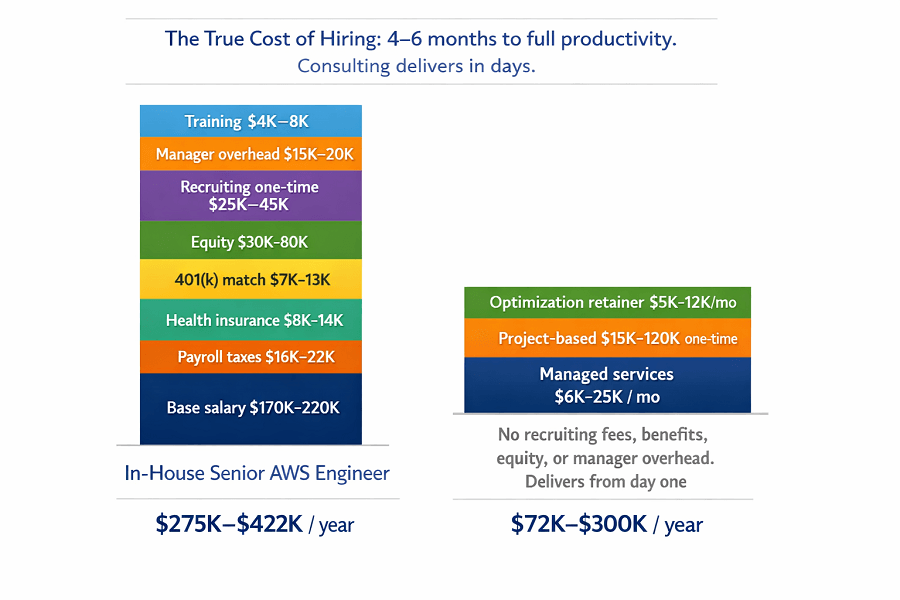
Most hiring decisions anchor on base salary. That is the wrong number. The true cost of employment is significantly higher, and the gap between base salary and total cost is where most hiring decisions underestimate the financial commitment.
| Cost Component | Junior-Mid | Senior | Notes |
|---|---|---|---|
| Cost Component | Junior-Mid (3-5 yrs exp) | Senior (7+ yrs exp) | Notes |
| Base salary | $130,000-$160,000 | $170,000-$220,000 | US market, 2026. Remote roles at the lower end; SF/NYC at the upper end. |
| Payroll taxes (FICA, FUTA, SUTA) | $12,000-$16,000 | $16,000-$22,000 | Employer-side: ~9-10% of salary |
| Health, dental, vision insurance | $8,000-$14,000 | $8,000-$14,000 | Family coverage adds $5,000-$8,000 vs. individual |
| 401(k) match (4-6%) | $5,000-$10,000 | $7,000-$13,000 | Standard competitive match |
| Equity (cost at grant) | $15,000-$40,000/yr | $30,000-$80,000/yr | Opportunity cost of equity dilution; real but hard to quantify precisely |
| Recruiting cost (one-time) | $15,000-$25,000 | $25,000-$45,000 | Agency fee (20-25% of first-year salary) or internal recruiter time + job board costs |
| Manager overhead | $15,000-$20,000/yr | $15,000-$20,000/yr | Engineering manager time spent on 1:1s, reviews, context-setting - estimated at 8-10% of manager's comp |
| Training & conferences | $3,000-$6,000/yr | $4,000-$8,000/yr | AWS certifications, re:Invent, technical training to maintain currency |
| TOTAL YEAR 1 | $203,000-$291,000 | $275,000-$422,000 | Including one-time recruiting cost amortized over 2-year average tenure |
The hidden cost: ramp time
A new hire is not productive on day one. AWS infrastructure work requires deep context, your specific architecture, your deployment processes, your incident history, your vendor relationships. Ramp time for a new AWS certified engineer at a startup is typically:
| Period | Productivity Level |
|---|---|
| First 30 days | Orientation: understanding the environment, reading documentation that exists, identifying what doesn't exist. Minimal independent productivity. |
| Days 31-90 | Growing productivity: able to complete well-defined tasks, making changes with oversight. ~30-50% of full productivity. |
| Days 91-180 | Near-full productivity: able to own workstreams independently, make architectural decisions with confidence. ~70-85% of full productivity. |
| Day 180+ | Full productivity: deeply context-aware, able to drive strategic infrastructure decisions. The person you thought you were hiring on day one. |
Cost of ramp time: A $200,000/year senior engineer at 50% productivity for 90 days costs $25,000 in productivity loss before they deliver their first full contribution. This is not counted in any job offer calculation.
The True Cost of AWS Consulting in 2026
AWS consulting costs are more visible than hiring costs, there is a monthly invoice rather than a complex compensation structure. But consulting also has a fuller picture than the headline retainer number.
| Consulting Model | Cost & What It Covers |
|---|---|
| Managed services retainer | $6,000-$25,000/month - covers 24/7 monitoring, incident response, proactive management, monthly optimization reviews, and security patching. This is the most direct hire-replacement model. |
| Project-based engagements | $15,000-$120,000 one-time - for migrations, DevOps builds, compliance readiness, architecture design. Defined scope, defined deliverable, no ongoing commitment. |
| Optimization retainer | $5,000-$12,000/month - focused on cost governance, rightsizing, Reserved Instance management. Often self-funding (savings exceed cost within first billing cycle). |
| Advisory / fractional CTO | $5,000-$15,000/month - part-time senior AWS architect on call for architecture decisions, review, and escalation. No delivery execution. |
| Free Well-Architected Review | $0 - EaseCloud's entry point. Full findings report, no commitment. Demonstrates expertise before any paid scope begins. |
In-House vs. Consulting: The Complete Comparison
| Dimension | In-House Engineer | AWS Consulting | Key Insight |
|---|---|---|---|
| Annual cost (year 1) | ✓ $203K-$291K (mid-level) $275K-$422K (senior) | AWS consulting: $72K-$300K/yr depending on engagement type | Consulting is cost-competitive or cheaper at managed services tier; much cheaper for project work |
| Time to value | 4-6 months (hiring + ramp) | ✓ Days to weeks | Consulting delivers from day one. Hire takes months to full productivity |
| Architecture depth | One person's expertise | ✓ Team of specialists | No single engineer is equally strong in cost, security, DevOps, and compliance |
| Cost optimization expertise | Depends on individual | ✓ Dedicated specialty | Cost optimization requires continuous tooling, benchmarks, and experience across many environments |
| Security & compliance depth | Depends on individual | ✓ Dedicated specialty | SOC 2, HIPAA, and security architecture require deep, current expertise - rare in generalists |
| 24/7 on-call coverage | ✗ Business hours + on-call fatigue | ✓ SLA-backed 24/7 | One engineer cannot provide sustainable 24/7 coverage without significant personal cost |
| Breadth of services covered | ✗ 1-2 domains of deep expertise | ✓ Full AWS surface | A consulting team covers migration + DevOps + security + cost simultaneously |
| Scalability | ✗ Re-hire to scale up | ✓ Scope adjusts monthly | Consulting scales to a migration sprint and back without a hire/layoff cycle |
| Institutional knowledge | ✓ Builds over time | Depends on documentation quality | A hire builds context; consulting builds context too - but in documented runbooks |
| Product context | ✓ Deep - attends standups | Lighter - periodic engagement | Hire has stronger product context; consulting has stronger infrastructure context |
| AWS tool / service currency | Updates with training budget | ✓ Stays current across clients | Consulting firms see new AWS services across many environments - faster currency |
| Flexibility if needs change | ✗ Costly to restructure | ✓ Adjust scope monthly | Layoffs and restructuring are painful and expensive; consulting scope adjusts contractually |
| Recruiting risk | ✗ 20-30% fail within 2 years | ✓ No recruiting risk | Engineering hires have a high failure rate; a bad hire costs $100K+ in total impact |
| Vendor lock-in risk | ✗ Low (internal team) | Moderate (partner dependency) | Mitigation: require IaC ownership and documentation transfer at all times |
The Expertise Breadth Problem: What One Engineer Cannot Be
This is the dimension that most hiring arguments underestimate. AWS infrastructure work at a modern SaaS company spans five distinct discipline areas. Each deep enough to be a full-time specialization at larger organizations.
| Domain | What Full Expertise Requires |
|---|---|
| Cloud Architecture | VPC design, multi-account structures, compute selection, database choice, network topology, disaster recovery design. Requires breadth of AWS service knowledge and architectural pattern experience. |
| DevOps & CI/CD | Pipeline design, container orchestration, infrastructure as code, GitOps workflows, deployment strategies (blue-green, canary). Requires software engineering skills in addition to AWS knowledge. |
| Cost Optimization | Rightsizing analysis, Reserved Instance strategy, Savings Plans management, data transfer optimization, zombie resource elimination, ongoing governance. Requires both financial modeling and deep AWS billing knowledge. |
| Security & Compliance | IAM design, encryption architecture, SOC 2/HIPAA control implementation, threat detection configuration, audit evidence collection. Requires compliance domain expertise, not just technical skill. |
| Observability & SRE | Distributed tracing, SLO/SLA design, on-call process, incident management, runbook creation, capacity planning. Requires both technical and operational process depth. |
A single engineer, however talented, has deep expertise in one or two of these domains and working knowledge of the others. That is not a criticism; it is how specialization works. An AWS Solutions Architect who is expert in architectural design may have surface-level knowledge of cost optimization tooling. A DevOps engineer who excels at CI/CD pipelines may have limited SOC 2 compliance experience.
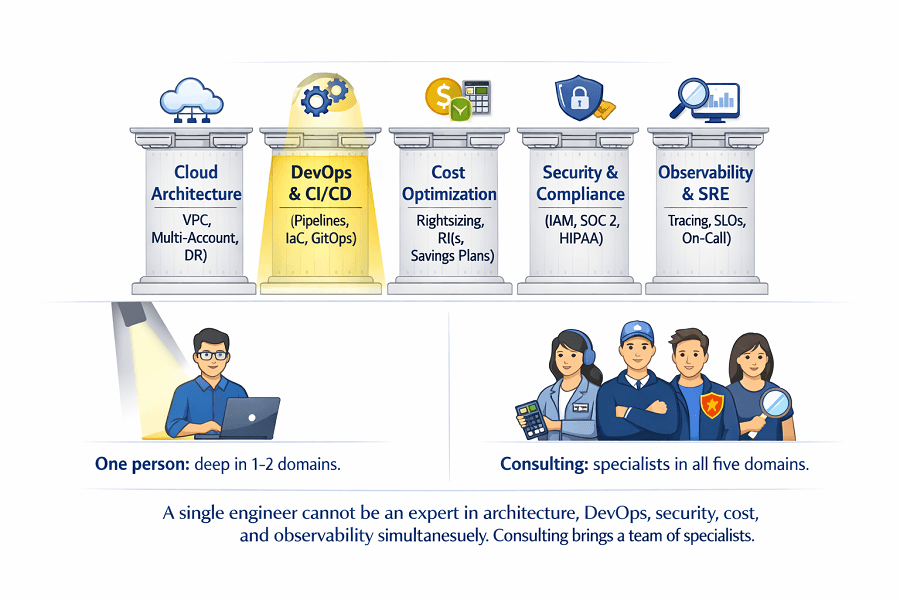
A consulting firm brings specialists in each domain who collaborate on your environment. The cost optimization specialist who works on your Reserved Instance strategy works alongside the security engineer implementing your SOC 2 controls, simultaneously, not sequentially.
Cost optimization is a full-time specialization – rightsizing, Reserved Instances, Savings Plans, data transfer, zombie cleanup. One engineer cannot cover it all.
The table above shows five distinct disciplines. Cost optimization alone requires continuous tooling, benchmarks, and experience across many environments. A generalist cannot match the depth of a specialist.
We help you:
- Audit your current AWS spend – Find exactly where your money is going – and where it's wasted
- Implement rightsizing, Savings Plans, and Spot – 30–40% cost reduction with no performance impact
- Eliminate zombie resources – Unattached EBS volumes, idle load balancers, orphaned snapshots
- Set up ongoing cost governance – Budget alerts, anomaly detection, monthly reviews
The Coverage Problem: What Happens at 2am on a Saturday?
Production incidents do not observe business hours. A database failure, a DDoS event, a failed deployment, a runaway process consuming resources, these happen at 2am on a Saturday as readily as at 2pm on a Tuesday.
For a single in-house engineer, this creates a coverage problem that is hard to solve cleanly:
| Coverage Challenge | The Real Consequence |
|---|---|
| On-call rotation | With one engineer, you have no rotation, that person is always on call. Sustainable for weeks. Unsustainable for months. Engineers in permanent single-person on-call roles burn out and leave, usually within 12–18 months. |
| Vacation and PTO | When the engineer takes two weeks off in August, who covers production incidents? Another engineer who doesn't know the infrastructure, or nobody. |
| Illness and personal events | Unexpected unavailability, illness, family emergency, power outage, leaves production infrastructure with no dedicated owner for hours or days. |
| Growth beyond one person | As the infrastructure grows, one person cannot maintain deep enough context across all systems to respond effectively to incidents in unfamiliar corners of the environment. |
| Knowledge concentration risk | If the engineer leaves, voluntarily or involuntarily, all infrastructure knowledge leaves with them unless extensive documentation was maintained. Most infrastructure engineers do not prioritize documentation. |
How consulting solves this: A managed services engagement includes SLA-backed 24/7 coverage by a team, not an individual. When a critical alert fires at 2am on Saturday, the on-call engineer for that shift responds within the SLA window. No single engineer carries the full burden. No coverage gaps during holidays or PTO. Dedicated engineers know your environment, but the team provides continuity when individuals are unavailable.
The Hybrid Model: What Fast-Growing Companies Actually Do
The most effective model for most companies between $2M and $20M ARR is not a binary choice, it is a hybrid that leverages both in-house engineers and a consulting partner for different functions.
The hybrid model in practice
| Function | Who Owns It & Why |
|---|---|
| In-house engineers own | Product infrastructure: the systems that ship product features. Application deployment, feature flags, service configuration, developer tooling. The work that requires deep product context and daily collaboration with the engineering team. |
| Consulting partner owns | Platform infrastructure: the systems that support all product infrastructure. Network architecture, security posture, cost governance, observability platform, CI/CD pipeline design, disaster recovery, compliance controls. |
| Shared ownership | Major incidents (consulting handles 24/7 first response; in-house engineers engage for product-specific context). Migrations and modernization projects (consulting leads execution; in-house engineers provide context and validation). |
Why this division makes sense
- Product infrastructure work scales with your engineering team, it should be internal. Platform infrastructure work scales with your infrastructure complexity, it benefits from specialist depth.
- Product context is best held internally. Security and cost optimization expertise is best held externally, where it is sharpened across dozens of environments, not just yours.
- The consulting partner builds the platform infrastructure correctly and in code, then hands it off with full documentation. In-house engineers inherit a well-documented, IaC-managed foundation they can maintain.
- Cost efficiency: a $10,000/month consulting retainer plus three product engineers is significantly cheaper than a four-person fully in-house team covering both product and platform, while delivering better platform depth.
The Decision Guide: What's Right for Your Stage?
| Your Situation | Recommendation | Why |
|---|---|---|
| Pre-revenue / Seed, < 5 engineers | Consulting | No infrastructure team to manage. Use AWS credits. Consulting is cheaper than any hire and delivers faster. |
| Series A, $1–5M ARR, 5–15 engineers, single infrastructure person | Hybrid | One infra hire for product context; consulting partner for platform, security, cost, and 24/7 coverage. |
| Needs SOC 2 in < 6 months for enterprise deal | Consulting | No internal team can achieve this at speed without prior SOC 2 experience. Consulting with compliance specialists. |
| Active migration (on-prem to AWS, or Azure to AWS) | Consulting | Migrations have 100+ discrete decision points. Consulting firms have done this before; a new hire has not. |
| AWS bill growing faster than revenue, unclear why | Consulting | Cost optimization requires tooling, benchmarks, and experience across many accounts. One-time audit pays for itself. |
| Series B+, $5M+ ARR, 2–3 infrastructure engineers | Hybrid | Internal team handles product infra. Consulting covers platform architecture, security, and major infrastructure programs. |
| Stable, well-documented environment, no major changes planned | In-house | At this stage, deep product context and internal ownership may outweigh consulting breadth benefits. |
| Production incident rate is high, on-call is burning out | Consulting | 24/7 SLA-backed coverage solves the coverage problem immediately without another on-call addition. |
| Planning a major modernization (monolith → microservices) | Consulting | Modernization programs require architecture, DevOps, and security depth simultaneously, beyond a single hire. |
9. Avoiding Consulting Lock-In: How to Protect Yourself
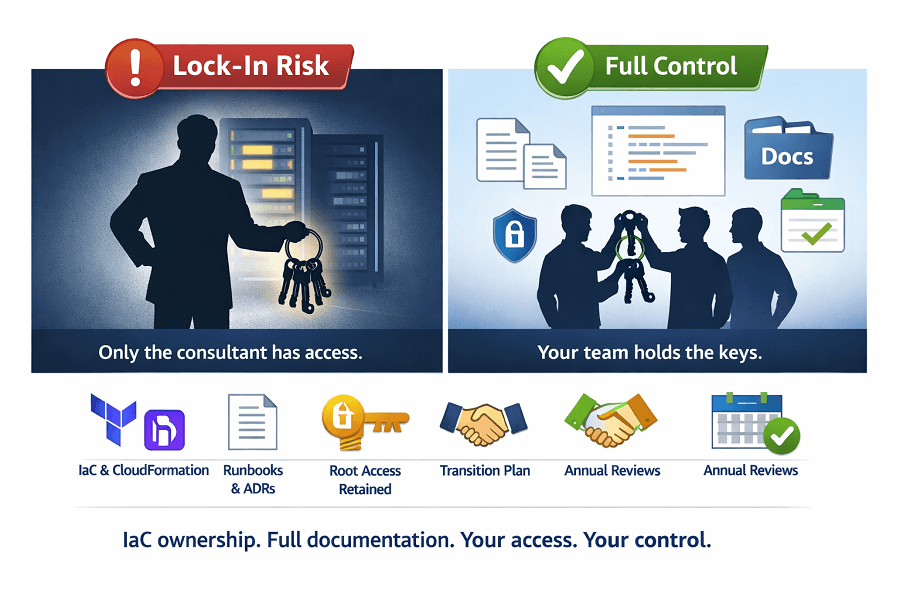
The legitimate concern about consulting is dependency, what happens if the relationship ends, or if the consulting firm becomes your only source of infrastructure knowledge? This is a real risk that should be mitigated from the start.
How to structure a consulting relationship that prevents lock-in
- Require all infrastructure in code (Terraform or CloudFormation) from day one. You own the repository. No console-only configurations.
- Require comprehensive documentation: runbooks, architecture decision records, access documentation. The consulting firm's knowledge must be transferable.
- Require regular knowledge transfer sessions with your internal team, not just delivery outputs. Your engineers should understand the infrastructure at a conceptual level even if not managing it daily.
- Maintain your own AWS account access and root credentials at all times. Never allow a consulting firm to be the sole account administrator.
- Define a transition plan in the contract: what happens at end of engagement, how is knowledge transferred, what is the documentation standard.
- Perform an annual review of the relationship: is the consulting partner building your internal capability or creating deeper dependency? The right partner does the former.
Conclusion
The choice between hiring an in-house AWS engineer and engaging an AWS consulting partner is not binary – and the most effective approach for fast-growing companies is a hybrid. In-house engineers are essential for product-context work: application deployment, developer tooling, and daily collaboration with the engineering team.
Consulting partners are stronger for platform infrastructure: network architecture, security posture, cost governance, compliance, and 24/7 coverage. The cost comparison is clear – a senior engineer costs $275K–$422K/year fully loaded, while a consulting retainer delivering equivalent breadth costs $72K–$300K/year with no recruiting risk or ramp time. But cost is only one dimension. The real differentiator is breadth of expertise and coverage.
One engineer cannot be an expert in architecture, DevOps, security, cost optimization, and observability simultaneously – consulting brings a team of specialists. The most common mistake is treating this as either/or. Most companies between $2M and $20M ARR use both: internal engineers for product context, consulting for platform depth.
Frequently Asked Questions
What if we hire the wrong person? What does a bad hire actually cost?
A failed hire at the senior AWS engineer level costs $100,000–$200,000 in total impact: the recruiting cost to find a replacement ($25,000–$45,000), the productivity loss during the vacancy (3–4 months at full salary equivalent), the ramp time for the replacement, and the opportunity cost of infrastructure work that stalled. This risk is entirely absent from consulting engagements.
Can a consulting firm really understand our environment as well as an in-house engineer?
For infrastructure depth, yes, and often better, because consulting engineers see infrastructure patterns across many environments and bring comparative experience. For product context (how the application works, what features are being built, what the roadmap is), an in-house engineer has a natural advantage. This is why the hybrid model works: consulting for infrastructure depth, in-house for product context.
What happens to consulting deliverables if we end the engagement?
With a properly structured engagement (IaC in your repository, full documentation, access credentials owned by you), ending a consulting engagement is clean. You own the Terraform code, the runbooks, and the architecture documentation. Your team takes over operations. EaseCloud designs engagements for clean transition, not dependency.
Should we hire first and then bring in consulting, or the other way around?
For most startups: engage consulting first, especially for urgent work (migration, compliance, cost reduction). Use the consulting engagement to build a well-documented, IaC-managed foundation. Then hire into a defined, documented environment where the new engineer can be productive quickly, rather than into an undocumented environment where they spend months on archaeology.
How do we evaluate whether a consulting firm is actually delivering value?
Three measurable dimensions: AWS bill trend (cost optimization engagements should produce verifiable savings in your billing dashboard), incident frequency and MTTR (managed services engagements should reduce both), and deployment frequency (DevOps engagements should increase it). Ask EaseCloud for specific, measurable commitments tied to your engagement before signing. Any firm unwilling to commit to measurable outcomes should be approached with caution.
Start With a Free Assessment, No Hiring Decision Required
Before committing to a hire or a consulting engagement, EaseCloud offers a free Well-Architected Review and cost analysis that shows exactly what your infrastructure needs.
Summarize this post with: