How to Achieve SOC 2 Compliance on AWS: Step-by-Step for Startups
A practical, AWS-specific SOC 2 roadmap for startups, what the five Trust Service Criteria require, which AWS services satisfy each control, a phased implementation timeline, and the compliance automation tools that reduce manual evidence burden.
- What this guide covers: The complete SOC 2 compliance journey on AWS, from understanding what SOC 2 requires, to mapping AWS services to each control, to executing the implementation and preparing for audit.
- Who it's for: Startup founders, CTOs, and engineering leads who have been told by a prospect or investor that SOC 2 is required, and want to understand what that actually means for their AWS environment.
- The key insight: SOC 2 on AWS is achievable in 3–6 months for most startups. AWS provides many of the required controls natively, the challenge is configuration, documentation, and evidence collection, not building from scratch.
1. What Is SOC 2 and Why Do Startups Need It?
SOC 2 (System and Organization Controls 2) is an auditing standard developed by the American Institute of Certified Public Accountants (AICPA). It is the most widely required security and compliance certification for B2B SaaS companies in North America and increasingly in Europe.
A SOC 2 report is a third-party auditor's assessment that your organization has implemented and operates the controls required to protect customer data securely. It is not a self-certification, it requires an independent CPA firm to review your systems, interview your team, and test your controls before issuing the report.
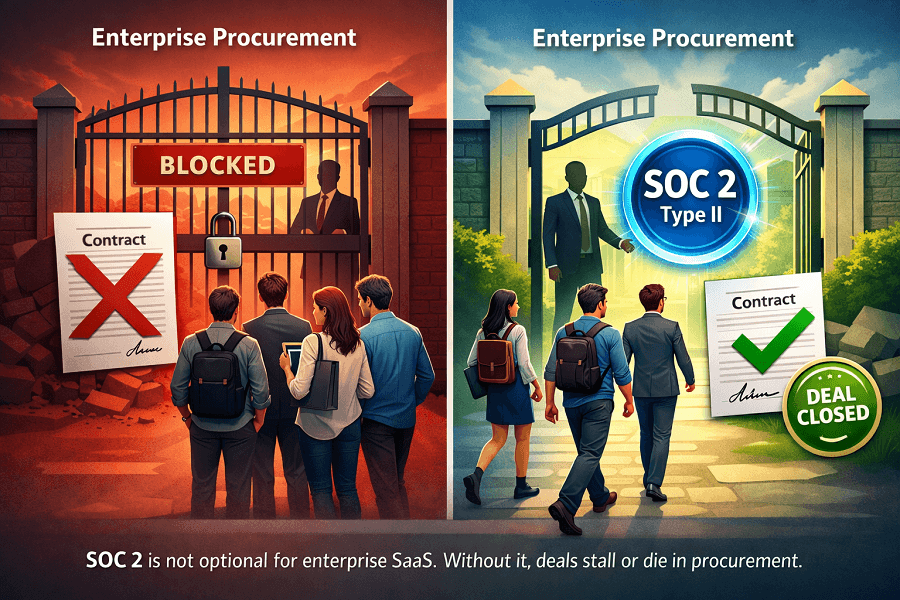
The business driver is straightforward: enterprise customers will not sign contracts without it. Security questionnaires from mid-market and enterprise buyers now routinely include 'Do you have SOC 2 Type II?' as a binary qualifier. Without it, deals stall or die in procurement.
SOC 2 Type I vs. Type II, what's the difference?
| Report Type | What It Means & When to Use It |
|---|---|
| SOC 2 Type I | Point-in-time assessment. Auditor confirms that your controls are designed appropriately as of a specific date. Faster to obtain (2–3 months). Less credible with sophisticated buyers, it proves design, not operation. |
| SOC 2 Type II | Period-of-time assessment. Auditor confirms that your controls operated effectively over an observation period, minimum 3 months, typically 6–12 months. The standard that enterprise buyers require. More credible, takes longer to obtain. |
| Which to pursue | For most startups: SOC 2 Type I first (to unblock deals in the near term), then Type II over the following observation period. Some startups skip Type I and go directly to Type II, appropriate when no urgent deal is waiting. |
The five Trust Service Criteria (TSC)
SOC 2 is organized around five Trust Service Criteria categories. Security (CC) is mandatory for all SOC 2 reports. The other four are optional, most startups include Availability and Confidentiality. Rarely is Processing Integrity or Privacy included in a first SOC 2.
| TSC Category | What It Covers & Whether to Include |
|---|---|
| CC, Security (required) | The foundational category. Covers access controls, logical and physical security, system monitoring, change management, and risk management. Every SOC 2 report includes this. |
| Availability (common) | System availability meets SLA commitments. Covers infrastructure redundancy, disaster recovery, and incident response. Include if customers ask about uptime guarantees. |
| Confidentiality (common) | Confidential information is protected. Covers encryption, data handling, access restrictions on sensitive data. Include if you handle customer data that is designated confidential. |
| Processing Integrity (rare) | System processing is complete, valid, accurate, and timely. Primarily relevant for payment processors, financial systems, and data transformation pipelines. |
| Privacy (rare) | Personal information is collected, used, retained, and disclosed appropriately. Relevant if you process significant volumes of personal data (overlaps with GDPR concerns). |
2. AWS and SOC 2: The Shared Responsibility Model
One of the most common misconceptions about SOC 2 on AWS: "AWS is SOC 2 certified, so we inherit their compliance." This is incorrect, and the misunderstanding has caused multiple audit failures.
AWS itself holds SOC 2 Type II certification, covering the physical data centers, hypervisors, global network infrastructure, and the hardware underlying all AWS consulting services. This is AWS's shared responsibility model.
What AWS's certification does not cover is everything above the hypervisor: your operating system configurations, your IAM policies, your application security, your data encryption decisions, your access controls, and your operational processes. That is your responsibility as the AWS customer.
| Responsibility | What It Covers |
|---|---|
| AWS is responsible for | Physical security of data centers, hardware availability and durability, hypervisor security, global network infrastructure, managed service platform security (e.g. RDS engine patching, S3 infrastructure). |
| You are responsible for | IAM configuration and access controls, OS hardening on EC2, encryption of data at rest and in transit, network controls (security groups, NACLs, VPC design), application security, logging configuration, backup procedures, incident response processes, and all operational procedures audited under SOC 2. |
The good news: AWS provides the native services that satisfy most SOC 2 technical controls, CloudTrail for audit logging, KMS for encryption, IAM for access control, GuardDuty for threat detection. The work is in configuring these services correctly, documenting the controls, and collecting the evidence that proves to an auditor that the controls operated throughout the observation period.
3. AWS Services Mapped to SOC 2 Controls
This is the core implementation guide. For each major SOC 2 control area, here are the specific AWS services that satisfy the requirement, and what configuration is needed.
Access Control (CC6 - Logical Access)
The auditor will verify that only authorized individuals can access your systems, that access is granted on a least-privilege basis, and that access is reviewed and removed promptly when employees leave.
| AWS Service | SOC 2 Criterion | Implementation Requirement |
|---|---|---|
| AWS IAM | CC6.1, CC6.2, CC6.3 | Implement least-privilege IAM policies per service and per engineer. No shared credentials. No long-lived access keys for humans, use IAM Identity Center (SSO) with MFA. Define IAM roles for all applications; never use root account for daily operations. |
| AWS IAM Identity Center | CC6.1, CC6.2 | Centralizes human access across all AWS accounts. Integrates with your Identity Provider (Okta, Google Workspace, Azure AD) for single sign-on. Provides centralized access reviews, critical for demonstrating user access governance to auditors. |
| AWS Organizations + SCPs | CC6.1 | Service Control Policies enforce guardrails across all accounts, prevent engineers from disabling CloudTrail, creating public S3 buckets, or bypassing required security controls even with account-level admin permissions. |
| AWS Secrets Manager | CC6.1, CC6.7 | Store and rotate application secrets (database passwords, API keys) automatically. Eliminates hardcoded credentials in application code, a common audit finding. Rotation logs provide evidence of credential hygiene. |
Audit Logging & Monitoring (CC7 - System Monitoring)
SOC 2 requires evidence that your systems are continuously monitored, that security events are detected and responded to, and that a complete audit trail of who did what exists.
| AWS Service | SOC 2 Criterion | Implementation Requirement |
|---|---|---|
| AWS CloudTrail | CC7.1, CC7.2 | Enable CloudTrail in ALL regions with multi-region trail. Log to S3 with integrity validation enabled, this proves to the auditor that logs have not been tampered with. Set log retention to minimum 1 year. Enable CloudTrail Insights for anomaly detection. |
| Amazon CloudWatch | CC7.1, CC7.3 | Centralize all application and infrastructure logs. Create metric filters and alarms for: root account usage, console sign-in failures, security group changes, IAM policy changes, and S3 bucket policy changes. These alarms are directly auditable. |
| AWS GuardDuty | CC7.1, CC7.2 | Enable GuardDuty in all regions, one-click activation, no agents. ML-based threat detection for account compromise, crypto-mining, exfiltration, and unusual API activity. GuardDuty findings are evidence of your threat detection capability. |
| AWS Security Hub | CC7.1, CC7.2 | Aggregates findings from GuardDuty, Inspector, Macie, and Config into a single dashboard. Enable AWS Foundational Security Best Practices standard, provides automated compliance checks against 200+ controls. Finding remediation history is audit evidence. |
| AWS Config | CC7.1, CC7.4 | Continuous configuration recording for all AWS resources. Config Rules detect non-compliant configurations automatically. Provides auditors with proof that configuration drift is detected and remediated, not just periodically reviewed. |
Encryption & Data Protection (CC6.7 - Transmission & Storage)
All data at rest and in transit must be encrypted. The auditor will test that encryption is enforced by policy, not just best-effort
| AWS Service | SOC 2 Criterion | Implementation Requirement |
|---|---|---|
| AWS KMS | CC6.7 | Use KMS customer-managed keys (CMKs) for all sensitive data stores: RDS, S3, EBS, DynamoDB, ElastiCache. CMKs provide key rotation, access policies, and usage audit logs in CloudTrail. Never use default AWS-managed keys for data classified as confidential. |
| ACM + ALB/CloudFront | CC6.7 | AWS Certificate Manager provides free SSL/TLS certificates. Enforce HTTPS-only on all ALBs and CloudFront distributions. Configure HTTP → HTTPS redirect. Auditors test that unencrypted connections are rejected, not just that HTTPS is available. |
| S3 Encryption Policies | CC6.7 | Enable S3 default encryption (SSE-KMS) on all buckets. Apply bucket policies that deny PUT requests without server-side encryption headers. Block S3 public access at the account level, a single Config rule provides ongoing evidence. |
| RDS Encryption | CC6.7 | Enable encryption at rest for all RDS and Aurora instances (must be set at creation, cannot be enabled on existing unencrypted instances without snapshot-and-restore). Enable SSL enforcement parameter for all database connections. |
Availability & Incident Response (A1 - Availability, CC7.3 - Incident Response)
| Control / Service | SOC 2 Criterion | Implementation Requirement |
|---|---|---|
| Multi-AZ Architecture | A1.1, A1.2 | Deploy all production services across at least two AZs. RDS Multi-AZ, ECS services across multiple AZs, ALB with multi-AZ targets. Single-AZ production is a High-risk WAR finding and a likely SOC 2 exception. |
| AWS Backup | A1.2 | Centralized backup management across RDS, DynamoDB, EFS, EC2, and EBS. Define backup plans with retention policies that meet your RPO. Evidence requirement: backup completion logs + tested restore procedures. |
| Amazon Route 53 | A1.2 | Health checks on all endpoints with automated DNS failover. Provides evidence of availability monitoring and automated recovery, two auditor requirements under the Availability criterion. |
| Incident Response Runbook | CC7.3 | Not an AWS service, a documented process. Define: what constitutes a security incident, who is the incident commander, escalation path, communication templates, post-mortem process. Auditors will request this document and interview team members about it. |
Change Management (CC8 - Change Control)
| Control / Service | SOC 2 Criterion | Implementation Requirement |
|---|---|---|
| Infrastructure as Code (Terraform) | CC8.1 | All infrastructure changes made via Terraform or CloudFormation, not manual console changes. IaC in version control provides an auditable change log. Pull request approvals provide evidence of change review process. |
| CI/CD Pipeline | CC8.1 | All application deployments through an automated pipeline (GitHub Actions, CodePipeline). No manual production deployments. Pipeline logs provide evidence that code review (PR approval) occurred before every production change. |
| AWS Config Rules | CC8.1 | Config Rules detect infrastructure drift from IaC baselines, if someone makes a manual console change, Config flags it. Provides evidence of change detection and enforcement. |
4. Compliance Automation Tools: Reducing Manual Evidence Burden
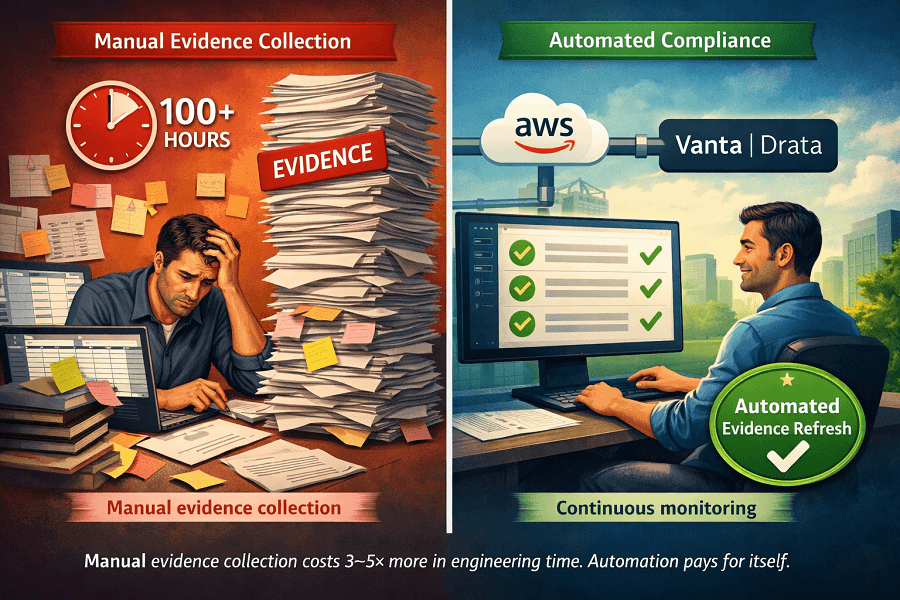
The most time-consuming part of SOC 2 is not implementing controls, it is collecting and organizing evidence to prove those controls operated throughout the observation period. Compliance automation tools dramatically reduce this burden.
| Tool | Annual Cost | EaseCloud's Assessment |
|---|---|---|
| Vanta | $12,000–$20,000/yr | Market-leading compliance automation. Native AWS integration, connects to your account and automatically collects evidence for hundreds of controls. Integrates with Okta, GitHub, Jira, and your MDM. Provides readiness dashboard, auditor portal, and automated evidence refresh. Preferred by most EaseCloud clients. |
| Drata | $15,000–$25,000/yr | Strong AWS integration with automated control monitoring. Feature-rich auditor portal. Slightly more expensive than Vanta but preferred by some auditors for its evidence organization. |
| Sprinto | $8,000–$15,000/yr | More affordable option with solid AWS coverage. Good for seed-stage startups with tighter budgets. Less polish than Vanta/Drata but covers core SOC 2 requirements effectively. |
| Secureframe | $10,000–$18,000/yr | Good multi-framework support (SOC 2, ISO 27001, HIPAA). Useful if you anticipate needing multiple certifications. |
| Manual (no tool) | $0 (tool cost) | Possible but not recommended. Evidence collection via spreadsheets and manual AWS console exports is extremely time-consuming and error-prone. The tool cost is almost always recovered in engineering time saved during the observation period and at audit time. |
5. The SOC 2 Implementation Timeline: Phase by Phase
SOC 2 Type II for a typical B2B SaaS startup running on AWS takes 6–12 months from kickoff to report delivery. Here is the phased approach EaseCloud uses.
| Step & Time | Actions |
|---|---|
| 1 Gap Assessment & Scoping (Weeks 1–3) |
- Define SOC 2 scope: which systems, which TSC categories (Security + Availability + Confidentiality recommended) - Run AWS Well-Architected Review with security focus, surfaces control gaps before formal audit - Connect compliance automation tool (Vanta/Drata) to AWS account, generates initial readiness score - Identify top 20 gap items: typically IAM hygiene, CloudTrail gaps, MFA enforcement, encryption coverage - Produce remediation roadmap with effort estimates and priority order - Deliverable: SOC 2 gap report + prioritized remediation backlog |
| 2 Technical Control Implementation (Weeks 4–12) |
- IAM cleanup: enforce least-privilege, implement IAM Identity Center, remove long-lived access keys - Enable and configure CloudTrail (all regions, integrity validation, 1-year retention) and AWS Config - Enable GuardDuty and Security Hub with AWS Foundational Security Best Practices standard - Implement KMS encryption for all sensitive data stores (RDS, S3, DynamoDB, EBS) - Enforce HTTPS everywhere: ALB listeners, CloudFront distributions, API Gateway - Implement multi-AZ for all production databases and services - Configure AWS Backup with tested restore procedures documented - Build CI/CD pipelines if not already present, required for CC8.1 change management evidence |
| 3 Policy & Process Documentation (Weeks 8–14) |
- Write and approve: Information Security Policy, Access Control Policy, Incident Response Plan - Write and approve: Business Continuity Plan, Disaster Recovery Plan, Vendor Management Policy - Write and approve: Change Management Process, Data Classification Policy, Acceptable Use Policy - Create employee onboarding security checklist (background check, security training, NDAs) - Document and test incident response tabletop exercise, auditors will review this - Configure compliance tool to link policies to controls and track employee attestations |
| 4 Observation Period (3–12 months for Type II) |
- All controls must operate consistently throughout the observation period, this is what auditors test - Run monthly access reviews: review all IAM users, roles, and third-party access; remove stale access - Conduct quarterly vulnerability scans of all production systems - Respond to and document any security incidents per the incident response plan - Maintain security training completion records for all employees - Monitor compliance tool dashboard, remediate any new findings promptly - Collect and organize evidence automatically via Vanta/Drata throughout this period |
| 5 Auditor Selection & Pre-Audit Prep (4–6 weeks before audit) |
- Select a AICPA-licensed CPA firm experienced in SaaS SOC 2 audits (expect $15,000–$40,000 for audit fee) - Run internal readiness assessment: use compliance tool's audit-ready check to identify gaps - Prepare evidence package: organize all CloudTrail logs, access reviews, incident response records - Brief your team: all engineers and senior staff may be interviewed by auditors, align on process documentation - Schedule auditor access to AWS environment (read-only) and compliance tool auditor portal |
| 6 Audit & Report Delivery (2–4 weeks) |
- Auditors conduct walkthroughs, system demonstrations, and evidence reviews - Respond to auditor requests for additional evidence promptly, delays extend the audit - Auditor issues draft report with findings, review and respond to any exceptions - Final SOC 2 Type II report issued, typically a PDF of 50–100 pages - Report is valid for 12 months; begin planning the next observation period immediately - Share report with prospects and customers under NDA, the report itself is confidential |
6. SOC 2 Cost Breakdown for Startups in 2026
| Cost Category | Typical Range & Notes |
|---|---|
| AWS infrastructure changes | $5,000–$15,000 one-time. Multi-AZ upgrades, KMS key setup, CloudTrail storage, GuardDuty activation. Most of this is already best practice, SOC 2 just enforces it. |
| Compliance automation tool | $8,000–$20,000/yr (Vanta, Drata, Sprinto, Secureframe). Non-negotiable for startups, manual evidence collection is 3–5× more expensive in engineering time. |
| Implementation consulting | $20,000–$40,000 if engaging an AWS consulting firm (like EaseCloud) for full implementation support. Covers gap assessment, technical control implementation, and policy documentation. |
| Auditor fees (CPA firm) | $15,000–$40,000 for SOC 2 Type II audit. Lower for simpler environments; higher for complex multi-product, multi-region, or heavily regulated environments. |
| Internal engineering time | 50–150 hours total across the implementation period. Varies significantly based on current control gaps and whether an automation tool is used. |
| Total first-year cost (typical) | $50,000–$115,000 all-in for a typical B2B SaaS startup with a moderate compliance gap. Subsequent years are lower: $25,000–$50,000 for annual audit + tool renewal. |
a single mid-market enterprise contract blocked by 'we require SOC 2' is typically worth $50,000-$500,000 ARR.
The certification cost recovers in 1-3 enterprise deals. Most clients who complete SOC 2 close their first enterprise deal within 6 months of report delivery.
7. The Most Common SOC 2 Mistakes Startups Make
- Starting the observation period before controls are implemented. The observation period clock starts when controls are in place and operating. Starting it prematurely, before IAM is cleaned up, CloudTrail is fully configured, or MFA is enforced, means the auditor reviews a period where controls were not operating. The observation period resets.
- Scoping too broadly for a first SOC 2. Including all five TSC categories in a first audit is unnecessary and expensive. Security + Availability + Confidentiality satisfies the vast majority of enterprise buyers. Add Processing Integrity or Privacy only if a specific customer or regulatory requirement demands it.
- Assuming policies don't matter as much as technical controls. Auditors test both. A technically perfect AWS environment with undocumented processes, no security training records, and no access review log will fail a SOC 2 audit. Policies and their operational evidence are 40–50% of a typical audit scope.
- Leaving manual console changes uncaptured. If your team makes infrastructure changes via the AWS console without IaC, those changes are not captured in version control and leave no code-level audit trail. CC8.1 (change management) requires evidence that all significant changes were reviewed and authorized. IaC is the most reliable way to provide that evidence.
- Not running access reviews during the observation period. Monthly (or at minimum quarterly) access reviews are a SOC 2 requirement. An access review means: listing all users, roles, and third-party integrations with access to production systems, confirming each is still appropriate, and documenting the review. Tools like Vanta automate the scheduling and evidence collection.
- Choosing the cheapest auditor without checking SaaS experience. Not all CPA firms have equal expertise in cloud-native SOC 2 audits. An auditor who primarily audits traditional IT environments will struggle with AWS-native control implementations. Ask specifically for their SaaS client references before engaging.
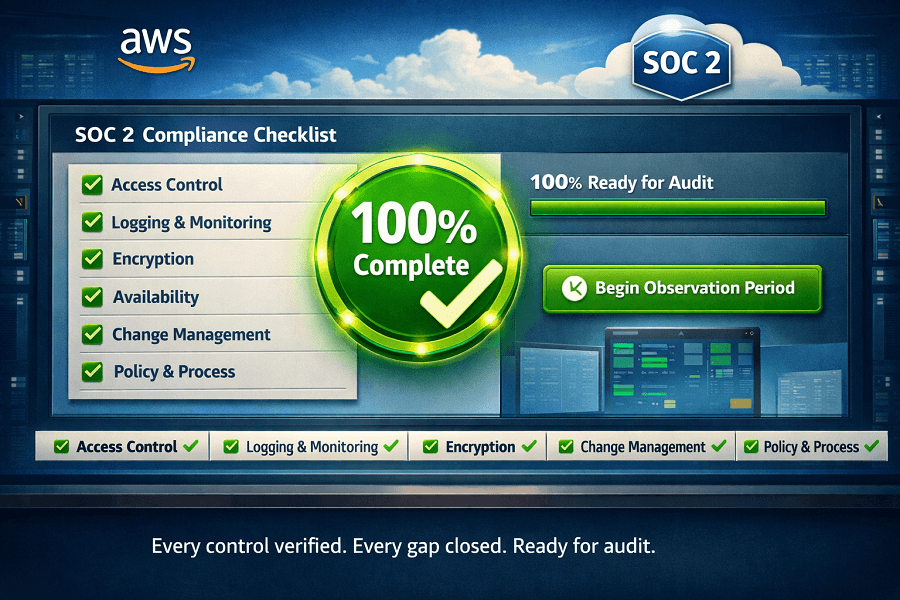
8. AWS SOC 2 Readiness Checklist
Use this checklist to assess your current readiness before beginning the observation period. Every item should be in place before the observation clock starts.
Access Control
- AWS IAM Identity Center (SSO) deployed, no shared passwords
- MFA enforced for all human AWS console access
- No long-lived access keys for human users
- All IAM roles and policies reviewed for least-privilege compliance
- AWS root account MFA enabled, access keys deleted, used only for break-glass
- Third-party integrations using IAM roles, no embedded credentials
Logging & Monitoring
- AWS CloudTrail enabled in all regions with multi-region trail
- CloudTrail log integrity validation enabled
- CloudTrail logs retained for minimum 1 year in S3
- AWS Config enabled with all resource types recorded
- Amazon GuardDuty enabled in all regions
- AWS Security Hub enabled with Foundational Security Best Practices standard
- CloudWatch alarms for: root account login, IAM changes, S3 policy changes, security group changes
Encryption
- KMS encryption enabled for all RDS and Aurora databases
- KMS encryption enabled for all production S3 buckets
- KMS encryption enabled for all EBS volumes
- S3 Block Public Access enabled at the account level
- HTTPS enforced on all ALBs and CloudFront distributions (no HTTP allowed)
- RDS SSL parameter enforced for all database connections
Availability & Change Management
- All production databases deployed in Multi-AZ configuration
- All production services deployed across at least two Availability Zones
- Automated backups configured and restore procedure tested and documented
- All infrastructure changes made via Terraform or CloudFormation, no manual console changes
- CI/CD pipeline in place for all application deployments
- Incident Response Plan documented and tabletop exercise completed
Policy & Process
- Information Security Policy written and approved by leadership
- Access Control Policy documenting IAM standards
- Incident Response Plan with defined escalation path
- Business Continuity / Disaster Recovery Plan
- Vendor Risk Management Policy (covering AWS and other key vendors)
- All employees completed security awareness training (documented)
- Employee offboarding procedure includes same-day access revocation
Conclusion
SOC 2 compliance on AWS is achievable for most startups in 6–12 months with the right approach. AWS provides the native services that satisfy technical controls – CloudTrail for logging, KMS for encryption, IAM for access, GuardDuty for threat detection. The challenge is configuration, documentation, and evidence collection. Compliance automation tools like Vanta or Drata are non-negotiable for reducing manual burden.
The investment ($50K–$115K first-year) is justified by a single enterprise deal that requires SOC 2 – often worth $50K–$500K ARR. Start with a gap assessment, implement the highest-risk controls first, and begin the observation period only when all controls are fully operational. The roadmap is proven; the tools are mature; the business case is clear.
SOC 2 on AWS, Frequently Asked Questions
Does AWS's own SOC 2 certification help us at all?
Yes, but less than most people think. AWS's SOC 2 report (the 'Service Organization Controls' report, available via AWS Artifact) covers the controls AWS manages: data center physical security, hardware durability, and the underlying infrastructure. You can reference AWS's report to satisfy auditor questions about your infrastructure provider's controls. But your own report must cover everything above that layer, which is the substantial majority of what auditors test.
How do we choose between Vanta, Drata, and other automation tools?
For most startups: start with Vanta. It has the widest AWS integration coverage, the most auditor familiarity, and the best product experience at a startup-appropriate price point. If you have an existing relationship with an auditor who strongly prefers Drata, use Drata. If budget is the primary constraint, Sprinto covers the core requirements at lower cost. Get demos from 2–3 vendors before committing, all offer free trials.
What if we already have some controls in place but not all?
You do not need to start from zero. EaseCloud's gap assessment maps your existing controls to SOC 2 criteria and identifies only the genuine gaps. Most startups with a reasonably well-configured AWS environment already satisfy 40–60% of technical controls. The gap work is typically concentrated in IAM hygiene, logging completeness, and policy documentation.
Can a startup achieve SOC 2 without a consultant?
Yes, especially with a compliance automation tool that guides the process. The risk of self-service SOC 2: common gaps that your team doesn't know to look for (undocumented infrastructure changes, incomplete CloudTrail configuration, missing access review records) appear as audit exceptions. An experienced consultant closes these gaps before they become findings. For a first SOC 2 with an enterprise deal on the line, the consulting investment is typically justified.
How long is a SOC 2 report valid?
A SOC 2 Type II report covers a specific observation period (e.g. January 1 – December 31, 2026). The report itself does not expire but becomes dated. Most enterprise buyers require a report from the last 12 months. Plan your audit timing so the report is delivered in time for your sales cycle, and begin the next observation period before the current report expires.
We start with a free Well-Architected Review focused on security, identifying your highest-risk control gaps before any paid scope begins.
Get SOC 2 Audit-Ready on AWS with EaseCloud
EaseCloud takes startups from "no compliance program" to "SOC 2 Type II report in hand" in 6–9 months.
Free Security AssessmentSummarize this post with: