AWS FinOps: The Complete Guide to Cloud Financial Management and Cost Optimization
Learn AWS FinOps best practices, cloud financial management, governance, KPIs, cost optimization, forecasting, and FinOps implementation strategies.

As organizations migrate more workloads to Amazon Web Services (AWS), cloud spending becomes increasingly dynamic and difficult to manage. Unlike traditional on-premises infrastructure, where hardware investments are made upfront, cloud resources can be provisioned, scaled, and decommissioned within minutes. While this flexibility accelerates innovation, it also introduces new financial challenges.
Engineering teams prioritize speed and performance, finance teams focus on budgets and forecasting, and business leaders seek measurable returns on cloud investments. Without a shared operating model, cloud costs can grow rapidly, leading to budget overruns, inefficient resource utilization, and reduced business value.
This is where FinOps comes in.
FinOps, short for Cloud Financial Operations, is a collaborative practice that brings together engineering, finance, procurement, and business teams to manage cloud spending responsibly while enabling innovation. Rather than treating cloud cost optimization as a one-time exercise, FinOps promotes continuous visibility, accountability, forecasting, governance, and optimization throughout the cloud lifecycle.
AWS provides a rich ecosystem of services including AWS Cost Explorer, AWS Budgets, AWS Cost and Usage Report (CUR), AWS Compute Optimizer, AWS Trusted Advisor, and Savings Plans that support FinOps initiatives. However, these services deliver the greatest value when combined within a structured FinOps framework.
What This Guide Covers
- What AWS FinOps is
- Why FinOps matters
- The FinOps lifecycle
- Core FinOps principles
- Roles and responsibilities
- AWS services that enable FinOps
- FinOps KPIs and metrics
- Cost allocation strategies
- Governance best practices
- Common implementation mistakes
- How EaseCloud helps organizations build mature FinOps practices
What Is FinOps?
FinOps (Cloud Financial Operations) is an operational framework that helps organizations maximize the business value of cloud investments through collaboration between technology, finance, and business teams.
Instead of viewing cloud costs as purely a finance problem, FinOps encourages shared responsibility across the organization.
Its primary goals include:
- Improving cloud cost visibility
- Increasing financial accountability
- Optimizing cloud resource utilization
- Supporting faster business decisions
- Aligning cloud spending with business outcomes
- Enabling continuous optimization
FinOps is not simply about reducing costs.
It is about spending intelligently.
Organizations practicing FinOps often increase cloud spending while simultaneously improving efficiency because investments are aligned with measurable business value.
Why FinOps Matters
Cloud computing fundamentally changes how organizations consume infrastructure.
Unlike traditional data centers:
- Resources can be provisioned instantly.
- Costs scale with usage.
- Teams deploy independently.
- Infrastructure changes continuously.
- Pricing models vary across services.
Without proper governance, organizations may experience:
- Rapid cost growth
- Idle infrastructure
- Duplicate resources
- Unused storage
- Oversized compute instances
- Poor visibility into spending
- Departmental budget conflicts
FinOps addresses these challenges by introducing standardized financial management processes.
Benefits include:
- Better forecasting
- Faster optimization
- Improved budgeting
- Greater engineering accountability
- Executive visibility
- Stronger governance
- Higher return on cloud investments
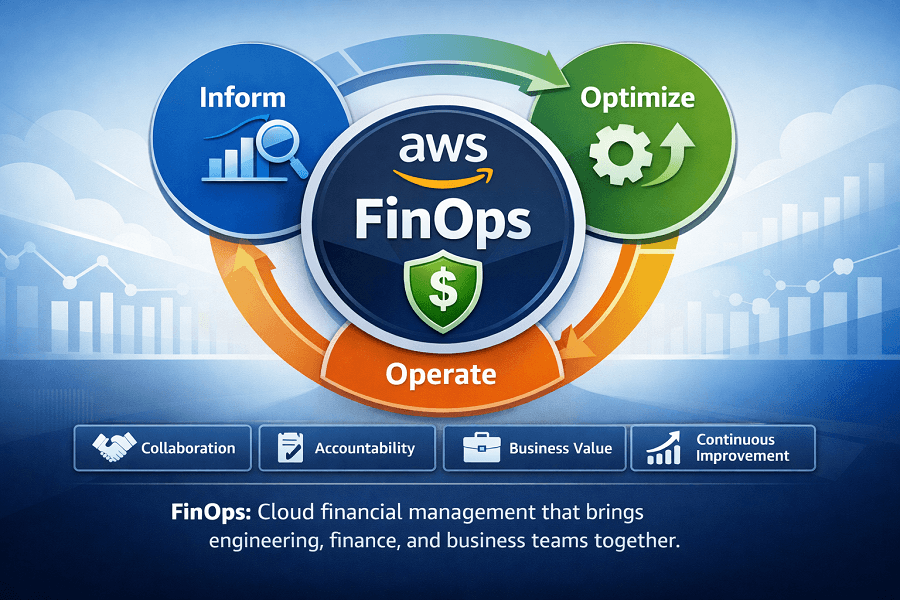
The Three Phases of the FinOps Lifecycle
The FinOps Foundation describes cloud financial management as a continuous lifecycle consisting of three interconnected phases.
Rather than following a linear process, organizations continuously move through these stages as workloads evolve.
The three phases are:
- Inform
- Optimize
- Operate
Each phase builds upon the previous one to create an ongoing cycle of financial improvement.
Phase 1: Inform
The Inform phase focuses on building visibility into cloud spending.
Organizations cannot optimize what they cannot measure.
The primary objective is to provide accurate, timely, and actionable financial data to all stakeholders.
Key activities include:
- Collecting billing data
- Monitoring cloud costs
- Allocating costs to teams
- Creating executive dashboards
- Forecasting future AWS spending
- Tracking budgets
AWS services commonly used during this phase include:
- AWS Cost Explorer
- AWS Cost and Usage Report (CUR)
- AWS Budgets
- Amazon QuickSight
- AWS Organizations
The outcome of this phase is a shared understanding of cloud spending across engineering, finance, and leadership teams.
Phase 2: Optimize
Once organizations understand their cloud costs, they can begin improving efficiency.
Optimization focuses on eliminating waste while ensuring applications continue to meet performance and reliability requirements.
Common optimization activities include:
- Rightsizing Amazon EC2 instances
- Purchasing Savings Plans
- Managing Reserved Instances
- Deleting unused Amazon EBS volumes
- Optimizing Amazon S3 storage classes
- Reducing idle Elastic IP addresses
- Improving Auto Scaling configurations
- Reviewing AWS Trusted Advisor recommendations
Optimization is an ongoing process rather than a one-time project.
Engineering teams should regularly evaluate workloads as application requirements evolve.
Phase 3: Operate
The Operate phase embeds FinOps into daily business operations.
Rather than relying on occasional cost reviews, organizations establish governance processes that promote continuous financial accountability.
Activities in this phase include:
- Budget ownership
- Cloud governance policies
- Cost anomaly response
- KPI reviews
- Quarterly business reviews
- Executive reporting
- Procurement planning
- Continuous optimization
At this stage, cloud financial management becomes an integral part of organizational culture rather than a separate initiative.
FinOps Principles
Although every organization implements FinOps differently, several core principles remain consistent.
These include:
Collaboration
Engineering, finance, procurement, and business teams work together to make cloud investment decisions.
Accountability
Teams take ownership of the cloud resources they provision and the associated costs.
Timely Decision-Making
Cloud spending data should be available quickly enough to support operational decisions.
Business Value
Success is measured not only by cost reduction but also by the value delivered through cloud investments.
Continuous Improvement
Optimization is an ongoing cycle of monitoring, analyzing, implementing changes, and measuring results.
FinOps Roles and Responsibilities
One of the biggest misconceptions about FinOps is that it is solely the responsibility of the finance department.
In reality, FinOps is a cross-functional operating model where engineering, finance, procurement, operations, and executive leadership collaborate to make informed cloud spending decisions.
Each stakeholder has a distinct role.
Executive Leadership
Executive sponsors including CTOs, CIOs, CFOs, and Heads of Engineering define the organization's cloud financial objectives.
Their responsibilities include:
- Establishing cloud spending policies
- Approving budgets
- Measuring business outcomes
- Aligning cloud investments with company strategy
- Reviewing executive dashboards
- Supporting governance initiatives
Leadership provides direction while enabling engineering teams to innovate responsibly.
Finance Teams
Finance professionals focus on financial planning, budgeting, forecasting, and reporting.
Responsibilities include:
- Budget planning
- Monthly forecasting
- Variance analysis
- Cloud cost reporting
- Cost center management
- Financial compliance
- Procurement coordination
Finance teams rely heavily on accurate data from AWS Cost and Usage Report (CUR), AWS Budgets, and executive dashboards.
Engineering Teams
Engineering teams directly influence cloud spending because they provision, configure, and operate AWS resources.
Typical responsibilities include:
- Rightsizing workloads
- Optimizing architectures
- Removing unused resources
- Managing Auto Scaling
- Selecting appropriate storage classes
- Reviewing Trusted Advisor recommendations
- Improving workload efficiency
Rather than being measured solely on uptime or delivery speed, mature organizations also evaluate engineering teams on cost efficiency.
DevOps and Platform Engineering
Platform engineers automate cloud operations and build the infrastructure that supports FinOps practices.
Common responsibilities include:
- Infrastructure as Code (IaC)
- Resource tagging automation
- CI/CD optimization
- Policy enforcement
- Cost monitoring automation
- Budget notifications
- Infrastructure governance
Automation reduces manual effort while improving financial consistency across cloud environments.
Procurement Teams
Procurement teams become increasingly important as cloud spending grows.
Responsibilities include:
- Negotiating enterprise agreements
- Reviewing Savings Plans
- Reserved Instance planning
- Vendor management
- License optimization
- Contract renewals
Close collaboration between procurement and engineering ensures organizations purchase the most appropriate pricing commitments.
Cloud Center of Excellence (CCoE)
Many enterprise organizations establish a Cloud Center of Excellence.
The CCoE develops standards that guide cloud adoption across the business.
Typical responsibilities include:
- Cloud governance
- Security standards
- Tagging policies
- Cost optimization frameworks
- Architecture reviews
- Best practice documentation
- Training and enablement
The CCoE acts as a central authority that supports consistency while allowing individual teams to innovate.
FinOps Key Performance Indicators (KPIs)
Successful FinOps programs rely on measurable outcomes.
Rather than focusing solely on reducing cloud spending, organizations track KPIs that demonstrate business value.
Cloud Spend
The most basic metric measures total cloud expenditure over time.
Organizations monitor:
- Monthly spend
- Quarterly spend
- Annual spend
- Growth trends
- Forecast accuracy
Cloud spending should always be evaluated alongside business growth.
Cost Per Customer
Many SaaS businesses calculate infrastructure cost per active customer.
Example:
| Metric | Value |
|---|---|
| Monthly AWS Spend | $200,000 |
| Active Customers | 20,000 |
| Cost Per Customer | $10 |
Tracking this metric helps organizations understand unit economics as they scale.
Cost Per Transaction
Businesses processing payments, API requests, or e-commerce orders often measure cloud cost per transaction.
Example:
| Metric | Value |
|---|---|
| Monthly Cloud Cost | $75,000 |
| Transactions | 15 million |
| Cost Per Transaction | $0.005 |
Monitoring this KPI helps engineering teams optimize application efficiency.
Cost Per API Request
API-driven businesses frequently analyze cloud spending per API request.
This metric is particularly valuable for:
- SaaS platforms
- AI applications
- Mobile applications
- Microservices
- Developer platforms
As traffic increases, organizations can evaluate whether infrastructure scales efficiently.
Cost Per Environment
Organizations often compare spending across:
- Production
- Development
- Testing
- Staging
- Sandbox
Unexpected growth in non-production environments frequently reveals opportunities for optimization.
Gross Margin Impact
Cloud costs directly affect product profitability.
FinOps teams often analyze:
Revenue → Infrastructure Costs → Gross Margin
Improving infrastructure efficiency without reducing service quality increases business profitability.
Forecast Accuracy
Forecasting is a critical FinOps capability.
Organizations compare:
Forecasted Spend vs Actual Spend
Large variances may indicate:
- Rapid business growth
- Poor resource governance
- Unexpected workload changes
- Inaccurate planning assumptions
Improving forecast accuracy enables better financial planning.
Cost Allocation Strategy
Accurate cost allocation is one of the foundations of FinOps.
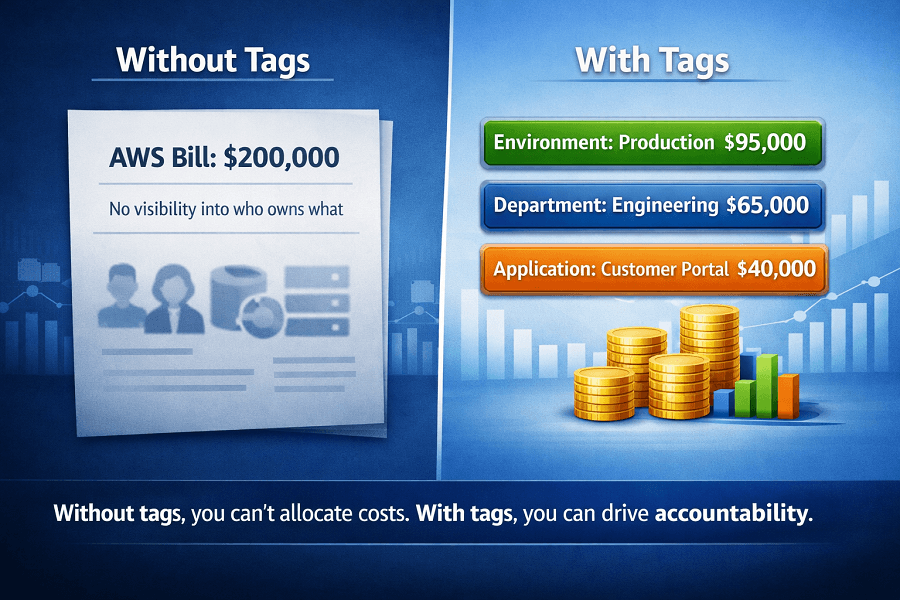
Without it, organizations struggle to understand who owns cloud resources or which business units are responsible for spending.
Resource Tagging
Every production resource should include standardized tags.
Recommended tags include:
- Environment
- Department
- Team
- Application
- Product
- Customer
- Cost Center
- Owner
- Project
Example:
| Key | Value |
|---|---|
| Environment | Production |
| Department | Engineering |
| Application | Customer Portal |
| Cost Center | ENG-102 |
| Owner | Platform Team |
Consistent tagging enables detailed reporting, budgeting, and accountability.
Cost Categories
Cost Categories organize spending into business-friendly groupings.
Examples include:
- Infrastructure
- Storage
- Networking
- AI & Machine Learning
- Security
- Analytics
- Database Services
Rather than reviewing thousands of individual billing records, executives can analyze costs at a strategic level.
Chargeback vs Showback
Both financial models encourage accountability.
Showback
Departments receive reports showing their cloud consumption.
No internal billing occurs.
Benefits:
- Increased awareness
- Better budgeting
- Easier implementation
Chargeback
Departments become financially responsible for cloud usage.
Benefits include:
- Stronger accountability
- Improved forecasting
- Reduced unnecessary provisioning
- Better resource ownership
Large enterprises often implement chargeback once tagging practices have matured.
AWS Services That Enable FinOps
AWS provides a comprehensive ecosystem that supports every phase of the FinOps lifecycle.
Rather than relying on a single service, organizations combine multiple tools to gain visibility, optimize workloads, enforce governance, and improve financial decision-making.
AWS Cost Explorer
Supports:
- Historical cost analysis
- Service-level reporting
- Cost trends
- Forecasting
- Savings recommendations
Used primarily during the Inform phase.
AWS Budgets
Supports:
- Budget creation
- Forecast alerts
- Spending notifications
- Budget Actions
- Financial governance
Budgets help prevent cost overruns before they occur.
AWS Cost and Usage Report (CUR)
Provides:
- Detailed billing records
- Cost allocation
- Chargeback
- Showback
- Executive reporting
- FinOps analytics
CUR serves as the organization's primary financial dataset
AWS Compute Optimizer
Uses machine learning to recommend:
- EC2 rightsizing
- EBS optimization
- Lambda memory tuning
- ECS resource optimization
These recommendations improve infrastructure efficiency while reducing unnecessary costs.
AWS Trusted Advisor
Trusted Advisor complements FinOps by identifying:
- Idle resources
- Security improvements
- Performance opportunities
- Service quota issues
- Reliability enhancements
It supports continuous operational optimization.
Savings Plans and Reserved Instances
Savings Plans and Reserved Instances helps reduce compute costs for predictable workloads.
FinOps teams continuously evaluate:
- Coverage
- Utilization
- Commitment levels
- Effective discounts
Optimizing pricing commitments is a key FinOps responsibility.
Building Executive FinOps Dashboards
Different stakeholders require different insights.
Executive dashboards often include:
Financial KPIs
- Total AWS Spend
- Budget vs Actual
- Forecasted Spend
- Monthly Growth
- Gross Margin Impact
Engineering KPIs
- Cost Per Deployment
- EC2 Utilization
- Idle Resources
- Savings Opportunities
- Optimization Progress
Operational KPIs
- Resource Tag Compliance
- Budget Alerts
- Cost Anomalies
- Rightsizing Progress
- Savings Plan Utilization
Providing role-specific dashboards improves collaboration between engineering and finance teams.
The FinOps Maturity Model
Organizations rarely become FinOps mature overnight.
Most companies evolve through multiple stages as their cloud environments, engineering teams, and business operations grow.
The FinOps Foundation generally describes this progression as a maturity journey rather than a fixed destination.
A simplified maturity model consists of three stages:
- Crawl
- Walk
- Run
Each stage introduces additional processes, automation, and governance.
Stage 1: Crawl
Organizations at the Crawl stage are focused on gaining visibility into cloud spending.
Common characteristics include:
- Basic AWS billing reviews
- Limited tagging strategy
- Manual cost reporting
- Budget monitoring
- Minimal cost ownership
- Reactive optimization
Typical AWS services used include:
- AWS Billing Dashboard
- AWS Cost Explorer
- AWS Budgets
At this stage, organizations are asking:
- How much are we spending?
- Which services cost the most?
- Why did our AWS bill increase?
The objective is to establish transparency.
Stage 2: Walk
As cloud adoption increases, organizations begin implementing structured financial governance.
Characteristics include:
- Standardized tagging
- Cost allocation
- Department reporting
- Chargeback or Showback
- Rightsizing initiatives
- Savings Plans management
- Executive dashboards
AWS services commonly used include:
- AWS Cost and Usage Report (CUR)
- Amazon Athena
- Amazon QuickSight
- AWS Compute Optimizer
- AWS Trusted Advisor
Organizations shift from reactive reporting to proactive optimization.
Stage 3: Run
The Run stage represents mature FinOps practices.
Cloud financial management becomes embedded within daily operations.
Characteristics include:
- Automated reporting
- Predictive forecasting
- AI-assisted optimization
- Continuous governance
- KPI-driven decision making
- Automated policy enforcement
- Enterprise-wide accountability
Engineering and finance teams collaborate continuously rather than meeting only during budgeting cycles.
Cloud investments are evaluated based on measurable business outcomes.
Building a Cloud Governance Framework
FinOps cannot succeed without governance.
Governance provides the policies, standards, and processes that guide cloud adoption while balancing innovation with financial control.
A mature cloud governance framework typically includes several key areas.
Resource Ownership
Every AWS resource should have a clearly identified owner.
Ownership enables organizations to answer questions such as:
- Who launched this resource?
- Which team maintains it?
- Who approves ongoing costs?
- Who should respond to budget alerts?
Resource ownership reduces orphaned infrastructure and improves accountability.
Standardized Tagging
Tagging is one of the most important governance practices.
Recommended mandatory tags include:
- Environment
- Application
- Department
- Owner
- Project
- Cost Center
- Business Unit
- Compliance Level
Consistent tagging supports reporting, budgeting, automation, and cost allocation.
Budget Governance
Budgets should exist at multiple organizational levels.
Examples include:
- Department budgets
- Project budgets
- Environment budgets
- Product budgets
- Team budgets
- Customer budgets
Budget ownership should be assigned to business stakeholders rather than relying solely on finance teams.
Infrastructure Standards
Governance should define approved standards for:
- EC2 instance selection
- Storage classes
- Backup policies
- Encryption
- IAM permissions
- Network architecture
- Logging
- Monitoring
Standardization reduces unnecessary complexity while improving operational efficiency.
Building a FinOps Culture
Technology alone does not create successful FinOps programs.
People and organizational culture are equally important.
Organizations should encourage shared responsibility rather than assigning cloud costs exclusively to finance teams.
Successful FinOps cultures emphasize:
Transparency
Everyone understands cloud spending.
No hidden infrastructure.
No unexplained invoices.
Accountability
Engineering teams own both application performance and infrastructure costs.
Cloud efficiency becomes part of engineering success metrics.
Collaboration
Finance, engineering, operations, security, and leadership work together to make informed decisions.
Cloud optimization becomes a shared objective.
Continuous Learning
AWS pricing models evolve regularly.
New services are introduced frequently.
Organizations should continuously educate teams on:
- AWS pricing
- FinOps best practices
- Optimization techniques
- Governance standards
Common FinOps Challenges
Even mature organizations face challenges during FinOps adoption.
Recognizing these obstacles early can improve long-term success.
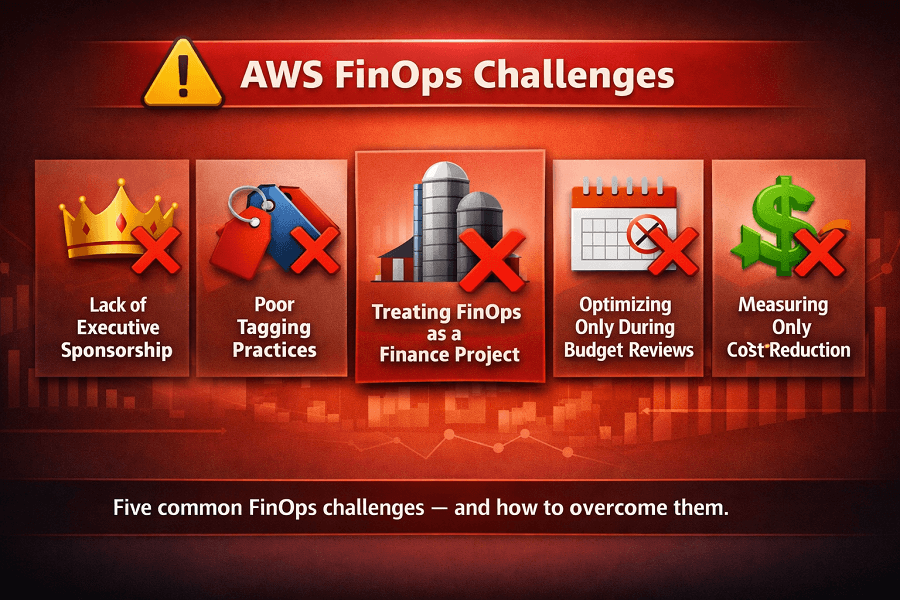
Lack of Executive Sponsorship
Without leadership support, FinOps initiatives often lose momentum.
Executive sponsorship ensures:
- Budget approval
- Organizational alignment
- Policy enforcement
- Cross-functional collaboration
Poor Tagging Practices
Inconsistent or missing tags reduce reporting accuracy and weaken accountability.
Organizations should regularly audit tagging compliance and automate tag enforcement where possible.
Treating FinOps as a Finance Project
FinOps is a business-wide discipline.
If engineering teams are excluded, optimization opportunities are often missed because they control the majority of cloud resources.
Optimizing Only During Budget Reviews
Cloud optimization should occur continuously.
Waiting until the end of the quarter or fiscal year often allows unnecessary costs to accumulate.
Measuring Only Cost Reduction
Reducing cloud spend is not always the correct objective.
Organizations should also measure:
- Business growth
- Customer experience
- Deployment velocity
- Platform reliability
- Revenue per workload
- Cloud ROI
FinOps seeks to maximize value, not simply minimize spending.
Future Trends in AWS FinOps
Cloud financial management continues to evolve as AWS introduces new capabilities and organizations adopt AI-driven workloads.
Emerging trends include:
- AI-powered cost forecasting
- Automated anomaly detection
- Predictive rightsizing
- Policy-as-Code for financial governance
- Real-time cost observability
- Sustainability metrics integrated with cost reporting
- Unit economics for AI and GPU workloads
- Multi-cloud FinOps across AWS, Azure, and Google Cloud
Organizations investing in these capabilities will be better positioned to control cloud costs while supporting innovation.
Conclusion
AWS FinOps represents the evolution of cloud cost management from reactive billing reviews to proactive financial governance. By bringing together engineering, finance, procurement, and executive leadership, organizations can make informed cloud investment decisions that balance innovation, performance, and cost efficiency.
The AWS ecosystem provides powerful tools, including AWS Cost Explorer, AWS Budgets, AWS Cost and Usage Report (CUR), AWS Compute Optimizer, AWS Trusted Advisor, and AWS Organizations but these services deliver their greatest value when integrated into a structured FinOps operating model.
Successful FinOps is not defined by the lowest cloud bill. It is defined by the ability to maximize business value, improve financial visibility, strengthen accountability, and continuously optimize cloud investments as business needs evolve.
Whether you're beginning your cloud financial management journey or scaling FinOps across a global enterprise, implementing a structured framework will help ensure your AWS environment remains both cost-efficient and aligned with long-term business goals.
If your organization is looking to establish or mature its AWS FinOps capabilities, EaseCloud's cloud consultants can help design a tailored strategy that combines governance, automation, analytics, and optimization to support sustainable growth.
Frequently Asked Questions
Is FinOps only for large enterprises?
No.
Organizations of all sizes can benefit from FinOps.
Small businesses may begin with basic cost visibility and budgeting, while larger enterprises often implement advanced governance, automation, and chargeback models.
Does FinOps reduce cloud costs?
FinOps helps organizations optimize cloud spending and improve financial accountability.
Although cost savings are often achieved, the primary goal is maximizing business value from cloud investments rather than simply minimizing expenses.
Which AWS services are most important for FinOps?
A mature FinOps practice commonly uses:
- AWS Cost Explorer
- AWS Budgets
- AWS Cost and Usage Report (CUR)
- AWS Compute Optimizer
- AWS Trusted Advisor
- AWS Organizations
- Amazon Athena
- Amazon QuickSight
Each service contributes to visibility, optimization, reporting, and governance.
How often should FinOps reviews occur?
Best practice is to establish a regular operating cadence.
Many organizations perform:
- Weekly engineering cost reviews
- Monthly budget reviews
- Quarterly business reviews
- Annual strategic planning
The appropriate frequency depends on workload complexity and business objectives.
Can FinOps support multi-cloud environments?
Yes.
Although this article focuses on AWS, FinOps principles apply equally to Azure, Google Cloud Platform (GCP), and hybrid cloud environments.
Many enterprises implement a unified FinOps framework across multiple cloud providers.
How EaseCloud Helps Organizations Implement AWS FinOps
At EaseCloud, we help organizations move beyond ad hoc cost optimization by building structured FinOps practices that align engineering, finance, and business objectives.
Rather than delivering one-time recommendations, we help organizations establish repeatable processes, governance models, and reporting frameworks that support sustainable cloud financial management.