Qwen vs DeepSeek Benchmarks: Complete AI Performance Comparison (2026)
Compare Qwen vs DeepSeek benchmark performance across coding, reasoning, math, multilingual tasks, latency, context windows, and enterprise AI.
The rapid advancement of open-source Large Language Models (LLMs) has fundamentally changed how organizations evaluate artificial intelligence. Today, selecting an AI model is no longer based solely on brand recognition or marketing claims. Instead, developers, AI engineers, researchers, and enterprise architects increasingly rely on standardized benchmark evaluations to determine which models deliver the best real-world performance.
Among the most closely watched open-weight AI models are Qwen from Alibaba Cloud and DeepSeek from DeepSeek AI. Both have consistently achieved impressive benchmark results across coding, reasoning, mathematics, multilingual understanding, and general language tasks, making them strong alternatives to many proprietary AI models.
However, benchmark leaderboards often create confusion.
One benchmark may show DeepSeek outperforming Qwen in mathematical reasoning, while another demonstrates Qwen leading in multilingual understanding or software engineering. Different providers also evaluate models using different hardware, inference engines, prompt formats, and model variants, making direct comparisons difficult.
This raises several important questions:
- Which benchmark should developers trust?
- Do benchmark scores accurately reflect production performance?
- Does a higher benchmark score always mean a better AI model?
- Which model performs better for enterprise applications?
- Which benchmark matters most for coding, AI agents, or business automation?
These are the questions engineering teams ask when choosing an AI model for production systems.
Organizations working with AI consulting partners such as EaseCloud rarely make deployment decisions based on a single benchmark leaderboard. Instead, they evaluate models using a combination of benchmark performance, infrastructure requirements, inference cost, deployment flexibility, security, governance, and workload-specific testing.
This comprehensive guide explains how Qwen and DeepSeek compare across the industry's most important benchmark suites and, more importantly, what those benchmark scores actually mean for real-world deployments. For detailed guidance on deploying these models in production, see our guide on Deploy LLMs on AWS.
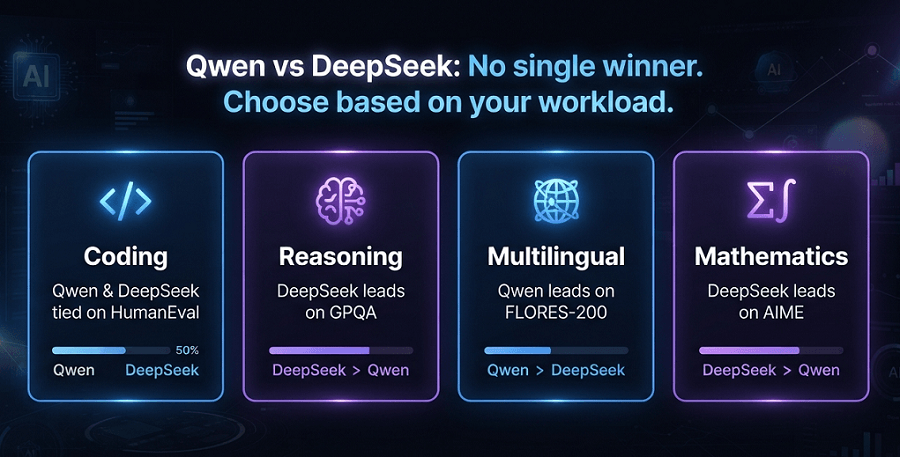
What This Guide Covers
- Coding benchmarks
- Reasoning benchmarks
- Mathematics benchmarks
- Knowledge benchmarks
- Multilingual evaluations
- Long-context performance
- Inference speed
- Latency
- Memory efficiency
- Enterprise scalability
- Infrastructure requirements
Rather than simply presenting benchmark tables, we'll interpret the results from the perspective of software engineers, AI architects, and enterprise decision-makers so you can confidently determine which model best aligns with your technical and business requirements.
Why AI Benchmarks Matter
Large Language Models perform thousands of different tasks.
A single AI model may be used to:
- Generate software code
- Solve mathematical equations
- Translate documents
- Answer customer questions
- Build AI agents
- Analyze legal contracts
- Summarize research papers
- Process financial reports
- Assist software developers
- Automate business workflows
Because no single task represents overall intelligence, researchers use specialized benchmark suites to evaluate different capabilities.
For example:
| Capability | Common Benchmarks |
|---|---|
| Coding | HumanEval, SWE-bench, LiveCodeBench |
| Mathematics | AIME, GSM8K, MATH-500 |
| Reasoning | GPQA, ARC Challenge |
| Knowledge | MMLU, AGIEval |
| Multilingual | CMMLU, CEval, FLORES-200 |
| Long Context | LongBench, InfiniteBench |
| Enterprise Performance | Latency, Throughput, Context Window |
Each benchmark measures a different aspect of model capability.
A model that performs exceptionally well on programming tasks may not necessarily lead in multilingual translation or mathematical reasoning.
Understanding this distinction is critical when selecting an AI model.
Why Benchmarks Can Be Misleading
One of the biggest misconceptions in the AI industry is believing that the model with the highest benchmark score is automatically the best model.
In reality, benchmark scores have several limitations.
Different Benchmarks Measure Different Skills
A coding benchmark evaluates software engineering ability.
A mathematics benchmark evaluates logical problem-solving.
A multilingual benchmark evaluates language understanding.
These results should never be compared directly.
Evaluation Conditions Differ
Benchmark scores may vary depending on:
- Prompt formatting
- Temperature settings
- Sampling strategy
- Hardware configuration
- Inference engine
- Quantization method
- Model version
- Context length
Even small changes in evaluation methodology can significantly affect reported scores.
Benchmarks Do Not Measure Production Readiness
Production AI systems require much more than benchmark performance.
Organizations must also evaluate:
- Reliability
- API availability
- Response consistency
- Security
- Scalability
- Cost
- Deployment flexibility
- Governance
- Monitoring
- Operational complexity
A slightly lower benchmark score may be acceptable if the model delivers greater stability, lower operational costs, or stronger enterprise support.
EaseCloud Insight
When helping organizations adopt AI, EaseCloud recommends treating benchmark results as one input in a broader evaluation process. For a comparison of the major ML platforms, see SageMaker vs Azure ML vs Vertex AI.
Before selecting an AI model for production, teams should validate performance using their own datasets, repositories, and workflows. Real-world testing often provides more actionable insights than leaderboard rankings alone.
Understanding the Qwen Model Family
Before comparing benchmark scores, it's important to understand which models belong to the Qwen ecosystem.
The Qwen family has evolved into a comprehensive collection of language models designed for different workloads, including software development, reasoning, multilingual communication, document analysis, and enterprise AI applications.
Major Qwen models include:
- Qwen 3
- Qwen Coder
- Qwen-Max
- Qwen-Plus
- Qwen Turbo
- Qwen VL (Vision Language)
- Qwen Audio
- Qwen reasoning variants
These models differ in:
- Parameter count
- Context window
- Speed
- Cost
- Coding specialization
- Reasoning capability
- Deployment requirements
Because benchmark results often refer to specific variants, understanding which model is being tested is essential before making comparisons.
Understanding the DeepSeek Model Family
DeepSeek has rapidly become one of the most influential open-weight AI ecosystems by emphasizing efficient architectures and strong reasoning performance.
Key models include:
- DeepSeek V3
- DeepSeek R1
- DeepSeek Coder
- DeepSeek Math
- Distilled reasoning models
Each variant targets different workloads.
For example:
- DeepSeek V3 is designed as a versatile general-purpose model.
- DeepSeek R1 focuses on advanced reasoning and complex problem solving.
- DeepSeek Coder specializes in software engineering tasks.
- DeepSeek Math is optimized for mathematical reasoning.
Comparing Qwen with DeepSeek requires selecting equivalent models for each benchmark rather than treating entire model families as a single entity.
How AI Benchmarks Are Categorized
Modern LLM evaluations are typically divided into several major categories.
Understanding these categories helps explain why one model may outperform another in specific scenarios.
Coding Benchmarks
These measure a model's ability to generate, understand, debug, and modify software code.
Common benchmarks include:
- HumanEval
- SWE-bench
- LiveCodeBench
- BigCodeBench
- MBPP
- MultiPL-E
- EvalPlus
- Aider Polyglot Benchmark
These benchmarks are particularly valuable for software developers.
Reasoning Benchmarks
Reasoning benchmarks measure logical thinking and multi-step problem solving.
Important benchmarks include:
- GPQA Diamond
- ARC Challenge
- HellaSwag
- DROP
Reasoning performance is especially important for:
- AI agents
- Scientific research
- Decision support
- Planning systems
Mathematics Benchmarks
These evaluate quantitative reasoning and problem solving.
Widely used benchmarks include:
- AIME
- GSM8K
- MATH-500
These tests assess a model's ability to solve mathematical problems accurately rather than simply retrieving memorized information.
Knowledge Benchmarks
Knowledge benchmarks evaluate factual understanding across multiple academic disciplines.
Examples include:
- MMLU
- MMLU-Pro
- AGIEval
These benchmarks measure performance in areas such as:
- Science
- Law
- Medicine
- Economics
- Computer Science
- History
- Engineering
Multilingual Benchmarks
Modern AI models increasingly serve global audiences.
Multilingual benchmarks evaluate:
- Translation quality
- Cross-lingual reasoning
- Language understanding
- Cultural knowledge
Important evaluations include:
- CMMLU
- CEval
- FLORES-200
- MGSM
Qwen has historically demonstrated particularly strong multilingual capabilities, while DeepSeek continues to improve rapidly in this area.
Long-Context Benchmarks
As AI systems process increasingly large documents, long-context performance has become a critical differentiator.
Benchmarks include:
- LongBench
- InfiniteBench
- RULER
- Needle in a Haystack
These evaluations measure how effectively a model can:
- Process lengthy documents
- Understand large repositories
- Analyze legal contracts
- Summarize books
- Work with enterprise knowledge bases
Enterprise Performance Benchmarks
Beyond academic evaluations, enterprise deployments require operational performance metrics.
Organizations typically measure:
- First-token latency
- Tokens per second
- Throughput
- GPU memory utilization
- Concurrent request handling
- Context scalability
- Cost efficiency
- Inference stability
These metrics often have a greater impact on production success than benchmark scores alone.
Benchmark Methodology Used in This Comparison
Rather than relying on a single leaderboard, this guide evaluates Qwen and DeepSeek across multiple benchmark categories and interprets the results in the context of practical enterprise use.
Our comparison framework considers:
- Public benchmark performance
- Coding capabilities
- Reasoning quality
- Mathematical accuracy
- Multilingual understanding
- Long-context handling
- Inference efficiency
- API responsiveness
- Local deployment flexibility
- Enterprise scalability
Where appropriate, we'll also explain why a model performs well on a benchmark and whether that advantage is likely to matter in real-world engineering workflows.
Overall Benchmark Comparison
The table below provides a high-level overview before we analyze each benchmark individually.
| Benchmark Category | Qwen | DeepSeek | Initial Leader |
|---|---|---|---|
| Coding | ⭐⭐⭐⭐⭐ | ⭐⭐⭐⭐⭐ | Tie |
| Software Engineering | ⭐⭐⭐⭐⭐ | ⭐⭐⭐⭐⭐ | Tie |
| Logical Reasoning | ⭐⭐⭐⭐☆ | ⭐⭐⭐⭐⭐ | DeepSeek |
| Mathematics | ⭐⭐⭐⭐☆ | ⭐⭐⭐⭐⭐ | DeepSeek |
| General Knowledge | ⭐⭐⭐⭐⭐ | ⭐⭐⭐⭐☆ | Qwen |
| Multilingual Understanding | ⭐⭐⭐⭐⭐ | ⭐⭐⭐⭐☆ | Qwen |
| Long Context | ⭐⭐⭐⭐⭐ | ⭐⭐⭐⭐⭐ | Tie |
| Enterprise Deployment | ⭐⭐⭐⭐⭐ | ⭐⭐⭐⭐⭐ | Tie |
| API Ecosystem | ⭐⭐⭐⭐⭐ | ⭐⭐⭐⭐☆ | Qwen |
| Local Deployment | ⭐⭐⭐⭐⭐ | ⭐⭐⭐⭐⭐ | Tie |
While this overview highlights general trends, individual benchmark results often tell a more nuanced story. In the next section, we'll examine each benchmark in detail—including HumanEval, SWE-bench, LiveCodeBench, GPQA, MMLU, AIME, LongBench, and more—to understand where each model truly excels and where benchmark leadership translates into real-world value.
HumanEval Benchmark
What Is HumanEval?
HumanEval is one of the most widely recognized coding benchmarks for Large Language Models.
Developed by OpenAI, it evaluates whether an AI model can generate correct Python functions from natural language instructions.
Unlike simple code completion tests, HumanEval focuses on whether generated code passes hidden unit tests.
It evaluates:
- Code correctness
- Python programming
- Algorithm implementation
- Function generation
- Logical reasoning
- Prompt understanding
Although HumanEval focuses only on Python, it remains an important indicator of software engineering capability.
Qwen Performance
Qwen consistently performs at a very high level on HumanEval.
Its strengths include:
- Clean code generation
- Readable implementations
- Strong documentation
- Modern Python conventions
- Reliable syntax
Developers often find Qwen particularly effective when building:
- REST APIs
- Data processing scripts
- Automation tools
- Backend services
The generated code usually requires minimal formatting or stylistic corrections.
DeepSeek Performance
DeepSeek also performs exceptionally well on HumanEval.
Its outputs frequently demonstrate:
- Strong algorithm optimization
- Efficient implementations
- Better edge-case handling
- Excellent logical reasoning
DeepSeek often produces concise solutions that experienced developers appreciate, especially for algorithm-heavy tasks.
EaseCloud Insight
For enterprise software engineering, EaseCloud recommends using HumanEval as an initial indicator rather than the final decision-maker. Production systems depend on maintainability, documentation, testing, and security practices that extend beyond benchmark performance.
SWE-bench
What Is SWE-bench?
SWE-bench is considered one of the most realistic software engineering benchmarks available today.
Instead of solving isolated programming problems, models must resolve actual GitHub issues taken from open-source repositories.
Tasks include:
- Understanding repositories
- Reading multiple files
- Finding bugs
- Updating code
- Running tests
- Producing valid patches
Because it evaluates complete software engineering workflows, SWE-bench has become one of the most valuable benchmarks for developers.
Qwen Performance
Qwen performs strongly on repository-level engineering tasks.
It excels at:
- Understanding project architecture
- Reading documentation
- Explaining unfamiliar code
- Updating APIs
- Refactoring existing systems
Its long-context capabilities help it maintain awareness across multiple files within larger repositories.
DeepSeek Performance
DeepSeek is particularly effective when resolving complex bugs.
Common strengths include:
- Root-cause analysis
- Multi-step debugging
- Logic correction
- Test failure diagnosis
- Repository reasoning
Engineering teams frequently value DeepSeek's analytical approach when investigating difficult production issues.
Enterprise Perspective
Benchmark leadership on SWE-bench is especially meaningful for organizations building AI coding assistants because repository understanding more closely resembles day-to-day engineering than isolated coding exercises.
LiveCodeBench
What Is LiveCodeBench?
Traditional coding benchmarks eventually become outdated.
LiveCodeBench solves this problem by continuously introducing new programming challenges.
This benchmark evaluates:
- General coding ability
- Adaptability
- Competitive programming
- Reasoning under unseen conditions
Because tasks change over time, it provides a better estimate of how models perform on previously unseen problems.
Qwen Analysis
Qwen consistently demonstrates reliable performance across newly introduced programming tasks.
Strengths include:
- Stable code generation
- Consistent reasoning
- Strong language understanding
- Practical implementations
DeepSeek Analysis
DeepSeek frequently performs exceptionally well on novel programming challenges that require multiple reasoning steps.
Its architecture is particularly effective for:
- Complex algorithms
- Mathematical programming
- Dynamic programming
- Optimization problems
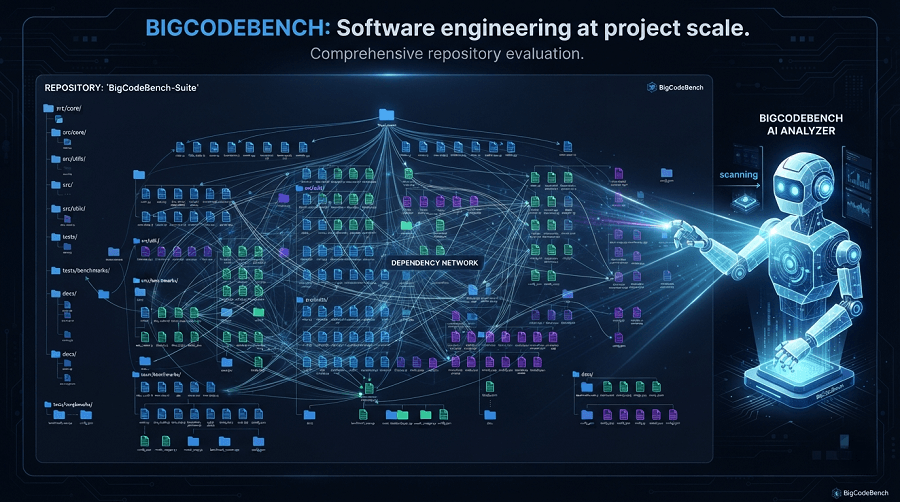
BigCodeBench
BigCodeBench evaluates software engineering at project scale.
Rather than testing isolated functions, it focuses on:
- Large repositories
- Software architecture
- Dependency management
- Multi-file editing
- Framework understanding
This benchmark is highly relevant for enterprise software development.
Qwen
Qwen performs well because it generates:
- Readable project structures
- Consistent coding style
- Well-organized modules
- Strong documentation
DeepSeek
DeepSeek often demonstrates stronger architectural reasoning in technically demanding repositories.
It performs particularly well when:
- Updating legacy systems
- Understanding dependencies
- Optimizing existing architectures
MBPP (Mostly Basic Python Problems)
MBPP evaluates practical Python programming skills.
It includes tasks involving:
- Lists
- Dictionaries
- Loops
- Sorting
- String manipulation
- Functions
Although considered a simpler benchmark, MBPP reflects many real-world automation tasks.
Qwen
Produces highly readable Python code with clear variable names and maintainable structure.
DeepSeek
Often generates slightly shorter and more optimized implementations while maintaining correctness.
MultiPL-E
Modern software engineering extends far beyond Python.
MultiPL-E evaluates coding performance across multiple languages including:
- Python
- Java
- JavaScript
- TypeScript
- Go
- Rust
- PHP
- C#
- C++
- Kotlin
Qwen Strengths
- JavaScript
- TypeScript
- Python
- SQL
- PHP
- Bash
DeepSeek Strengths
- Rust
- Go
- C++
- Java
- Algorithm-intensive programming
EaseCloud Recommendation
Organizations should benchmark models using the programming languages that dominate their own codebase rather than relying on generalized benchmark averages.
GPQA Diamond
What Is GPQA?
GPQA (Graduate-Level Google-Proof Q&A) measures reasoning across highly specialized scientific subjects.
It evaluates knowledge in areas such as:
- Physics
- Chemistry
- Biology
- Advanced reasoning
Unlike factual benchmarks, GPQA emphasizes analytical thinking rather than memorization.
Qwen
Qwen performs strongly, particularly when explanations require combining scientific knowledge with natural language clarity.
DeepSeek
DeepSeek often demonstrates stronger logical reasoning for complex scientific and analytical questions, making it a compelling choice for research-oriented workloads.
AIME
The American Invitational Mathematics Examination (AIME) benchmark evaluates advanced mathematical reasoning.
Tasks involve:
- Algebra
- Geometry
- Number theory
- Combinatorics
Qwen
Produces structured mathematical reasoning and step-by-step solutions.
DeepSeek
Often achieves stronger results on highly complex mathematical problems due to its reasoning-focused architecture.
GSM8K
GSM8K measures grade-school mathematical reasoning.
Although the problems appear simple, they require multi-step logical thinking.
Both Qwen and DeepSeek perform well, but DeepSeek often demonstrates slightly stronger consistency on chained reasoning tasks.
MATH-500
MATH-500 expands mathematical evaluation to significantly more difficult problems.
It measures:
- Proof construction
- Symbolic reasoning
- Advanced calculations
- Logical consistency
This benchmark is particularly useful when evaluating models for research, education, or scientific applications.
MMLU
Massive Multitask Language Understanding (MMLU) evaluates general knowledge across dozens of academic disciplines.
Topics include:
- Medicine
- Engineering
- Computer Science
- Economics
- Psychology
- Law
- Mathematics
Qwen
Qwen consistently demonstrates excellent general knowledge and produces detailed, well-structured responses across a broad range of subjects.
DeepSeek
DeepSeek also performs strongly but often distinguishes itself through more analytical reasoning when questions involve multiple logical steps.
MMLU-Pro
MMLU-Pro increases the complexity of standard MMLU questions by reducing ambiguity and introducing more challenging reasoning requirements.
Performance on this benchmark provides a stronger indication of how well a model handles advanced professional knowledge.
Both Qwen and DeepSeek achieve highly competitive results, making them suitable for enterprise knowledge applications.
CMMLU and CEval
These benchmark suites evaluate Chinese language understanding and academic knowledge.
They measure:
- Reading comprehension
- Professional knowledge
- Educational reasoning
- Language understanding
Given their origins, both Qwen and DeepSeek perform exceptionally well, making them strong candidates for multilingual applications involving Chinese content.
FLORES-200
FLORES-200 evaluates multilingual translation quality across hundreds of language pairs.
It measures:
- Translation accuracy
- Cross-lingual understanding
- Semantic preservation
- Language consistency
Qwen
One of Qwen's strongest advantages is its multilingual capability. It performs exceptionally well across many global languages and maintains high translation quality while preserving context.
DeepSeek
DeepSeek also offers strong multilingual performance, though Qwen generally demonstrates broader language coverage and greater consistency in multilingual enterprise scenarios.
LongBench
LongBench evaluates how effectively an AI model processes long documents.
Tasks include:
- Document summarization
- Long-form question answering
- Repository analysis
- Legal document understanding
- Research paper analysis
Both Qwen and DeepSeek support long-context workloads, making them suitable for enterprise knowledge management and Retrieval-Augmented Generation (RAG) systems.
InfiniteBench
InfiniteBench pushes models to their limits by testing their ability to retain information over extremely long contexts.
This benchmark becomes increasingly important for:
- AI agents
- Enterprise search
- Large codebases
- Financial documents
- Technical documentation
Both ecosystems continue to improve in this area, with model selection often depending on the specific deployment configuration.
RULER
RULER measures long-context retrieval accuracy.
Rather than simply accepting long inputs, models must successfully locate and use information buried deep within extensive documents.
This benchmark reflects real-world enterprise scenarios involving:
- Compliance documents
- Internal knowledge bases
- Multi-thousand-page manuals
- Software documentation
Organizations implementing enterprise AI assistants should pay close attention to retrieval accuracy rather than context length alone.
Overall Benchmark Category Comparison
| Category | Qwen | DeepSeek | Best Choice |
|---|---|---|---|
| HumanEval | ⭐⭐⭐⭐⭐ | ⭐⭐⭐⭐⭐ | Tie |
| SWE-bench | ⭐⭐⭐⭐⭐ | ⭐⭐⭐⭐⭐ | Tie |
| LiveCodeBench | ⭐⭐⭐⭐☆ | ⭐⭐⭐⭐⭐ | DeepSeek |
| BigCodeBench | ⭐⭐⭐⭐⭐ | ⭐⭐⭐⭐⭐ | Tie |
| MBPP | ⭐⭐⭐⭐⭐ | ⭐⭐⭐⭐☆ | Qwen |
| MultiPL-E | ⭐⭐⭐⭐⭐ | ⭐⭐⭐⭐⭐ | Tie |
| GPQA | ⭐⭐⭐⭐☆ | ⭐⭐⭐⭐⭐ | DeepSeek |
| AIME | ⭐⭐⭐⭐☆ | ⭐⭐⭐⭐⭐ | DeepSeek |
| GSM8K | ⭐⭐⭐⭐☆ | ⭐⭐⭐⭐⭐ | DeepSeek |
| MATH-500 | ⭐⭐⭐⭐☆ | ⭐⭐⭐⭐⭐ | DeepSeek |
| MMLU | ⭐⭐⭐⭐⭐ | ⭐⭐⭐⭐☆ | Qwen |
| MMLU-Pro | ⭐⭐⭐⭐⭐ | ⭐⭐⭐⭐⭐ | Tie |
| FLORES-200 | ⭐⭐⭐⭐⭐ | ⭐⭐⭐⭐☆ | Qwen |
| LongBench | ⭐⭐⭐⭐⭐ | ⭐⭐⭐⭐⭐ | Tie |
| InfiniteBench | ⭐⭐⭐⭐⭐ | ⭐⭐⭐⭐⭐ | Tie |
| RULER | ⭐⭐⭐⭐⭐ | ⭐⭐⭐⭐⭐ | Tie |
Benchmark Scores vs Real-World Performance
One of the biggest misconceptions in AI is that the model with the highest benchmark score is automatically the best choice.
In reality, benchmark leadership does not always translate into higher developer productivity or better business outcomes.
For example:
- A model may lead on AIME but provide slower API responses.
- Another model may rank lower on GPQA but generate cleaner production code.
- One model may excel at reasoning while another offers significantly lower infrastructure costs.
This is why organizations should evaluate models across four dimensions:
| Evaluation Area | Why It Matters |
|---|---|
| Benchmark Performance | Measures technical capability |
| Infrastructure Performance | Determines scalability and latency |
| Operational Cost | Impacts long-term ROI |
| Business Fit | Aligns AI with organizational goals |
First-Token Latency
For interactive applications, users notice how quickly a model begins responding—not just how fast it completes the response.
This is known as First-Token Latency (FTL).
Lower FTL improves the experience in:
- AI chatbots
- Coding assistants
- Customer support
- AI copilots
- Enterprise knowledge assistants
Factors Affecting First-Token Latency
- Model size
- GPU hardware
- Inference engine
- Quantization
- Network latency
- API provider
- Prompt length
Qwen
Qwen generally provides responsive first-token performance when deployed through optimized inference platforms.
DeepSeek
DeepSeek also performs well, though reasoning-focused models may intentionally spend additional time processing more complex prompts before generating responses.
EaseCloud Insight
When optimizing enterprise AI systems, EaseCloud measures end-user latency rather than benchmark latency. A fast benchmark result has limited value if production users experience delays caused by networking, infrastructure bottlenecks, or inefficient model serving.
Tokens Per Second (Inference Throughput)
Once a model begins responding, throughput becomes the next critical metric.
Tokens per second determine:
- User experience
- API responsiveness
- Enterprise scalability
- Infrastructure utilization
- Operating costs
Higher throughput allows organizations to serve more users using the same GPU infrastructure.
Factors influencing throughput include:
- GPU type
- Quantization
- Batch size
- Inference framework
- Context length
- Model architecture
Both Qwen and DeepSeek can achieve excellent throughput when deployed using optimized inference engines such as vLLM or TensorRT-LLM.
Context Window Performance
Modern AI systems increasingly process:
- Large repositories
- Technical documentation
- Contracts
- Financial reports
- Research papers
- Enterprise knowledge bases
The context window determines how much information a model can analyze in a single request.
Both Qwen and DeepSeek support long-context variants suitable for:
- Repository understanding
- AI agents
- RAG systems
- Enterprise search
- Multi-document analysis
However, context length alone is not enough.
The real question is:
How accurately can the model retrieve and reason over information located deep within that context?
Benchmarks such as LongBench and RULER provide better insight than advertised token limits.
GPU Memory Requirements
Infrastructure planning is an essential part of AI adoption.
GPU memory requirements vary depending on:
- Model size
- Precision
- Quantization
- Batch size
- Concurrent users
Organizations typically deploy these models on hardware such as:
- NVIDIA H100
- NVIDIA A100
- NVIDIA L40S
- NVIDIA RTX 6000 Ada
- Consumer RTX GPUs for development
Larger reasoning models require more VRAM, while quantized variants significantly reduce hardware requirements without dramatically affecting quality.
Local Deployment Performance
Many organizations prefer local deployment for security, compliance, and cost reasons.
Popular deployment options include:
Ollama
Ideal for:
- Developers
- Local experimentation
- Offline coding assistants
- Private AI workflows
vLLM
Designed for production environments requiring:
- High throughput
- Dynamic batching
- Efficient GPU utilization
- OpenAI-compatible APIs
LM Studio
Useful for:
- Desktop testing
- Prompt engineering
- Rapid experimentation
- Local inference
Kubernetes
Large enterprises typically deploy inference workloads using Kubernetes to achieve:
- High availability
- Horizontal scaling
- Load balancing
- Automated recovery
- Rolling updates
At EaseCloud, Kubernetes-based deployments are commonly implemented on Amazon EKS, enabling organizations to scale GPU workloads while integrating monitoring, autoscaling, and governance into their AI infrastructure.
API Ecosystem Comparison
A strong model is only as useful as the ecosystem surrounding it.
Organizations should evaluate:
- API reliability
- Regional availability
- SDK support
- Documentation quality
- Enterprise authentication
- Rate limits
- Monitoring capabilities
Qwen Ecosystem
Available through:
- Alibaba Cloud Model Studio
- OpenRouter
- Together AI
- Fireworks AI
- Community deployments
Strengths include:
- Broad provider availability
- Enterprise cloud integration
- Strong multilingual support
DeepSeek Ecosystem
Available through:
- DeepSeek Platform
- OpenRouter
- Together AI
- Fireworks AI
- Self-hosted inference
Strengths include:
- Competitive pricing
- Active developer adoption
- Strong open-weight ecosystem
Infrastructure Cost Considerations
Organizations often focus on API pricing while overlooking broader infrastructure expenses.
Important cost factors include:
- GPU infrastructure
- Cloud storage
- Networking
- Monitoring
- Autoscaling
- Backup systems
- Engineering time
- Security operations
- Model updates
A model with slightly higher API pricing may still provide lower overall operating costs if it improves developer productivity or reduces infrastructure complexity.
Enterprise Scalability
When deploying AI across hundreds or thousands of users, scalability becomes a strategic requirement.
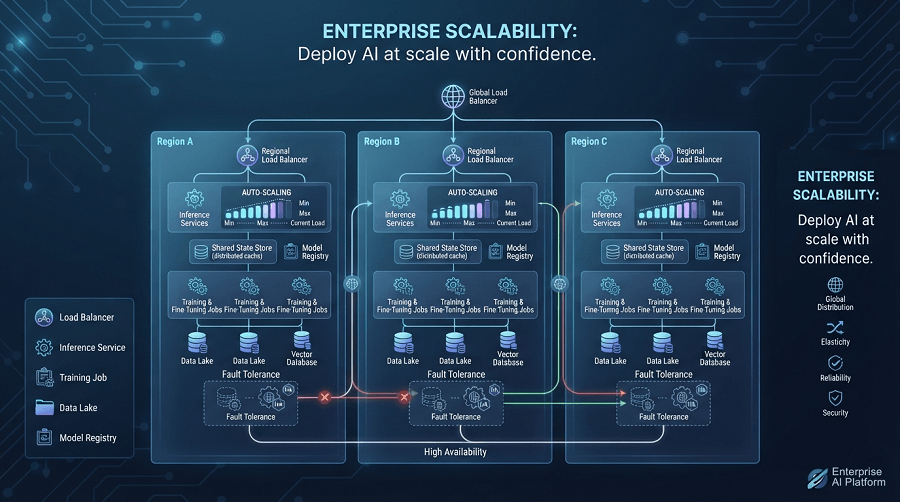
Enterprise AI platforms should support:
- Load balancing
- Multi-region deployment
- Auto-scaling
- Fault tolerance
- High availability
- Centralized monitoring
- API governance
- Role-based access control
For a framework to evaluate these enterprise capabilities, refer to the AWS Well-Architected Review Guide. Both Qwen and DeepSeek can be integrated into scalable enterprise architectures using cloud-native infrastructure.
Which Model Wins by Use Case?
Rather than selecting a single overall winner, it's more useful to compare models based on specific business and engineering needs.
| Use Case | Recommended Model | Why |
|---|---|---|
| General Software Development | Qwen | Excellent code quality, documentation, and multilingual support |
| Competitive Programming | DeepSeek | Strong reasoning and algorithmic performance |
| Enterprise Knowledge Assistants | Qwen | Better multilingual understanding and documentation generation |
| AI Research | DeepSeek | Excels in analytical and scientific reasoning |
| Customer Support AI | Qwen | Clear responses and multilingual capabilities |
| AI Agents | Tie | Depends on tools, architecture, and workflow |
| Long-Context Applications | Tie | Both support advanced long-context processing |
| Startup MVPs | Tie | Choose based on provider pricing and deployment preferences |
| Large Enterprise Platforms | Tie | Evaluate governance, infrastructure, and operational requirements |
| RAG Applications | Qwen | Strong retrieval‑friendly responses and structured output |
Common Benchmark Misconceptions
Understanding benchmark limitations helps organizations make more informed AI decisions.
"Higher Scores Always Mean Better Models"
Not necessarily.
Production success depends on:
- Stability
- Latency
- Security
- Integration
- Developer productivity
"Coding Benchmarks Measure All Programming Skills"
Coding benchmarks typically evaluate isolated tasks.
Real software engineering also requires:
- Repository understanding
- Code reviews
- Architecture
- Documentation
- Testing
- Collaboration
"One Benchmark Represents Overall Intelligence"
No benchmark measures every aspect of intelligence.
Different benchmark suites evaluate different capabilities.
"Benchmark Rankings Never Change"
AI evolves rapidly.
New model releases frequently change leaderboard positions, making continuous evaluation important.
Conclusion
Benchmark leaderboards provide valuable insights into model capabilities, but they are only one piece of the evaluation process. Successful AI adoption requires balancing technical performance with scalability, governance, operational cost, and user experience.
By combining benchmark analysis with real-world testing, organizations can select an AI model that delivers measurable value in production—not just impressive numbers on a leaderboard.
Frequently Asked Questions
Is Qwen better than DeepSeek?
Neither model is universally better.
Qwen excels in multilingual applications, documentation, and enterprise software engineering, while DeepSeek often demonstrates stronger reasoning for mathematical and algorithmic tasks.
Which benchmark is most important?
That depends on your use case.
- Developers should prioritize HumanEval and SWE-bench.
- Researchers may focus on GPQA and AIME.
- Enterprise teams should evaluate latency, throughput, and deployment flexibility alongside benchmark scores.
Should enterprises rely only on benchmark leaderboards?
No.
Benchmark scores should be combined with workload-specific testing, infrastructure evaluation, and governance considerations before selecting a production model.
Which model is better for AI agents?
Both Qwen and DeepSeek are capable of powering AI agents.
The overall quality of an agent depends not only on the model but also on prompt design, retrieval strategy, tool integration, memory management, and orchestration frameworks.
Can benchmark results predict production performance?
Only partially.
Benchmarks indicate technical capability, but production success depends on infrastructure, monitoring, prompt engineering, integration quality, and operational processes.
Final Verdict
Qwen and DeepSeek are among the most capable open-weight AI ecosystems available today, and both perform exceptionally well across a wide range of benchmark suites.
Choose Qwen if your priorities include:
- Enterprise software development
- Multilingual applications
- Documentation generation
- Business automation
- Customer-facing AI
- Structured outputs
Choose DeepSeek if your priorities include:
- Advanced reasoning
- Mathematical problem solving
- Scientific research
- Algorithm optimization
- Competitive programming
For most organizations, the best decision is not determined by a single benchmark score but by how effectively the model integrates into existing engineering workflows, infrastructure, and business objectives.
How EaseCloud Evaluates AI Models
At EaseCloud, benchmark rankings are treated as the starting point rather than the final decision.
Our evaluation framework combines technical testing with operational and business considerations to help organizations choose the right model for production deployments.
Step 1: Define Business Objectives
We first identify how AI will be used, such as:
- AI coding assistants
- Customer support
- Enterprise search
- Knowledge management
- AI agents
- Internal productivity tools
Step 2: Benchmark Relevant Capabilities
Instead of reviewing every leaderboard, we focus on the benchmark categories that align with the intended workload, such as coding, reasoning, multilingual understanding, or long-context processing.
Step 3: Evaluate Infrastructure
We assess:
- GPU requirements
- Deployment architecture
- API performance
- Throughput
- Scalability
- Cloud costs
Step 4: Conduct Real-World Testing
Models are validated using:
- Internal repositories
- Business documents
- Enterprise workflows
- Security requirements
- Existing cloud infrastructure
Step 5: Deploy and Optimize
Once a model is selected, we help organizations deploy and optimize AI workloads using:
- AWS AI infrastructure
- Amazon EKS
- Kubernetes
- GPU clusters
- MLOps and LLMOps
- Monitoring and observability
- Cost optimization (FinOps)
This production-first methodology ensures that organizations select models based on measurable business outcomes rather than benchmark rankings alone.
Summarize this post with: