Best Open-Source LLMs for Enterprise AI in 2026
Compare the best open-source LLMs for enterprise AI in 2026, including Qwen, DeepSeek, GLM and more for RAG, coding, agents and private deployment.

TL;DR
- Qwen – strongest all-around enterprise choice. Broad ecosystem: coding, reasoning, agents, multilingual (201+ languages), RAG, private deployment. Apache 2.0. Best starting point.
- DeepSeek – best for reasoning + technical workloads. 1M context, tool calls, strong coding. Ideal for research, finance, complex engineering.
- GLM – best for agentic engineering. GLM-4.7 (73.8% SWE-bench) and GLM-5 (744B, multi-GPU). Apache 2.0. Strong for enterprise automation and coding agents.
- Llama – mature ecosystem, broad vendor support, enterprise integrations. Good for existing Llama-based stacks.
- Mistral – open models + managed enterprise options. Strong for private inference and European data requirements.
- Gemma – Apache 2.0, efficient across CPU/GPU/TPU. Good for multimodal and hardware-flexible deployments.
- For most enterprises: benchmark Qwen + DeepSeek + GLM on your actual workload. Measure cost per successful task, not benchmark scores. Evaluate licensing, security, private deployment, and TCO before committing.
What Makes an LLM Enterprise-Ready?
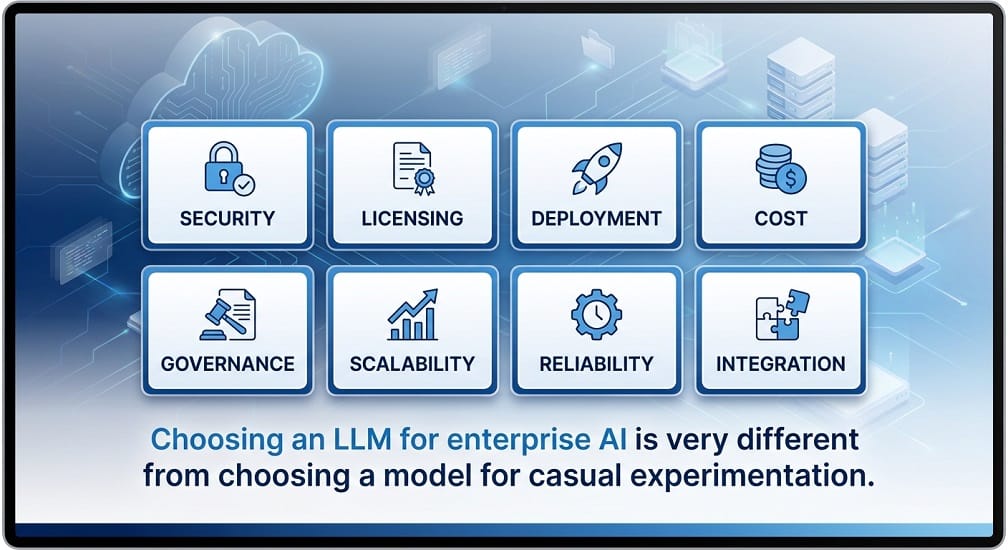
Choosing an LLM for enterprise AI is very different from choosing a model for casual experimentation.
A developer may care mostly about answer quality and speed.
An enterprise also needs to consider:
- Security
- Data privacy
- Licensing
- Scalability
- Reliability
- Infrastructure
- Governance
- Integration
- Total cost of ownership
A model can perform extremely well and still be a poor enterprise choice if it is difficult to deploy, expensive to operate, or unsuitable for the company's data requirements.
The most useful enterprise evaluation therefore combines model capability and operational practicality.
| Enterprise Factor | What to Evaluate |
|---|---|
| Reasoning | Complex business and technical tasks |
| Coding | Developer productivity |
| RAG | Enterprise knowledge retrieval |
| Agents | Multi‑step automation |
| Context | Documents and repositories |
| Multilingual | Global business operations |
| Security | Data and access controls |
| Licensing | Commercial rights and restrictions |
| Deployment | API, private cloud, self‑hosting |
| Cost | Infrastructure and inference economics |
| Reliability | Latency, uptime, failure handling |
| Governance | Monitoring, auditability, policy |
Open-Source vs Open-Weight for Enterprise AI
This distinction is particularly important for businesses.
An AI model may be available as:
- Open source
- Open weight
- Source available
- Commercially licensed
- Research-only
- Custom licensed
These categories should not be treated as identical.
For example, Qwen3 states that its open-weight models are licensed under Apache 2.0. GLM-5's repository uses Apache 2.0. Gemma 4 is also released under Apache 2.0 according to Google. Llama, by contrast, uses its own model license and acceptable-use framework rather than simply Apache 2.0 or MIT.
That means enterprise teams should always review the exact model and version before deployment.
The Leading Enterprise Open-Model Shortlist
For a new enterprise AI project, the strongest initial shortlist should include:
- Qwen
- DeepSeek
- GLM
- Llama
- Mistral
- Gemma
Additional models such as Kimi and MiniMax may become relevant for specific use cases.
The objective is not to create a permanent ranking.
Instead, each model should be evaluated against the enterprise workload.
Qwen for Enterprise AI
Qwen is one of the broadest open-model ecosystems available today.
The Qwen family covers:
- General-purpose language models
- Reasoning models
- Coding models
- Multimodal models
- Agentic models
- Smaller local models
- Large-scale models
Qwen3's official project also documents tool use, fine-tuning, local inference, and production deployment through multiple inference frameworks. Its open-weight models are licensed under Apache 2.0.
That combination makes Qwen particularly attractive for organizations that want a single ecosystem covering many AI workloads.
Qwen Enterprise Strengths
Qwen is particularly relevant for:
- Enterprise coding assistants
- RAG
- Internal knowledge systems
- AI agents
- Multilingual applications
- Private deployment
- Custom fine-tuning
One of its biggest advantages is ecosystem breadth.
A company can begin with a smaller Qwen model for experimentation and later evaluate larger models without completely changing its overall model ecosystem.
Qwen for Coding
Qwen3-Coder is especially important for enterprises with software-development teams.
It can be used for:
- Code generation
- Code review
- Debugging
- Repository analysis
- Automated testing
- Coding agents
That makes Qwen a strong choice for organizations looking to build an internal AI developer platform.
Qwen for Private Deployment
Qwen's deployment ecosystem supports:
- Ollama
- llama.cpp
- vLLM
- SGLang
- TensorRT-LLM
- Kubernetes-based inference
This allows organizations to move between local inference experimentation and enterprise private infrastructure.
Enterprise verdict
Qwen is one of the strongest all-around enterprise open-model ecosystems.
DeepSeek for Enterprise AI
DeepSeek is particularly attractive for enterprises where reasoning and technical problem-solving are central.
The current DeepSeek ecosystem has expanded into newer V4 models that support large context, tool use, structured output, and reasoning-oriented workflows.
DeepSeek V4-Pro is currently positioned above V4-Flash, with stronger performance across coding, tool use, and scientific reasoning according to recent independent evaluation reported by Reuters.
DeepSeek Enterprise Strengths
DeepSeek is particularly relevant for:
- Technical research
- Software engineering
- Reasoning-heavy applications
- Large-context analysis
- Coding agents
- Enterprise RAG
DeepSeek for Coding
DeepSeek has remained especially strong in software-related workloads.
Enterprise use cases include:
- Internal coding assistants
- Code analysis
- Debugging
- Software research
- Automated development workflows
DeepSeek for Reasoning
Reasoning is one of DeepSeek's strongest enterprise use cases.
Potential applications include:
- Research automation
- Financial analysis
- Engineering analysis
- Complex decision support
- Mathematical workloads
Enterprise verdict
DeepSeek is a strong choice when reasoning and technical work are central to the business case.
GLM for Enterprise AI
GLM has increasingly moved toward enterprise-oriented agentic AI.
Current GLM generations emphasize:
- Coding
- Tool use
- Agentic engineering
- Long-horizon tasks
- Reasoning
- Enterprise automation
The GLM-5 project describes the model as designed for complex agentic engineering tasks and lists an Apache-2.0 license for the repository.
GLM Enterprise Strengths
GLM is particularly relevant for:
- Enterprise agents
- Coding agents
- Terminal workflows
- Business automation
- Complex multi-step applications
- Long-running AI tasks
GLM for Enterprise Agents
If an organization wants AI that can perform more than answer questions, GLM becomes particularly interesting.
Examples include:
- Automated software maintenance
- Operational assistants
- Research agents
- Internal workflow automation
Enterprise verdict
GLM is a strong candidate for enterprise agentic workflows and complex multi-step automation.
Llama for Enterprise AI
Llama remains one of the most widely recognized open-model ecosystems.
The current Llama model family includes models across different sizes and modalities, with Llama 4 providing very large context capabilities and mixture-of-experts architectures. Meta's model catalog also documents distinct licenses and acceptable-use policies for its releases.
Llama Enterprise Strengths
Llama is particularly attractive when enterprises value:
- Mature ecosystem
- Large community
- Broad tooling
- Cloud availability
- Vendor support
- Fine-tuning options
Llama for Private Deployment
Llama has broad deployment support across:
- Major cloud platforms
- GPU infrastructure
- Kubernetes
- vLLM
- TensorRT-LLM
- Other inference frameworks
Enterprise verdict
Llama remains an important benchmark and ecosystem choice for enterprises that want broad vendor and developer support.
Mistral for Enterprise AI
Mistral has a strong enterprise position because its lineup combines open-weight models with commercial models and managed deployment options.
Current Mistral documentation describes open-weight models that can run on private infrastructure using vLLM, TensorRT-LLM, and other runtimes. It also supports deployment through services such as Azure, Amazon Bedrock, Google Cloud, Snowflake, IBM watsonx, and Mistral Compute.
Mistral Enterprise Strengths
Mistral is especially relevant for:
- Enterprise RAG
- Coding
- Multimodal applications
- Private inference
- European data and deployment requirements
- Hybrid cloud environments
The current lineup includes Mistral Small 4 under Apache 2.0 and Mistral Medium 3.5 under a modified MIT license, so the exact model license should be reviewed before commercial adoption.
Enterprise verdict
Mistral is a strong option for enterprises that want a mix of open-weight models and managed enterprise deployment.
Gemma for Enterprise AI
Gemma is Google's open-weight model family and is particularly attractive for organizations that need capable models across different hardware sizes.
The current Gemma 4 family is designed around:
- Advanced reasoning
- Agentic workflows
- Multimodal applications
- Efficient deployment
- Local and cloud environments
Google states that Gemma 4 is released under Apache 2.0 and is designed for deployment across environments ranging from personal computers to cloud infrastructure.
The Gemma ecosystem also supports CPU, GPU, and TPU deployment, making it attractive for teams with different hardware environments.
Enterprise verdict
Gemma is particularly interesting when model efficiency, broad hardware support, and multimodal or agentic workloads matter.
Initial Enterprise Comparison
| Model | Main Enterprise Strength | Private Deployment | Coding | Reasoning | Agents |
|---|---|---|---|---|---|
| Qwen | Broad AI ecosystem | Excellent | Excellent | Excellent | Excellent |
| DeepSeek | Reasoning + technical workloads | Strong | Excellent | Excellent | Excellent |
| GLM | Agentic engineering | Strong | Excellent | Excellent | Excellent |
| Llama | Ecosystem + vendor support | Excellent | Strong | Strong | Strong |
| Mistral | Open + managed enterprise options | Excellent | Excellent | Strong | Strong |
| Gemma | Efficiency + multimodal | Excellent | Strong | Strong | Strong |
These are starting assessments, not final rankings.
The best enterprise model depends on the workload, infrastructure, license, and business requirements.
What Enterprises Should Compare Before Choosing a Model
A strong enterprise evaluation should go beyond benchmark scores.
Model Capability
Measure:
- Accuracy
- Reasoning
- Coding
- Tool use
- Long-context performance
Security
Evaluate:
- Data handling
- Authentication
- Encryption
- Network isolation
- Access control
- Auditability
Licensing
Check:
- Exact model version
- Weight license
- Code license
- Commercial use
- Redistribution
- Fine-tuning
- Derivative models
Infrastructure
Consider:
- GPU memory
- Quantization
- Inference framework
- Kubernetes
- Cloud availability
- Scaling
Economics
Measure:
- API cost
- GPU cost
- Storage
- Networking
- Operations
- Developer overhead
Enterprise Integration
Evaluate compatibility with:
- RAG
- Existing APIs
- AI gateways
- Kubernetes
- AWS
- Identity systems
- Monitoring
- LLMOps
Best Open-Source LLM for Enterprise RAG
Enterprise RAG combines an LLM with a retrieval system that provides relevant company information before generation.
Typical sources include:
- Internal documentation
- Policies
- Product information
- Support tickets
- Technical documentation
- Contracts
- Knowledge bases
The model needs to understand retrieved context and produce an answer that stays grounded in the provided information.
Qwen for Enterprise RAG
Qwen is a strong general-purpose option because of its broad language support, context capabilities, and large model ecosystem.
It is particularly attractive for:
- Multilingual knowledge bases
- Internal enterprise assistants
- Technical documentation
- Large document collections
DeepSeek for Enterprise RAG
DeepSeek is especially interesting when retrieved information requires substantial reasoning.
Examples include:
- Technical research
- Financial analysis
- Complex document comparison
- Engineering knowledge systems
GLM for Enterprise RAG
GLM is a good candidate for RAG systems that also need multi-step reasoning or agentic actions after retrieving information.
RAG recommendation
For a new enterprise RAG project, start with:
Qwen + DeepSeek + GLM
Then benchmark:
- Retrieval accuracy
- Grounded answer quality
- Citation correctness
- Long-context performance
- Latency
- Cost
Best Open-Source LLM for Enterprise Coding
Software teams have become one of the largest enterprise users of LLMs.
Typical workloads include:
- Code generation
- Code review
- Debugging
- Refactoring
- Test creation
- Repository analysis
- Coding agents
Qwen
Qwen3-Coder is one of the strongest choices for this category because it is specifically designed around software engineering and agentic coding.
DeepSeek
DeepSeek remains a strong choice when coding tasks require substantial reasoning.
GLM
GLM is especially relevant when coding becomes a long-running agent task involving terminal use, tool calling, testing, and repeated iterations.
Coding recommendation
For enterprise developer platforms, the initial benchmark should include:
Qwen3-Coder + DeepSeek + GLM
Measure developer acceptance, task completion, retry rate, latency, and cost per successful task.
Best Open-Source LLM for AI Agents
Enterprise agents can perform actions instead of simply returning text.
Examples include:
- Creating support tickets
- Updating CRM records
- Querying databases
- Running internal tools
- Searching knowledge systems
- Writing code
- Executing operational tasks
For agents, model quality is only one part of the system.
Evaluate:
- Tool selection
- Tool argument accuracy
- Multi-step planning
- Error recovery
- Structured output
- Context management
- Task completion rate
Qwen
Qwen has a particularly strong agent ecosystem, including dedicated coding models and agent tooling.
DeepSeek
DeepSeek is a strong candidate when the agent requires substantial reasoning before taking an action.
GLM
GLM is particularly relevant for longer-running engineering and operational agents.
Other Models
MiniMax and newer Kimi models should also be considered when their current capabilities match the specific agent workload.
Agent recommendation
Don't choose the model from a benchmark score alone.
Measure:
successful workflows / total workflows
and then calculate the cost per successful workflow.
Best Open-Source LLM for Enterprise Customer Support
Customer support has different requirements.
The model needs to:
- Follow business policies
- Understand customer history
- Retrieve knowledge
- Maintain tone
- Avoid unsupported claims
- Produce structured responses
- Escalate when necessary
For this workload, an expensive reasoning model may not always be necessary.
A smaller, faster model with strong RAG can provide better economics.
Qwen
Strong candidate for multilingual customer support.
Llama
Strong candidate when the enterprise already has a mature Llama-based ecosystem.
Mistral
Strong option for enterprise deployments that prioritize private infrastructure and managed cloud choices.
Gemma
Useful when efficiency and smaller deployment footprints matter.
Recommendation
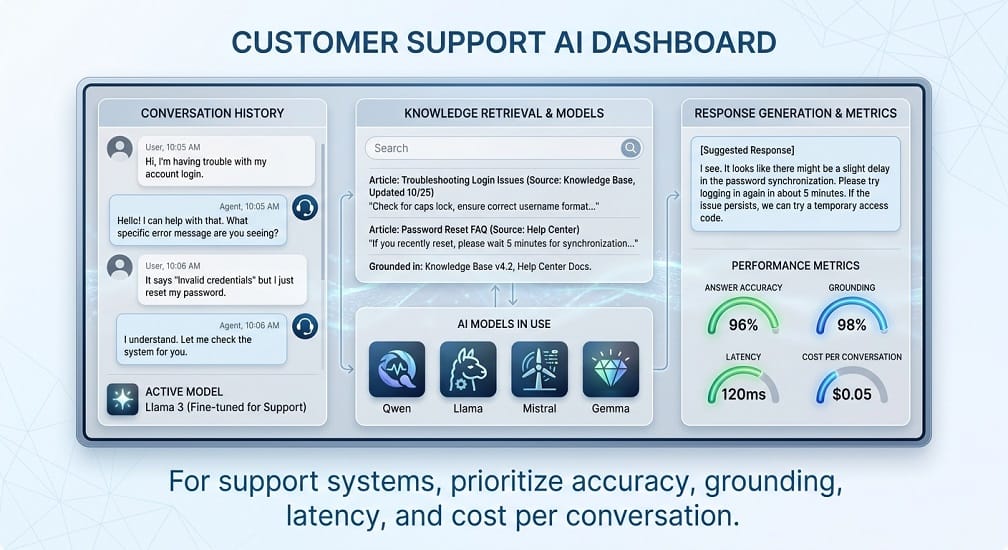
For support systems, prioritize:
- Answer accuracy
- Grounding
- Latency
- Cost per conversation
- Escalation accuracy
rather than maximum benchmark reasoning.
Best Open-Source LLM for Document Intelligence
Document workloads can include:
- Contracts
- Invoices
- Reports
- Legal documents
- Technical manuals
- Financial statements
- Internal policies
The model must often combine:
document understanding + extraction + reasoning + structured output
Qwen, Gemma, Mistral, DeepSeek, and GLM can all be considered depending on the document type and modality.
For multimodal documents, evaluate models that can directly handle the relevant images, layouts, tables, or scanned pages instead of relying only on text extraction.
Best Open-Source LLM for Multilingual Enterprise AI
For international businesses, multilingual support can be more important than raw English benchmark performance.
Qwen has particularly broad language coverage across its newer model generations.
It is therefore a strong first choice for:
- Global customer support
- International search
- Translation
- Multilingual knowledge assistants
- Cross-language document workflows
Kimi and other Chinese model families can also be evaluated when their current language support matches the business requirements.
The correct benchmark should use the actual languages your customers speak.
Best Open-Source LLM for Long Documents
Long-context models are attractive for:
- Legal analysis
- Technical documentation
- Large repositories
- Research
- Enterprise knowledge bases
But enterprises should avoid using maximum context as a substitute for good retrieval.
A strong architecture combines:
- Document indexing
- Retrieval
- Reranking
- Context construction
- LLM generation
The model should receive the information that matters rather than every document available in the enterprise.
API vs Private Deployment
One of the biggest enterprise decisions is whether to use a hosted API or deploy the model privately.
Hosted API
A managed API is usually preferable when:
- The product is still being validated
- Traffic is unpredictable
- The company wants minimal infrastructure work
- The latest models are required quickly
Private Deployment
Private inference is more attractive when:
- Data is sensitive
- Source code is proprietary
- Data residency matters
- Usage is large and predictable
- The company needs more control
- Custom inference is required
Neither approach is automatically cheaper.
Calculate the total cost for the expected workload.
Private LLM Deployment
Private deployment can run on:
- Dedicated servers
- Cloud GPU instances
- Kubernetes
- Amazon EKS
- Private data centers
Common inference engines include:
- vLLM
- SGLang
- TensorRT-LLM
- llama.cpp
- Ollama for smaller local environments
For enterprise workloads, vLLM or SGLang are often stronger choices for high-throughput serving.
Enterprise LLM on AWS
AWS provides several options for private model serving.
A simplified architecture can use:
| Component | Purpose |
|---|---|
| Amazon EC2 GPU | Model inference |
| Amazon EKS | Kubernetes platform |
| Amazon S3 | Model artifacts |
| Amazon VPC | Network isolation |
| IAM | Identity and permissions |
| Secrets Manager | Credential management |
| CloudWatch | Monitoring |
| ECR | Container images |
| KMS | Encryption |
The appropriate GPU depends on model size and workload.
Smaller enterprise models may fit on lower-memory GPUs, while large Qwen, DeepSeek, or GLM deployments can require H100, H200, or newer Blackwell-class systems.
Kubernetes for Enterprise LLMs
Kubernetes is particularly useful when organizations operate more than one model or application.
It provides:
- GPU scheduling
- Service discovery
- Scaling
- Deployment management
- Isolation
- Rollouts
- Monitoring integration
Amazon EKS can provide this functionality inside an AWS environment.
Enterprise Model Routing
Large organizations don't always need one model.
A model-router architecture can select a model based on:
- Task type
- Complexity
- Context size
- Latency target
- Cost target
- Availability
For example, a simple classification request may use a smaller model while a complex coding or research request uses a larger reasoning model.
This approach can reduce average infrastructure and API costs.
Enterprise LLM Security
The following security requirements should be addressed before production.
Important areas include:
- Identity
- Authentication
- Authorization
- Encryption
- Network isolation
- Secret management
- Audit logs
- Data retention
- Model access
- Prompt logging policies
For sensitive workloads, keep inference infrastructure private and restrict access through authenticated internal services.
Enterprise LLM Licensing
License evaluation should happen before implementation rather than after the product is built.
Review:
- Exact model
- Exact version
- Model-weight license
- Code license
- Commercial-use rights
- Fine-tuning rights
- Redistribution
- Derivative-model rules
- Acceptable-use requirements
This is especially important because two versions from the same model family can have different licensing terms.
Enterprise LLM Cost
The most useful financial metric is not always token price.
For self-hosted AI, consider:
- GPU compute
- Storage
- Networking
- Kubernetes
- Monitoring
- Engineering
- Model upgrades
Then calculate:
Cost per successful task
For an agent:
Cost per successful workflow
For RAG:
Cost per successful grounded response
For coding:
Cost per accepted software-engineering task
This makes different model architectures easier to compare financially.
Total Cost of Ownership
A useful enterprise TCO calculation includes:
| Cost Category | Examples |
|---|---|
| Model | API or GPU |
| Infrastructure | EC2, EKS, storage |
| Networking | Traffic and private connectivity |
| Operations | DevOps and LLMOps |
| Monitoring | Metrics and logs |
| Engineering | Model integration |
| Maintenance | Upgrades and testing |
The cheapest model is not automatically the cheapest platform.
A model that requires significantly more retries, larger GPUs, or more human review can have a higher real-world cost.
Best Open-Source LLM by Enterprise Workload
| Enterprise Workload | Best Starting Candidates |
|---|---|
| General enterprise AI | Qwen |
| Enterprise RAG | Qwen / DeepSeek |
| Enterprise coding | Qwen3‑Coder / DeepSeek |
| Coding agents | Qwen / GLM |
| Reasoning‑heavy workloads | DeepSeek |
| Agentic engineering | GLM |
| Multilingual AI | Qwen |
| Customer support | Qwen / Llama / Mistral |
| Document intelligence | Qwen / Mistral / Gemma |
| Private deployment | Qwen / Llama / Mistral |
| Large enterprise platform | Qwen / DeepSeek / GLM |
These are starting candidates, not permanent rankings.
When Should an Enterprise Use a Smaller Model?
A common mistake is assuming the biggest model will always provide the best ROI.
Smaller models can be preferable when:
- Tasks are repetitive
- Context requirements are moderate
- Latency matters
- GPU budgets are limited
- High concurrency is required
A smaller model may also be easier to run across multiple replicas.
For many enterprise applications, quality per dollar matters more than maximum model size.
How Should an Enterprise Choose an Open-Source LLM?
There is no single model that is best for every business.
The right choice depends on five practical questions:
- What will the model actually do?
- How sensitive is the data?
- How much traffic will it handle?
- What infrastructure can the company operate?
- What is the acceptable cost per successful task?
A useful enterprise evaluation should therefore start with the workload rather than the model brand.
Best Model for Large Enterprises
For large organizations, the strongest starting shortlist is:
- Qwen
- DeepSeek
- GLM
- Llama
- Mistral
These ecosystems cover most major enterprise requirements.
Qwen
Best when the company wants a broad ecosystem covering coding, reasoning, agents, multilingual workloads, and private deployment.
DeepSeek
Best when technical reasoning, coding, and complex analysis are major requirements.
GLM
Best when advanced agentic workflows and long-running engineering tasks are important.
Llama
Best when ecosystem maturity, broad vendor support, and existing enterprise integrations are priorities.
Mistral
Best when organizations want a strong combination of open-weight models and managed enterprise deployment options.
Best Model for Startups
Startups should usually avoid starting with the largest model they can find.
Their priorities are normally:
- Fast development
- Low initial cost
- Simple APIs
- Easy scaling
- Limited operational overhead
A practical starting shortlist is:
- Qwen
- DeepSeek
- Mistral
Then add GLM or another specialized model when the workload requires it.
For a startup, hosted inference is often the fastest route to product validation.
Self-hosting becomes more interesting once usage becomes predictable or privacy requirements become stronger.
Best Model for Regulated or Sensitive Data
When data is sensitive, technical capability is only one part of the decision.
Consider:
- Private deployment
- Data residency
- Network isolation
- Encryption
- Access control
- Audit logs
- Retention policies
- Model licensing
For these workloads, a model that can be deployed inside a private AWS or Kubernetes environment may be more attractive than a model that is slightly better on a benchmark but requires external API access.
Qwen, Llama, Mistral, DeepSeek, and GLM can all be evaluated for private deployment depending on the exact model and license.
Best Model for Enterprise RAG
For RAG, the model itself is only one part of the architecture.
A strong RAG system also needs:
- Good document ingestion
- Effective chunking
- Strong embeddings
- Retrieval
- Reranking
- Context construction
- Grounded generation
For the model layer, a strong shortlist is:
Qwen for broad multilingual and enterprise workloads
DeepSeek for reasoning-heavy documents
GLM for agent-assisted knowledge workflows
Mistral for enterprise deployments where its ecosystem and infrastructure options are a good fit
Llama where an existing Llama-based stack already exists
Best Model for Enterprise Coding
For software engineering teams, I'd start with:
- Qwen3-Coder
- DeepSeek
- GLM
Use the same repository and same tasks for every model.
Measure:
- Code correctness
- Debugging
- Refactoring
- Repository changes
- Tests
- Tool usage
- Review acceptance
- Cost per completed task
The model with the highest benchmark score is not necessarily the model that gives developers the greatest productivity increase.
Best Model for Enterprise AI Agents
For agents, prioritize:
- Tool calling
- Planning
- Structured output
- Error recovery
- Long context
- Task completion
- Reliability
A strong enterprise agent benchmark should use real business tasks rather than generic prompts.
For example:
- Create a support ticket
- Search internal documentation
- Update a CRM record
- Analyze a customer account
- Produce a financial summary
- Open a software issue
- Generate and test a code change
Measure the entire task, not just the first model response.
Best Model for Multilingual Enterprise AI
Global organizations should test their actual languages.
Do not assume a model's multilingual rating represents the quality your company needs.
Test:
- Customer support
- Search
- Translation
- Document understanding
- Internal communication
- Mixed-language conversations
Qwen is particularly attractive for businesses with broad multilingual requirements, but the final decision should still be based on the languages and domain-specific content your employees or customers actually use.
Best Model for Private Deployment
For private deployment, the model should work well with your selected infrastructure.
Common deployment choices include:
- Ollama for development
- vLLM for production inference
- SGLang for supported high-performance workloads
- Docker
- Kubernetes
- Amazon EKS
Qwen is particularly flexible in this area because of its broad model range and extensive deployment ecosystem.
Llama and Mistral also have mature private-deployment ecosystems.
DeepSeek and GLM can be attractive when their capabilities justify the required GPU infrastructure.
Best Model for AWS
AWS deployment introduces an additional decision:
Which model gives the best quality relative to GPU cost?
A simple private architecture may use:
- Amazon EC2 GPU
- vLLM
- Amazon S3
- Amazon VPC
- IAM
- Secrets Manager
- CloudWatch
A larger platform may use:
- Amazon EKS
- GPU node pools
- Karpenter
- vLLM or SGLang
- AI gateway
- Model routing
- Central observability
Your AWS model choice should therefore consider:
- GPU memory
- Model size
- Quantization
- Context
- Concurrent users
- Target latency
- Throughput
Open Model vs Managed API
This is one of the most important enterprise decisions.
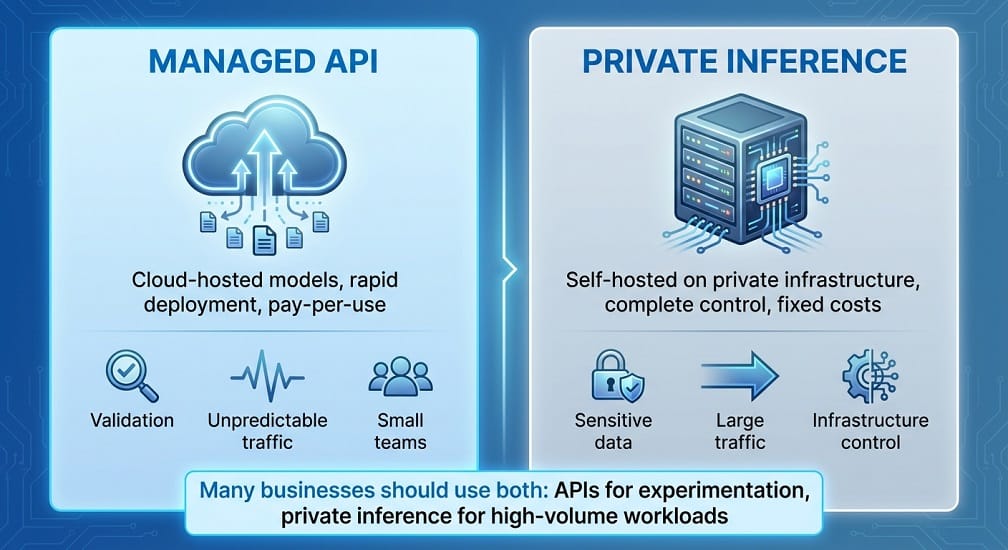
Choose a managed API when:
- The application is still being validated
- Usage is unpredictable
- The team is small
- Infrastructure isn't the core business
- Fast deployment matters most
Choose private inference when:
- Data sensitivity is high
- Traffic is large and predictable
- Custom inference is required
- The organization needs infrastructure control
- Long-term operating economics justify the investment
Many businesses should use both.
For example, APIs can be used for experimentation while private inference is introduced for high-volume or sensitive workloads.
Enterprise Licensing Checklist
Before approving a model, record:
| Item | What to Check |
|---|---|
| Exact model | Name and version |
| Weight license | Rights and restrictions |
| Code license | Separate from weights where applicable |
| Commercial use | Allowed or restricted |
| Fine‑tuning | Allowed or restricted |
| Redistribution | Terms and obligations |
| Derivatives | Conditions |
| Acceptable use | Restrictions |
| Attribution | Required notices |
| Review date | When terms were checked |
This prevents a common enterprise mistake: building a product first and reviewing licensing afterward.
For more detail, read our guide about Chinese Open-Source AI Model Licenses.
Enterprise LLM Security Checklist
Before production, evaluate:
- Identity
- Authentication
- Authorization
- Encryption
- Secrets
- Network isolation
- Logging
- Monitoring
- Data retention
- Prompt access
- Output handling
For internal coding assistants, consider keeping source code inside a private environment.
For customer-facing AI, ensure user information is isolated appropriately.
Enterprise LLM Cost Optimization
Model cost comes from more than tokens.
For private inference, consider:
GPU cost + storage + networking + Kubernetes + monitoring + operations
For API deployments, consider:
input tokens + output tokens + caching + retries + tool calls
For agent systems, also include:
failed attempts + additional tool calls + human review
The most useful metric is often:
Cost per successful task
This gives a much better business comparison than raw token price.
Common Enterprise Mistakes
Choosing by Benchmark Alone
A benchmark doesn't represent your business workload.
Using the Largest Model for Everything
A smaller model may provide much better economics for routine tasks.
Ignoring Licensing
The word "open" does not guarantee unrestricted commercial use.
Ignoring Retrieval
Poor RAG retrieval can make an excellent model appear weak.
Sending Too Much Context
More context can increase both cost and latency.
Ignoring Infrastructure
A model that requires a large GPU cluster may be economically unsuitable.
Using One Model for Every Task
A multi-model approach can be more efficient.
A Practical Enterprise Evaluation
Use a representative test set.
For example:
| Workload | Test Count |
|---|---|
| RAG | 20 |
| Coding | 20 |
| Reasoning | 20 |
| Agent tasks | 20 |
| Document processing | 20 |
Then measure:
- Accuracy
- Task completion
- Latency
- Cost
- Retry rate
- Human review time
Create separate scores for:
- Quality
- Operations
- Economics
Don't collapse everything into one number too early.
Enterprise Model Selection by Business Size
| Company Type | Starting Strategy |
|---|---|
| Small startup | Hosted API + small model |
| Growing startup | API + private pilot |
| Mid‑market | Model benchmark + private deployment |
| Large enterprise | Multi‑model evaluation |
| Highly sensitive enterprise | Private inference + strong governance |
The right architecture can change as the business grows.
EaseCloud Recommendation
At EaseCloud, the strongest enterprise approach is to treat model selection and infrastructure as one decision.
The process should consider:
- Model capability
- Security
- Licensing
- Infrastructure
- Operating cost
- Developer productivity
For organizations using Qwen, DeepSeek, GLM, or other open models, EaseCloud can support the infrastructure side through:
- AWS AI infrastructure
- Amazon EKS
- Kubernetes
- GPU architecture
- vLLM
- SGLang
- Private inference
- LLMOps
- Observability
- AI cost optimization
The objective is to avoid both overbuilding and underbuilding the AI platform.
Final Ranking by Enterprise Use Case
| Use Case | Best Starting Choice |
|---|---|
| General enterprise AI | Qwen |
| Enterprise RAG | Qwen / DeepSeek |
| Enterprise coding | Qwen3‑Coder / DeepSeek |
| Coding agents | Qwen / GLM |
| Technical reasoning | DeepSeek |
| Agentic engineering | GLM |
| Multilingual AI | Qwen |
| Private deployment | Qwen / Llama / Mistral |
| Enterprise ecosystem | Llama / Qwen |
| Cost‑sensitive deployment | Benchmark smaller models |
| Large multi‑model platform | Qwen + DeepSeek + GLM |
Frequently Asked Questions
What is the best open-source LLM for enterprise AI?
For a broad enterprise deployment, start by evaluating Qwen, DeepSeek, GLM, Llama, and Mistral against your actual workload.
Is Qwen good for enterprise use?
Yes. Qwen is a strong enterprise candidate for coding, RAG, agents, multilingual workloads, and private deployment.
Is DeepSeek suitable for businesses?
Yes. DeepSeek can be particularly attractive for reasoning-heavy, technical, and coding workloads.
Is GLM suitable for enterprise AI?
Yes. GLM is particularly interesting for agentic workflows, software engineering, and complex multi-step automation.
Should enterprises self-host an LLM?
Not necessarily. Hosted APIs are often better during early experimentation, while private deployment becomes more attractive when data sensitivity, control, or predictable high usage justifies the additional infrastructure.
What is the cheapest enterprise LLM?
There is no permanent cheapest model. Calculate the total cost of your actual workload, including retries, infrastructure, and human review.
Which model is best for enterprise RAG?
Qwen, DeepSeek, GLM, Llama, and Mistral are all reasonable candidates. The retrieval system and document pipeline can have as much impact as the model itself.
Which model is best for enterprise coding?
Start with Qwen3-Coder, DeepSeek, and GLM and evaluate them using your real repositories.
Final Verdict
The enterprise LLM market has moved beyond the question:
“Which model is smartest?”
The more useful question is:
Which model provides the best combination of capability, security, deployment flexibility, and total cost for this specific business?
| Model | Description |
|---|---|
| Qwen | The strongest all‑around starting point. |
| DeepSeek | A strong choice for reasoning, coding, and technical workloads. |
| GLM | A strong choice for agentic engineering and complex workflows. |
| Llama | A mature ecosystem choice with broad enterprise adoption and tooling. |
| Mistral | A strong option for organizations that value open models alongside managed enterprise deployment. |
| Gemma | A useful choice where efficiency, multimodal capabilities, and flexible hardware are important. |
For most enterprises, the best strategy is not to select one model immediately.
Start with a shortlist, run the same workloads, measure quality and economics, then choose the deployment architecture that matches the result.
That approach also creates the cleanest path from model evaluation to private AI infrastructure, where EaseCloud can support AWS, Kubernetes, GPU, inference, LLMOps, and cost optimization requirements.