AWS vs Azure vs GCP Pricing Models Compared
AWS Azure GCP pricing comparison for 2026. See how compute, storage, and network costs differ and where reserved, on-demand, or spot buys save most.

TLDR;
- Compute, storage, and network prices diverge by up to 40% across AWS, Azure, and GCP in the same EU region.
- Spot and preemptible instances save 60–91% for fault-tolerant workloads.
- Three-year commitments cut compute up to 72% but require steady baseline demand.
- Egress fees remain the hidden cost that multi-cloud architects routinely miss.
- EU buyers should compare Frankfurt, Dublin, and Paris regions for local pricing bands.
CTOs planning a 2026 cloud strategy cannot choose a provider on brand alone. An AWS Azure GCP pricing comparison grounded in current rate cards, regional pricing, and purchase commitments is the only way to keep multi-cloud budgets predictable.
Each hyperscaler prices compute, storage, and networking against a different cost model, and the gap between list price and effective price can reach 70% once reservations, savings plans, and spot discounts enter the picture.
European teams also face a second dimension: Frankfurt, Ireland, and Paris are billed differently than US regions, and Schrems II-aligned data residency rules often restrict where workloads may run.
This cluster compares the three clouds side by side and links to the multi-cloud cost optimization pillar.
How the Three Clouds Price Compute
Each provider sells compute through three primary pricing tiers: on-demand, committed (reserved instances or savings plans), and spot (or preemptible). According to the AWS EC2 on-demand pricing page, an m6i.large in Frankfurt lists at $0.1152/hour.
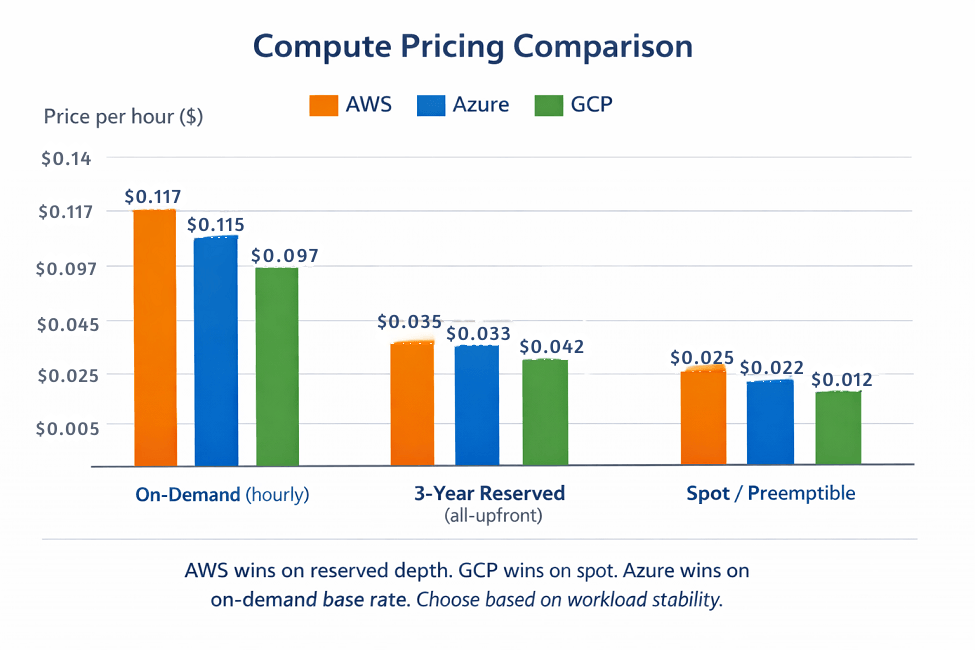
According to the Azure Virtual Machines pricing page, the comparable D2s v5 in West Europe lists around $0.096/hour. According to the Google Compute Engine pricing page, an n2-standard-2 in europe-west3 lists around $0.097/hour.
The ranking reverses at scale:
| Provider | 3-Year All-Upfront | Spot/Preemptible Range |
|---|---|---|
| AWS | ~72% off | 60-90% off |
| Azure | ~62% off | 60-90% off |
| GCP | ~57% off | 60-91% off |
Newer instance families add another layer of variation. AWS Graviton3 processors undercut Intel-based m6i by roughly 20% for the same performance profile, Azure's Dpdsv6 line introduces Arm options in Europe, and GCP's Tau T2D delivers price-performance gains for scale-out web workloads.
Teams that standardize on multi-arch container images can pick whichever Arm fleet is cheapest at build time, expanding arbitrage options without application rewrites.
Compute, Storage, and Networking Side by Side
The table below compares list prices for representative EU regions. Values come directly from each provider's pricing pages and round to the nearest cent.
| Workload | AWS eu-central-1 | Azure West Europe | GCP europe-west3 |
|---|---|---|---|
| On-demand 2 vCPU / 8 GB (linux) | $0.115/hour | $0.096/hour | $0.097/hour |
| 3-year reserved, all-upfront | $0.033/hour | $0.036/hour | $0.042/hour |
| Spot / preemptible (typical) | $0.020/hour | $0.022/hour | $0.012/hour |
| Object storage (standard, 1 TB) | $24.50/month | $20.80/month | $23.00/month |
| Egress to internet (first TB) | $0.09/GB | $0.087/GB | $0.12/GB |
| Inter-region egress (EU-EU) | $0.02/GB | $0.02/GB | $0.02/GB |
Three patterns stand out. First, GCP preemptible pricing often wins the spot bracket, though shorter 24-hour lifetimes limit which workloads fit. Second, Azure lists the cheapest on-demand tier in Western Europe for general-purpose compute. Third, AWS storage is slightly pricier but richer in tiering options, letting finance teams shift cold data to Glacier Deep Archive at $0.00099/GB.
# pricing-comparison.yaml
workload: batch-etl-eu
runtime_hours_per_month: 720
vcpu: 2
ram_gb: 8
storage_tb: 5
egress_gb: 250
providers:
  aws:
    compute_usd: 82.80        # on-demand m6i.large
    storage_usd: 122.50
    egress_usd: 22.50
  azure:
    compute_usd: 69.12
    storage_usd: 104.00
    egress_usd: 21.75
  gcp:
    compute_usd: 69.84
    storage_usd: 115.00
    egress_usd: 30.00
| Provider | Compute (2 vCPU, 720 hrs) | Storage (5 TB) | Egress (250 GB) | Total |
|---|---|---|---|---|
| AWS | $82.80 | $122.50 | $22.50 | $227.80 |
| Azure | $69.12 | $104.00 | $21.75 | $194.87 |
| GCP | $69.84 | $115.00 | $30.00 | $214.84 |
Feeding this file into an Infracost or FinOut pipeline keeps per-workload comparisons current as providers publish new rates. Automating the pull against provider pricing APIs matters: AWS publishes roughly 100,000 SKU price changes a year and GCP frequently adjusts committed-use discounts. Manual spreadsheets go stale within weeks.
Regional variation inside the EU are:
| Region | Pricing Characteristic |
|---|---|
| Frankfurt (eu-central-1, westeurope, europe-west3) | Slight premium due to density |
| Stockholm (eu-north-1) | 3-5% cheaper compute sometimes |
| Paris (eu-west-3) | 3-5% cheaper compute sometimes |
Teams with flexibility on latency can mix regions to lower average cost without leaving the EU.
AWS: $0.033/hr reserved. Azure: $0.096/hr on-demand. GCP: $0.012/hr spot. We help you choose the right mix.
Each provider wins in different scenarios. AWS reserved for baseline compute. Azure on-demand for Windows workloads. GCP spot for batch processing.
Our cloud cost optimization experts help you:
- Compare your workload against provider strengths – Compute, storage, egress, databases
- Calculate provider-specific TCO – 3-year all-upfront reservations (72% off AWS, 62% Azure, 57% GCP)
- Select optimal purchase models – Reserved for baseline, spot for burst, on-demand for variable
- Automate price comparisons – Infracost/FinOut pipelines against provider APIs (100K+ SKU changes/year)
Reserved, On-Demand, and Spot Decisions
The choice between purchase models hinges on demand stability. Reserve capacity only where forecast accuracy sits above 85%. According to the FinOps Foundation 2024 State of FinOps survey, rate-optimization practices (commitments and discounts) rank among the top three priorities for finance-engineering teams.
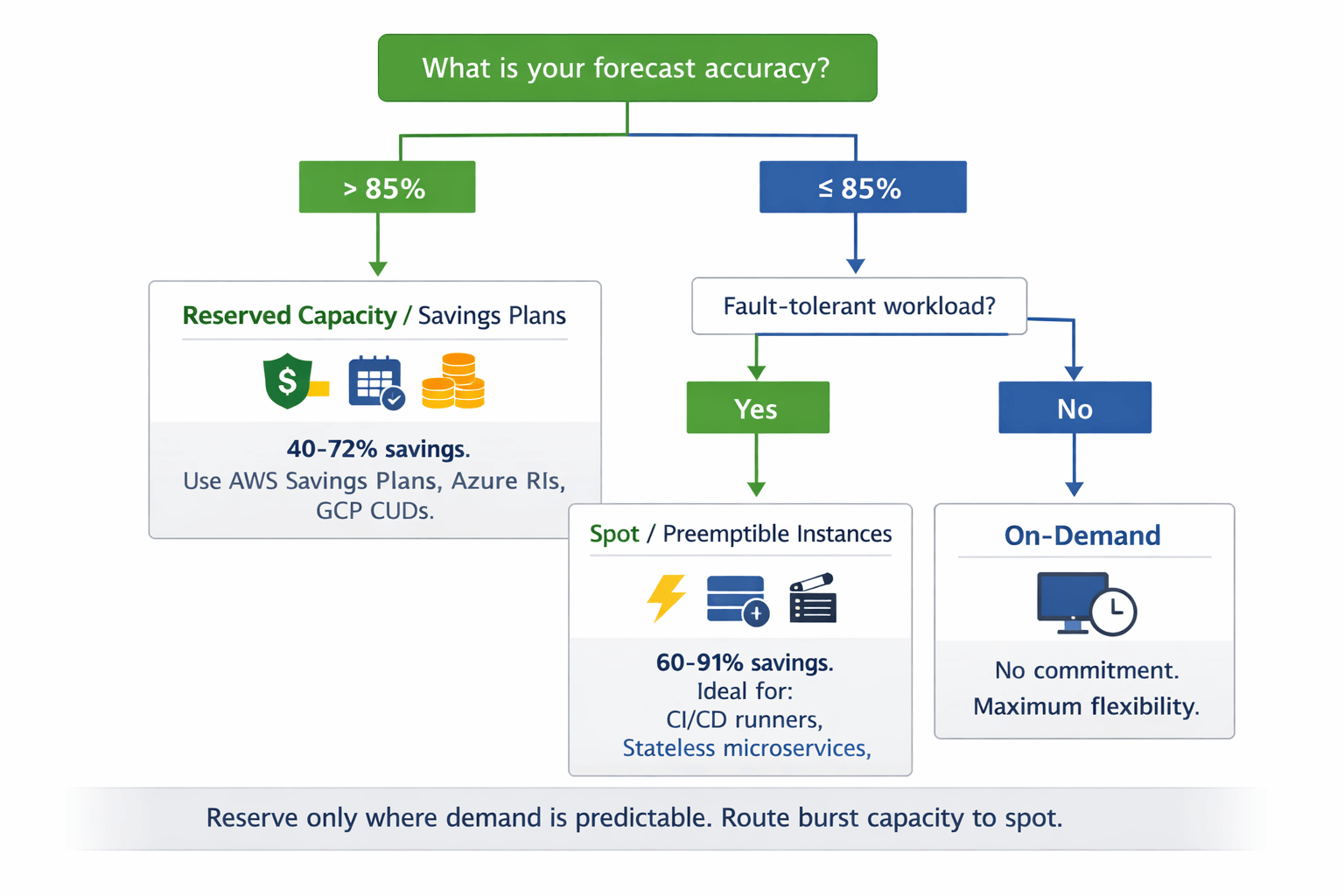
Use AWS Savings Plans or Azure Reserved Instances for baseline demand, then route burst capacity through spot schedulers like Karpenter, AKS Spot pools, or GKE Spot VMs. Fault-tolerant pipelines, CI/CD runners, rendering jobs, and stateless microservices are ideal spot candidates.
For deeper patterns, review the cluster on the companion guide on serverless cost optimization strategies.
Storage purchase decisions follow similar logic.
| Tier | Cost | Best For |
|---|---|---|
| Standard | Highest | Active data |
| Infrequent-access | 40-50% lower | Monthly-access files |
| Archive (Glacier Deep Archive) | $0.002/GB | Cold backups |
Lifecycle policies should automate the promotion and demotion so finance does not pay warm prices for cold bytes.
Networking is the toughest lever: flat egress prices resist discounting, but private interconnects and regional peering trim per-GB fees when steady flows justify the commitment.
Database pricing factors beyond per-hour rates:
- Storage I/O costs
- Backup retention charges
- HA replica costs
- Full service envelope (not just primary instance), including backup windows and standby replicas
Data warehouse model differences:
- BigQuery – on-demand queries charge per TB scanned
- Redshift – sells by cluster-hour
- Synapse – bundles storage with compute
- Picking the right model is often worth more than shaving instance pricing.
Monitoring and Governance
Pricing only matters if finance can see it. According to Gartner's 2024 Public Cloud Services Forecast, worldwide public cloud spending will exceed $675 billion in 2024, and governance tooling now decides which buyers capture the discounts.
Governance best practices:
- Tag every resource with:
env,cost_center,region - Feed spend data into FinOps dashboard comparing unit cost (euros per transaction) across clouds
- Configure monthly variance alerts when unit cost drifts more than 10%
- Pair each alert with a clear owner
Conclusion
An evidence-based AWS Azure GCP pricing comparison, refreshed quarterly and tied to workload-level unit economics, keeps multi-cloud budgets predictable in 2026.
CTOs who combine disciplined commitments, spot arbitrage, and EU-region selection routinely cut cloud spend by 25–35% without compromising reliability or GDPR compliance.
EaseCloud helps European teams build these comparisons, negotiate with providers, and automate purchase decisions. Book a pricing review to see where your current workload mix overspends.
Frequently Asked Questions
Which cloud is cheapest overall?
None of them universally. AWS often wins on committed compute, Azure on Windows and general-purpose VMs, GCP on preemptible batch and data warehousing.
Do EU regions cost more than US regions?
Frankfurt and Paris usually sit 5–10% above Virginia for equivalent compute, partly due to energy costs and data center supply.
How often should we rerun pricing comparisons?
Quarterly at minimum. Providers update SKUs monthly, and new instance families (Graviton, Dpdsv6, Tau T2D) frequently shift the optimum.