Why Shipping Features Keeps Taking Longer
Discover why feature delivery slows down as startups scale. Learn practical strategies to fix delivery bottlenecks and ship faster without sacrificing quality.


TLDR;
- Delivery slows due to complexity, coordination overhead, and tech debt — not lazy engineers
- Coding is only 20-30% of delivery time; rest is testing, approvals, deployments, hidden work
- Fix it: Smaller releases, deployment automation, clear ownership, limit WIP
- Key metric: Lead time per feature
Your first features shipped in days. Now the same scope takes weeks. Your team has grown, your tools have improved, and yet delivery keeps slowing down. This pattern frustrates founders and CTOs across Europe, especially when market windows are shrinking and competitors move faster.
This article explains why feature delivery naturally decelerates as startups grow and what you can do about it. You will learn to identify the root causes, recognize warning signs, and implement systems that restore delivery speed without burning out your team.
Why Feature Delivery Slows Down as Startups Grow
Early-stage startups ship fast because they operate with minimal constraints. Small codebases, few users, and tight teams mean quick decisions and immediate execution. As companies scale, this changes fundamentally.
More users create more edge cases. According to DORA's State of DevOps Report 2024, elite performing organizations deploy 973 times more frequently than low performers, yet even top teams face slowdowns during growth phases. The difference lies in how they manage increasing complexity.
Growing technical complexity compounds the problem. Each new feature interacts with existing systems, creating dependencies that require careful coordination. European SaaS companies, particularly those handling GDPR-sensitive data, face additional compliance requirements that add review cycles and approval gates.
Higher expectations for quality also play a role. Early customers tolerate rough edges. Enterprise buyers demand stability, security audits, and SLA guarantees. Meeting these standards takes time.
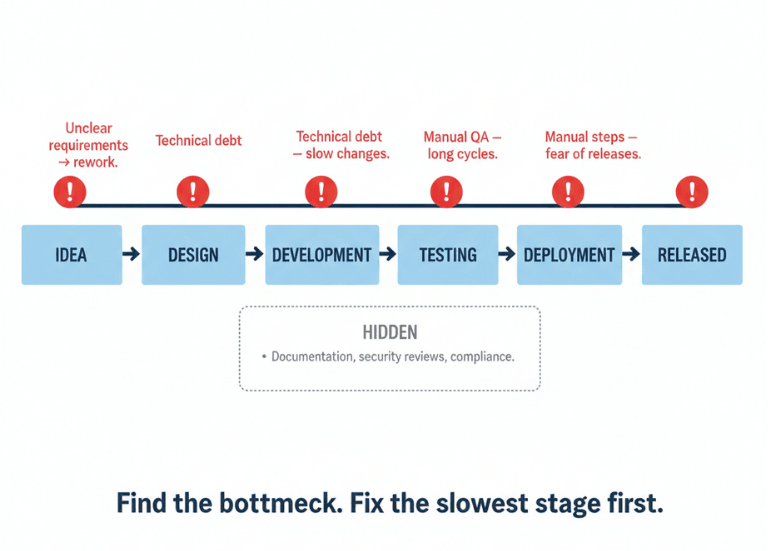
What "Shipping a Feature" Actually Involves
Founders often underestimate the full scope of feature delivery.
| Phase | Activities | Typical Time Impact |
|---|---|---|
| Design | User research, wireframes, stakeholder alignment | Part of the 70-80% non-coding work |
| Development | Coding, code review, integration with existing systems | Only 20-30% of delivery time |
| Testing | Unit tests, integration tests, manual QA | Significant portion of delivery time |
| Deployment | Staging environments, production releases, monitoring setup | Often underestimated |
| Hidden work | Documentation, security reviews, accessibility compliance, performance optimization | Rarely on roadmaps but consumes significant engineering time |
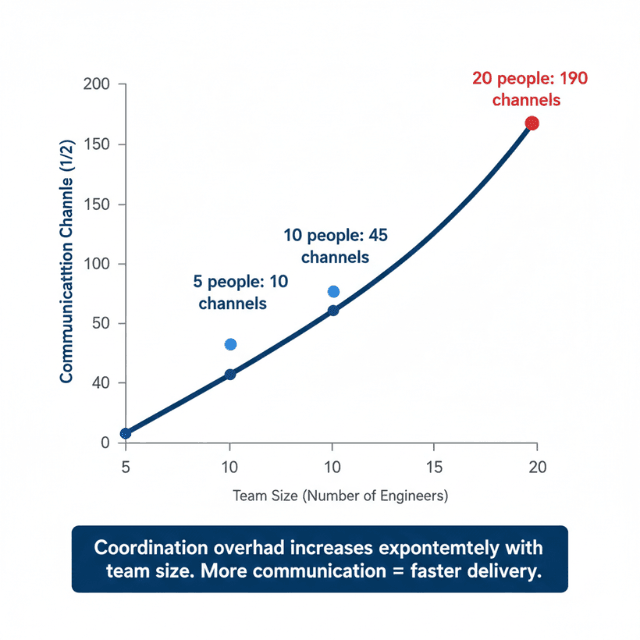
Atlassian's research on software development practices shows that coordination overhead increases exponentially with team size.
| Team Size | Communication Channels |
|---|---|
| 5 people | 10 channels |
| 20 people | 190 channels |
Common Reasons Features Take Longer to Ship
Increasing Technical Debt
Technical debt accumulates when teams choose speed over sustainability. Quick fixes compound over time, creating fragile systems that break unexpectedly.
Martin Fowler's analysis of technical debt explains how interest payments on this debt manifest as longer development times, more bugs, and reduced team morale. A feature that should take three days now takes two weeks because engineers must navigate around brittle code.
Fragile systems slow development by creating fear. Engineers hesitate to modify code they do not fully understand, leading to workarounds that add more complexity.
Manual or Fragile Deployment Processes
When deployments require manual steps, releases become events rather than routine. Teams batch changes into large releases, increasing risk and extending cycle times.
Fear of releases stems from past failures. If a deployment caused an outage, teams naturally become cautious. This caution manifests as longer testing cycles and delayed releases.
Rollbacks taking too long compound the problem. According to Google's Site Reliability Engineering practices, the ability to quickly roll back failed deployments directly impacts release confidence and frequency.
Lack of Clear Ownership and Priorities
Context switching destroys productivity. Research from Microsoft's study on developer productivity shows that engineers need 15-30 minutes to regain focus after an interruption. Multiple priority shifts throughout a sprint fragment attention and extend delivery times.
Unclear definitions of "done" create rework. When stakeholders disagree on requirements, features bounce between teams, consuming cycles without delivering value.
How Infrastructure and DevOps Quietly Impact Delivery Speed
How infrastructure impacts delivery speed.
- Slow environments frustrate developers (e.g., 20-minute staging deploys)
- Unreliable pipelines erode trust in automated tests
- Missing automation creates repetitive work
- Organizations with mature CI/CD pipelines deploy 208 times more frequently than those relying on manual processes
Source: CNCF's Cloud Native Survey 2024
The Cost of Slow Feature Delivery
| Cost Category | Impact |
|---|---|
| Missed market opportunities | Competitors capture customers, establish brand recognition, create switching costs |
| Customer frustration | Promised features arrive late, support requests unaddressed, enterprise clients evaluate alternatives |
| Team morale decline | Talented engineers leave, knowledge silos worsen, hiring and onboarding take months |
| First-mover disadvantages | In regulated industries like fintech and healthcare, advantages can last years |
Founder and CTO-Level Signals Something Is Broken
Founder/CTO-level warning signals includes:
- Lead time per feature keeps increasing - Average time from commitment to production going up indicates structural problems
- Frequent hotfixes - Every deployment requiring immediate patches suggests rushed releases and inadequate testing
- Growing backlog with no throughput - Work keeps entering but completions stay flat indicates prioritization problems
How High-Performing Teams Ship Faster Without Cutting Corners
How high-performing teams ship faster.
- Smaller, safer releases reduce risk - Accelerate research by Nicole Forsgren demonstrates that batch size directly correlates with delivery performance (Accelerate research)
- Better automation and visibility - Automated tests catch regressions; feature flags allow gradual rollouts; monitoring provides immediate feedback
- Clear delivery ownership - When one team owns a feature end-to-end, decisions happen faster and accountability improves
How EaseCloud Helps Fix Product Delivery Bottlenecks
EaseCloud works with European startups and scale-ups to diagnose and resolve delivery bottlenecks. Our approach begins with delivery pipeline assessments that map your current process and identify friction points.
Infrastructure and deployment optimization removes the technical barriers to fast releases. We implement CI/CD pipelines, automate environment provisioning, and establish monitoring that gives your team confidence to deploy frequently.
Reducing friction in release cycles means examining approvals, testing strategies, and coordination patterns. Small process changes often yield significant speed improvements without requiring new tools or additional headcount.
Ready to Ship Faster Without Burning Out Your Team?
You've identified the bottlenecks. Now get expert help fixing them.
EaseCloud helps European startups restore delivery speed through:
- Delivery pipeline assessments – Identify your specific friction points
- CI/CD automation – From manual deployments to push-button releases
- Infrastructure optimization – Fast environments, reliable pipelines
- Fractional CTO guidance – Strategic direction without full-time cost
Free 30-min consultation: We'll review your current delivery process and identify your biggest bottleneck.
Conclusion: Speed Comes From Systems, Not Pressure
Final takeaway includes:
- Sustainable delivery requires systems that support speed
- Pushing harder on teams with broken processes leads to burnout, not faster releases
- Execution over urgency means investing in automation, reducing batch sizes, and establishing clear ownership
- These investments pay dividends for years
- The startups that win their markets are not necessarily those with the most engineers - they are the ones who have built systems that allow small teams to ship reliably and frequently
FAQs: Product Delivery Problems and Feature Shipping
Why does feature delivery slow down over time?
Delivery slows due to accumulated technical debt, increasing system complexity, and coordination overhead from larger teams. Each new feature must integrate with existing code, creating dependencies that require more careful planning and testing.
Is technical debt always the main problem?
Not always. Process issues, unclear priorities, and manual deployment steps often contribute equally. A thorough assessment examines all factors before prescribing solutions.
How much does DevOps affect shipping speed?
Significantly. DORA research shows elite DevOps performers deploy hundreds of times more frequently than low performers. Investment in automation and reliability directly enables faster, safer releases.
Can small teams ship fast without automation?
Yes, but only temporarily. Early-stage startups ship quickly because their systems are simple. As complexity grows, manual processes become bottlenecks. Teams that invest in automation early maintain their velocity longer.
How do founders measure delivery performance?
Track lead time (commitment to production), deployment frequency, change failure rate, and mean time to recovery. These four metrics, identified by DORA research, provide a clear picture of delivery health.