Top Multi-Cloud Cost Management Tools
Multi-cloud cost management tools compared for 2026. Review CloudHealth, Spot.io, Apptio, Kubecost, and FinOps platforms built for EU engineering teams.

TLDR;
- Native billing dashboards miss 30–40% of multi-cloud context, so specialized tools close the gap.
- CloudHealth (VMware Aria Cost), Apptio Cloudability, and Flexera One lead the enterprise segment.
- Spot.io and Kubecost specialize in automated optimization and Kubernetes unit economics.
- FinOps Foundation certified platforms integrate with AWS CUR, Azure Exports, and GCP BigQuery billing data.
- EU buyers should verify GDPR data processing terms and EU data residency for every tool.
Multi-cloud cost management tools bridge the gap between AWS, Azure, and GCP native billing consoles and the finance-grade visibility European CTOs need. A CFO cannot compare unit costs across providers by exporting three separate CSVs, and engineering leads cannot right-size workloads without real-time recommendations.
According to the FinOps Foundation 2024 State of FinOps survey, workload optimization and allocation are the top practitioner priorities, and tool maturity directly influences how fast teams deliver savings. This cluster reviews the platforms that matter in 2026, explains when each one fits, and shows how to select a stack that respects GDPR and EU data residency rules. Pair it with the multi-cloud cost optimization and the cluster on comparing AWS, Azure, and GCP pricing models.
Why Native Dashboards Fall Short
AWS Cost Explorer, Azure Cost Management, and GCP's billing reports each show their own cloud clearly, but none answer multi-cloud questions. They cannot show that a microservice costs 18% more on Azure West Europe than on GCP europe-west3, nor can they tag Kubernetes namespaces running across clusters on two providers.
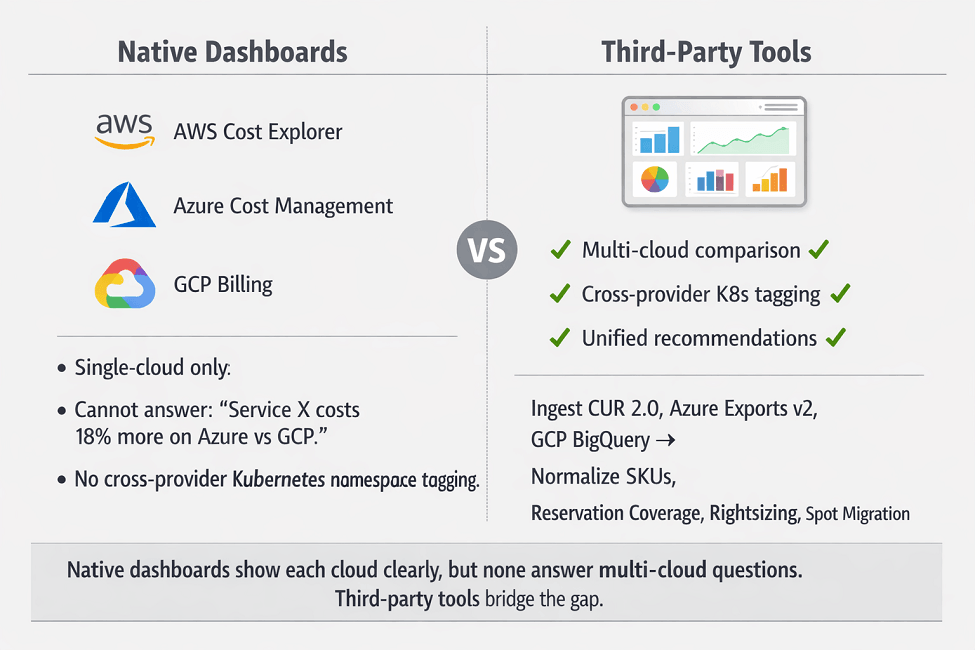
According to Gartner's 2024 Public Cloud Services Forecast, worldwide public cloud spending will exceed $675 billion in 2024, raising the value of unified cost tooling. Third-party platforms ingest each cloud's detailed billing export, normalize SKUs, and overlay recommendations such as reservation coverage, rightsizing candidates, and spot migration opportunities.
Platforms Worth Evaluating in 2026
The multi-cloud cost management tools market splits into three segments: enterprise FinOps suites, automated optimization engines, and Kubernetes-native analytics.
- CloudHealth by VMware (now VMware Aria Cost). Mature enterprise suite with chargeback, showback, and governance rules. Strong AWS and Azure coverage; GCP support has improved in 2024.
- Apptio Cloudability (IBM). Strengths in allocation, amortized cost views, and business-unit reporting. Good fit for finance-led FinOps programs.
- Flexera One. Broad SaaS and cloud inventory integration, license optimization included.
- Spot.io (NetApp). Automated spot-instance scheduling across clouds. According to the Spot.io product documentation, customers report up to 80% compute savings on fault-tolerant workloads.
- Kubecost and OpenCost. Open-source-first Kubernetes cost allocation. Free tier covers single clusters; the enterprise edition federates clusters across providers.
- Finout, Vantage, and CloudZero. Newer unit-economics platforms focused on SaaS cost per customer and per feature.
- Native plus FOCUS. The FinOps Foundation's FOCUS specification standardizes billing data so lightweight dashboards can be built on BigQuery or Snowflake.
| Tool | Best for | Deployment | Typical pricing model |
|---|---|---|---|
| VMware Aria Cost | Enterprise FinOps and governance | SaaS | % of cloud spend under mgmt |
| Apptio Cloudability | Finance-led showback / chargeback | SaaS | Annual subscription |
| Flexera One | SaaS + cloud + license mix | SaaS | Annual subscription |
| Spot.io | Automated spot scheduling | SaaS + agent | % of savings delivered |
| Kubecost / OpenCost | Kubernetes unit economics | Self-hosted | Free core + enterprise tier |
| Finout / Vantage | Product-level unit economics | SaaS | Tiered by integrations |
# kubecost-values.yaml  (Helm chart excerpt)
global:
  prometheus:
    fqdn: http://prometheus.monitoring.svc:9090
cloudIntegration:
  aws:
    athenaBucketName: s3://cur-reports-eu-central-1
    athenaRegion: eu-central-1
  azure:
    subscriptionID: 0000-0000-0000-0000
    storageContainer: billing-exports
  gcp:
    projectID: finops-eu
    bigQueryBillingDataDataset: billing_export.gcp_billing_v1
Kubecost federates three providers into a single cost allocation view with a handful of configuration lines, giving engineering and finance teams one language for unit cost.
Enterprise FinOps suite vs. automated optimizer vs. Kubernetes-native – we match tools to your maturity.
Spend under €500k/year? Start with OpenCost + FOCUS-based BigQuery dashboard. Enterprise scale? CloudHealth/Apptio/Flexera. Kubernetes-heavy? Kubecost with per-namespace unit cost.
We help you:
- Right-size tooling to your cloud spend – Free/FOCUS for small, SaaS suites above €500k
- Combine best-of-breed tools – Enterprise suite for governance + Spot.io for compute savings
- Deploy Kubecost/OpenCost – Self-hosted, open-source-first, no per-metric cost
- Avoid overbuying – Many teams don't need full enterprise suites early on
Selection Criteria for EU Teams
Choosing a tool is as much about trust as features. Four criteria matter most.
- Data residency. Verify the SaaS platform processes billing data inside the EU or offers a private deployment. Some vendors now offer dedicated Frankfurt or Dublin regions.
- GDPR data processing addendum. Confirm the tool signs an up-to-date DPA with Schrems II safeguards if any processing crosses borders.
- FOCUS and FinOps certification. Platforms adopting the FinOps Foundation FOCUS specification simplify switching and multi-tool strategies.
- Integration depth. Check whether the tool reads AWS CUR 2.0, Azure Exports v2, and GCP BigQuery billing export without custom connectors, and whether it supports OVHcloud or Scaleway if those matter for sovereignty workloads.
For lock-in-aware selection, open-source cores (OpenCost, Vantage's OpenCost variant, or FOCUS-based in-house dashboards) reduce switching cost later. See the cluster on avoiding vendor lock-in for broader guidance.
Implementation Best Practices
Tools deliver savings only when paired with a process.
- Start small – pilot against the two clouds that consume 80% of spend, then expand
- Assign named owners for tagging, reservation management, and rightsizing
- Integrate findings into weekly engineering standups (not quarterly finance meetings)
- Prioritize per-namespace unit cost – 84% of organizations run or evaluate Kubernetes (CNCF Annual Survey 2024)
For workload routing, see the related work on serverless cost optimization tools.
Monitoring and Governance
Governance defines who acts on the data. A simple model works:
| Role | Responsibility |
|---|---|
| Platform | Provides recommendations |
| Engineering | Approves actions |
| Finance | Reviews outcomes |
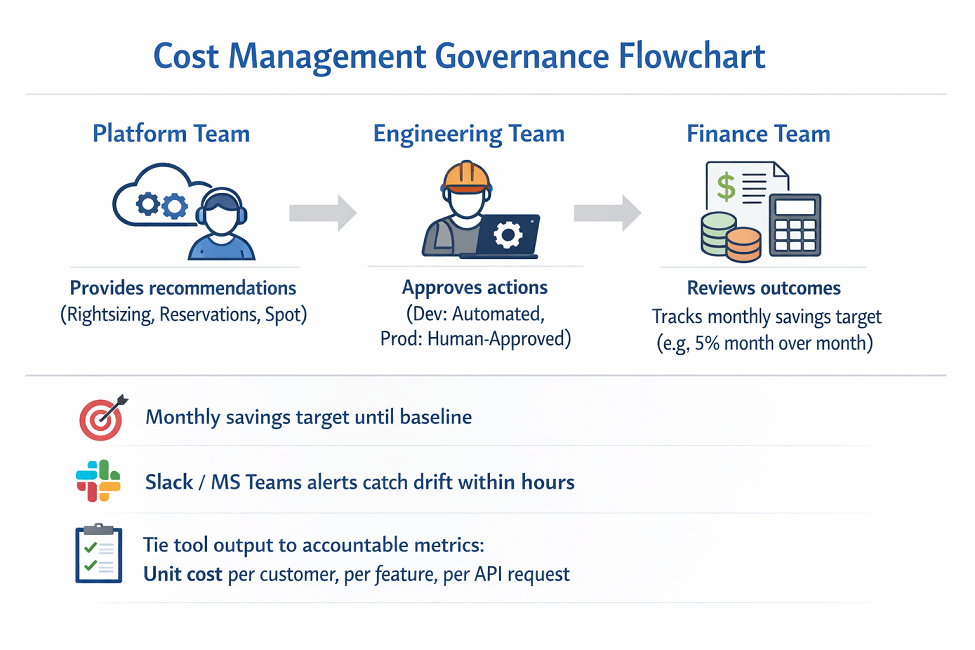
Set a monthly savings target (for example, 5% month over month until baseline), then retire it once unit economics stabilize. Automate rightsizing for development environments and keep production changes human-approved. Most multi-cloud cost management tools support Slack or Microsoft Teams alerts so drift is caught within hours.
Tie the tool's output to accountable metrics. Unit cost per customer, per feature, or per API request exposes drift more clearly than raw cloud spend.
| Meeting Type | Frequency | Focus |
|---|---|---|
| Engineering standups | Weekly | Review unit cost metrics |
| FinOps meetings | Isolated (avoid) | Not recommended alone |
| Scorecard review | Quarterly | Compare forecast to actual |
Teams that do this typically reach positive ROI on tooling within two quarters and extend tag coverage past the 85% threshold that enables reliable allocation.
Conclusion
Choosing the right multi-cloud cost management tools is the difference between a FinOps program that sustains 20–30% savings and one that stalls after the first quarter. European CTOs who combine one enterprise FinOps suite, one automated optimizer, and an open Kubernetes cost layer gain both top-down visibility and bottom-up action. EaseCloud helps EU teams shortlist, deploy, and operate these platforms end-to-end. Book a tooling review to see which stack fits your cloud mix.
Frequently Asked Questions
Do small teams need enterprise FinOps tools?
Usually not. Small teams vs. enterprise FinOps tools:
| Team Size / Spend Level | Recommended Approach |
|---|---|
| Small teams, cloud spend <€500k/year | Start with OpenCost + FOCUS-based BigQuery dashboard |
| Teams with spend >€500k/year | Graduate to SaaS FinOps suite |
Can one tool replace AWS, Azure, and GCP native consoles?
Tool roles: finance/optimization vs. engineering debugging:
| Use Case | Recommended Tool Type |
|---|---|
| Finance and optimization (multi-cloud comparison, rightsizing, reservation coverage) | Third-party FinOps platform (can replace native consoles) |
| Deep debugging of individual services | Native consoles (AWS, Azure, GCP) – not replaceable |
Engineering teams still need native consoles for deep debugging of individual services.
Which tools are GDPR-friendly by default?
VMware Aria Cost, Apptio, Finout, and Kubecost all offer EU data processing options; always review the current DPA before signing.