How to Modernize Your Legacy Systems Using AWS
Learn how to modernize legacy systems using AWS with proven strategies for refactoring, scalability, security, and reduced infrastructure costs.
TL;DR
- Legacy systems are business killers: They block innovation, increase costs, drive away talent, and compound technical debt daily. Every delay makes modernization harder and more expensive.
- Use the 6 Rs framework (Rehost, Replatform, Refactor, Repurchase, Retire, Retain): Apply different strategies to different systems. Refactor customer-facing apps into microservices; rehost back-office systems for quick wins; repurpose unused CRMs; retire dead applications; retain critical systems with minimal footprint.
- The Strangler Fig pattern enables gradual modernization: Build new features in cloud-native architecture, route specific functions to modern systems while legacy handles the rest, then incrementally migrate until the legacy system can be turned off—without business disruption.
- AWS tools for enterprise scale: Control Tower (governance), Migration Hub (tracking), ECS/EKS (containerization), Lambda (modern features). Database modernization from Oracle to Aurora alone can cut costs by 60% and improve performance.
- Realistic economics: Expect initial cost increases (e.g., 20% higher cloud bills) before optimization. Long-term savings reach 45%+ after right-sizing, plus hidden savings from eliminated Oracle licenses, reduced data center footprints, and faster time-to-market.
The Legacy System Time Bomb
Your core banking system runs on a mainframe from 1982. The last developer who truly understands it retired last month. Adding a simple feature takes six months and costs a fortune. Meanwhile, a fintech startup just launched your entire product suite as a mobile app. Sound familiar?
Enterprise legacy systems aren't just old, they're business killers. They're why you can't launch features fast enough. Why your costs keep climbing. Why your best talent leaves for companies that actually innovate. And here's the scary part: every day you wait to modernize, the problem gets worse and more expensive to fix.
But you can't just flip a switch and go cloud-native. You're processing millions of transactions daily. One mistake could make headlines for all the wrong reasons. This is where easecloud.io comes for small and and medium size businesses to help you modernize without destroying what you've built over decades.
Why Legacy Systems Are Killing Your Business
Let's be honest about what "legacy" really means. It's not just old technology. It's decades of business logic that nobody fully understands, written in languages fewer people know each year. It's technical debt that compounds daily. It's the reason you can't compete with cloud-native startups.
The risks are real and growing. Security patches that can't be applied because they'll break something. Compliance requirements you can't meet with 40-year-old systems. Performance that degrades as data grows. And the killer: inability to innovate. While you're maintaining status quo, competitors are deploying features daily.
But here's what makes enterprise modernization different: you can't stop the business to rebuild everything. You need strategies that transform technology while keeping operations running. It's like rebuilding a plane while flying it. Difficult? Yes. Impossible? Not with the right approach.
AWS Tools Built for Enterprise Scale
AWS isn't just cloud servers; it's a complete ecosystem designed for enterprise transformation. AWS Control Tower establishes governance across hundreds of accounts. Organizations manage complexity that matches your corporate structure. Migration Hub tracks thousands of workloads moving to cloud.
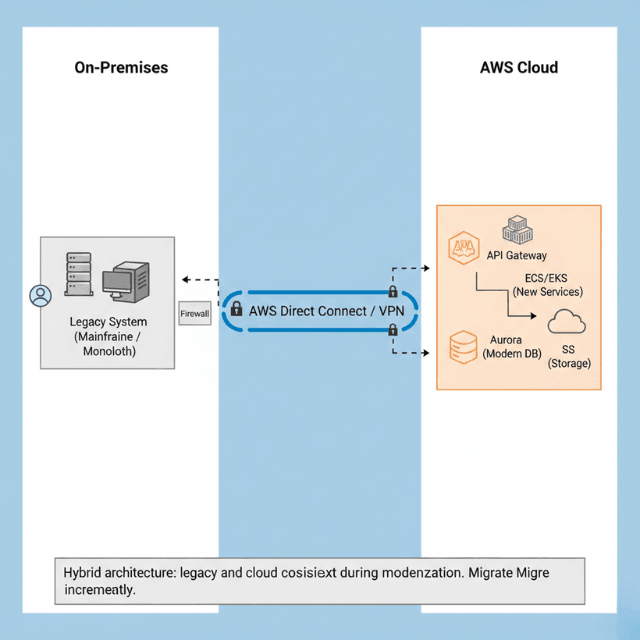
For computing, you have options beyond basic servers. ECS and EKS enable containerization without rebuilding everything. Lambda lets you add modern features while keeping core systems stable. The key is choosing the right tool for each part of your transformation, not forcing everything into one approach.
Database modernization alone can transform your economics. Moving from Oracle to Amazon Aurora can cut database costs by 60% while improving performance. One financial services firm saved $5 million annually just on Oracle licenses. But it's not just lift-and-shift, it's about reimagining data architecture for cloud scale.
The Smart Way to Modernize
The 6 Rs in Real Life
The 6 Rs framework, Rehost, Replatform, Refactor, Repurchase, Retire, and Retain, isn't about picking one strategy. It's about applying different strategies to different systems based on business value and technical complexity.
Your customer-facing applications? Refactor them into microservices for agility. Back-office systems that work fine? Rehost them quickly for cost savings. That expensive CRM nobody likes? Repurchase it as Salesforce. The custom reporting system nobody uses? Retire it. Legacy systems that absolutely can't move? Retain them but minimize their footprint.
One global retailer used this approach brilliantly. They refactored their e-commerce platform for Black Friday scaling, rehosted their inventory system for quick wins, and retired 30% of applications nobody actually used. Result: 50% cost reduction and 10x faster feature delivery where it mattered.
Containerization Without Chaos
Containers aren't just for startups. Enterprises are containerizing everything from 30-year-old Java applications to modern microservices. But enterprise containerization needs sophisticated orchestration, security controls, and governance that startups don't worry about.
The key is starting with the right applications. That stable Java app that rarely changes? Perfect for containers. The complex system with hundreds of dependencies? Maybe wait on that one. Build confidence with quick wins before tackling the hard stuff.
One manufacturing giant containerized 200 applications in 18 months. They started with internal tools, learned lessons, then moved to production systems. By the end, they had 60% lower infrastructure costs and could deploy updates in minutes instead of months.
The Strangler Fig Pattern
You can't rebuild everything at once, but you can modernize gradually. The Strangler Fig pattern, named after the tree that gradually envelopes its host, lets you replace legacy systems piece by piece without disruption.
Start by building new features in cloud-native architecture. Route specific functions to modern systems while legacy handles the rest. Gradually migrate more functionality until the legacy system handles nothing. Then turn it off. The business never stops, customers only see improvements, and risk is minimized.
The Strangler Fig pattern is brilliant. We've executed it dozens of times.
Gradual replacement without business disruption. New features in cloud-native. Legacy handling the rest. One piece at a time.
We help you:
- Identify the first functions to strangle – High value, low risk
- Build the routing layer – Route specific requests to modern systems
- Migrate incrementally – Every sprint delivers value, no big bang
- Know when to turn off the legacy system – The final satisfying step
Enterprise Security and Compliance
Enterprise security isn't optional, it's existential. One breach doesn't just cost money; it destroys decades of trust. AWS provides enterprise-grade security, but implementing it requires understanding both cloud security and enterprise requirements.
Identity management becomes complex with thousands of users across dozens of systems. You need federated identity that integrates with Active Directory while enabling cloud-native authentication. Role-based access that matches your organizational structure. Audit trails that satisfy regulators and lawyers.
Compliance in cloud requires continuous validation, not periodic audits. AWS Config continuously monitors compliance. CloudTrail provides forensic-level logging. Security Hub centralizes findings across your entire infrastructure. It's not just about being secure, it's about proving it continuously.
The Real Economics of Modernization
Enterprise cloud migrations often show initial cost increases before savings kick in. This scares executives who were promised immediate savings. Set realistic expectations: the first few months might cost more, but year two will show dramatic improvements.
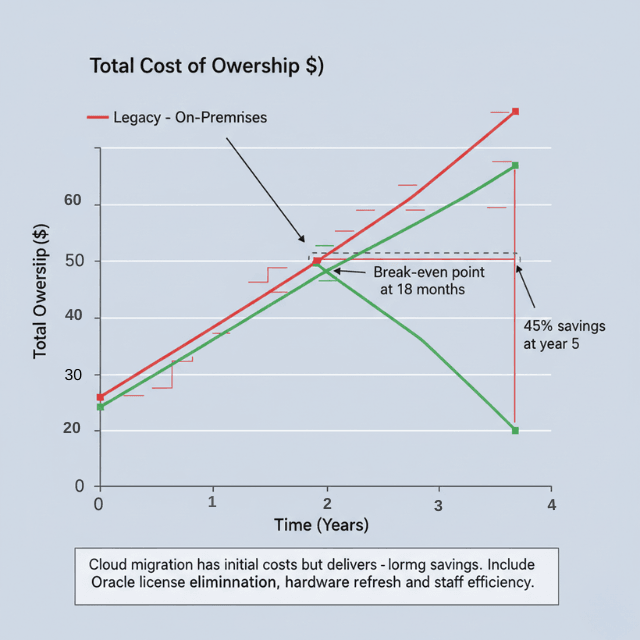
One manufacturing enterprise saw their AWS bill increase 20% initially. After optimization, they're now saving 45% compared to on-premises costs. But the real savings came from agility, launching new products in weeks instead of months, entering new markets without building data centers, and scaling for demand without overprovisioning.
Don't forget hidden savings. Eliminating Oracle licenses. Reducing data center footprints. Cutting operational staff needs. Avoiding hardware refresh cycles. When you calculate total cost of ownership over 5 years, cloud wins every time.
Choosing Your Enterprise Partner
Enterprise modernization requires different expertise than standard cloud consulting. You need cloud partners who understand enterprise governance, procurement processes, and change management. Who can work with your existing vendors and system integrators? Who know that downtime isn't just inconvenient, it's catastrophic.
Look for partners with real enterprise experience, not one Fortune 500 client, but dozens. They should understand your industry's specific requirements. They should have 24/7 support with 15-minute response times, not next-business-day email support.
Ask about their largest migration. How many applications? How much data? What went wrong and how did they fix it? Real enterprise partners have war stories and battle scars. They've seen what fails and know how to prevent it.
Starting Your Modernization Journey
Every day you delay modernization, the gap between you and cloud-native competitors widens. Your systems become harder to maintain. Your costs increase. Your risks multiply. The question isn't whether to modernize, but how fast you can do it safely.
Start with an honest assessment. What systems do you have? Which ones drive business value? Which ones just exist because they always have? Build a roadmap that balances quick wins with long-term transformation.
Then move decisively but carefully. Modernize in waves. Celebrate victories. Learn from challenges. Build momentum that carries the entire organization forward.
Your enterprise's future depends on decisions you make today. Legacy systems got you here, but they won't take you forward. The time for modernization is now. The question is: will you lead the change or be forced to follow?
Conclusion
Modernizing legacy systems on AWS isn't about flipping a switch—it's about strategic, incremental transformation. The 6 Rs framework and Strangler Fig pattern let you move at your own pace, reducing risk while delivering tangible value early. AWS provides enterprise-grade tools for governance, security, and compliance, but success requires honest assessment, realistic expectations, and the right partner.
The cost of inaction is far greater than the cost of modernization: lost competitiveness, mounting technical debt, and increasing risk. Start with a pilot project, build momentum, and transform your enterprise into a cloud-native innovator. The time to act is now.
FAQs
1. How long does a typical legacy modernization take?
It varies widely based on system complexity and scope. A single application can take 3-6 months; an entire enterprise portfolio may take 2-3 years.
The key is to use the Strangler Fig pattern to deliver incremental value from the start, not wait for a "big bang" completion.
2. What's the biggest risk in legacy modernization?
Data loss or corruption during migration. Mitigate by implementing extensive testing, using AWS Database Migration Service (DMS) with validation, and maintaining parallel run periods where both old and new systems operate simultaneously. Also, ensure rollback plans are tested before cutover.
3. Can we modernize without refactoring everything?
Absolutely. Use the 6 Rs: rehost (lift-and-shift) many applications quickly to gain cloud benefits, then selectively refactor only those that need agility.
The majority of enterprise applications can be rehosted or replatformed without rewriting code, delivering 30-50% cost savings and better scalability.
Summarize this post with:
Ready to put this into production?
Our engineers have deployed these architectures across 100+ client engagements — from AWS migrations to Kubernetes clusters to AI infrastructure. We turn complex cloud challenges into measurable outcomes.