Why Startups Make Bad Technical Decisions Under Pressure
Pressure does not cause bad technical decisions. Lack of leadership does. Learn why startups make poor choices under stress.
TLDR;
- Pressure doesn't cause bad decisions — lack of leadership does
- Missing elements: decision frameworks, predefined trade-offs, urgent vs important separation
- Reactive choices under stress compound into long-term problems
- Prevention: Establish principles before crises so teams respond deliberately, not desperately
Every startup faces moments when pressure forces difficult technical choices. A critical customer demands a feature by month-end. Runway shrinks while the product still needs work. A production incident threatens customer trust.
In these moments, many startups make decisions they later regret. They choose shortcuts that become permanent. They cut corners that compound into larger problems. They react instead of respond.
But pressure itself does not cause bad decisions. The absence of leadership, frameworks, and preparation does. This article examines why startups make poor technical decisions under pressure and how better leadership prevents these mistakes.
Why Pressure Is Constant in Startup Leadership
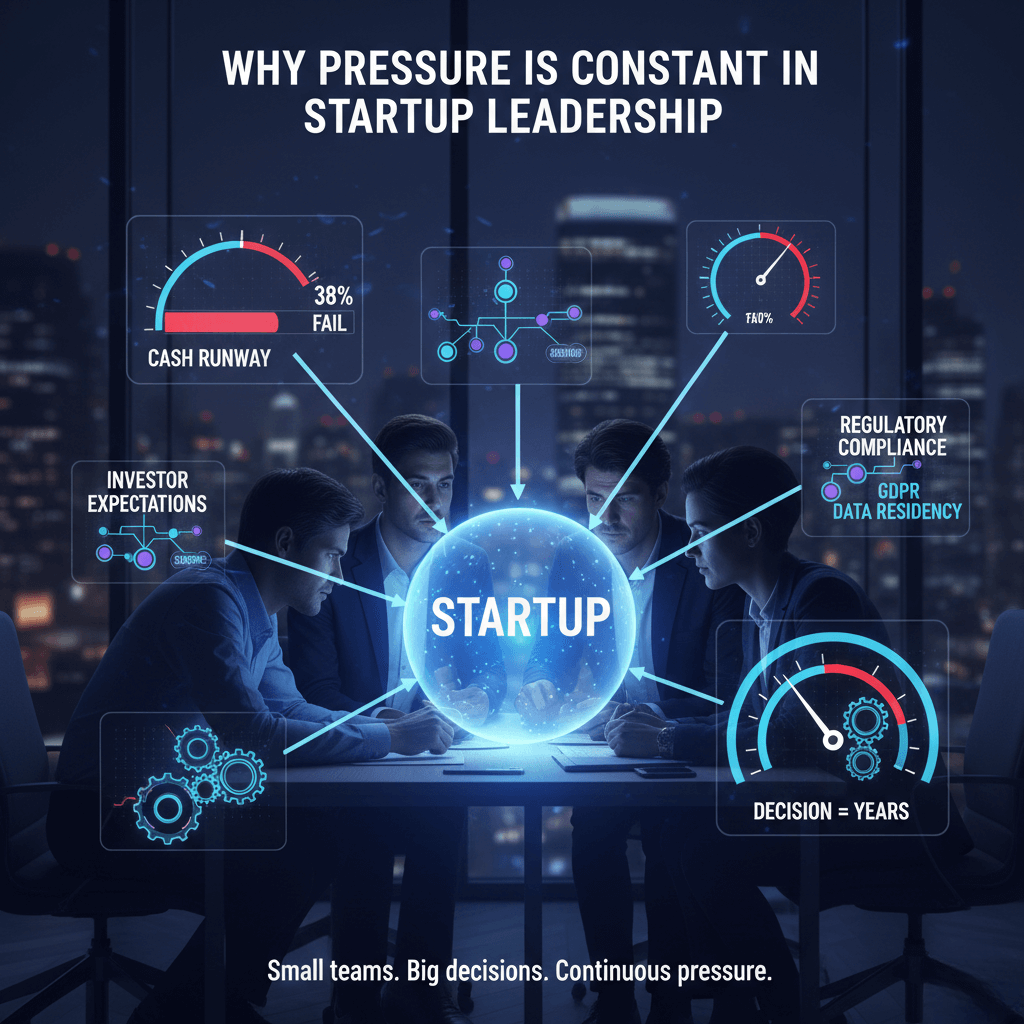
Startup life means operating under continuous pressure. Limited runway creates urgency around every decision. High investor expectations demand rapid progress. Small teams handle responsibilities that larger companies spread across departments.
According to CB Insights analysis of startup failures, running out of cash remains the top reason startups fail, affecting 38% of failed companies. This financial pressure drives decision-making across every function, including engineering.
European startups face additional complexity. Regulatory requirements like GDPR compliance add constraints that US competitors may not face. Data residency requirements affect architecture choices. Privacy-by-design obligations shape how teams build features.
Small teams handling big decisions means that individual choices carry outsized impact. A technical decision made in an afternoon may affect the company for years.
What Pressure-Driven Decisions Look Like in Practice
Under pressure, teams default to survival mode. They choose speed over clarity, picking whatever solution gets them past the immediate crisis without evaluating alternatives.
Short-term fixes become permanent. A quick workaround implemented during a crisis stays in place because nobody has time to replace it. Over time, the codebase accumulates layers of these emergency patches.
Decisions get made without full context. When time is short, teams skip research, skip consultation, and skip consideration of alternatives. They act on incomplete information because waiting feels impossible.
Research from the Standish Group found that rushed software projects have a 29% success rate compared to 42% for projects with adequate planning time. The pressure to move fast often produces the opposite result.
Common Pressure Scenarios That Trigger Costly Decisions
Scaling or Launch Deadlines
External commitments create immovable targets. A product launch announced to customers. A demo scheduled for investors. A feature promised to a key account.
Teams cut corners to hit dates. Testing gets compressed. Code reviews become cursory. Architecture discussions get skipped. The immediate goal takes precedence over long-term impact.
These shortcuts often succeed in meeting the deadline while failing in every other dimension. The feature ships on time but breaks under load. The demo works but the underlying system cannot support real usage.
Incidents and Outages
Production problems demand immediate response. Customers are affected. Revenue is at risk. The urgency is real and justified.
But emergency fixes rarely receive follow-up. The system returns to functional status, everyone exhales, and the team moves on to the next priority. Root causes remain unaddressed. The same incident recurs weeks or months later.
According to PagerDuty's incident response analysis, organizations without formal post-incident processes experience 2.7 times more repeat incidents than those with structured reviews.
Budget or Runway Constraints
Financial pressure leads to technical cost-cutting. Teams delay infrastructure upgrades, skip security investments, and postpone necessary maintenance.
These cost cuts often create larger expenses later. Deferred infrastructure work becomes an emergency when systems fail. Skipped security investments become breach remediation costs. The savings prove illusory.
Leadership Gaps That Make Pressure Worse
Pressure amplifies existing weaknesses. When no clear technical decision owner exists, pressure creates paralysis or conflict. Teams either cannot decide or make contradictory choices.
Lack of predefined principles means every decision starts from scratch. Under time pressure, there is no foundation to build on. Teams must invent their approach while the clock runs.
Reactive planning leaves no buffer for problems. When schedules have no slack, any delay cascades through the entire roadmap. Teams operate in constant crisis mode because the plan assumed nothing would ever go wrong.
How Pressure-Driven Decisions Become Long-Term Problems
Growing technical debt. Every shortcut adds to the maintenance burden. McKinsey estimates that technical debt consumes 40% of IT budgets at typical enterprises. Startups with less discipline often fare worse.
Rising cloud and maintenance costs. Hasty architecture decisions lead to inefficient resource usage. Poor infrastructure choices drive up operational expenses. What seemed fast and cheap becomes slow and expensive.
Slower delivery and reliability issues. Accumulated shortcuts make every new feature harder to build. The codebase becomes fragile. Changes in one area break functionality elsewhere.
Why Founders Often Realize the Cost Too Late
Problems surface months after decisions are made. The shortcut taken in January causes the outage in July. The connection is invisible until someone traces the root cause.
Teams adapt around bad decisions. They develop workarounds and procedures that mask underlying problems. These adaptations maintain functionality while hiding how much effort is required.
Costs appear as delivery slowdowns rather than discrete failures. Features just take longer. Estimates just grow. The cause is diffuse and hard to attribute.
How Strong Leadership Reduces Pressure-Driven Mistakes
Clear decision frameworks. When principles are established in advance, teams know how to evaluate options under pressure. "We never skip security review" removes the decision from crisis moments. Google's Site Reliability Engineering practices demonstrate how predefined frameworks enable faster, better decisions during incidents.
Agreed-upon trade-offs. Leadership defines in advance which trade-offs are acceptable. Teams know what corners can be cut and which cannot. This shared understanding speeds decisions without sacrificing critical quality.
Separation of urgent versus important. Strong leaders distinguish between problems that need immediate action and those that feel urgent but can wait. This discipline prevents every issue from becoming an emergency.
How EaseCloud Helps Leaders Make Better Decisions Under Pressure
EaseCloud provides the leadership support that European startups need during high-pressure periods. We bring experience and objectivity when both are in short supply.
Objective technical assessments. When pressure clouds judgment, we provide clear analysis of options and consequences. Our outside perspective helps teams see past immediate stress.
Clear options with trade-offs. We present alternatives with explicit costs and benefits. Decision-makers get the information they need without doing the research themselves.
Ongoing strategic support. Pressure decisions improve when leadership has access to experienced counsel. We work alongside founders and technical teams to build better decision-making capacity over time.
Schedule a consultation with EaseCloud to discuss how we can support your technical decision-making.
Final Takeaway
Pressure does not cause bad decisions. Lack of leadership does.
Startups that prepare for pressure by establishing frameworks, defining principles, and building decision-making capacity perform better when crises arrive. They respond rather than react. They make deliberate choices rather than desperate ones.
The best time to improve technical decision-making is before the pressure hits. The second best time is now.
Reframe pressure as a test of leadership, not a cause of failure. Emphasize preparation over reaction. Build the structures that enable good decisions regardless of circumstances.
FAQs
Why do startups make worse technical decisions under pressure?
Without established frameworks and clear ownership, teams must improvise under stress. This leads to inconsistent, short-term focused choices that create long-term problems.
How can founders slow down decision-making without delaying delivery?
Invest time upfront in decision frameworks and principles. When guidance exists, individual decisions happen faster because teams do not need to reinvent their approach each time.
Who should own technical decisions in high-pressure situations?
The same person who owns them in normal times. Pressure should not change accountability. Clear ownership before crisis enables faster response during crisis.
Can external advisors help during critical decisions?
Yes. External advisors bring objectivity and experience that internal teams may lack. They can evaluate options without the emotional investment that clouds judgment during stressful periods.
How do leaders recover from past pressure-driven decisions?
Start by documenting existing technical debt and its business impact. Prioritize remediation based on cost and risk. Allocate regular capacity for improvement rather than treating it as optional work.