Cloud Cost Management Strategies for SaaS
Optimize cloud costs for SaaS companies with proven strategies for infrastructure, SaaS application management, and FinOps. Reduce spending by 30-40% while scaling profitably.
TL;DR
- 30-40% of cloud spend is wasted – unused SaaS licenses, orphaned resources, idle dev environments, and overprovisioned instances.
- Track unit economics, not just total spend – measure cost-per-customer and cost-per-feature to know what's actually profitable.
- Quick wins: rightsize instances, use spot instances (60-90% savings), shut down dev environments off-hours (70% savings), and harvest unused software licenses.
- FinOps = engineering + finance collaboration – make developers cost-aware, tag everything, and review costs monthly.
- Result: Most SaaS companies cut cloud costs 30-40% while scaling faster.
Cloud infrastructure costs now rank among the top three expense categories for SaaS businesses, with 73% of companies reporting that cloud costs consume at least 6% of revenue. Without a formalized cloud cost management strategy, companies face budget overruns, poor valuations, and decision-making based on incomplete data.
This guide provides proven strategies to optimize cloud costs, eliminate waste, and implement sustainable practices that align with business goals. You'll discover actionable tactics used by successful SaaS companies to reduce cloud costs by 20-90% while maintaining or improving performance and scalability.
Understanding SaaS Cloud Cost Management
Cloud cost management for SaaS companies encompasses monitoring, analyzing, and optimizing expenses across infrastructure (IaaS), platforms (PaaS), and software (SaaS) services, a crucial part of building a startup’s cloud strategy from day one.
Unlike traditional software companies, SaaS businesses face unique challenges where cloud infrastructure costs scale with customer growth but don't always scale proportionally.
The three primary cost categories includes:
| Category | Examples |
|---|---|
| Infrastructure as a Service (IaaS) | AWS, Azure, GCP compute, storage, networking |
| Platform as a Service (PaaS) | Managed database services, serverless functions, container orchestration |
| Software as a Service (SaaS) | 275+ applications teams use for operations |
Cloud unit economics has emerged as the secret weapon for SaaS profitability. Rather than just tracking total cloud spend, successful companies measure cost-per-customer, cost-per-feature, and cost-per-transaction. This granular visibility enables informed decisions about pricing, feature development, and customer acquisition strategies.
Traditional cost accounting methods fail in cloud environments. Cloud costs are variable, consumption-based, and distributed across hundreds of services. Monthly budgeting doesn't account for the dynamic nature of cloud computing, making cloud unit economics essential.
Identifying Hidden Costs
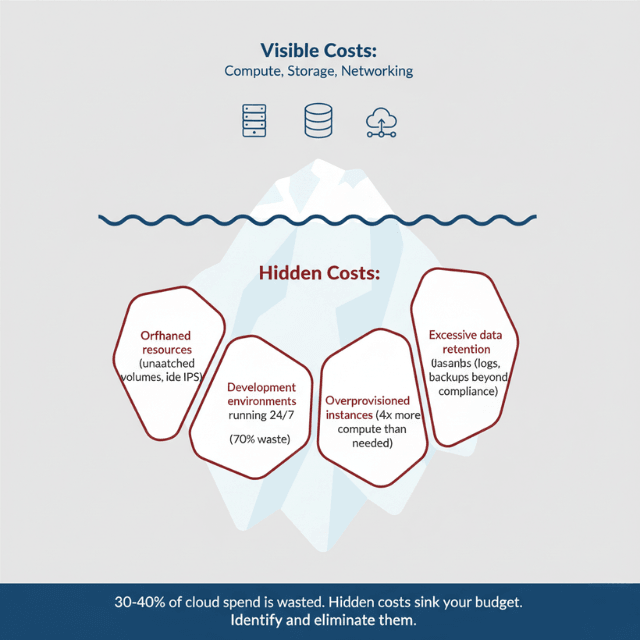
Research shows that 30-40% of SaaS spending is wasted, but these costs often hide in plain sight. Decentralized SaaS purchasing creates shadow IT spending that doesn't appear in finance reports until credit card bills arrive.
This leads to duplicate applications where multiple teams subscribe to tools with overlapping functionality, zombie subscriptions that continue charging long after teams stop using them, and premium licenses assigned to users who only need basic features.
One mid-sized SaaS company discovered they were paying for 1,200 Zoom licenses when only 800 employees regularly used the platform. The unused 400 licenses represented $60,000 in annual waste.
Auto-renewal contracts automatically renew at list price, even when better terms could be negotiated. Without a proactive renewal strategy, companies routinely overpay by 15-30% compared to what negotiation could achieve.
Hidden cost types:
| Cost Type | Description | Example |
|---|---|---|
| Orphaned resources | EC2 instances, volumes running with no connections | Idle infrastructure |
| Development environments 24/7 | Running when only used 40 hours weekly | 70% potential savings |
| Overprovisioned instances | 4x more compute power than required | Rightsizing opportunity |
| Excessive data retention | Logs and backups beyond compliance | Storage waste |
Strategic Cost Optimization Approaches
License Optimization Strategies:
| Strategy | Action | Benefit |
|---|---|---|
| Automated SaaS discovery | Connect to SSO, financial systems, cloud platforms | Identify all subscriptions |
| Employee surveys | Uncover shadow IT purchases on personal cards | Complete visibility |
| Credit card statement review | Scan for recurring SaaS charges | Catch hidden spend |
| Login activity tracking | Identify users not accessing in 30/60/90 days | License reclamation |
| Feature utilization monitoring | Distinguish active users from license hoarders | Right-size licenses |
| Automated license harvesting | Reclaim and reassign in real-time | Continuous optimization |
Not every user needs premium features. Analyze actual feature usage to identify opportunities for license downgrades. A SaaS company with 500 Salesforce licenses found that 200 sales development representatives only needed basic access, saving $50,000 annually by downgrading to lower-tier plans.
- Map functionality across entire portfolio to identify overlapping capabilities
- Survey users to understand which tools they find valuable
- Evaluate integration ecosystems to choose platforms that reduce need for point solutions
- Key insight: Average SaaS company uses applications that overlap in 40-60% of their functionality
Decentralized purchasing might be convenient, but it's expensive. Establish centralized procurement to negotiate volume discounts of 20-40%, achieve better contract terms, reduce administrative overhead, and improve security and compliance.
Infrastructure Cost Optimization
Infrastructure cost optimization strategies:
| Strategy | Implementation | Potential Savings |
|---|---|---|
| Rightsizing | Analyze 30-day utilization metrics | Eliminate overprovisioned resources |
| Autoscaling | Adjust capacity based on actual demand | Pay only for what you use |
| Spot/preemptible instances | Use for fault-tolerant workloads | 60-90% vs. on-demand |
| Environment scheduling | Run non-production only during business hours | Up to 70% on dev/test |
| Storage tiering | Move infrequently accessed data to cheaper tiers | Variable |
Riot Games reduced annual infrastructure costs by $10 million through rightsizing and optimization strategies while simultaneously improving deployment speed by 12x.
Rightsizing, spot instances, autoscaling – we implement them all.
These techniques save 60-90% on compute costs. But getting them right requires expertise.
We help you:
- Analyze utilization patterns – Find overprovisioned resources
- Implement autoscaling policies – Match capacity to demand dynamically
- Deploy spot/preemptible instances – 60-90% savings for fault-tolerant workloads
- Optimize storage tiers – Move cold data to cheaper classes
Cloud Unit Economics
Cloud unit economics measures infrastructure costs at granular levels: cost-per-customer, cost-per-feature, cost-per-transaction, or cost-per-API call. This approach answers critical business questions like which customers are profitable, what it costs to serve enterprise versus SMB customers, which features consume the most resources, and how infrastructure costs scale with growth.
- Tag all cloud resources with relevant metadata (customer, feature, environment, team)
- Establish cost allocation rules for shared infrastructure costs
- Build dashboards that visualize unit economics metrics for business stakeholders
- Set target unit economics to track progress over time
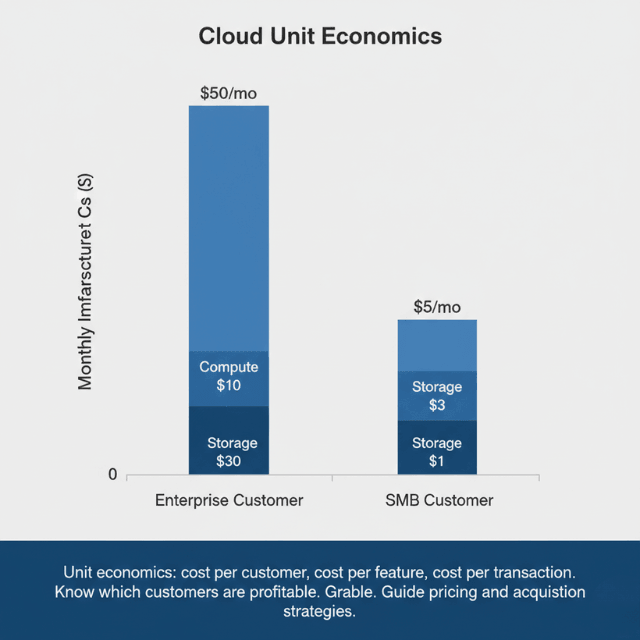
Companies that master cloud unit economics can optimize profitability even while scaling rapidly.
Cost Management Tools
CloudZero stands out for SaaS companies focused on understanding unit economics. The platform aggregates cost data from AWS, Azure, GCP, Kubernetes, and third-party services into a unified view, providing cost per customer, cost per feature, and cost per team insights with automated anomaly detection.
For organizations using Datadog for monitoring, the Cloud Cost Management module provides seamless integration between performance metrics and costs. Correlate costs with performance metrics and resource utilization, track costs as queryable metrics alongside application performance data, and allocate costs using built-in and custom tags.
Harness offers the most advanced automation and optimization capabilities, particularly for Kubernetes workloads and multi-cloud environments. AI/ML-powered autostopping for idle resources, automated cost optimization recommendations, and Kubernetes cost visibility provide engineering-led optimization.
Native tools from cloud providers (AWS Cost Explorer, Azure Cost Management, GCP Cloud Billing) offer deep visibility into infrastructure costs but limited SaaS management. Specialized platforms like Zylo, Torii, and BetterCloud focus on license optimization and vendor management.
Implementing FinOps
FinOps (Financial Operations) represents a cultural shift in how organizations approach cloud cost management. Rather than treating it as a finance-only responsibility, FinOps promotes cross-functional collaboration between engineering, finance, and operations teams.
The FinOps Foundation defines three phases:
| Phase | Focus | Activities |
|---|---|---|
| Inform | Visibility and allocation | Tagging, cost allocation, dashboards, unit economics |
| Optimize | Cost reduction strategies | Rightsizing, scheduling, spot instances, license optimization |
| Operate | Continuous governance | Policies, approvals, automated enforcement, regular reviews |
The foundation reports that approximately 70% of FinOps practitioners manage both infrastructure and SaaS application costs in a unified approach.
Make engineering cost-aware:
- Show engineers the cost impact of their architectural decisions
- Include unit economics metrics in sprint reviews
- Celebrate cost optimization wins alongside feature releases
Establish cloud cost governance:
- Approved resource types and sizes for different use cases
- Spending limits with automated alerts when approaching thresholds
- Required tagging compliance before provisioning resources
- Approval workflows for high-cost resource types
Hold monthly FinOps reviews:
- Representatives from each team
- Create shared accountability for cost targets
- Align incentives so cost optimization benefits all teams
- Share success stories and lessons learned
Best Practices for Sustainable Cost Management
Include cost considerations in development processes. Provide developers with visibility into how their code and configuration choices impact infrastructure costs. Tools that estimate costs during CI/CD pipelines help developers make informed decisions before deployment.
Automated resource cleanup, snapshot lifecycle management, off-hours shutdown for non-production environments, and rightsizing recommendations ensure consistency and free engineering time for higher-value activities.
Multi-cluster architectures provide isolation and resilience, but each cluster adds costs. Evaluate whether workload isolation truly requires separate clusters or if namespaces with policies suffice.
Schedule quarterly audits to identify idle clusters, unused namespaces, orphaned volumes, and abandoned projects. Technical debt accumulates quickly in cloud environments.
Create runbooks documenting optimization strategies, tool configurations, and lessons learned. Share successes and failures across teams to accelerate organizational learning.
AWS continuously releases new instance types, services, and pricing models. Subscribe to cloud provider blogs, attend conferences, and regularly review documentation for new optimization opportunities.
Conclusion
Cloud cost management for SaaS companies requires systematic attention to both infrastructure optimization and SaaS application management. Organizations typically achieve 30-40% cost reductions through the strategies outlined in this guide, with some achieving up to 90% savings in specific areas.
Start with high-impact wins like SaaS discovery and license optimization, infrastructure rightsizing, and establishing basic cost visibility. These quick wins demonstrate value and build momentum for more sophisticated approaches like cloud unit economics, automated optimization, and mature FinOps practices.
Cost optimization philosophies:
- Cost optimization isn't about minimizing spending at all costs
- It's about maximizing business value per dollar invested
- Transform cost management from reactive fire drill into proactive competitive advantage
Frequently Asked Questions
How do SaaS companies typically manage cloud costs?
SaaS companies manage cloud costs through a combination of strategies including:
- Implementing FinOps frameworks
- Using cloud cost management tools
- Rightsizing infrastructure resources
- Optimizing SaaS license allocation
- Tracking unit economics (cost-per-customer)
- Establishing cross-functional teams (engineering, finance, operations) for shared accountability
Key statistic: Approximately 70% of FinOps practitioners manage both infrastructure costs and SaaS application costs in a unified approach.
What percentage of cloud spending is typically wasted in SaaS companies?
Research indicates that 30-40% of SaaS spending is wasted on unused licenses, redundant applications, overprovisioned infrastructure, and resources running when not needed.
| Category | Waste Percentage | Sources of Waste |
|---|---|---|
| SaaS spending | 30-40% | Unused licenses, redundant applications |
| Infrastructure | Part of above | Orphaned resources, dev environments running 24/7, overprovisioned capacity |
| Identified and eliminated | 20-30% | Through comprehensive cost management programs (without impacting performance) |
Which cloud cost management tool is best for SaaS companies?
The best cloud cost management tool depends on your specific needs.
| Tool | Best For | Key Differentiator |
|---|---|---|
| CloudZero | Unit economics | Understanding cost-per-customer metrics |
| Datadog Cloud Cost Management | Teams already using Datadog | Integrated cost visibility with observability |
| Harness | Kubernetes workloads | Most advanced automation and AI-driven optimization |
| Zylo, Torii, BetterCloud | SaaS license management | Specialized license optimization capabilities |
Recommendation: Most companies benefit from using a combination of tools.
How can FinOps help with cloud cost management in SaaS companies?
FinOps Benefits
- Creates cultural and operational framework for collaboration between engineering, finance, and operations
- Makes engineers cost-aware
- Establishes cloud governance policies
- Creates continuous optimization practices
- Typical cost reduction: 15-30%
- Additional benefit: Improves decision-making speed
The framework operates in three phases:
| Phase | Focus | Activities |
|---|---|---|
| Inform | Visibility and allocation | Cost tagging, dashboards, showback/chargeback |
| Optimize | Implementing cost reductions | Rightsizing, scheduling, purchasing plans |
| Operate | Ongoing governance | Policies, continuous improvement, anomaly detection |
What is cloud unit economics and why does it matter for SaaS companies?
Cloud unit economics measures your infrastructure costs at a granular level.
| Metric | What It Measures |
|---|---|
| Cost-per-customer | Infrastructure cost per individual customer |
| Cost-per-feature | Resources consumed by specific features |
| Cost-per-transaction | Cost per business transaction |
| Cost-per-API call | Cost per API invocation |
This matters because it reveals the true relationship between cloud costs and business value.
For example, you might discover that enterprise customers cost $50 monthly to serve while SMB customers cost $5 monthly, informing pricing strategies and customer acquisition decisions. Unit economics also helps identify which features consume disproportionate resources, guiding product development priorities. Companies that master unit economics can optimize profitability while scaling.
Summarize this post with: