What Investors See in Your Tech Architecture (and How It Affects Valuation)
Learn how tech architecture impacts startup valuation. Discover what investors evaluate in due diligence and how to prepare for funding rounds.
TLDR;
- Architecture reveals execution maturity, hidden risks, and scalability potential
- Investors want: Clear scalability paths, failure isolation, DR readiness, cost awareness
- Red flags: Single points of failure, over-engineering, key-person dependencies
- Prepare: Document decisions, ensure stage-appropriate design, create evolution roadmap
Your product works. Customers pay for it. Growth looks promising. But when investors start asking about your tech architecture, the conversation shifts from what you have built to how you built it. This distinction often determines whether your startup commands premium valuations or faces discounted offers.
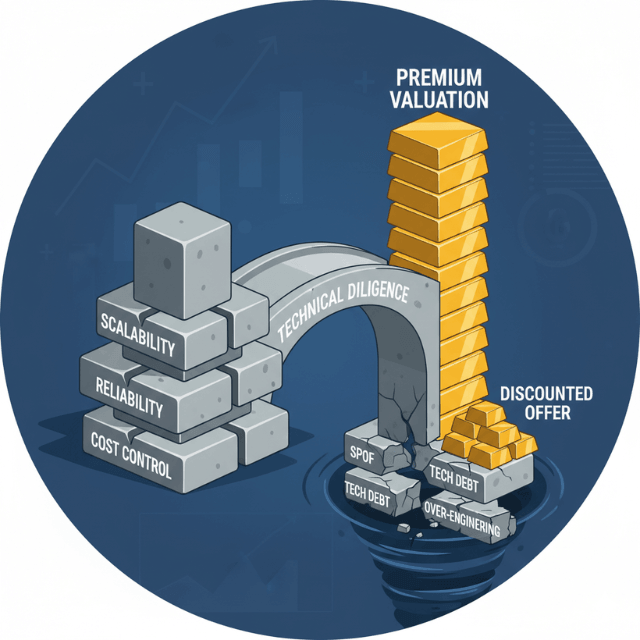
For European SaaS founders raising Series A or B rounds, architecture conversations have become standard. Investors want to understand if your technical foundation can support the growth their capital will fuel.
Why Tech Architecture Matters in Investor Due Diligence
Architecture reflects execution maturity. When investors evaluate startups, they look beyond revenue metrics and user growth. They assess whether your team makes sound technical decisions under constraints. According to First Round Capital's research, technical due diligence has become a standard part of Series A and B investments, with over 70% of deals including some form of architecture review.
Risk assessment extends beyond revenue. Your architecture reveals hidden risks that financial metrics cannot capture. A system with multiple single points of failure represents future downtime and customer churn. Tightly coupled components signal expensive rewrites ahead. Investors price these risks into their offers.
Scalability and defensibility create investment confidence. Andreessen Horowitz notes that technical moats often provide more durable competitive advantages than first-mover status. Architecture that enables rapid feature development or handles scale efficiently can differentiate your startup from competitors who may struggle with technical debt.
What Investors Mean by "Tech Architecture"
When investors ask about architecture, they focus on system design rather than specific tools. Whether you use AWS or Azure matters less than how you have structured your services, managed data flows, and handled failure scenarios.
Scalability and reliability patterns demonstrate engineering maturity. Investors look for evidence that your team understands distributed systems principles. Can you explain how your system handles increased load? Do you have clear patterns for adding new features without destabilising existing functionality?
Cost and operational efficiency signal sustainable unit economics. According to McKinsey's research on cloud economics, startups that optimise cloud spending early typically achieve 20-40% better gross margins than competitors with uncontrolled infrastructure costs.
Architecture Signals That Raise Valuation Confidence
Clear Scalability Path
Investors favour architectures that can grow without requiring complete rebuilds. If your system can handle 10x user growth with incremental infrastructure additions rather than fundamental redesigns, you present lower execution risk.
Predictable infrastructure evolution matters. Document your scaling strategy with specific thresholds and planned responses. When you can explain that at 100,000 users you will add read replicas, and at 500,000 users you will implement sharding, investors see a team that thinks ahead.
Reliability and Risk Management
Failure isolation demonstrates mature engineering practices. Systems where a single component failure brings down the entire product concern investors. The AWS Well-Architected Framework emphasises designing for failure as a core principle. Showing how your architecture contains failures builds confidence.
Disaster recovery readiness protects investor capital. If your primary region fails, can you recover? European investors particularly value this given GDPR requirements around data availability. Document your recovery time objectives and recovery point objectives with evidence of testing.
Cost Awareness and Control
Architecture aligned with margins impresses sophisticated investors. When you can show how your infrastructure costs relate to revenue, and demonstrate that these ratios improve with scale, you present a business that understands its economics.
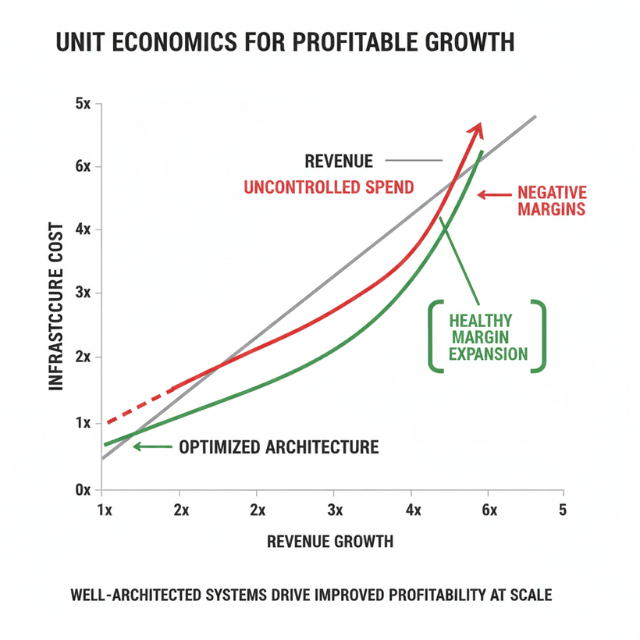
Avoiding runaway infrastructure risk requires planning. Startups that spend 50% of revenue on cloud bills struggle to reach profitability. Gartner research indicates that cloud waste often exceeds 30% of total spend for growing companies without active cost governance.
Architecture Red Flags That Lower Valuation
Single points of failure concern every experienced investor. A monolithic database without replication, a critical service running on a single server, or authentication tied to one engineer's personal account all represent unacceptable risks.
Over-engineered or fragile systems raise questions about team judgment. If you have built Kubernetes clusters for 100 users, investors wonder about your prioritisation skills. Premature optimisation suggests a team that may not make pragmatic decisions with their capital.
High operational dependency on key individuals creates succession risk. When only one engineer understands your deployment process or can troubleshoot production issues, investors see a company that cannot scale its team.
How Architecture Decisions Translate Into Valuation Risk
Slower growth potential reduces expected returns. If your architecture requires six months of refactoring before you can launch in new markets, investors discount your growth projections accordingly.
Higher future capital requirements lower current valuations. When investors anticipate that scaling will demand a complete replatforming effort, they factor those costs into their valuation models. A startup that needs additional funding to rebuild its tech before it can scale will receive lower offers today.
Execution uncertainty increases risk premiums. According to CB Insights analysis, technology problems rank among the top reasons startups fail to deliver on their plans. Architecture concerns amplify these execution risks in investor minds.
Why Founders Often Underestimate Architecture's Valuation Impact
Founders focus on product features because that drives customer acquisition. The technical decisions that make those features possible remain invisible to users but visible to investors reviewing your codebase.
Architecture often seems like an internal detail rather than a business asset. Until you sit across from a technical due diligence team, the strategic value of clean architecture may not be apparent.
Problems surface during diligence when stakes are highest. Founders who have not prepared architecture narratives find themselves defending decisions made years ago under different circumstances. This reactive position weakens negotiating leverage.
How Founders Can Make Architecture Investor-Ready
Document decisions and trade-offs proactively. Create architecture decision records that explain why you made specific choices given your constraints at the time. Investors respect pragmatic trade-offs more than perfection claims.
Ensure stage-appropriate design throughout your system. Early-stage startups should have simple, maintainable architectures. Growth-stage companies should show evolution toward more sophisticated patterns. Match your architecture to your company stage.
Develop a clear evolution roadmap before fundraising conversations. Know what changes you will make at different scale points. This roadmap demonstrates strategic thinking and reduces investor concerns about technical surprises.
How EaseCloud Helps Startups Prepare Architecture for Investors
Architecture reviews for due diligence give founders confidence. Our team of certified cloud architects evaluates your systems through an investor lens, identifying strengths to highlight and weaknesses to address before fundraising.
Risk and scalability assessments provide documentation investors expect. We create architecture summaries that technical due diligence teams can review, saving time during the funding process and presenting your systems professionally.
Founder-level clarity enables better fundraising conversations. We translate technical complexity into business language, helping non-technical founders discuss architecture with confidence and technical founders communicate strategic value effectively.
Investors Fund Confidence, Not Just Code
Architecture serves as a trust signal in fundraising. When investors see well-documented, pragmatically designed systems, they gain confidence in your team's ability to execute. This confidence translates directly into valuation premiums and better terms.
Valuation ties directly to execution readiness. Startups that demonstrate they can scale efficiently, handle failures gracefully, and control costs effectively command higher multiples than competitors with uncertain technical foundations.
Preparing your architecture story before fundraising pays dividends. The effort invested in documentation, planning, and cleanup returns multiples in valuation impact and negotiating leverage.
Conclusion
Your tech architecture is not just an engineering concern it's a business asset that directly influences how investors perceive risk, scalability, and execution maturity. When you enter a funding round, your architecture tells a story about your team's judgment, foresight, and operational discipline.
Founders who proactively document decisions, plan for scale, and address technical debt before fundraising transform architecture from a potential liability into a competitive advantage.
The effort invested in preparation three to six months before you need the capital returns multiples in valuation premiums and negotiating leverage. Investors fund confidence, not just code. Give them reasons to believe in your technical foundation, and they will reward you accordingly.
FAQs on Tech Architecture and Startup Valuation
Do investors really review tech architecture?
Yes. Technical due diligence has become standard for Series A and beyond. While depth varies, most institutional investors either conduct internal reviews or hire third-party firms to evaluate architecture before committing capital.
Can poor architecture delay fundraising?
Absolutely. Investors who identify significant technical risks often pause deal processes to request additional information, demand lower valuations, or include protective provisions in term sheets. Some walk away entirely.
Is over-engineering a valuation risk?
Yes. Investors want to see appropriate architecture for your stage. Premature complexity suggests a team that may not allocate resources wisely. Simple systems that work reliably often impress more than sophisticated systems with unclear benefits.
How technical do founders need to be for investor discussions?
Non-technical founders should understand their architecture at a conceptual level and bring technical co-founders or advisors to detailed discussions. The ability to explain why decisions were made matters more than reciting technical specifications.
When should startups review architecture before fundraising?
Begin architecture preparation three to six months before planned fundraising. This provides time to address issues, create documentation, and develop your architecture narrative without rushed timelines.
Summarize this post with:
Ready to put this into production?
Our engineers have deployed these architectures across 100+ client engagements — from AWS migrations to Kubernetes clusters to AI infrastructure. We turn complex cloud challenges into measurable outcomes.