7 AWS Cost Optimization Mistakes Early-Stage Startups Can't Afford
Avoid 7 costly AWS mistakes that drain startup runway. Learn practical cost optimization strategies for early-stage founders and technical teams.
TLDR;
- Startups waste 28% of cloud spend on preventable mistakes
- 7 common traps: over-provisioning, no cost visibility, on-demand pricing for stable workloads, unused resources, poor storage choices, no environment separation, one-time optimization
- Fix it: Set budget alerts, right-size based on actual usage, schedule monthly cost reviews
AWS offers startups powerful infrastructure, but that power comes with financial risk. Many early-stage founders discover their cloud bill has doubled overnight, burning through precious runway. This article identifies seven AWS cost optimization mistakes that drain startup budgets and provides actionable fixes for each.
By the end, you will understand which costly patterns to avoid, how to implement basic cost controls, and when professional guidance makes financial sense. Whether you are pre-seed or Series A, these insights apply to your AWS environment.
Why AWS Cost Optimization Is Critical for Early-Stage Startups
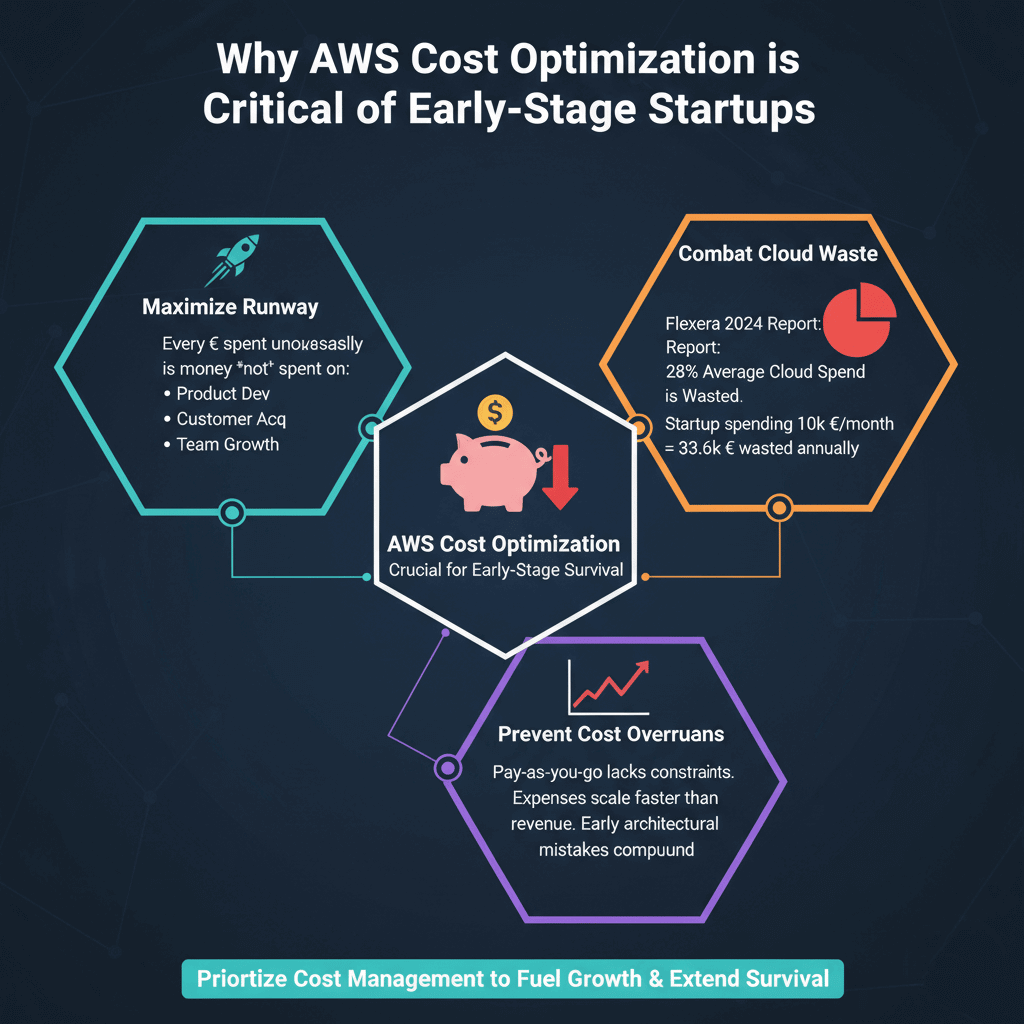
Runway defines survival for early-stage startups. Every euro spent on unnecessary AWS resources is money not spent on product development, customer acquisition, or team growth.
According to Flexera's 2024 State of the Cloud Report, organizations waste an average of 28% of their cloud spend. For a startup spending 10,000 EUR monthly on AWS, that translates to 33,600 EUR wasted annually.
AWS's pay-as-you-go model creates flexibility, but it also removes natural spending constraints. Without deliberate cost management, expenses scale faster than revenue. Early mistakes compound rapidly because architectural decisions made today become expensive to change tomorrow.
Mistake 1: Over-Provisioning Resources Just in Case
New startups frequently select oversized EC2 instances and RDS databases anticipating traffic that never materializes. A t3.2xlarge running 24/7 costs roughly 245 USD monthly, while a properly sized t3.medium handles many workloads at 30 USD monthly.
This over-provisioning stems from uncertainty. Engineers choose larger instances because they lack performance data and fear service disruptions. The fix starts with accepting that initial sizing will be imperfect.
Launch with smaller instances and establish monitoring before scaling up. AWS Compute Optimizer analyzes your utilization patterns and recommends right-sized instances based on actual usage rather than speculation.
Mistake 2: Ignoring AWS Cost Visibility and Monitoring
Many startups operate without cost dashboards or budget alerts until they receive a shocking monthly invoice. By then, the money is already spent.
AWS provides native tools for cost visibility. AWS Budgets allows you to set spending thresholds and receive alerts when costs approach limits. Setting a budget takes five minutes but can prevent thousands in unexpected charges.
Create at least three budget alerts: one at 50% of expected spend, one at 80%, and one at 100%. European startups should also tag resources by environment (dev, staging, production) to identify which environments consume the most budget.
Mistake 3: Using On-Demand Pricing for Everything
On-demand pricing makes sense for unpredictable workloads and short-term experiments. However, startups often run stable workloads on on-demand instances indefinitely, paying premium rates for resources they use continuously.
AWS Reserved Instances and Savings Plans offer up to 72% discount compared to on-demand pricing for committed usage. A production database running 24/7 qualifies for these savings immediately.
The signal to optimize pricing appears when workloads run consistently for more than two months. Start with one-year, no-upfront commitments to balance savings with flexibility. As your infrastructure stabilizes, consider three-year terms for deeper discounts.
Mistake 4: Not Shutting Down Unused and Idle Resources
Orphaned resources accumulate silently. A developer launches an EC2 instance for testing, forgets about it, and the instance runs for months. Unused Elastic IPs, detached EBS volumes, and idle load balancers add up.
AWS Trusted Advisor identifies underutilized and idle resources automatically. Schedule weekly reviews of Trusted Advisor recommendations to catch waste before it accumulates.
Development and staging environments represent particular risk areas. Implement automated shutdown schedules using AWS Instance Scheduler for non-production environments. Running dev instances only during business hours reduces those costs by 65%.
Mistake 5: Poor Storage and Data Transfer Decisions
Storage costs catch startups by surprise. Teams store everything in S3 Standard tier when most data is rarely accessed. Data egress charges add another layer of unexpected expense.
According to AWS S3 pricing documentation, S3 Standard costs 0.023 USD per GB monthly, while S3 Glacier Deep Archive costs 0.00099 USD. That difference matters when storing terabytes of logs and backups.
Implement S3 Lifecycle policies to automatically transition objects to cheaper storage tiers after specified periods. For data transfer, keep traffic within the same availability zone when possible and use VPC endpoints to avoid NAT gateway charges for AWS service communication.
Mistake 6: No Environment Separation Strategy
Mixing development, staging, and production workloads within a single AWS account creates cost attribution problems. You cannot optimize spending you cannot measure.
AWS Organizations enables separate accounts for each environment with consolidated billing. This structure provides clear visibility into which environment consumes resources and allows different cost optimization strategies per environment.
Production environments might use Reserved Instances while development environments use spot instances. Without separation, applying these optimizations becomes complicated and error-prone.
Mistake 7: Treating AWS Cost Optimization as a One-Time Task
Startups often perform one cost review, implement changes, and assume the problem is solved. Cloud costs drift over time as teams add services, traffic patterns change, and AWS introduces new pricing options.
Effective cost optimization requires continuous attention. Schedule monthly cost reviews where engineering and finance stakeholders examine spending trends together. Track unit economics, specifically cost per customer or cost per transaction, rather than just total spend.
The AWS Cost Anomaly Detection service monitors spending patterns and alerts you to unexpected changes, helping maintain cost discipline without constant manual oversight.
How Early-Stage Startups Should Approach AWS Cost Optimization Instead
Start with visibility before optimization. Install cost monitoring, tagging, and alerting before making any changes. Data-driven decisions outperform intuition-based cost cutting.
Optimize for your current stage, not hypothetical future scale. An architecture designed for one million users when you have one thousand users wastes money today without providing benefits. Right-size for now and plan to evolve.
Align infrastructure decisions with business priorities. If speed-to-market matters more than cost efficiency at your stage, accept higher costs temporarily. Document these decisions so you can revisit them as priorities shift.
When DIY Cost Optimization Stops Working
Engineering teams possess the technical skills for cost optimization, but they also have competing priorities. Every hour spent analyzing AWS bills is an hour not spent building product features.
Hidden opportunity costs make DIY optimization expensive. A senior engineer earning 100 EUR hourly who spends 10 hours monthly on cost analysis represents 1,000 EUR in implicit cost, potentially exceeding the savings achieved.
Advanced optimization techniques require specialized knowledge. Multi-account governance, enterprise discount programs, and architectural refactoring for cost efficiency demand expertise most startups lack internally.
How EaseCloud Helps Startups Reduce AWS Costs Without Slowing Growth
EaseCloud provides startup-focused AWS cost audits that identify savings opportunities within your existing infrastructure. Our certified architects analyze your environment against industry benchmarks and deliver actionable recommendations.
We implement right-sizing and pricing strategy changes with minimal disruption to your development workflow. For startups in the European Union, we address data residency requirements while optimizing costs, ensuring GDPR compliance remains intact.
Ongoing cost optimization and governance services help maintain savings over time. Rather than one-time audits, we provide continuous monitoring and quarterly optimization reviews tailored to startup growth patterns.
Final Thoughts: Cut AWS Waste Before It Cuts Your Runway
The seven mistakes outlined here represent the most common patterns we observe in early-stage startup environments. Over-provisioning, poor visibility, on-demand pricing addiction, orphaned resources, storage inefficiency, environment mixing, and one-time optimization mindsets all drain budgets unnecessarily.
Proactive cost control preserves runway and demonstrates financial discipline to investors. European founders operating in competitive markets cannot afford to waste 20-30% of their cloud budget on preventable inefficiencies.
Consider an expert review early in your growth journey. The investment in professional guidance typically pays for itself within the first quarter through identified savings.
FAQs About AWS Cost Optimization for Startups
Why do startups overspend on AWS?
Startups overspend because they lack visibility into actual resource usage, over-provision out of caution, and deprioritize cost management while focusing on product development. Without established processes, costs accumulate unnoticed.
How much can startups save with AWS cost optimization?
Typical savings range from 20-40% of monthly AWS spend. The exact amount depends on current inefficiencies, workload characteristics, and willingness to implement recommendations like Reserved Instances or architectural changes.
Is AWS cost optimization worth it at an early stage?
Yes. Early optimization establishes good practices and prevents technical debt. Fixing cost problems becomes harder and more expensive as infrastructure grows and dependencies develop.
How often should startups review AWS costs?
Monthly reviews work well for most early-stage startups. Set calendar reminders to examine cost trends, unused resources, and optimization opportunities alongside sprint planning or monthly business reviews.
Should startups hire AWS consultants for cost optimization?
External consultants make sense when internal teams lack cloud expertise, when cost optimization competes with product priorities, or when you need rapid results before fundraising milestones.