Top SaaS Cost Tools That Save Millions Yearly
Compare leading SaaS cost management platforms including CloudHealth, Apptio, Flexera, and Kubecost. Learn which tools deliver maximum ROI for your cloud environment and size.
TL;DR
- Cost reduction: SaaS cost tools typically save 20-40% through automation, anomaly detection, and FinOps workflows.
- Start native: AWS Cost Explorer, Azure Cost Management, or GCP native tools work fine for single-cloud, <$500K annual spend.
- Go third-party for multi-cloud or scale:
- CloudHealth – Best for multi-cloud governance, >$1M/year (≈3% of spend)
- Apptio Cloudability – FinOps-first, ties costs to products/customers (2-3% of spend)
- Flexera One – Uniquely handles cloud + SaaS + on-prem
- Specialized tools:
- Kubecost – Kubernetes cost visibility (open-source available)
- Spot by NetApp – Automates RIs and Savings Plans
- nOps – ML-powered AWS optimization
- Selection by spend:
- <$10K/month → native tools only
- $10K-50K/month → add Kubecost or lightweight enterprise tier
- $50K/month or multi-cloud → enterprise platform (2-3% fee, 3-6 month ROI)
- Kubernetes is unique: Traditional tools fail at container-level allocation. Kubecost provides per-pod, per-namespace breakdowns—essential for K8s-heavy environments.
SaaS cost management tools have evolved from simple dashboards to sophisticated platforms integrating cost optimization, FinOps workflows, and automated remediation. Organizations managing complex cloud environments report 20-40% cost reduction through proper tooling, with enterprise platforms enabling millions in annual savings for large deployments.
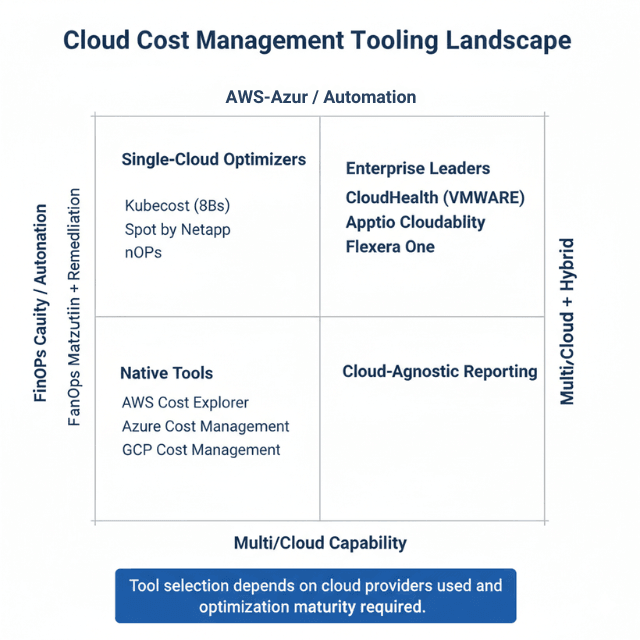
The challenge lies in selecting tools matching your specific requirements, cloud providers, organizational size, and FinOps maturity. Native cloud provider tools work well for single-cloud environments below $500K annual spend.
Third-party platforms deliver value for multi-cloud deployments, sophisticated allocation requirements, or organizations requiring enterprise-grade features. This guide evaluates leading platforms across capabilities, pricing, and best-fit use cases.
Enterprise Platforms
CloudHealth by VMware has established itself as a leader in multi-cloud cost management for enterprise organizations. The platform provides visibility across AWS, Azure, and GCP with sophisticated reporting, governance, and optimization recommendations. CloudHealth excels at multi-cloud consolidation for organizations spending over $1M annually across multiple providers.
Key capabilities include unified dashboards consolidating spending across cloud providers, policy-driven governance enforcing budgets and cost controls automatically, rightsizing recommendations based on actual utilization data, and customizable reporting for finance departments. Pricing typically runs 3% of cloud spend under management, making it a significant investment requiring substantial spending to justify.
Apptio Cloudability takes a FinOps-first approach with platforms designed specifically to support FinOps best practices. The interface is notably more intuitive than CloudHealth, making it accessible beyond dedicated FinOps professionals. Cloudability provides budget forecasting with machine learning predictions, anomaly detection identifying cost spikes within hours, and seamless integration with IT Business Management processes.
The platform excels at tying infrastructure costs directly to cost centers, products, or customers, proving invaluable for SaaS companies practicing unit economics. Pricing ranges from 2-3% of cloud spend or tiered annual fees based on spend levels. Cloudability works well for startups and mid-market companies with dedicated FinOps teams prioritizing user experience.
Flexera One distinguishes itself by aggregating costs from cloud providers (AWS, Azure, GCP, IBM Cloud, Oracle Cloud) plus SaaS subscriptions and on-premises infrastructure. This makes it particularly valuable for enterprises in hybrid cloud transformation journeys. Software Asset Management (SAM) capabilities extend beyond cloud infrastructure to track software licenses, maintenance contracts, and SaaS subscriptions.
Specialized Tools
Kubecost provides Kubernetes-native cost management with real-time visibility into cluster spending. The platform offers cost breakdown by namespace, deployment, service, or label with rightsizing recommendations for containers and nodes. Kubecost supports multi-cluster deployments across AWS EKS, Google GKE, Azure AKS, and on-premises Kubernetes.
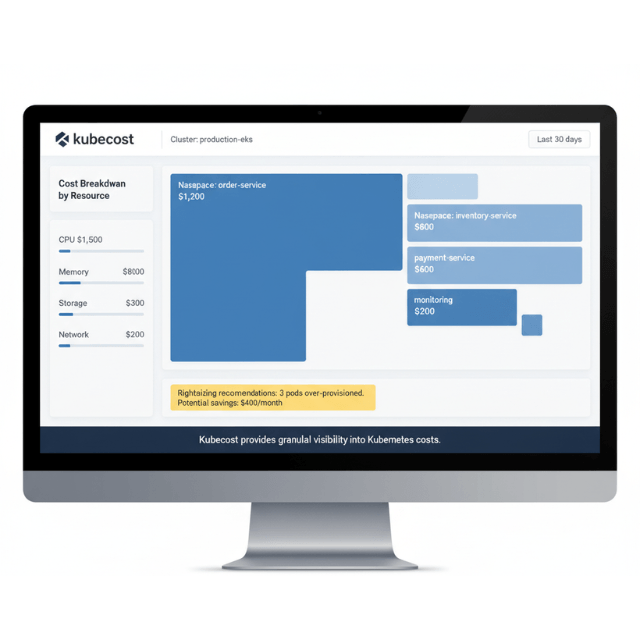
The open-source version provides substantial functionality for teams getting started with Kubernetes cost management. Enterprise features add multi-cluster views, advanced RBAC, long-term metric retention, and dedicated support. Pricing starts free for single clusters with paid tiers based on cluster count and features required.
Spot by NetApp focuses specifically on AWS cost optimization through automated commitment management and workload optimization. The platform automatically purchases and manages Reserved Instances and Savings Plans using machine learning to optimize coverage and utilization. Spot's Ocean product provides intelligent Kubernetes cluster management with automated rightsizing and spot instance integration.
nOps applies machine learning to AWS cost optimization, offering automated rightsizing, Savings Plans management, and intelligent spot instance orchestration. The platform's algorithms learn from usage patterns to make increasingly accurate recommendations over time. nOps includes scheduler for non-production environments, automatically shutting down development resources outside business hours.
Native Cloud Tools
AWS Cost Explorer and Budgets provide substantial value for AWS-only organizations without additional platform costs. Cost Explorer offers detailed visualization of spending patterns enabling analysis by service, account, region, or custom tags. Built-in forecasting projects future costs based on historical trends. AWS Budgets enables proactive cost control through customizable budget thresholds with alerts when spending exceeds defined limits.
Limitations include AWS-only visibility problematic for multi-cloud environments, basic forecasting capabilities compared to third-party platforms, and limited cost allocation features. An estimated 55% of companies use third-party solutions for FinOps needs, suggesting these limitations matter in practice.
Azure Cost Management provides native cost visibility for Azure resources with cost analysis, budgets and alerts, recommendations for reserved instances, and cost allocation through tags and management groups. Integration with Power BI enables custom reporting beyond standard portal dashboards. The platform works well for Azure-focused organizations and Microsoft-centric IT environments.
Google Cloud Cost Management offers cost breakdown by project, service, or SKU with budget alerts, committed use discount recommendations, and BigQuery export for advanced analysis. Active Assist recommender provides AI-powered optimization recommendations across security, performance, and cost dimensions, giving GCP native tools a slight intelligence edge.
Selection Criteria
Startup and small businesses with monthly cloud spending below $10K should start with native tools like AWS Cost Explorer or Azure Cost Management. Implement basic tagging for environment and product, set up budget alerts, and graduate to platforms like Spendflo when reaching $50K+ monthly spend.
Mid-market companies typically require multi-cloud support, anomaly detection, showback/chargeback capabilities, and integration with existing tools. Recommended platforms include Apptio Cloudability, CloudHealth, or specialized tools matching specific use cases like Kubecost for Kubernetes-heavy environments.
Large enterprises require platforms handling thousands of cloud accounts, complex organizational structures, sophisticated governance, and integration with enterprise financial systems. Evaluation criteria include scalability managing high-volume data, security and compliance certifications, advanced analytics and reporting, and professional services quality.
Conclusion
SaaS cost management tools deliver 20-40% cost reduction through automated optimization, anomaly detection, and FinOps workflow enablement. Native cloud tools suffice for single-cloud environments below $500K annual spending. Third-party platforms add value for multi-cloud deployments, sophisticated allocation requirements, or enterprise scale.
CloudHealth and Apptio lead the enterprise market with comprehensive capabilities. Specialized tools like Kubecost optimize specific platforms like Kubernetes. Selection depends on cloud providers used, organizational size, FinOps maturity, and specific requirements like multi-cloud visibility or container cost management.
Start with native tools and evaluate third-party platforms when specific capability gaps emerge. Implement gradually validating ROI through documented savings before expanding deployment across entire cloud environment.
Frequently Asked Questions
Do I need third-party cost management tools if I use AWS native tools?
AWS native tools provide substantial capability for AWS-only organizations, especially those spending under $500K annually. Third-party platforms add value for multi-cloud environments, advanced allocation and chargeback requirements, or sophisticated FinOps workflows. Start with native tools and evaluate third-party solutions when specific gaps emerge in visibility, allocation, or automation capabilities.
How much should I budget for cost management platform fees?
Enterprise platforms typically charge 2-3% of cloud spend under management. For organizations spending $1M annually, expect $20K-$30K in platform fees. Validate ROI by tracking cost reductions directly attributable to platform recommendations and automation. Most platforms pay for themselves within 3-6 months through identified optimizations.
Which platform works best for multi-cloud environments?
CloudHealth, Flexera One, and Apptio Cloudability all provide strong multi-cloud capabilities across AWS, Azure, and GCP. CloudHealth leads in governance and policy enforcement. Flexera excels for hybrid environments including on-premises infrastructure. Apptio provides the best user experience and FinOps workflow support. Evaluate based on specific cloud providers used and organizational requirements.
Summarize this post with:
Ready to put this into production?
Our engineers have deployed these architectures across 100+ client engagements — from AWS migrations to Kubernetes clusters to AI infrastructure. We turn complex cloud challenges into measurable outcomes.