Multi-Tenant SaaS Cost Control Strategies
Optimize multi-tenant SaaS costs through tenant isolation, resource pooling, cost allocation, and efficient data partitioning strategies that reduce infrastructure expenses by 40-60%.
TL;DR
- Hybrid isolation is key: Don't choose between silo and pool—use both. Pool small tenants on shared infrastructure for 60-80% cost efficiency. Give enterprise tenants dedicated resources for isolation and compliance. Automate placement based on size and needs.
- Database strategy drives 40-60% of costs: Use shared schema with tenant ID for maximum density (but enforce row-level security). Use schema-per-tenant for moderate isolation with shared instances. Use dedicated databases only for premium tenants. Hybrid approaches win.
- Prevent noisy neighbors with quotas and limits: Set resource quotas (CPU, memory, IOPS) per tenant in Kubernetes namespaces. Use rate limiting at API and database layers. Monitor consumption and throttle tenants exceeding fair share—before they impact others.
- Tag everything for cost allocation: Apply tenant-specific tags to every resource (EC2, RDS, Lambda). Implement application-level metering to track per-tenant compute, storage, and API usage. Calculate unit economics: infrastructure costs should be 15-30% of tenant revenue for healthy margins.
- Tier your tenants: Free tier gets minimal resources with strict limits. Paid tiers scale up. Enterprise gets dedicated options. Automate provisioning based on tier to match costs with revenue potential.
Multi-tenant SaaS architectures present unique cost optimization challenges distinct from single-tenant or traditional applications. Shared infrastructure across hundreds or thousands of tenants offers economies of scale but requires sophisticated cost allocation, fair resource distribution, and tenant isolation without wasteful over-provisioning.
Organizations building multi-tenant platforms often struggle with noisy neighbor problems, unpredictable per-tenant costs, and difficulty attributing infrastructure expenses to specific customers.
Strategic multi-tenant cost optimization reduces infrastructure costs by 40-60% through efficient resource pooling, intelligent tenant placement, automated scaling policies, and accurate cost attribution.
This guide explores tenant isolation models, database partitioning strategies, compute resource pooling, cost allocation tagging, and monitoring approaches specific to multi-tenant architectures.
Tenant Isolation Models
Multi-tenant architectures span a spectrum from fully shared (silo) to fully isolated (pool), each with different cost implications. The silo model provides dedicated infrastructure per tenant including separate databases, compute instances, and storage. This approach maximizes isolation and customization but minimizes cost efficiency through resource duplication.
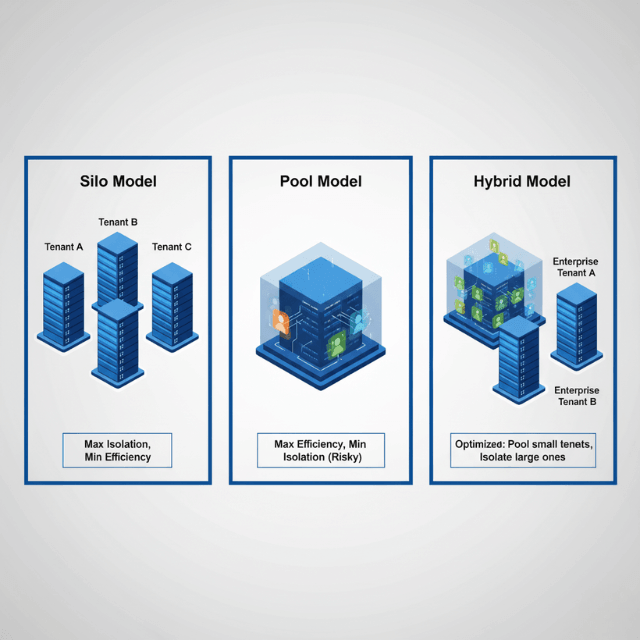
The pool model shares infrastructure across all tenants with application-level isolation. This maximizes resource utilization and cost efficiency but requires sophisticated safeguards preventing one tenant from impacting others.
Most SaaS platforms adopt hybrid approaches, pooling smaller tenants while providing dedicated resources for enterprise customers with specific requirements.
Compute pooling consolidates tenant workloads onto shared compute resources like EKS clusters, Lambda functions, or container services. Application-level routing directs requests to appropriate tenant data while sharing underlying infrastructure. This approach achieves 60-80% cost reduction compared to dedicated instances per tenant.
Database Partitioning Strategies
Database costs often represent 40-60% of SaaS infrastructure expenses, making database architecture a critical optimization focus. Schema-per-tenant approaches create isolated databases or schemas per tenant within shared database instances. This provides strong isolation but complicates management and can lead to resource waste as many small tenants underutilize dedicated capacity.
Shared schema with tenant ID column consolidates all tenant data into shared tables, using tenant identifiers to filter queries. This approach maximizes resource utilization and enables efficient multi-tenant queries but requires rigorous access controls preventing cross-tenant data leakage. Row-level security policies in PostgreSQL or partition pruning in DynamoDB enforce tenant isolation at the database level.
Hybrid approaches assign small tenants to pooled databases while providing dedicated databases for large enterprise customers. This balances cost efficiency for long-tail customers against isolation requirements for premium tenants. Automated tenant placement algorithms assign new tenants to databases based on expected usage, resource availability, and isolation requirements.
Cost Allocation and Chargeback
Accurate cost allocation attributes infrastructure expenses to specific tenants, enabling profitability analysis and informing pricing decisions. Tag all resources with tenant identifiers using cost allocation tags. EC2 instances, RDS databases, S3 buckets, and other resources should include tenant-specific tags for expense tracking.
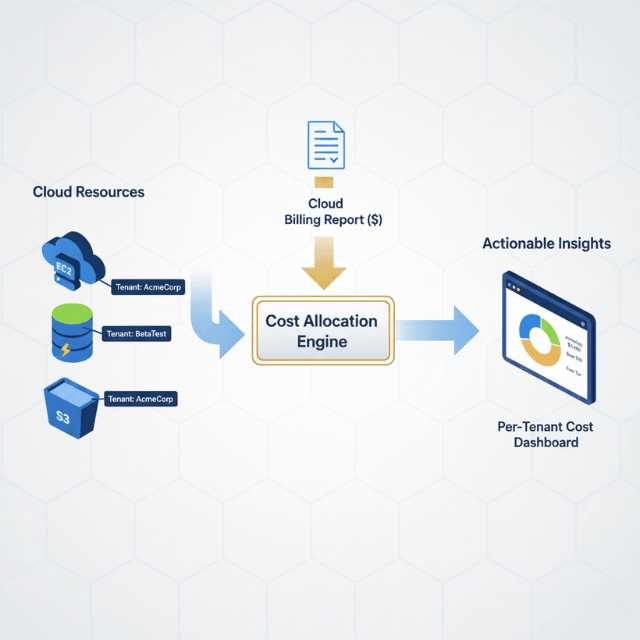
Application-level metering tracks tenant-specific resource consumption including compute time, storage usage, bandwidth consumption, and API calls. Store metering data in time-series databases for analysis and reporting. Calculate per-tenant infrastructure costs by combining cloud provider bills with metering data.
Unit economics analysis determines profitability per tenant or cohort. Compare per-tenant infrastructure costs against revenue to identify unprofitable customers requiring pricing adjustments or usage limits. Target gross margins of 70-85% for healthy SaaS businesses, with infrastructure costs representing 15-30% of revenue.
Resource Pooling Optimization
Kubernetes clusters provide efficient multi-tenant compute through namespaces, resource quotas, and network policies. Deploy shared EKS or GKE clusters with tenant-specific namespaces. Configure resource quotas limiting CPU, memory, and storage per namespace, preventing tenants from consuming disproportionate resources.
Serverless architectures naturally support multi-tenancy through isolated function executions. Lambda functions serve multiple tenants with application-level routing, scaling automatically based on aggregate demand. This approach eliminates capacity planning while providing strong isolation through separate execution environments per invocation.
Database connection pooling reduces overhead from many small tenant connections. Use connection poolers like PgBouncer for PostgreSQL or Amazon RDS Proxy, maintaining connection pools shared across tenants while isolating queries through session management.
Monitoring and Optimization
Per-tenant monitoring tracks resource consumption, performance metrics, and costs. CloudWatch custom metrics or Prometheus gauges capture tenant-specific data including request rates, response times, error rates, and resource utilization. Dashboard tenant metrics to identify anomalies, capacity constraints, and optimization opportunities.
Tenant-tiering strategies provision resources based on customer tier. Free or trial tenants receive minimal resources with aggressive limits. Paid tiers receive proportionally more resources. Enterprise tiers may warrant dedicated infrastructure. Automate tier-based resource allocation to match costs with revenue potential.
Conclusion
Multi-tenant SaaS cost optimization requires balancing resource efficiency against tenant isolation and performance requirements. Hybrid isolation models pool small tenants while isolating large customers, achieving 60-80% cost reduction through shared infrastructure.
Database partitioning strategies consolidate tenant data while maintaining isolation through row-level security or schema separation. Accurate cost allocation tags and application-level metering enable profitability analysis and inform pricing decisions.
Resource pooling through Kubernetes namespaces or serverless architectures maximizes utilization while preventing noisy neighbor problems. Per-tenant monitoring identifies optimization opportunities and capacity constraints. Implement tiered resource provisioning matching infrastructure costs to customer value.
Frequently Asked Questions
Should I use dedicated or shared databases for multi-tenant SaaS?
Use shared databases with tenant ID filtering for small tenants maximizing cost efficiency. Provide dedicated databases for large enterprise customers with compliance requirements, high usage volumes, or customization needs.
Most platforms use hybrid approaches with automated tenant placement based on size and requirements.
How do I prevent noisy neighbor problems in multi-tenant architectures?
Implement resource quotas limiting CPU, memory, and IOPS per tenant. Use rate limiting at application and database levels. Configure auto-scaling policies that add capacity before resource saturation.
Monitor per-tenant resource consumption and implement throttling for tenants exceeding fair share allocations.
What percentage of infrastructure costs should each tenant represent?
Target 15-30% infrastructure cost as percentage of tenant revenue for healthy unit economics. High-value enterprise customers should have lower cost percentages through economies of scale.
Free or trial tenants should be limited to prevent infrastructure costs exceeding potential revenue. Calculate gross margins per cohort to identify unprofitable segments requiring pricing or limit adjustments.
Summarize this post with:
Ready to put this into production?
Our engineers have deployed these architectures across 100+ client engagements — from AWS migrations to Kubernetes clusters to AI infrastructure. We turn complex cloud challenges into measurable outcomes.