Qwen vs DeepSeek vs GLM for RAG: Which Model Is Best for Enterprise Knowledge Bases?
Compare Qwen, DeepSeek and GLM for RAG, including retrieval, long context, citations, reasoning, cost, local deployment and enterprise knowledge bases.

TL;DR
- RAG = retrieval + generation. The LLM is only half the system. Retrieval quality, chunking, and reranking matter as much as the model. Poor retrieval makes any model look bad.
- Qwen – best all-around RAG choice. Multilingual (201+ languages), coding knowledge bases, agentic RAG via Qwen-Agent, flexible private deployment. Strongest starting point.
- DeepSeek – best for reasoning-heavy RAG. 1M context, tool calls, JSON output. Ideal for multi-document comparison, financial analysis, technical research.
- GLM – best for long-context + agentic RAG. GLM-5.2 provides 1M context. Strong for large document collections and knowledge-intensive workflows with multi-step actions.
- Measure citations and grounding – a good RAG system refuses to answer when evidence is insufficient. Citation accuracy matters as much as answer fluency.
- For most enterprises: benchmark Qwen + DeepSeek + GLM on your own documents. Measure retrieval recall, groundedness, latency, and cost per successful answer. A well-designed retrieval pipeline with a smaller model often beats a larger model with poor retrieval.
What Is RAG?
Retrieval-Augmented Generation, or RAG, connects an LLM with an external knowledge source.
Instead of relying entirely on information stored in model parameters, the application retrieves relevant information and provides it to the model when answering a question.
A typical enterprise RAG system may work with:
- Internal documentation
- Product manuals
- Customer records
- Policies
- Contracts
- Technical documentation
- Support tickets
- Databases
- Knowledge bases
The goal is simple:
Give the model the right information at the right time.
That makes model selection only one part of the RAG problem.
The retrieval system, embeddings, reranking, chunking, context construction, and model all affect the final result.
Why Compare Qwen, DeepSeek and GLM for RAG?
Qwen, DeepSeek, and GLM are interesting RAG candidates because their current ecosystems cover different combinations of:
- Reasoning
- Long context
- Tool use
- Structured output
- Coding
- Agentic workflows
- Local inference
Qwen also has an established agent and RAG ecosystem through Qwen-Agent, which provides RAG-related components and supports long-document question answering.
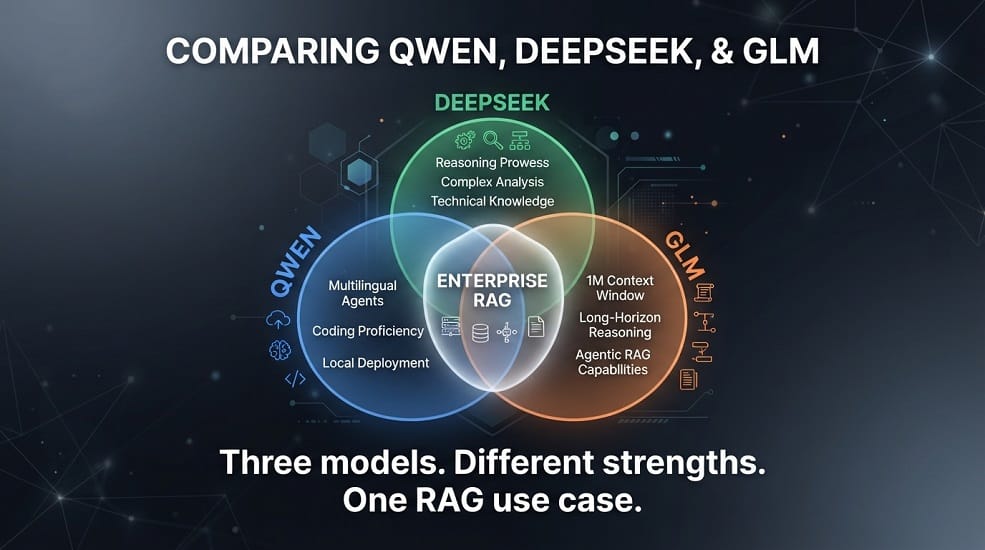
DeepSeek is particularly relevant when retrieved information needs deeper reasoning before producing an answer.
GLM's current generation is increasingly focused on long-horizon tasks and very large context windows, making it a useful candidate for large-document and knowledge-intensive applications. Current GLM-5.2 documentation lists a 1M-token context.
What Makes a Good RAG Model?
A strong RAG model should do more than understand a large context.
It should be good at:
| Feature | Why It Matters |
|---|---|
| Context understanding | Can it understand the retrieved documents accurately? |
| Grounded generation | Does it base the answer on the provided evidence? |
| Retrieval awareness | Can it identify which retrieved information actually matters? |
| Citation handling | Can it connect claims to the correct source? |
| Reasoning | Can it combine information from several retrieved documents? |
| Long‑context processing | Can it handle large amounts of relevant context without losing important details? |
| Structured output | Can it return predictable JSON or other formats for downstream systems? |
| Cost efficiency | Can it provide the required quality without excessive inference cost? |
Qwen for RAG
Qwen is one of the strongest candidates for enterprise RAG because of its broad model ecosystem and tooling.
Its ecosystem includes Qwen-Agent, which supports RAG and long-document question answering. The current Qwen-Agent documentation also describes a fast RAG solution for very long documents and an agent-based alternative.
Qwen can therefore fit several RAG scenarios:
- Internal knowledge assistants
- Technical documentation search
- Enterprise support
- Multilingual knowledge bases
- Developer documentation
- Large repositories
Qwen's RAG Strengths
Qwen is especially attractive when the RAG platform also needs:
- Tool calling
- Coding
- Multilingual understanding
- AI agents
- Local deployment
- Flexible model sizes
That breadth can simplify architecture for teams that want one model family across several AI applications.
DeepSeek for RAG
DeepSeek becomes particularly interesting when the RAG task involves reasoning over retrieved information.
For example, instead of asking:
What does this policy say?
you may need:
Compare these three policies and determine which one applies to this customer scenario.
That requires more than retrieval.
The model needs to:
- Identify relevant evidence.
- Compare multiple pieces of information.
- Resolve conflicts.
- Reason over the retrieved context.
- Produce a defensible answer.
This is where DeepSeek can become especially attractive.
DeepSeek's RAG Strengths
DeepSeek is particularly worth testing for:
- Research assistants
- Technical analysis
- Financial analysis
- Complex enterprise questions
- Multi-document reasoning
- Coding knowledge bases
GLM for RAG
GLM's newer generations are increasingly focused on long-horizon reasoning and large-context workloads.
GLM-5.2 is currently documented with a 1M-token context window, making it particularly interesting for very large document collections and project-level knowledge tasks.
This does not automatically make GLM the best RAG model.
Large context and good retrieval are different capabilities.
But for workloads where large amounts of relevant context genuinely need to be processed together, GLM deserves serious evaluation.
Qwen vs DeepSeek vs GLM for RAG
| Capability | Qwen | DeepSeek | GLM |
|---|---|---|---|
| Context understanding | Excellent | Excellent | Excellent |
| Reasoning over retrieved data | Excellent | Excellent | Excellent |
| Long‑context workloads | Excellent | Excellent | Excellent |
| Structured output | Excellent | Excellent | Excellent |
| Tool use | Excellent | Excellent | Excellent |
| Enterprise RAG | Excellent | Excellent | Excellent |
| Local deployment | Excellent | Strong | Strong |
| Multilingual RAG | Excellent | Strong | Strong |
| Agentic RAG | Excellent | Excellent | Excellent |
This should be treated as a starting evaluation, not a permanent ranking.
RAG Is More Than the LLM
One of the biggest mistakes in RAG projects is blaming the LLM for a retrieval problem.
Consider a simple example.
The correct document exists in the knowledge base, but the retrieval system returns five unrelated documents.
Even an excellent model may produce a poor answer.
That means a RAG system should be evaluated in at least two layers:
Retrieval quality
Did the system find the right information?
Generation quality
Did the model use that information correctly?
Retrieval Quality vs Generation Quality
A useful enterprise benchmark separates:
| Layer | What to Measure |
|---|---|
| Retrieval | Recall, relevance, ranking |
| Context | Completeness, noise |
| Generation | Accuracy, grounding |
| Citations | Source correctness |
| End‑to‑end | Task success |
This makes troubleshooting much easier.
Qwen vs DeepSeek vs GLM: Long Context
Long context can reduce the need to retrieve many smaller chunks, but it should not replace a good retrieval system.
A model may support a million-token context, but sending an entire enterprise knowledge base into every request can create:
- Higher latency
- Higher cost
- More memory consumption
- More irrelevant information
A better approach is often:
retrieve relevant information first, then use the model's context efficiently.
When Long Context Is Useful
Long context is especially valuable for:
- Large contracts
- Technical manuals
- Software repositories
- Research reports
- Complex policy comparisons
- Large project documentation
For these workloads, compare Qwen, DeepSeek, and GLM on:
- Accuracy
- Information retention
- Cross-document reasoning
- Citation correctness
- Latency
- Cost
RAG vs Long Context
These approaches are not necessarily competitors.
A strong system can combine them.
Use retrieval to locate the relevant material.
Then use a large context window to analyze the retrieved material together.
This can be especially useful for complex enterprise questions that require information from multiple related documents.
Best Model for Enterprise RAG
For a new enterprise project, I would start with:
Qwen
When the organization needs a broad, multilingual, agent-capable ecosystem.
DeepSeek
When reasoning over retrieved information is central.
GLM
When large-context and long-horizon knowledge tasks are particularly important.
The final decision should come from a real benchmark using the company's own documents.
Best Model for RAG and Coding
This is an important use case for software organizations.
A developer knowledge assistant may need to search:
- Git repositories
- API documentation
- Architecture documents
- Runbooks
- Tickets
- Deployment guides
Qwen is especially attractive here because its broader coding ecosystem can be combined with RAG and agent capabilities.
DeepSeek is useful when the retrieved information needs deeper technical reasoning.
GLM is worth testing for large project-level context and complex engineering tasks, involving Internal Developer Platform integration and infrastructure as code.
Best Model for Multilingual RAG
For organizations with multilingual knowledge bases, Qwen should be one of the first models tested.
The latest Qwen family has a broad multilingual focus, which can be useful for companies operating across multiple regions.
The evaluation should still use the exact languages and domain vocabulary in your own documents.
Best Model for Private RAG
Private RAG is especially relevant when documents contain:
- Proprietary source code
- Internal financial data
- Customer information
- Contracts
- Confidential research
- Business strategy
In those cases, organizations may prefer private inference.
Possible deployment environments include:
- Local GPU servers
- AWS EC2
- Amazon EKS
- Kubernetes
- vLLM
- SGLang for optimized LLM inference
Qwen's current ecosystem supports multiple local and production serving options, making it particularly convenient for private RAG experimentation.
Qwen vs DeepSeek vs GLM for Retrieval Quality
A strong RAG system starts with retrieval.
If the correct information never reaches the model, even an excellent LLM may produce the wrong answer.
For that reason, evaluate retrieval separately from generation.
The key metrics are:
| Metric | What It Measures |
|---|---|
| Recall | How often the correct information is retrieved |
| Precision | How much retrieved information is actually relevant |
| Ranking | Whether the best chunks appear first |
| Coverage | Whether all necessary evidence is retrieved |
| Noise | How much irrelevant context is included |
Qwen-Agent currently provides built-in RAG capabilities with document parsing, chunking, and retrieval, including BM25-based retrieval in its current documentation.
For a production enterprise system, you may still choose a dedicated retrieval stack with embeddings, vector search, keyword search, and reranking.
Chunking Matters More Than Many Teams Expect
A document needs to be divided into useful pieces before retrieval.
If chunks are too small, you can lose important context.
If chunks are too large, retrieval becomes noisy and expensive.
For example:
| Chunk Strategy | Typical Problem |
|---|---|
| Very small | Missing surrounding context |
| Very large | Too much irrelevant content |
| Fixed‑size | May split logical sections |
| Semantic | More context‑aware, more complex |
The ideal chunk size depends on the documents.
A technical manual may benefit from section-aware chunking.
A legal contract may benefit from clause-based chunks.
A source-code repository may benefit from function, class, and file boundaries rather than arbitrary token lengths.
Qwen for Chunked RAG
Qwen-Agent's current RAG tooling includes configurable chunking and retrieval controls, making it useful for experimentation without building every retrieval component from scratch.
This can be useful for teams developing a proof of concept.
For larger enterprise deployments, however, the retrieval layer should be benchmarked independently of the LLM.
DeepSeek for Retrieved Context
DeepSeek becomes more interesting after retrieval when the task requires reasoning over multiple pieces of evidence.
For example:
Compare the company's 2025 and 2026 refund policies and determine which rule applies to this customer.
The model must not only retrieve the right documents.
It must compare them and reason about their relationship.
DeepSeek's current V4 API supports long context, JSON output, and tool calls, which makes it suitable for reasoning-heavy RAG applications.
GLM for Retrieved Context
GLM is particularly interesting for knowledge-intensive workloads that combine long context with multi-step reasoning.
The current GLM-5.2 release is designed around long-horizon tasks and provides a 1M-token context window, making it relevant to applications that need to analyze large amounts of related material together.
But the same rule applies:
A 1M-token context does not replace good retrieval.
Reranking: An Important Missing Layer
Many enterprise RAG systems use more than one retrieval stage.
The first stage finds potentially relevant chunks.
A reranker then determines which results are most useful.
A common design is:
Keyword + vector retrieval → reranking → LLM
This can reduce the amount of irrelevant context sent to the model.
It also helps control token usage.
Qwen vs DeepSeek vs GLM for Reranked RAG
The LLM should not be expected to solve poor retrieval by itself.
A strong benchmark should compare:
- Top-5 retrieval
- Top-10 retrieval
- Reranked top-5
- Full retrieved context
- Final answer quality
Then measure whether additional retrieved documents actually improve the answer.
Citations and Grounding
Enterprise RAG often needs more than a fluent answer.
Users may need to know:
Where did this answer come from?
A production system should therefore evaluate citation quality.
Useful metrics include:
| Citation Metric | What to Test |
|---|---|
| Citation presence | Did the answer provide sources? |
| Citation correctness | Does the source support the claim? |
| Citation completeness | Are important claims supported? |
| Citation relevance | Is the cited section actually useful? |
The LLM should not receive full credit simply because it produced a citation.
The cited material must actually support the statement.
Qwen for Grounded RAG
Qwen-Agent's RAG implementation formats retrieved knowledge into structured context for the model, which makes source-grounded document QA straightforward to prototype.
For enterprise production, you can preserve document IDs, page numbers, sections, or URLs alongside retrieved chunks so citations can be generated reliably.
DeepSeek for Grounded Reasoning
DeepSeek is particularly worth evaluating when the question requires combining several sources.
For example:
Which product configuration meets all three requirements listed in these documents?
This requires evidence aggregation rather than simple extraction.
DeepSeek's tool and structured-output support can also be useful when the final response needs to fit a downstream enterprise application.
GLM for Large Knowledge Sets
GLM is a strong candidate to test when retrieved information is large and interconnected.
Current GLM-5.2 documentation emphasizes stable 1M-token long-context work, which can be useful when multiple related documents need to be considered together.
Again, the goal should be to keep the context relevant, not simply maximize its size.
Long Context vs Retrieval
This is one of the most important decisions in modern RAG systems.
Retrieval-heavy approach
Retrieve a small amount of highly relevant information.
Advantages:
- Lower cost
- Lower latency
- Less noise
- Easier scaling
Long-context approach
Provide much more source material to the model.
Advantages:
- Less aggressive retrieval
- Easier multi-document analysis
- Useful for highly interconnected documents
The strongest enterprise systems often combine both. In some cases, fine-tuning may also be used alongside RAG to further specialize model behavior for specific domains.
Qwen vs DeepSeek vs GLM for Long-Context RAG
Current DeepSeek V4 models document 1M-token context, while current GLM-5.2 also provides a 1M-token context. Qwen's current ecosystem includes both 256K-class open coding models and larger managed-context options.
The practical winner depends on:
- Quality at long context
- Retrieval quality
- Cost
- Latency
- Memory requirements
- Output accuracy
Structured Output for RAG
Structured output is useful when RAG results feed other software.
For example:
{
  "answer": "The standard warranty is 24 months.",
  "sources": [
    {
      "document": "warranty-policy.pdf",
      "page": 12
    }
  ],
  "confidence": "high"
}
This can be used in:
- CRM systems
- Support platforms
- Compliance applications
- Workflow automation
- Enterprise search
DeepSeek's current API explicitly supports JSON output.
Qwen's broader agent ecosystem also supports structured tool-oriented workflows and context management.
RAG for Enterprise Coding
Coding knowledge bases are a particularly strong use case.
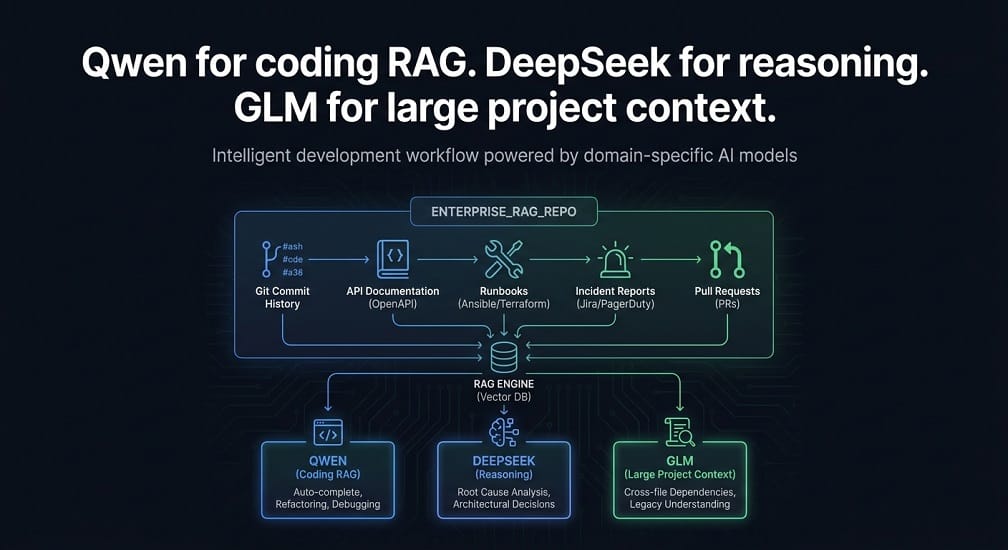
A company might index:
- Git repositories
- API documentation
- Architecture decisions
- Runbooks
- Incident reports
- Infrastructure guides
- Pull requests
Then developers can ask:
Why does this service use this authentication flow?
or:
Where is this API response transformed?
For this use case, evaluate:
- Code retrieval
- Symbol retrieval
- Dependency awareness
- Cross-file reasoning
- Repository freshness
Qwen should be one of the first models tested because its coding ecosystem is closely aligned with repository-level workflows.
DeepSeek should be tested when deeper technical reasoning is important.
GLM is worth testing for long-running engineering questions and larger project context.
RAG for Customer Support
For support systems, prioritize:
- Accuracy
- Grounding
- Speed
- Cost
- Escalation
A smaller model with excellent retrieval can outperform a much larger model if the support knowledge base is well designed.
Qwen is particularly attractive for multilingual support.
DeepSeek may be useful for more complex troubleshooting.
GLM can become useful when the support system also performs multi-step actions.
RAG for Legal and Compliance Documents
Legal RAG requires additional caution.
The system should distinguish between:
- Retrieved evidence
- Model interpretation
- Unsupported assumptions
Test the models on:
- Clause extraction
- Policy comparison
- Contract summarization
- Obligation identification
- Exception handling
Do not evaluate legal RAG only on how fluent the answer sounds.
Source support is essential.
RAG for Financial Analysis
Financial RAG often involves:
- Multiple reports
- Historical documents
- Tables
- Calculations
- Comparisons
DeepSeek is a strong candidate for reasoning-heavy financial workloads.
Qwen is useful when multilingual and broader enterprise functionality matters.
GLM is worth testing where the application also needs multi-step analysis and tool use.
Local RAG Deployment
For organizations that cannot send documents to a third-party API, private RAG is often the preferred architecture.
A private system can use:
- Qwen
- DeepSeek
- GLM
- Local embeddings
- Vector database
- Reranker
- vLLM
- Kubernetes
Qwen-Agent can also run with Qwen models served through local OpenAI-compatible inference endpoints such as vLLM and SGLang.
This makes it useful for testing private RAG architectures before moving to a larger enterprise platform.
RAG Cost Optimization
RAG costs are influenced by:
- Embedding generation
- Retrieval infrastructure
- Reranking
- Input tokens
- Output tokens
- Context size
- Number of model calls
A simple optimization is to reduce irrelevant context.
For example:
10,000 irrelevant tokens
can be much more expensive than:
2,000 highly relevant tokens
even if both requests produce the same final answer.
Evaluate Cost Per Grounded Answer
Instead of only measuring token price, use:
Total RAG cost ÷ successful grounded answers
This includes:
- Retrieval
- Reranking
- Model inference
- Retries
For enterprise buyers, this is much more useful than comparing model token prices in isolation.
Qwen vs DeepSeek vs GLM: RAG Scorecard
| RAG Capability | Qwen | DeepSeek | GLM |
|---|---|---|---|
| General RAG | Excellent | Excellent | Excellent |
| Reasoning over documents | Excellent | Excellent | Excellent |
| Long‑context analysis | Excellent | Excellent | Excellent |
| Multilingual RAG | Excellent | Strong | Strong |
| Coding knowledge bases | Excellent | Excellent | Excellent |
| Agentic RAG | Excellent | Excellent | Excellent |
| Structured output | Excellent | Excellent | Excellent |
| Local RAG | Excellent | Strong | Strong |
| Enterprise RAG | Excellent | Excellent | Excellent |
These ratings are best treated as a shortlisting guide.
Your own documents and queries should determine the production winner.
Practical Recommendation
Choose Qwen first when:
Your RAG system needs multilingual support, coding knowledge, agent functionality, and flexible private deployment.
Choose DeepSeek first when:
Your documents require substantial reasoning, comparison, technical analysis, or complex inference.
Choose GLM first when:
The RAG application involves very large context, long-running tasks, or agentic actions after retrieval.
Consider a Multi-Model RAG System when:
Different document types or queries require different model strengths.
For example, a company might use a faster model for simple FAQ retrieval and a stronger reasoning model for difficult research questions.
Which RAG Model Should an Enterprise Choose?
There is no universal winner between Qwen, DeepSeek, and GLM.
The best choice depends on the type of knowledge base, language requirements, reasoning complexity, context size, deployment model, and budget.
For most enterprise projects, the strongest starting shortlist is:
Qwen + DeepSeek + GLM
Then evaluate them using the company's real documents and questions.
Best RAG Model for Different Enterprise Use Cases
| Use Case | Best Starting Choice |
|---|---|
| General enterprise knowledge base | Qwen |
| Multilingual RAG | Qwen |
| Technical documentation | Qwen / DeepSeek |
| Complex document reasoning | DeepSeek |
| Financial analysis | DeepSeek |
| Coding knowledge base | Qwen |
| Agentic RAG | Qwen / GLM |
| Large‑context research | GLM / DeepSeek |
| Private RAG | Qwen / Llama / Mistral / DeepSeek |
| Cost‑sensitive RAG | Smaller Qwen / DeepSeek model |
| Enterprise‑scale RAG | Benchmark all three |
These are starting recommendations, not permanent rankings.
Best RAG Model for Customer Support
Customer-support RAG usually needs:
- Fast answers
- Accurate retrieval
- Grounded responses
- Policy compliance
- Multilingual support
- Escalation handling
For this workload, a smaller model may be more economical than a flagship reasoning model.
Qwen is a strong first candidate for multilingual support and broad knowledge-base applications.
DeepSeek becomes more attractive when support questions require complex troubleshooting.
GLM is worth testing when the support application must also perform multi-step actions.
The key metric is not model intelligence alone.
Measure:
correct answer rate + grounded answer rate + escalation accuracy + cost per conversation
Best RAG Model for Financial Services
Financial RAG can involve:
- Annual reports
- Earnings documents
- Regulatory filings
- Internal policies
- Market research
- Financial statements
The model needs to compare information across documents while avoiding unsupported conclusions.
DeepSeek is particularly worth testing for reasoning-heavy analysis.
Qwen is useful when the organization needs broader multilingual or enterprise functionality.
GLM can be tested where research and agentic workflows are combined.
For financial RAG, also evaluate numerical accuracy separately.
A fluent answer containing the wrong number is still a failed answer.
Best RAG Model for Legal Documents
Legal RAG requires strong grounding.
Test:
- Clause identification
- Contract comparison
- Policy interpretation
- Obligation extraction
- Exceptions
- Document references
A good legal RAG system should distinguish clearly between:
what the document says
and:
what the model infers
The evaluation should therefore score source support, not just answer quality.
Best RAG Model for Healthcare and Sensitive Data
For highly sensitive information, model capability is only one consideration.
The deployment environment becomes equally important.
Enterprises may require:
- Private inference
- Network isolation
- Encryption
- Access control
- Audit logging
- Data-retention policies
- Regional deployment
The exact compliance requirements depend on the country, industry, data type, and organization.
In such environments, a slightly stronger public API may be less attractive than a model that can be securely deployed inside the company's controlled environment.
Best RAG Model for Software Engineering
Software companies can build RAG systems around:
- Git repositories
- API documentation
- Architecture documents
- Pull requests
- Incident reports
- Runbooks
- Infrastructure configuration
Qwen is a particularly strong candidate because its coding and agent capabilities complement repository knowledge retrieval.
DeepSeek is useful for technical reasoning over the retrieved material.
GLM is worth evaluating for larger software-engineering tasks that require extended context and multi-step reasoning.
Private RAG vs Hosted API
The deployment decision should be made separately from the model decision.
Hosted API
Best when:
- Traffic is still uncertain
- Development speed matters
- The business does not want to manage GPUs
- The application is still being validated
Private RAG
Best when:
- Documents are highly sensitive
- Data residency matters
- The workload is predictable
- The company needs infrastructure control
- Custom inference is required
A hybrid strategy can also make sense.
For example, teams can use managed APIs during experimentation and introduce private inference for sensitive or high-volume workloads.
Hardware Requirements for RAG
RAG usually adds less memory pressure than simply sending enormous documents directly to an LLM, because the retrieval system can control how much context reaches the model.
Hardware still depends on:
- Model size
- Precision
- Context
- Concurrent requests
- Output length
A smaller RAG model may run comfortably on one GPU.
A large reasoning model may require high-memory GPUs or multi-GPU inference.
For production, benchmark the model using the expected context length rather than the maximum advertised context.
Qwen vs DeepSeek vs GLM RAG Cost
RAG cost has multiple components.
| Cost Component | Example |
|---|---|
| Embeddings | Indexing documents |
| Retrieval | Vector or hybrid search |
| Reranking | Improving document relevance |
| Inference | LLM generation |
| Storage | Documents and indexes |
| Networking | API and data transfer |
| Monitoring | Logs and metrics |
| Retries | Failed requests |
This means model token pricing is only part of the total cost.
How to Reduce RAG Costs
The easiest optimization is usually to improve the context sent to the model.
Instead of passing:
20,000 tokens of mixed information
try to retrieve:
3,000 tokens of highly relevant information
This can improve:
- Latency
- Cost
- Answer quality
- Context efficiency
Other useful optimizations include:
- Semantic chunking
- Hybrid retrieval
- Reranking
- Query rewriting
- Metadata filtering
- Context compression
- Caching
- Smaller models for simple questions
Use Different Models for Different RAG Queries
Not every question needs the same amount of reasoning.
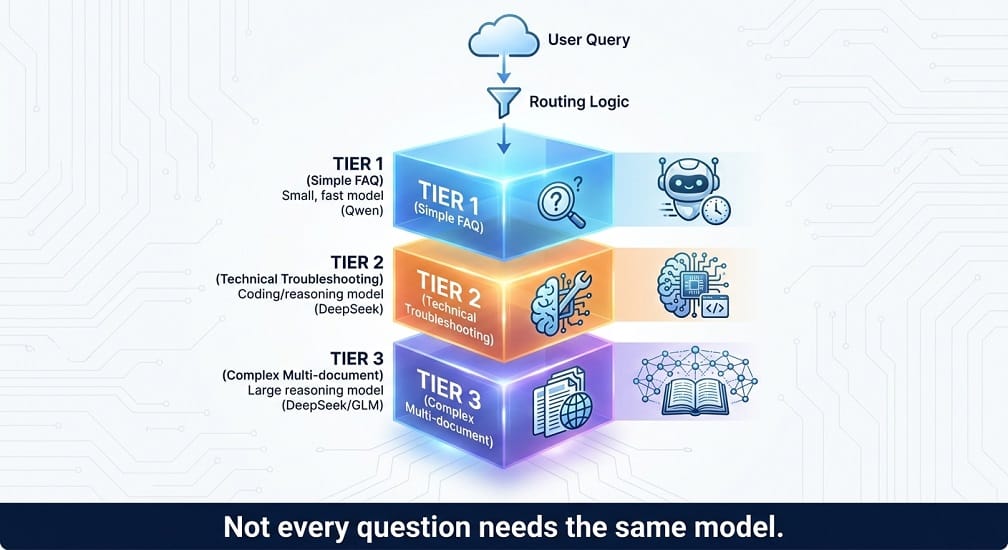
For example:
Simple FAQ
Use a smaller, faster model.
Technical troubleshooting
Use a stronger coding or reasoning model.
Complex multi-document analysis
Use a large reasoning model.
This can make an enterprise RAG platform significantly more economical.
RAG Evaluation Framework
Before selecting Qwen, DeepSeek, or GLM, create a benchmark with real company questions.
A useful evaluation set should contain:
| Category | Suggested Tests |
|---|---|
| Simple lookup | 20 |
| Multi‑document reasoning | 20 |
| Summarization | 10 |
| Comparison | 10 |
| Technical questions | 10 |
| Edge cases | 10 |
| Unanswerable questions | 10 |
The inclusion of unanswerable questions is extremely important.
A strong RAG system should know when the documents don't contain enough information.
RAG Metrics to Measure
| Metric | Definition |
|---|---|
| Retrieval Recall | Did the system retrieve the required information? |
| Context Precision | How much of the retrieved information was actually relevant? |
| Answer Accuracy | Did the model answer correctly? |
| Groundedness | Can the answer be supported by the retrieved evidence? |
| Citation Accuracy | Do cited sources actually support the claims? |
| Refusal Accuracy | Does the model avoid inventing an answer when evidence is missing? |
| Latency | How long does the complete RAG request take? |
| Cost | How much does each successful answer cost? |
Qwen vs DeepSeek vs GLM RAG Scorecard
A practical scorecard can look like this:
| Metric | Qwen | DeepSeek | GLM |
|---|---|---|---|
| Retrieval‑aware answering | Test | Test | Test |
| Multi‑document reasoning | Test | Test | Test |
| Groundedness | Test | Test | Test |
| Citation accuracy | Test | Test | Test |
| Long‑context performance | Test | Test | Test |
| Multilingual RAG | Test | Test | Test |
| Structured output | Test | Test | Test |
| Latency | Test | Test | Test |
| Cost per answer | Test | Test | Test |
This is more useful than assigning arbitrary scores without testing the company's own data.
Common RAG Mistakes
Using the LLM as the Retrieval System
The model should not be expected to search thousands of documents by itself.
Use a dedicated retrieval layer.
Poor Chunking
Bad chunk boundaries can hide important information from the model.
No Reranking
A broad initial search may return relevant material too far down the ranking.
Too Much Context
More text doesn't automatically mean a better answer.
No Citation Validation
A citation is only useful when it actually supports the statement.
No Unanswerable Tests
A system that always answers can create dangerous hallucinations.
Choosing a Model Before Testing Retrieval
A poor retrieval system can make every model look bad.
Should You Use Qwen, DeepSeek or GLM?
Choose Qwen when:
You need a broad RAG platform with multilingual support, coding, agents, and flexible private deployment.
Choose DeepSeek when:
The RAG workload depends heavily on reasoning, analysis, technical research, or complex comparison.
Choose GLM when:
The application needs large-context reasoning combined with agentic or long-running workflows.
Use multiple models when:
Your RAG platform serves very different types of questions and a single model would create unnecessary cost or latency.
EaseCloud Recommendation for Enterprise RAG
At EaseCloud, the model should be evaluated together with the complete RAG platform.
That includes:
- Document processing
- Embeddings
- Vector search
- Hybrid retrieval
- Reranking
- Model serving
- GPU infrastructure
- AWS architecture
- Amazon EKS
- vLLM
- Monitoring
- MLOps
- LLMOps
- Cost optimization
The objective is to deliver a RAG platform that is:
accurate, grounded, private, scalable, and economically sustainable.
Final Verdict
For most organizations, start with Qwen, DeepSeek, and GLM rather than choosing one immediately.
Qwen
Best all-around starting point for enterprise RAG
Particularly strong for multilingual, coding, agentic, and private RAG workloads.
DeepSeek
Best candidate for reasoning-heavy RAG
Especially useful for technical, financial, research, and multi-document analysis.
GLM
Best candidate for long-context and agentic RAG
Especially relevant when retrieval is followed by complex multi-step actions.
But the final winner should be determined by:
retrieval quality + groundedness + answer accuracy + citation accuracy + latency + cost
The LLM is only one part of the system.
For an enterprise RAG deployment, a well-designed retrieval pipeline paired with a smaller, efficient model can easily outperform a much larger model connected to poor retrieval.
Frequently Asked Questions
Is Qwen good for RAG?
Yes. Qwen is a strong choice for enterprise RAG, particularly multilingual, coding, agentic, and private knowledge applications.
Is DeepSeek good for RAG?
Yes. DeepSeek is particularly worth testing when RAG questions require complex reasoning over multiple sources.
Is GLM good for RAG?
Yes. GLM is a strong candidate for large-context and agentic knowledge applications.
Which is better for RAG: Qwen or DeepSeek?
Qwen is the stronger broad starting point, while DeepSeek can be particularly attractive for reasoning-heavy RAG.
Which model is best for enterprise RAG?
Start by benchmarking Qwen, DeepSeek, and GLM with your own documents and questions.
Is long context better than RAG?
Not necessarily. RAG can reduce irrelevant context and cost, while long context can be valuable when several related documents need to be analyzed together.
Can I run Qwen, DeepSeek, or GLM for RAG locally?
Yes, supported models can be deployed locally or privately depending on the exact model, hardware, and inference framework.
Should I use an API or self-host my RAG model?
Use an API for quick experimentation and unpredictable workloads. Consider self-hosting for sensitive data, predictable high usage, and greater infrastructure control.