Why Founders Make Costly AWS Decisions Early (And How to Avoid Them)
Learn why founders overspend on AWS early and discover practical strategies to avoid costly cloud mistakes that drain runway and limit growth.
TLDR;
- Early AWS decisions persist for years and can shorten runway by months
- Common mistakes: Overbuilding for scale you don't have, no cost visibility, convenience over flexibility, set-and-forget mindset
- Avoid them: Stage-appropriate architecture, cost monitoring from day one, monthly reviews in year one
Every founder wants to move fast. But speed without strategy on AWS creates technical debt that compounds faster than credit card interest. The decisions you make in your first months on AWS often determine whether your cloud costs scale linearly with revenue or spiral out of control.
This guide breaks down the most common AWS mistakes founders make early and provides actionable strategies to build cloud infrastructure that enables growth rather than limiting it. Whether you run a pre-seed startup or have just closed your Series A, these principles will help you spend smarter on AWS.
Why Early AWS Decisions Matter More Than Founders Expect
Cloud architecture decisions made in the first six months tend to persist for years. According to Flexera's 2024 State of the Cloud Report, organisations waste an average of 28% of their cloud spend due to poor planning and lack of optimisation.
For startups, this waste eats directly into runway. A founder who burns an extra EUR 3,000 monthly on unnecessary AWS services has effectively shortened their runway by three months over a year. These early shortcuts become long-term constraints that require significant engineering effort to unwind.

The relationship between cost and architecture runs deep. Choosing the wrong database engine, over-provisioning compute resources, or ignoring data transfer costs in your initial design creates patterns that become harder to change as your application grows.
The Pressure Founders Face When Choosing AWS Early
Speed-to-market pressure drives most early infrastructure decisions. When you need to ship a feature by Friday, architectural elegance takes a back seat. This urgency is rational in the short term but costly over time.
Most founders lack deep cloud expertise when they start. According to AWS's own documentation on startup best practices, even experienced developers often underestimate the complexity of production cloud environments. The default settings and quick-start guides optimise for getting something running, not for cost efficiency.
Over-reliance on defaults creates hidden costs. AWS services often launch with configurations that prioritise reliability over economy. Without active management, these defaults quietly consume budget.
Common Costly AWS Decisions Founders Make Early
Overbuilding Infrastructure Too Soon
The temptation to design for future scale is powerful. Founders imagine millions of users and provision accordingly. But according to [research from a](<a href=) startup post-mortem analysis, 90% of startups fail, and many never need the infrastructure they built.
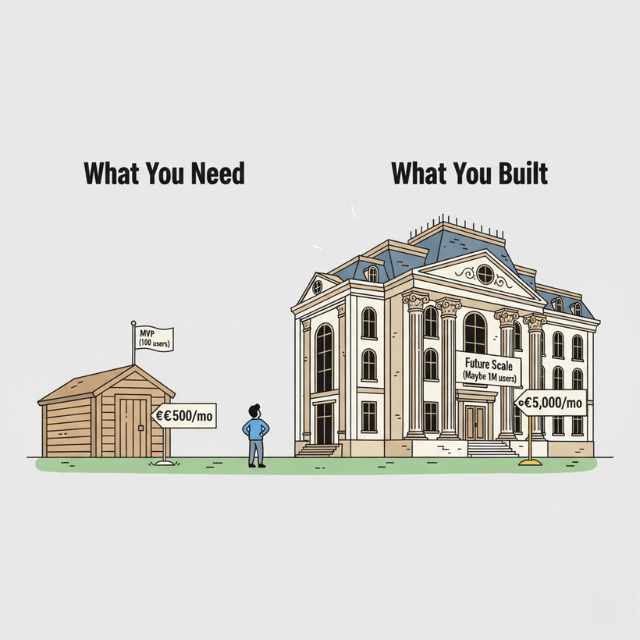
Designing for scale you do not have means paying for capacity you do not use. Running a multi-region setup with auto-scaling groups for an application serving 100 daily active users wastes thousands monthly. Start with the simplest architecture that serves your current users, then evolve as traffic justifies the investment.
Ignoring Cost Visibility from Day One
Many founders treat AWS billing as an afterthought. They discover their spend only when the credit card statement arrives or when AWS credits expire. Without budgets, alerts, or ownership of cloud spend, costs drift upward unnoticed.
AWS Cost Explorer and Budgets are free tools that provide this visibility. Yet according to CloudHealth by VMware research, fewer than 40% of organisations actively use cost management tools during their first year of cloud adoption.
Choosing Convenience Over Long-Term Flexibility
Rushed service choices create vendor lock-in. Using a managed service because it was the first search result, without considering alternatives, can leave you dependent on expensive proprietary solutions.
Hard-to-change architectures emerge from these decisions. A database choice made in week two might require months of migration work later. Evaluate exit costs and portability before committing to services that store your data.
Treating AWS as a Set-and-Forget Platform
Cloud infrastructure requires ongoing attention. Without regular review cycles, unused resources accumulate, pricing changes go unnoticed, and optimisation opportunities slip by.
An optimisation mindset means scheduling quarterly reviews of your AWS spend. Check for idle resources, evaluate Reserved Instance opportunities, and assess whether your current architecture still fits your needs.
How These Decisions Hurt as the Startup Grows
Escalating AWS bills create cash flow problems. When costs grow faster than revenue, every board meeting becomes a conversation about infrastructure instead of product and growth.
Scaling bottlenecks emerge from early architectural decisions. The quick database setup that worked at launch becomes the constraint that limits your ability to handle new customers. According to Gartner's infrastructure research, poorly planned cloud architecture is a leading cause of performance issues during growth phases.
Reduced runway means reduced flexibility. Every euro spent on inefficient infrastructure is a euro not spent on hiring, marketing, or product development. For European startups navigating uncertain funding environments, this efficiency matters more than ever.
What a Smart AWS Strategy Looks Like for Founders
Stage-appropriate architecture matches your infrastructure to your current reality. A pre-revenue startup needs different infrastructure than a company processing thousands of transactions daily. Build for today with clear migration paths for tomorrow.
Cost-aware decision-making means considering price in every architectural discussion. When evaluating services, compare not just features but total cost of ownership including data transfer, storage, and scaling costs.
Planning for change rather than perfection acknowledges that your first architecture will evolve. Design systems that can be modified without complete rebuilds. Use infrastructure as code from the start to make changes manageable.
Founder-Friendly Principles for Early AWS Strategy
Start simple and measure everything. Launch with the minimum viable infrastructure and instrument it thoroughly. You cannot optimise what you do not measure. AWS CloudWatch provides the baseline monitoring every startup needs.
Optimise for learning, not scale. Your early infrastructure should help you understand your workload patterns. These insights inform better architectural decisions when you actually need to scale.
Revisit decisions regularly. Schedule monthly reviews in your first year, then quarterly thereafter. What made sense three months ago may not fit your current situation.
When Founders Should Rethink Their AWS Strategy
Costs rising faster than revenue is the clearest signal. If your AWS bill doubles while your user count stays flat, something needs investigation.
Frequent performance issues indicate architectural limitations. When your team spends more time fighting fires than building features, your infrastructure has become a constraint rather than an enabler.
Engineering time lost to infrastructure management suggests over-complexity. If your developers spend significant hours on DevOps tasks despite using managed services, your architecture may need simplification.
How EaseCloud Helps Founders Make Smarter AWS Decisions
EaseCloud provides founder-focused AWS strategy sessions tailored to early-stage startups. We understand the constraints you face: limited budget, small teams, and pressure to ship quickly.
Our cost and architecture reviews identify immediate savings and long-term risks in your current setup. We have helped European startups reduce AWS costs by 30-50% while improving reliability.
Ongoing advisory support means you have an expert to consult when making architectural decisions. Rather than guessing or copying what larger companies do, you get guidance specific to your stage and needs.
Final Thoughts
Early AWS decisions should enable growth, not limit it. The infrastructure you build today becomes the foundation for everything you build tomorrow.
The most successful founders treat cloud strategy as a business discipline, not just a technical task. They maintain visibility into costs, question default configurations, and revisit decisions as their needs evolve.
If your AWS setup has grown organically without strategic oversight, now is the time to assess it. A few hours of review can save months of runway and position your startup for sustainable growth.
Contact EaseCloud for a free AWS strategy assessment for founders.
FAQs
Why do founders overspend on AWS early?
Founders overspend because they optimise for speed rather than cost, lack cloud-specific expertise, and often accept default configurations that prioritise reliability over economy. Without active cost management, spending drifts upward.
Can early AWS mistakes be fixed later?
Yes, but the cost increases with time. Database migrations, service changes, and architectural refactoring become more complex as applications grow. Fixing issues early costs less than fixing them at scale.
Should non-technical founders be involved in AWS decisions?
Absolutely. AWS costs directly impact runway and business metrics. Non-technical founders should understand cost drivers and participate in decisions about budget allocation and service selection, even if they delegate implementation details.
When should founders revisit AWS strategy?
Review your AWS strategy when costs rise faster than revenue, when approaching fundraising milestones, after significant product changes, or at minimum quarterly during rapid growth phases.
Is AWS consulting worth it for early-stage startups?
For most startups, yes. The cost of a strategy session is typically recovered within one to two months through identified savings. More importantly, good advice prevents costly mistakes that would take significant engineering effort to fix later.
Summarize this post with:
Ready to put this into production?
Our engineers have deployed these architectures across 100+ client engagements — from AWS migrations to Kubernetes clusters to AI infrastructure. We turn complex cloud challenges into measurable outcomes.