The Signs Your Startup Is Missing Technical Leadership
Spot warning signs your startup lacks technical leadership. Learn why gaps appear and how to fix them before they hurt growth.
TLDR;
- Warning signs: Reactive decisions, no team direction, recurring delivery/reliability problems
- Gaps compound into: Slower delivery, rising costs, tech debt, team churn
- Signs are often visible early if you look
- Fill the gap: Full-time CTO, fractional leadership, or external advisors (depends on stage/budget)
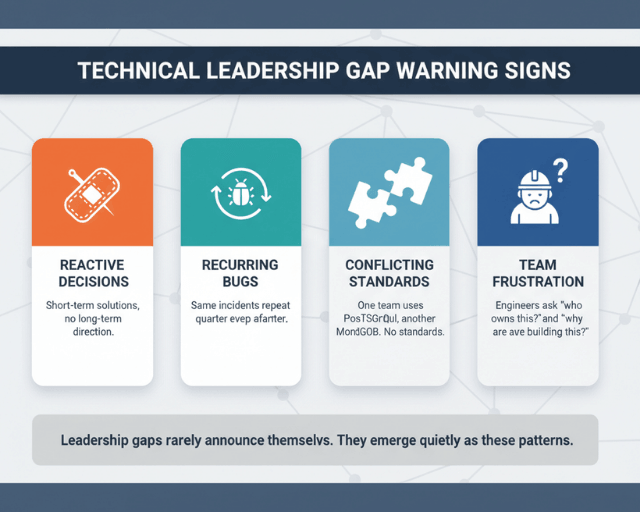
Technical leadership gaps rarely announce themselves. They emerge quietly as missed deadlines, recurring bugs, and rising frustration among engineers. By the time founders recognize the problem, months of momentum have already been lost.
For European startups navigating strict data regulations and competitive markets, strong technical leadership separates those that scale from those that stall. This article examines the warning signs that your startup lacks technical leadership and what you can do about it.
Why Technical Leadership Gaps Appear in Growing Startups
Most startups begin without formal technical leadership. Founders code alongside early engineers, decisions happen in real-time, and speed trumps structure. This works when teams are small and products are simple.
Problems emerge during growth. According to McKinsey research on scaling startups, companies that fail to develop management capabilities during rapid growth face a 60% higher chance of stalling within two years. The same study found that technical leadership gaps were among the top three reasons engineering teams underperform.
Fast early growth stretches founders thin. Engineering problems that once took a quick conversation now require coordination across teams. Technical decisions accumulate without clear ownership, and ad-hoc approaches that worked at five people break down at fifteen.
What Technical Leadership Actually Means
Technical leadership is not the same as being a skilled engineer. A technical leader owns decisions, sets direction, and aligns engineering work with business goals.
According to the Harvard Business Review analysis of tech company leadership, effective technical leaders spend 40% of their time on strategy and alignment rather than hands-on coding. They translate business requirements into technical roadmaps and manage trade-offs between speed, quality, and cost.
Technical leadership includes three core responsibilities:
- Decision ownership. Someone must have final authority on technical choices. Without this, teams debate endlessly or make conflicting decisions.
- Technical direction and trade-offs. Every startup faces choices between building fast and building well. Technical leaders define when to take shortcuts and when to invest in quality.
- Alignment between product, engineering, and business. Technical leaders bridge communication gaps and prevent engineering from operating in isolation.
Clear Signs Your Startup Lacks Technical Leadership
Technical Decisions Are Reactive and Short-Term
When no one owns technical direction, teams solve immediate problems without considering long-term impact. Every decision becomes a quick fix.
Gartner research on IT decision-making shows that organizations without clear technical governance spend 28% more time revisiting decisions and 35% more on rework. Symptoms include fixing the same bugs repeatedly, choosing tools based on familiarity rather than fit, and building features that conflict with existing architecture.
Watch for engineering discussions that focus exclusively on "how do we ship this week" without asking "how does this affect us in six months."
Engineering Teams Lack Direction or Alignment
Without technical leadership, engineers make independent choices that diverge over time. One team uses PostgreSQL while another chooses MongoDB. Code styles vary. Testing approaches differ.
This creates friction as teams integrate their work. Engineers spend hours resolving conflicts that better coordination would prevent. Priorities shift weekly based on whoever speaks loudest, and teams struggle to answer basic questions about technical standards.
Delivery and Reliability Problems Keep Repeating
Recurring incidents signal leadership gaps. If your system experiences the same outages, performance issues, or security vulnerabilities quarter after quarter, no one is owning systemic improvement.
Strong technical leadership implements post-incident reviews and follows through on prevention. Without this ownership, teams move to the next urgent task without addressing root causes.
How Leadership Gaps Impact Growth and Execution
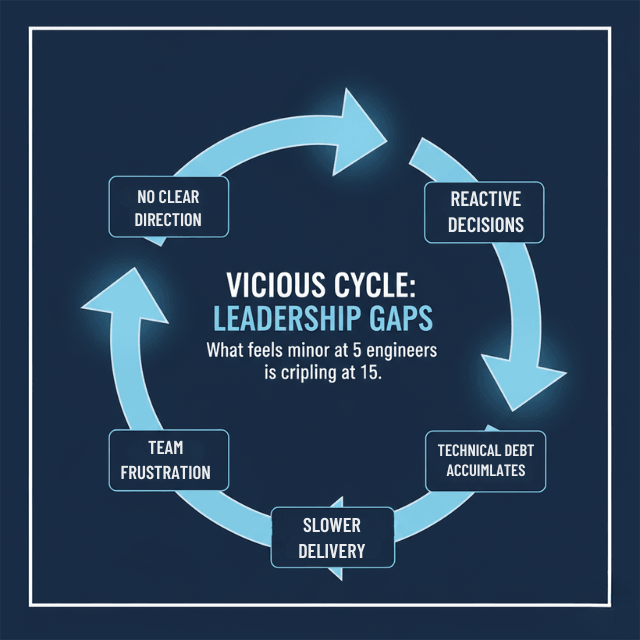
Leadership gaps compound over time. Stripe's 2023 Developer Productivity Report found that inefficient development practices cost companies an average of 42 days per developer per year. Much of this waste traces back to poor technical governance.
Slower product delivery. Without clear priorities and standards, teams work harder but produce less. Features take longer. Releases slip.
Rising costs and technical debt. Quick fixes accumulate. Infrastructure costs. Cloud bills grow faster than revenue.
Team frustration and churn. Engineers leave when they cannot see direction or feel their concerns are ignored. Replacing them costs 50-200% of annual salary according to SHRM retention research.
Why Founders Often Miss Technical Leadership Gaps
Founders underestimate leadership gaps because output still happens. Features ship. The product works. Revenue grows.
The hidden cost appears in how much more effort each achievement requires. Problems get framed as "engineering issues" rather than leadership failures. Founders respond by hiring more engineers instead of establishing better direction.
Hiring alone cannot solve leadership gaps. Adding engineers to a poorly led team increases complexity without improving outcomes. Brooks's Law, first documented in "The Mythical Man-Month," still holds: adding people to a late project makes it later.
When a Startup Usually Needs Stronger Technical Leadership
Most startups need dedicated technical leadership between Series A and Series B, though the trigger is team size rather than funding stage.
Post-MVP growth:
- Once your product has paying customers and a roadmap beyond the initial version
- Technical decisions require longer-term thinking
Team expansion:
- When engineering grows beyond 8-10 people
- Coordination becomes a full-time challenge
- Someone must own standards, priorities, and cross-team alignment
Infrastructure and cost complexity:
- European startups face particular challenges with data residency requirements under GDPR regulations
- Technical leadership ensures compliance is built into architecture rather than bolted on later
Options for Filling the Technical Leadership Gap
| Option | Description | Timeline/Cost Considerations |
|---|---|---|
| Hiring a full-time CTO | Traditional approach | Expect 4-6 months to find and onboard the right person. Works when you have budget, time to recruit, and enough work to justify a senior hire |
| Fractional or interim leadership | Experienced technical leaders who work part-time or for defined periods | Provides senior expertise without full-time cost. Can bridge the gap while searching for a permanent hire |
| External technical advisors | Regular advisory sessions | For startups not yet ready for dedicated leadership. Provides strategic input without operational involvement |
How EaseCloud Helps Close Technical Leadership Gaps
EaseCloud acts as a strategic technical partner for European startups navigating growth challenges. Rather than replacing your team, we supplement it with experienced leadership and hands-on support.
Our approach focuses on three areas:
Strategic technical partnership:
- Work alongside founders and engineering teams to set direction, define standards, and make decisions with confidence
Supporting teams during transitions:
- Provide stability and expertise during uncertain periods (e.g., searching for a CTO or scaling rapidly)
Providing clarity without overhead:
- Senior technical guidance without the commitment and cost of a full-time executive hire
Final Takeaway
Leadership gaps hurt more than skill gaps. A team of talented engineers without direction will underperform a smaller team with clear ownership and aligned priorities.
The signs are often visible early: reactive decisions, recurring problems, conflicting standards, and rising frustration. Recognizing these patterns is the first step toward fixing them.
Strong technical leadership provides the foundation for sustainable growth. Whether through a full-time hire, fractional support, or strategic partnership, addressing leadership gaps should be a priority for any startup serious about scaling.
Ready to Close Your Technical Leadership Gap?
You've recognized the signs. Now take the next step.
EaseCloud helps European startups like yours build technical leadership without the overhead of full-time executive hires.
What you get:
- Fractional CTO guidance – Strategy, direction, decision ownership
- Production-ready infrastructure – Scalable, secure, GDPR-compliant
- Team support – During hiring, transitions, and rapid scaling
- 24/7 monitoring – We watch your systems so you don't have to
FAQs
When should a startup hire a CTO?
Most startups benefit from dedicated technical leadership when engineering teams reach 8-10 people or when technical decisions regularly require trade-offs between competing priorities.
Can startups succeed without technical leadership?
Very small teams with experienced technical founders can operate without formal leadership temporarily. Beyond the early stage, lack of leadership creates compounding problems.
What is the difference between senior engineers and technical leaders?
Senior engineers excel at solving technical problems. Technical leaders own decisions, set direction, and align engineering with business goals. The skills overlap but are not identical.
Is fractional technical leadership effective?
Yes, particularly for startups between stages. Fractional leaders provide experienced guidance without full-time cost and can bridge gaps during hiring or rapid growth.
How do founders evaluate technical leadership needs?
Start with an honest assessment of decision ownership, recurring problems, and team alignment. If no one clearly owns technical direction, or the same issues resurface repeatedly, leadership investment is overdue.
Summarize this post with:
Ready to put this into production?
Our engineers have deployed these architectures across 100+ client engagements — from AWS migrations to Kubernetes clusters to AI infrastructure. We turn complex cloud challenges into measurable outcomes.