Cost Optimization vs Feature Development: A CEO's Tradeoff
A CEO framework for balancing cost optimization and feature development. Learn when to prioritize each, and how cloud costs affect this strategic decision.
TLDR;
- Don't choose — balance cost optimization and features based on stage
- Early stage: Prioritize features while finding product-market fit
- Growth stage: Find high-leverage wins (reserved instances, right-sizing) with minimal engineering effort
- Always protect core product velocity regardless of cost pressure
Every startup CEO faces the same resource allocation question: should engineering time go toward building new features or optimizing existing costs? Both paths have merit. Both have risks.
The wrong choice at the wrong time can damage your competitive position or drain your runway. European B2B founders must navigate this decision while managing additional regulatory overhead and market-specific requirements.
This guide provides a framework for making these calls strategically rather than reactively.
Why This Tradeoff Defines Startup Survival
Startups operate with limited resources and competing priorities. Engineering capacity represents your most constrained asset.
Every sprint spent on infrastructure optimization is a sprint not spent on customer-requested features. Every feature sprint that ignores mounting costs accelerates burn.
Pressure comes from multiple directions simultaneously. Customers want new capabilities. Investors want growth metrics.
Your CFO wants sustainable unit economics. Sales wants competitive feature parity. These demands conflict, and you cannot satisfy all of them.
According to CB Insights analysis, running out of cash remains the second most common reason startups fail. Long-term impact on runway and growth makes this tradeoff existential rather than merely operational.
What Cost Optimization and Feature Development Really Represent
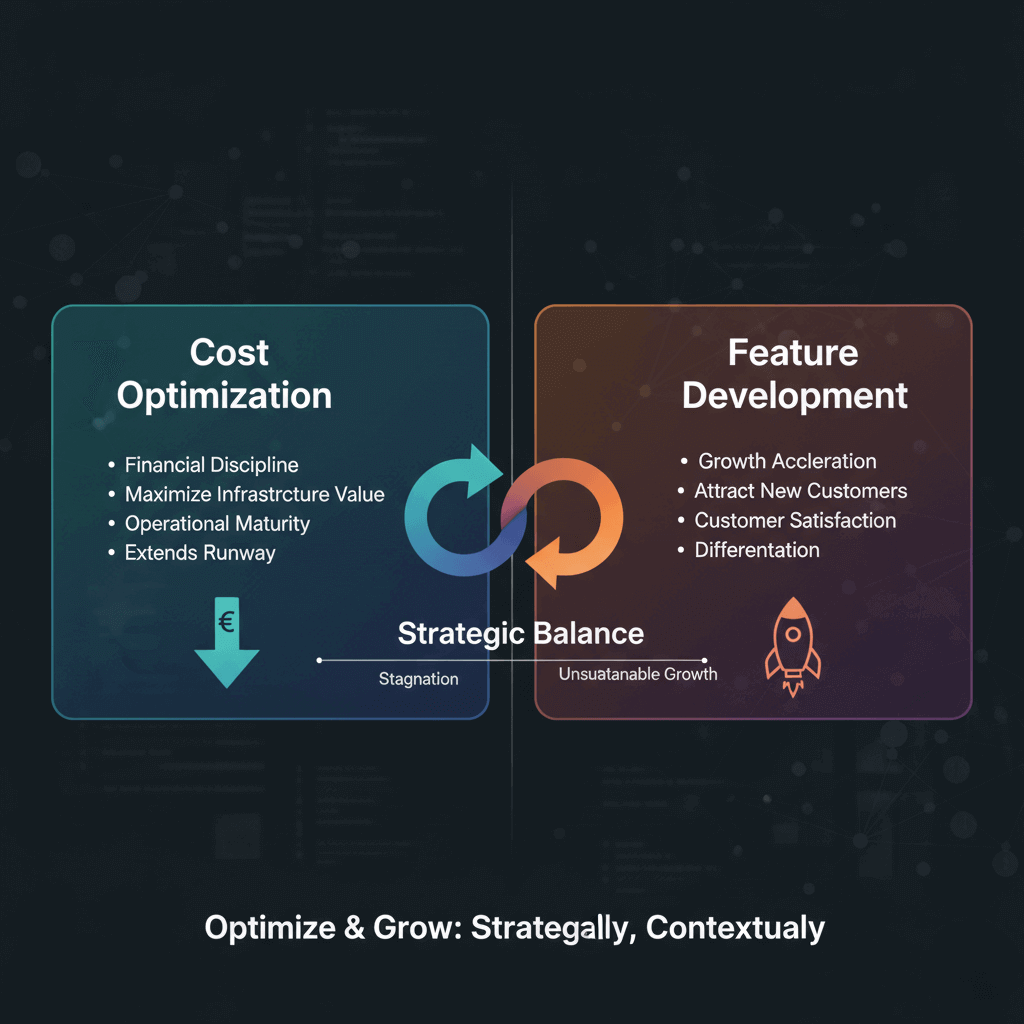
Cost optimization represents financial discipline. It means extracting maximum value from every euro spent on infrastructure. It signals operational maturity to investors and extends your runway to reach critical milestones.
Feature development represents growth acceleration. New features attract new customers, satisfy existing ones, and differentiate you from competitors.
Product-led growth research from OpenView Partners shows that companies with strong product velocity outperform on multiple metrics.
Neither should exist in isolation. Pure cost focus without product investment leads to stagnation.
Pure feature focus without cost awareness leads to unsustainable growth. The best companies do both, but they do them strategically based on context.
Common CEO Mistakes in This Tradeoff
Treating Cost Optimization as a "Later" Problem
Many CEOs assume growth will cover inefficiencies. They believe that revenue scaling faster than costs makes optimization unnecessary. This assumption fails when unit economics remain negative regardless of scale.
Benchmark data from KeyBanc Capital Markets shows that efficient SaaS companies maintain cloud costs below 25% of revenue. Companies exceeding this threshold face valuation pressure even when growth rates are strong.
Delaying financial control creates compounding problems. Small inefficiencies become large ones. Architectural decisions that seemed acceptable at low scale become expensive at high scale. Fixing these problems later costs more than addressing them earlier.
Over-Prioritizing Cost Cutting at the Expense of Product
The opposite mistake is equally dangerous. Some CEOs respond to cash pressure by slashing feature development entirely. They redirect all engineering resources to cost reduction while product stagnates.
Slowing innovation damages competitive position. Markets do not wait. Competitors continue shipping while you optimize. Customers evaluate your product against alternatives that evolve faster.
According to Gartner research, companies that maintain consistent R&D investment through economic cycles outperform those that cut and restore cyclically. Stopping feature development to cut costs often costs more than it saves.
How This Tradeoff Impacts Runway and Valuation
Burn rate determines how long you can operate before raising again or reaching profitability. Both cost optimization and feature development affect burn, but differently.
Optimization reduces expenses directly. Features increase revenue potential but require upfront investment.
Investor perception of balance matters for valuations. VCs want to see companies that can grow efficiently.
Neither excessive spending nor excessive frugality signals strong leadership. The ability to make appropriate tradeoffs demonstrates strategic thinking.
Long-term scalability depends on building systems that work at larger scale without proportionally larger costs.
Feature development that ignores efficiency creates technical debt. Cost optimization that ignores product needs creates capability debt. Both debts come due eventually.
A CEO Framework for Making the Right Call
Stage-based decision making provides the foundation. Early-stage companies searching for product-market fit should prioritize features.
Growth-stage companies with validated markets should balance both. Late-stage companies preparing for profitability should emphasize efficiency.
Identify high-leverage optimizations that deliver significant savings with minimal engineering effort. AWS Well-Architected Framework provides guidance on common optimizations that many startups overlook.
Reserved instances, right-sizing, and storage tiering often deliver 30-50% savings with days of work, not months.
Protect core product velocity regardless of cost pressure. Determine which features drive acquisition and retention. Ensure those capabilities continue advancing even during optimization periods.
When Cost Optimization Should Take Priority
Runway compression demands immediate cost attention. If your runway drops below 12 months without clear path to fundraising or profitability, optimization becomes urgent. Extending runway by three months through cost reduction may be worth delaying a feature release.
Infrastructure inefficiencies exceeding industry benchmarks indicate optimization opportunities. If your cloud costs represent 40% of revenue while peers operate at 20%, you have low-hanging fruit to harvest.
Pre-fundraising scrutiny makes efficiency metrics visible. According to Sapphire Ventures, investors increasingly request detailed infrastructure cost breakdowns during due diligence.
Demonstrating cost awareness before it becomes obvious improves your negotiating position.
When Feature Development Should Take Priority
Market validation phase requires features, not optimization. Before achieving product-market fit, your primary goal is learning what customers want. Optimizing systems you may rebuild entirely wastes effort.
Competitive pressure may demand feature acceleration. If competitors ship capabilities your customers request, delayed development costs revenue. Market share lost to feature gaps is difficult to recover.
Clear ROI on specific features justifies investment. When customer research shows strong demand, and sales data confirms conversion impact, feature development becomes the highest-leverage use of engineering time.
How Cloud Costs Often Sit at the Center of This Tradeoff
Infrastructure functions as silent burn that continues whether you address it or not. Unlike feature development with clear start and end dates, cloud costs accumulate continuously in the background.
Optimization requires engineering effort that competes with feature work. Implementing reserved instances, refactoring inefficient code, or migrating to different services requires skilled engineers who could be building features instead.
Strategic rather than reactive decisions produce better outcomes. Companies that plan optimization sprints into their roadmap alongside features maintain both velocity and efficiency. Companies that optimize only during cash crises sacrifice strategic advantage.
How EaseCloud Helps CEOs Balance Cost and Growth
EaseCloud identifies low-effort, high-impact savings that minimize engineering distraction. We find optimizations that your team can implement quickly without derailing feature roadmaps. Many clients reduce cloud costs by 30% with less than two weeks of focused work.
We align cloud spending with your product roadmap. Understanding which features launch next allows us to recommend infrastructure decisions that support growth without creating waste.
Ongoing financial visibility keeps costs transparent. Our monitoring and reporting surfaces cost trends before they become problems, enabling proactive rather than reactive management.
Contact EaseCloud for a strategic cloud cost review that respects your product development priorities.
Final Thoughts
Great CEOs do not choose between cost optimization and feature development. They balance both based on context, stage, and strategic priorities.
Emphasize strategic discipline over reactive decisions. Build cost awareness into your operating rhythm. Make optimization a continuous practice rather than an emergency response.
Long-term leadership means accepting that this tradeoff never fully resolves. Markets change, costs evolve, and customer needs shift. Your job is to continuously calibrate the balance as conditions change.
FAQs
Should startups pause feature development to cut costs?
Rarely. Complete pauses damage competitive position and team morale.
Instead, allocate a portion of engineering capacity to optimization while maintaining feature velocity on highest-priority items.
How much optimization is too much?
When optimization efforts consume more than 20-25% of engineering capacity for extended periods, you risk product stagnation. Optimization should be continuous but bounded, not all-consuming.
Do investors prefer growth or efficiency?
Investor preferences vary by stage and market conditions. During capital abundance, growth dominates.
During capital scarcity, efficiency matters more. Currently, most investors want to see both: efficient growth rather than growth at any cost.
How can CEOs evaluate ROI on cost optimization?
Calculate expected savings against engineering time invested.
A one-month optimization project that saves 5,000 euros monthly pays back in six months if you value engineering time at 10,000 euros per person-month.
Can cloud optimization slow product development?
Poor optimization approaches can slow development.
Well-executed optimization often accelerates it by reducing complexity, improving performance, and simplifying systems. Partner with experts who understand both efficiency and velocity.