How to Get AWS Decisions Investors Trust (A Founder's Guide)
Discover how to make AWS decisions that build investor confidence. Learn what VCs look for in cloud strategy and how to present your infrastructure story.
TLDR;
- Investors evaluate AWS decisions during due diligence as a signal of leadership maturity
- Infrastructure directly affects runway, margins, and execution risk
- Build confidence: Show clear cost models, stage-appropriate architecture, documented scaling plans
- Prepare to explain cloud costs in business terms during fundraising
Your AWS infrastructure tells investors more about your startup than your pitch deck. How you manage cloud costs, architect for scale, and handle reliability reveals your operational maturity and decision-making discipline.
Investors conduct increasingly sophisticated technical due diligence. They want to see that the founders they back can manage resources wisely, plan for growth, and avoid the infrastructure debt that has killed promising startups.
This guide shows you how to build and communicate an AWS strategy that strengthens rather than undermines investor confidence.
Why Investors Care About Your AWS Decisions
Infrastructure reflects leadership maturity. A well-managed AWS environment signals that you make data-driven decisions, think about long-term consequences, and can balance competing priorities. Investors see this as evidence of the judgment they want in their portfolio founders.
Cloud cost optimization strategies directly affect runway and margins. According to Bessemer Venture Partners' State of the Cloud Report, gross margins remain a critical metric for SaaS valuations. Every euro wasted on cloud infrastructure reduces your margins and extends the path to profitability.
Reliability and security signal execution risk. If your application goes down during a demo or your customer data lacks proper protection, investors question your ability to execute at scale. AWS Well-Architected Framework provides the baseline standards investors expect.
What Investors Look for in a Startup's AWS Strategy
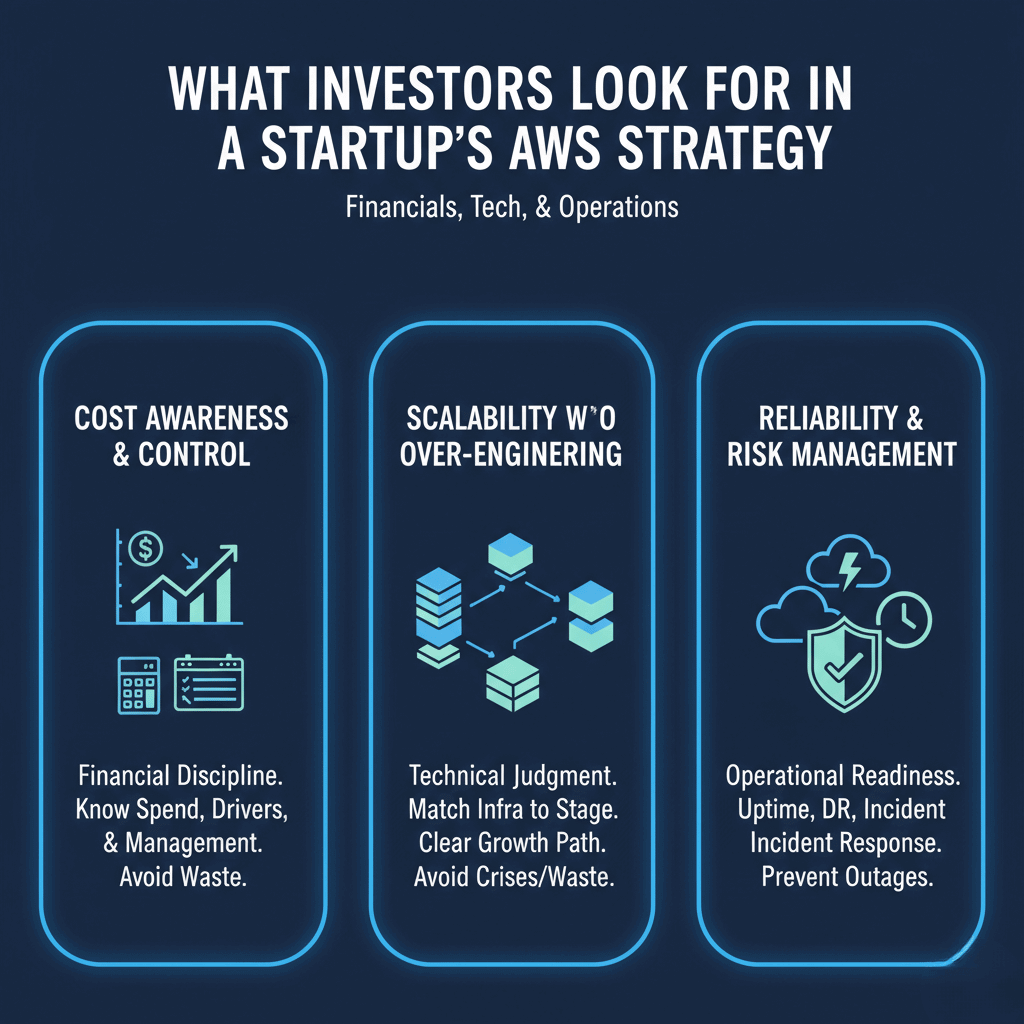
Cost awareness and control demonstrates financial discipline. Investors want to see that you know what you spend on AWS, understand the drivers of that spend, and have mechanisms to manage it. Startups that cannot explain their cloud costs often cannot explain other expenses either.
Scalability without over-engineering shows technical judgment. Building too small creates scaling crises. Building too large wastes capital. According to [a](<a href=) technology due diligence benchmarks, the best startups match infrastructure investment to their current stage while maintaining clear paths to scale.
Reliability and risk management indicate operational readiness. Investors ask about uptime, disaster recovery, and incident response. They have seen too many startups lose customers and momentum due to preventable outages.
Common AWS Decisions That Raise Investor Red Flags
Uncontrolled or Unexplained AWS Spending
No budgets or forecasting suggests a lack of financial planning. When founders cannot answer basic questions about their cloud costs, investors wonder what else they are not tracking.
Costs growing faster than revenue is the most common red flag. According to Flexera's 2024 Cloud Report, cloud waste averages 28% across organisations. For startups, this waste often signals architectural inefficiencies that will compound with growth.
Over-Engineered or Fragile Architectures
Building for scale too early burns capital without benefit. Running Kubernetes clusters for an application that could run on a single EC2 instance demonstrates poor resource allocation. Investors question whether you will make similar mistakes with their capital.
Complex systems without clear business justification raise concerns. If you cannot explain why you need a particular architecture, investors assume you built it because it seemed technically interesting rather than business necessary.
No Reliability or Disaster Recovery Story
Single points of failure in production environments suggest operational immaturity. Investors ask about backup strategies, failover mechanisms, and recovery time objectives. AWS disaster recovery guidance provides frameworks that startups should implement.
The "we'll fix it later" mindset worries investors who have seen startups learn hard lessons from outages. Technical debt in reliability often comes due at the worst possible moments, typically during high-growth phases when every customer matters.
Founder Blind Spots Around AWS Decisions
No ownership of cloud strategy creates accountability gaps. When no one owns the cloud environment, no one optimises it. Investors want to know who makes infrastructure decisions and how those decisions get reviewed.
Delegating without accountability means problems go undetected. Founders who have completely handed off cloud management often cannot answer basic questions about their infrastructure during due diligence.
How Smart AWS Decisions Build Investor Confidence
Clear cost models and projections demonstrate planning capability. Show investors that you understand your unit economics including infrastructure costs. Present projections that show how cloud costs scale with growth and what levers you have to manage them.
Architecture aligned with business stage shows resource discipline. Your infrastructure should match your current needs with documented plans for evolution. Investors appreciate founders who can articulate why they made specific choices and what triggers would prompt changes.
Measured, intentional scaling plans indicate forward thinking. Rather than "we'll figure it out when we grow," have a clear answer for how you handle 10x your current load. According to AWS scaling best practices, this planning is a hallmark of mature cloud operations.
Founder-Level Principles for Investor-Ready AWS Strategy
Simplicity over sophistication should guide architectural decisions. The best infrastructure is the simplest infrastructure that meets your needs. Complexity without justification wastes resources and creates maintenance burden.
Visibility over assumptions means measuring rather than guessing. Instrument your applications, track costs by service, and monitor performance. This data enables informed decisions and credible investor conversations.
Planned evolution, not perfection, acknowledges that requirements change. Build systems you can modify as your understanding improves. Document your architectural decisions and the assumptions behind them.
How to Communicate AWS Decisions During Investor Conversations
Explaining costs in plain business terms resonates with non-technical investors. Rather than describing services, explain cost drivers: "We spend EUR 2,000 monthly on database hosting, which handles our current 50,000 monthly active users at about EUR 0.04 per user."
Demonstrating control rather than just tools builds confidence. Investors do not care that you use AWS Cost Explorer. They care that you review costs weekly, catch anomalies quickly, and have reduced waste by specific amounts.
Showing readiness for growth addresses scale concerns. Walk through your scaling strategy: what happens when traffic doubles, what resources need to change, and what this costs. Concrete answers beat vague assurances.
When Founders Should Revisit AWS Strategy Before Fundraising
Rising infrastructure costs relative to revenue require attention before investor meetings. Clean up inefficiencies before due diligence exposes them.
Scaling milestones demand infrastructure review. Before launching major features or entering new markets, ensure your architecture supports the expected load.
Pre-seed versus Series A expectations differ significantly. Early investors accept simpler setups. Later-stage investors expect more mature operations. According to Y Combinator's guidance on technical due diligence, expectations increase substantially between rounds.
How EaseCloud Helps Founders Build Investor-Trusted AWS Strategy
EaseCloud provides AWS strategy reviews tailored for founders preparing for fundraising. We assess your infrastructure through the lens of what investors examine during due diligence.
Our cost, scalability, and reliability assessments identify gaps before investors find them. We help European startups present their cloud strategy as a competitive advantage rather than a concern.
Ongoing advisory support ensures you can answer investor questions confidently. We prepare founders for technical discussions and help craft the infrastructure narrative that supports your funding goals.
Final Thoughts
Investors trust founders who control their cloud. Your AWS strategy is a window into your decision-making, resource management, and operational maturity.
Confidence through clarity means understanding your infrastructure well enough to explain it simply. When you can articulate your cloud costs, scaling plans, and reliability measures, you demonstrate the judgment investors seek.
If fundraising is on your horizon, assess your AWS strategy now. Address weaknesses before investors discover them, and build the infrastructure story that supports your company narrative.
Schedule a pre-fundraising AWS strategy review with EaseCloud.
FAQs
Do investors review AWS infrastructure?
Yes, particularly at Series A and beyond. Technical due diligence increasingly includes infrastructure assessment. Investors examine cloud costs, architecture decisions, security posture, and scalability planning.
What AWS metrics do investors care about most?
Investors focus on cloud costs as a percentage of revenue, cost per user or transaction, infrastructure scalability relative to growth projections, and reliability metrics like uptime and incident frequency.
Is over-engineering a red flag for investors?
Yes. Over-engineering signals poor resource allocation and potentially misaligned priorities. Investors prefer founders who build appropriate solutions for their current stage rather than premature optimisation.
How can non-technical founders explain AWS decisions?
Focus on business outcomes rather than technical details. Explain what you spend, why it scales with your business, and how you control costs. Defer to technical co-founders or advisors for detailed questions.
Should startups audit AWS before fundraising?
Absolutely. An infrastructure audit identifies issues you can address before due diligence. This preparation demonstrates operational maturity and prevents surprises that could delay or derail funding discussions.