API-First Design
Master API-first design with OpenAPI specifications. Learn code generation, RESTful best practices, versioning strategies, and contract testing for scalable cloud-native APIs. Includes working examples.
TL;DR
- API-first means contract first: Define your API using an OpenAPI specification before writing any implementation code. This spec becomes the single source of truth that drives development, documentation, and testing.
- Generate code from your spec: Use OpenAPI Generator to create consistent server stubs (Python/Flask, Node.js/Express, Java/Spring) and client SDKs (Python, TypeScript, Go) automatically. This eliminates drift between your spec and implementation.
- Design for consistency: Follow RESTful conventions—use nouns for resources (
/orders), correct HTTP methods (POST for create, PUT for replace), and appropriate status codes (201 for created, 409 for conflicts). Implement cursor-based pagination for stable data retrieval. - Version and test your contract: Choose a clear versioning strategy (URL path versioning is simplest). Automate contract testing with tools like Schemathesis to ensure your API always complies with its OpenAPI spec, catching breaking changes early.
API-first design treats APIs as first-class artifacts, defining contracts before implementation begins. Organizations practicing API-first development report 40% faster integration cycles and 35% reduction in API-related defects according to Postman's 2024 State of the API Report.
This guide teaches production-ready API-first practices for cloud-native applications.
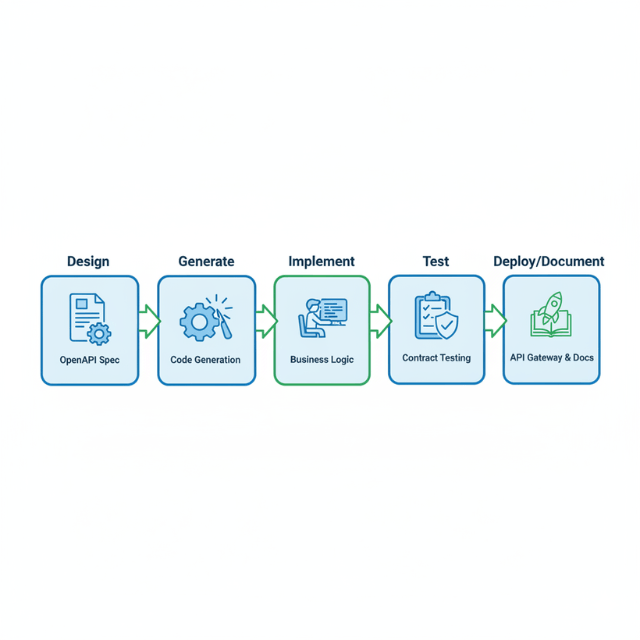
You will create OpenAPI specifications that serve as contracts between teams, implement code generation to maintain consistency between spec and implementation, design RESTful APIs following industry standards, and establish versioning strategies that enable backward compatibility. Each section includes working examples tested with real API gateways and client libraries.
Prerequisites: Understanding of RESTful API concepts, HTTP methods and status codes, and JSON data structures. Familiarity with at least one programming language (Python, Node.js, or Java) and basic API testing tools.
Expected outcomes: After completing this guide, you will write comprehensive OpenAPI specifications, generate server stubs and client SDKs from specifications, implement API versioning strategies that prevent breaking changes, and establish documentation that stays synchronized with implementation.
OpenAPI Specification Fundamentals
OpenAPI (formerly Swagger) provides a standardized format for describing RESTful APIs. Define endpoints, request/response schemas, authentication methods, and error handling in machine-readable YAML or JSON.
openapi: 3.0.3
info:
  title: Order Management API
  description: Production API for managing customer orders in cloud-native applications
  version: 2.1.0
  contact:
    name: Platform Engineering Team
    email: api-team@example.com
servers:
  - url: https://api.example.com/v2
    description: Production
  - url: https://staging-api.example.com/v2
    description: Staging
security:
  - BearerAuth: []

paths:
  /orders:
    post:
      summary: Create new order
      operationId: createOrder
      tags:
        - Orders
      requestBody:
        required: true
        content:
          application/json:
            schema:
              $ref: '#/components/schemas/CreateOrderRequest'
      responses:
        '201':
          description: Order created successfully
          content:
            application/json:
              schema:
                $ref: '#/components/schemas/Order'
        '400':
          description: Invalid request
          content:
            application/json:
              schema:
                $ref: '#/components/schemas/Error'
        '401':
          description: Unauthorized
        '429':
          description: Rate limit exceeded
    get:
      summary: List orders
      operationId: listOrders
      tags:
        - Orders
      parameters:
        - name: status
          in: query
          schema:
            type: string
            enum: [pending, processing, completed, cancelled]
        - name: customerId
          in: query
          schema:
            type: string
            format: uuid
        - name: limit
          in: query
          schema:
            type: integer
            minimum: 1
            maximum: 100
            default: 20
        - name: offset
          in: query
          schema:
            type: integer
            minimum: 0
            default: 0
      responses:
        '200':
          description: Orders retrieved successfully
          content:
            application/json:
              schema:
                $ref: '#/components/schemas/OrderList'

  /orders/{orderId}:
    get:
      summary: Get order by ID
      operationId: getOrder
      tags:
        - Orders
      parameters:
        - name: orderId
          in: path
          required: true
          schema:
            type: string
            format: uuid
      responses:
        '200':
          description: Order found
          content:
            application/json:
              schema:
                $ref: '#/components/schemas/Order'
        '404':
          description: Order not found
          content:
            application/json:
              schema:
                $ref: '#/components/schemas/Error'

components:
  securitySchemes:
    BearerAuth:
      type: http
      scheme: bearer
      bearerFormat: JWT

  schemas:
    CreateOrderRequest:
      type: object
      required:
        - customerId
        - items
      properties:
        customerId:
          type: string
          format: uuid
        items:
          type: array
          minItems: 1
          items:
            $ref: '#/components/schemas/OrderItem'
        shippingAddress:
          $ref: '#/components/schemas/Address'
        paymentMethod:
          type: string
          enum: [card, paypal, bank_transfer]

    OrderItem:
      type: object
      required:
        - productId
        - quantity
      properties:
        productId:
          type: string
        quantity:
          type: integer
          minimum: 1
        price:
          type: number
          format: double
          minimum: 0

    Order:
      type: object
      properties:
        id:
          type: string
          format: uuid
        customerId:
          type: string
          format: uuid
        status:
          type: string
          enum: [pending, processing, completed, cancelled]
        items:
          type: array
          items:
            $ref: '#/components/schemas/OrderItem'
        totalAmount:
          type: number
          format: double
        currency:
          type: string
          example: USD
        createdAt:
          type: string
          format: date-time
        updatedAt:
          type: string
          format: date-time

    OrderList:
      type: object
      properties:
        orders:
          type: array
          items:
            $ref: '#/components/schemas/Order'
        pagination:
          $ref: '#/components/schemas/Pagination'

    Pagination:
      type: object
      properties:
        total:
          type: integer
        limit:
          type: integer
        offset:
          type: integer
        hasMore:
          type: boolean

    Address:
      type: object
      required:
        - street
        - city
        - country
        - postalCode
      properties:
        street:
          type: string
        city:
          type: string
        state:
          type: string
        country:
          type: string
        postalCode:
          type: string

    Error:
      type: object
      required:
        - code
        - message
      properties:
        code:
          type: string
        message:
          type: string
        details:
          type: object
        requestId:
          type: string
Code Generation from Specifications
Generate server stubs and client SDKs directly from OpenAPI specifications. Maintains consistency between documentation and implementation.
Server-side code generation with OpenAPI Generator:
# Generate Python Flask server
openapi-generator generate \
  -i api-spec.yaml \
  -g python-flask \
  -o ./server \
  --additional-properties=packageName=order_api

# Generate Node.js Express server
openapi-generator generate \
  -i api-spec.yaml \
  -g nodejs-express-server \
  -o ./server

# Generate Java Spring Boot server
openapi-generator generate \
  -i api-spec.yaml \
  -g spring \
  -o ./server \
  --additional-properties=basePackage=com.example.api
Implementing generated stubs in Python:
"""
Order API implementation following generated interfaces.
OpenAPI Generator creates the routing and validation layer.
"""
from order_api.controllers import orders_controller
from order_api.models import Order, CreateOrderRequest, OrderList
from order_api.util import deserialize_model
from typing import Dict, List
import logging

logger = logging.getLogger(__name__)

def create_order(body: CreateOrderRequest) -> tuple:
    """
    Create new order endpoint implementation.

    Generated code handles:
    - Request validation against schema
    - Automatic 400 responses for invalid input
    - Response serialization

    Implementation focuses on business logic only.
    """
    try:
        # Validate customer exists
        customer = get_customer(body.customer_id)
        if not customer:
            return {'code': 'CUSTOMER_NOT_FOUND', 'message': 'Customer does not exist'}, 400

        # Validate inventory availability
        for item in body.items:
            available = check_inventory(item.product_id, item.quantity)
            if not available:
                return {
                    'code': 'INSUFFICIENT_INVENTORY',
                    'message': f'Product {item.product_id} not available'
                }, 400

        # Calculate total with current prices
        total_amount = calculate_order_total(body.items)

        # Create order in database
        order = Order(
            id=generate_uuid(),
            customer_id=body.customer_id,
            status='pending',
            items=body.items,
            total_amount=total_amount,
            currency='USD',
            created_at=datetime.utcnow(),
            updated_at=datetime.utcnow()
        )

        db.session.add(order)
        db.session.commit()

        # Publish order created event
        publish_event('order.created', order.to_dict())

        logger.info(f"Order created: {order.id}")
        return order.to_dict(), 201

    except Exception as e:
        logger.error(f"Order creation failed: {e}")
        db.session.rollback()
        return {
            'code': 'INTERNAL_ERROR',
            'message': 'Failed to create order',
            'requestId': get_request_id()
        }, 500

def get_order(order_id: str) -> tuple:
    """Get order by ID with proper error handling"""
    order = db.session.query(Order).filter_by(id=order_id).first()

    if not order:
        return {
            'code': 'ORDER_NOT_FOUND',
            'message': f'Order {order_id} not found'
        }, 404

    return order.to_dict(), 200

def list_orders(status: str = None, customer_id: str = None,
                limit: int = 20, offset: int = 0) -> tuple:
    """List orders with filtering and pagination"""
    query = db.session.query(Order)

    # Apply filters
    if status:
        query = query.filter_by(status=status)
    if customer_id:
        query = query.filter_by(customer_id=customer_id)

    # Get total count for pagination
    total = query.count()

    # Apply pagination
    orders = query.offset(offset).limit(limit).all()

    return {
        'orders': [order.to_dict() for order in orders],
        'pagination': {
            'total': total,
            'limit': limit,
            'offset': offset,
            'hasMore': offset + limit < total
        }
    }, 200
Client SDK generation for multiple languages:
# Generate Python client
openapi-generator generate \
  -i api-spec.yaml \
  -g python \
  -o ./client-python \
  --additional-properties=packageName=order_api_client

# Generate TypeScript client
openapi-generator generate \
  -i api-spec.yaml \
  -g typescript-axios \
  -o ./client-typescript

# Generate Go client
openapi-generator generate \
  -i api-spec.yaml \
  -g go \
  -o ./client-go
Using generated client in Python:
"""
Client usage example with generated SDK.
Generated clients handle authentication, retries, and error handling.
"""
from order_api_client import ApiClient, Configuration, OrdersApi
from order_api_client.models import CreateOrderRequest, OrderItem
from order_api_client.exceptions import ApiException

# Configure client
config = Configuration()
config.host = "https://api.example.com/v2"
config.access_token = "your-jwt-token"

# Create API client
api_client = ApiClient(configuration=config)
orders_api = OrdersApi(api_client)

try:
    # Create order using generated models
    order_request = CreateOrderRequest(
        customer_id="123e4567-e89b-12d3-a456-426614174000",
        items=[
            OrderItem(product_id="PROD-001", quantity=2, price=29.99),
            OrderItem(product_id="PROD-002", quantity=1, price=49.99)
        ],
        payment_method="card"
    )

    # Generated client handles serialization and HTTP request
    order = orders_api.create_order(order_request)
    print(f"Order created: {order.id}")

    # Retrieve order
    retrieved_order = orders_api.get_order(order.id)
    print(f"Order status: {retrieved_order.status}")

    # List orders with filtering
    order_list = orders_api.list_orders(
        status="pending",
        customer_id="123e4567-e89b-12d3-a456-426614174000",
        limit=10
    )
    print(f"Found {len(order_list.orders)} pending orders")

except ApiException as e:
    print(f"API error: {e.status} - {e.reason}")
    print(f"Response body: {e.body}")
RESTful API Design Best Practices
Resource naming conventions:
- Use nouns, not verbs:
/ordersnot/getOrders - Use plural nouns for collections:
/ordersnot/order - Use hyphens for multi-word resources:
/order-itemsnot/orderItems - Nest resources to show relationships:
/customers/{id}/orders
HTTP method usage:
- GET: Retrieve resource, idempotent, no body
- POST: Create resource, not idempotent, returns 201
- PUT: Replace entire resource, idempotent
- PATCH: Update partial resource, may not be idempotent
- DELETE: Remove resource, idempotent, returns 204
Status code selection:
- 200 OK: Successful GET, PUT, PATCH
- 201 Created: Successful POST with resource creation
- 204 No Content: Successful DELETE
- 400 Bad Request: Invalid request syntax or validation failure
- 401 Unauthorized: Authentication required or failed
- 403 Forbidden: Authenticated but insufficient permissions
- 404 Not Found: Resource does not exist
- 409 Conflict: Request conflicts with current state
- 429 Too Many Requests: Rate limit exceeded
- 500 Internal Server Error: Unexpected server error
- 503 Service Unavailable: Temporary service outage
Pagination implementation:
"""
Cursor-based pagination for stable results.
Offset pagination can miss or duplicate items under concurrent modifications.
"""
from typing import List, Optional
from datetime import datetime

def list_orders_cursor(cursor: Optional[str] = None,
                       limit: int = 20) -> Dict:
    """
    List orders using cursor-based pagination.

    Cursor encodes the last item's timestamp and ID for stable pagination.
    Works correctly even when items are added/removed during pagination.
    """
    query = db.session.query(Order).order_by(Order.created_at.desc(), Order.id.desc())

    # Apply cursor if provided
    if cursor:
        cursor_data = decode_cursor(cursor)
        query = query.filter(
            (Order.created_at < cursor_data['timestamp']) |
            ((Order.created_at == cursor_data['timestamp']) &
             (Order.id < cursor_data['id']))
        )

    # Fetch limit + 1 to determine if more pages exist
    orders = query.limit(limit + 1).all()
    has_more = len(orders) > limit

    if has_more:
        orders = orders[:limit]

    # Generate next cursor from last item
    next_cursor = None
    if has_more and orders:
        last_order = orders[-1]
        next_cursor = encode_cursor({
            'timestamp': last_order.created_at,
            'id': last_order.id
        })

    return {
        'orders': [order.to_dict() for order in orders],
        'pagination': {
            'limit': limit,
            'next_cursor': next_cursor,
            'has_more': has_more
        }
    }

def encode_cursor(data: Dict) -> str:
    """Encode cursor data to base64"""
    import base64
    import json
    json_str = json.dumps({
        'timestamp': data['timestamp'].isoformat(),
        'id': str(data['id'])
    })
    return base64.urlsafe_b64encode(json_str.encode()).decode()

def decode_cursor(cursor: str) -> Dict:
    """Decode cursor from base64"""
    import base64
    import json
    json_str = base64.urlsafe_b64decode(cursor.encode()).decode()
    data = json.loads(json_str)
    return {
        'timestamp': datetime.fromisoformat(data['timestamp']),
        'id': data['id']
    }
API Versioning Strategies
URL path versioning (recommended for simplicity):
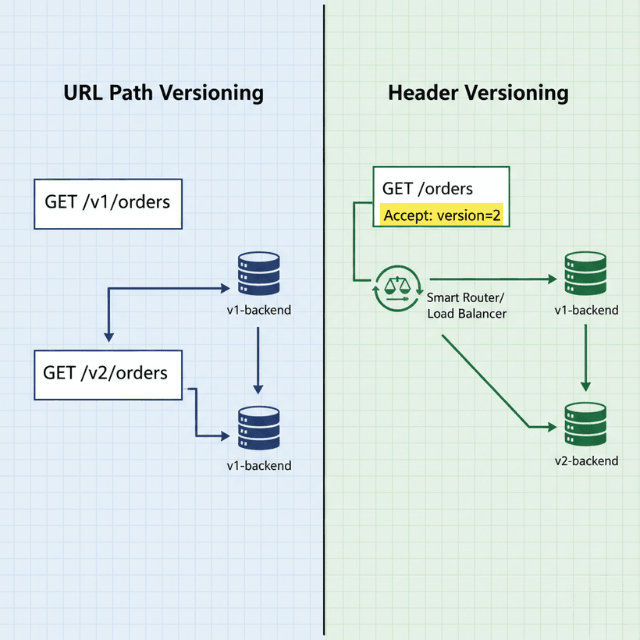
GET /v1/orders
GET /v2/orders
Benefits: Clear, simple routing, visible in URLs
Drawbacks: Requires separate codebases for each version
Header versioning (recommended for flexibility):
GET /orders
Accept: application/vnd.api+json; version=2
Benefits: Same URL for all versions, content negotiation
Drawbacks: Less visible, harder to test manually
Version management implementation:
"""
API versioning with backward compatibility.
Maintains multiple versions while sharing common logic.
"""
from flask import Flask, request, jsonify
from functools import wraps

app = Flask(__name__)

def api_version(version: str):
    """Decorator to specify API version for endpoint"""
    def decorator(f):
        @wraps(f)
        def decorated_function(*args, **kwargs):
            # Extract version from URL path
            if f'/v{version}/' in request.path:
                return f(*args, **kwargs)
            # Extract version from header
            accept_header = request.headers.get('Accept', '')
            if f'version={version}' in accept_header:
                return f(*args, **kwargs)
            return jsonify({'error': 'Version not supported'}), 400
        return decorated_function
    return decorator

# Version 1 endpoint (legacy)
@app.route('/v1/orders', methods=['GET'])
@api_version('1')
def list_orders_v1():
    """
    V1 returns simplified order structure.
    Maintained for backward compatibility.
    """
    orders = get_orders()
    return jsonify({
        'orders': [{
            'id': o.id,
            'customerId': o.customer_id,
            'total': o.total_amount,
            'status': o.status
        } for o in orders]
    })

# Version 2 endpoint (current)
@app.route('/v2/orders', methods=['GET'])
@api_version('2')
def list_orders_v2():
    """
    V2 returns enhanced structure with pagination and metadata.
    Uses cursor-based pagination for stability.
    """
    cursor = request.args.get('cursor')
    limit = int(request.args.get('limit', 20))

    result = list_orders_cursor(cursor, limit)
    return jsonify(result)
Contract Testing
Verify API implementations comply with OpenAPI specifications automatically.
Schemathesis for contract testing:
"""
Automated contract testing using Schemathesis.
Generates test cases from OpenAPI specification.
"""
import schemathesis
from hypothesis import settings

# Load API schema
schema = schemathesis.from_uri("http://localhost:8000/api/openapi.json")

@schema.parametrize()
@settings(max_examples=50)
def test_api_contract(case):
    """
    Test that API responses match OpenAPI specification.

    Schemathesis automatically:
    - Generates valid requests from spec
    - Validates response status codes
    - Validates response schemas
    - Tests edge cases and boundaries
    """
    response = case.call()
    case.validate_response(response)

# Custom test for business logic
@schema.parametrize(endpoint="/orders")
def test_create_order_business_logic(case):
    """Test specific business rules not in OpenAPI spec"""
    if case.method == "POST":
        response = case.call()
        if response.status_code == 201:
            order = response.json()
            # Verify total is calculated correctly
            expected_total = sum(item['price'] * item['quantity']
                               for item in order['items'])
            assert order['totalAmount'] == expected_total
API Gateway Integration
Deploy APIs behind API gateways for authentication, rate limiting, and monitoring.
Kong Gateway configuration from OpenAPI:
# Generate Kong declarative config from OpenAPI
deck openapi2kong -s api-spec.yaml -o kong.yaml

# Apply configuration to Kong
deck sync -s kong.yaml
Generated Kong configuration adds:
- Automatic rate limiting per consumer
- JWT authentication validation
- Request/response transformation
- Circuit breakers for backend failures
- Prometheus metrics export
Documentation and Developer Portal
Maintain synchronized documentation using tools that generate from OpenAPI specs.
ReDoc for API documentation:
<!DOCTYPE html>
<html>
  <head>
    <title>Order API Documentation</title>
    <meta charset="utf-8"/>
    <meta name="viewport" content="width=device-width, initial-scale=1">
    <link href="https://fonts.googleapis.com/css?family=Montserrat:300,400,700|Roboto:300,400,700" rel="stylesheet">
    <style>
      body { margin: 0; padding: 0; }
    </style>
  </head>
  <body>
    <redoc spec-url='./api-spec.yaml'></redoc>
    <script src="https://cdn.redoc.ly/redoc/latest/bundles/redoc.standalone.js"></script>
  </body>
</html>
Conclusion
API-first design accelerates development by establishing clear contracts before implementation begins. Teams work in parallel using shared specifications, reducing integration issues and API changes.
Start by writing OpenAPI specifications for new APIs before writing code. Use code generators to create server stubs and client SDKs. Implement contract testing in CI/CD pipelines to catch specification drift. Choose versioning strategy early and maintain backward compatibility within versions.
The investment in API-first practices pays dividends through faster integration, fewer defects, and better developer experience. Organizations report 40% reduction in API development time after establishing API-first workflows.
FAQs
What's the concrete benefit of "API-first" over just writing code and then generating documentation?
The key benefit is shifting left on consensus and integration issues. By defining the contract first, frontend and backend teams agree on the interface before anyone writes code.
This prevents the costly scenario where the backend implements something the frontend can't easily use, forcing rewrites. The spec becomes the blueprint everyone builds against simultaneously.
How do I handle breaking changes once my API is in production?
You never break existing clients. Introduce changes through a new API version. The recommended strategy is URL path versioning (e.g., /v1/orders, /v2/orders).
Maintain the old version for existing clients while developing the new one. Give consumers a reasonable timeline (months, not days) to migrate from v1 to v2 before deprecating the old version.
Does code generation really work for complex business logic?
Code generation handles the boilerplate perfectly: routing, request validation, serialization, and creating the API structure. It generates stubs—interfaces and controllers—that you then fill with your custom business logic.
This gives you the best of both worlds: a guaranteed-correct API structure and complete freedom to implement complex logic underneath.
Summarize this post with:
Ready to put this into production?
Our engineers have deployed these architectures across 100+ client engagements — from AWS migrations to Kubernetes clusters to AI infrastructure. We turn complex cloud challenges into measurable outcomes.