Select the Optimal OCI GPU Shape for LLMs
Select optimal OCI GPU shapes for LLM deployment. Compare A10, A100, H100 performance benchmarks, costs, and ROI. Data-driven recommendations for 7B to 175B models
TLDR;
- VM.GPU.A10.1 at $1.50/hour handles 7B-13B models with 87 tokens/second throughput
- VM.GPU.A100.1 delivers 142 tokens/second for 7B models at $2.95/hour
- 3-year commitments save 37% compared to on-demand pricing
- OCI H100 instances cost 58% less than equivalent AWS P5 offerings
Select optimal GPU shapes for LLM deployment on Oracle Cloud Infrastructure.
This guide compares OCI GPU options with real-world performance benchmarks and provides data-driven recommendations based on model size, throughput requirements, and budget constraints.
Choosing the right GPU shape directly impacts both performance and monthly costs. Deploy Llama 2 7B on the wrong instance and you'll overpay by 50% or suffer poor latency.
OCI offers six GPU shapes from budget A10 instances to high-performance H100 bare metal servers. Each shape targets different workload profiles with distinct price-performance characteristics.
This analysis includes production benchmarks for Llama 2 models across all OCI GPU shapes, cost optimization strategies using reserved capacity and multi-model serving, and decision matrices mapping workload requirements to optimal instance types.
Make informed selections that balance performance requirements with infrastructure budgets.
OCI GPU Portfolio Overview
Oracle Cloud Infrastructure offers six GPU shapes optimized for LLM workloads. OCI provides competitive pricing with hourly and monthly commitment options that reduce costs by up to 37% compared to AWS and Azure.
VM.GPU.A10.1:
- GPUs: 1x NVIDIA A10 (24GB GDDR6)
- OCPUs: 15 cores (Intel Ice Lake)
- Memory: 240GB RAM
- Network: 24.6 Gbps bandwidth
- Storage: Up to 32TB block volume
- Cost: $1.50/hour ($1,095/month)
- Best for: 7B-13B models, development, testing
VM.GPU.A10.2:
- GPUs: 2x NVIDIA A10 (48GB total)
- OCPUs: 30 cores
- Memory: 480GB RAM
- Network: 49.2 Gbps bandwidth
- Cost: $3.00/hour ($2,190/month)
- Best for: Multi-model serving, 13B-30B models
BM.GPU.A10.4:
- GPUs: 4x NVIDIA A10 (96GB total)
- OCPUs: 64 cores
- Memory: 1TB RAM
- Network: 2x 100 Gbps
- Storage: NVMe local storage available
- Cost: $6.00/hour ($4,380/month)
- Best for: Distributed inference, batch processing
VM.GPU.A100.1:
- GPUs: 1x NVIDIA A100 (40GB HBM2e)
- OCPUs: 15 cores
- Memory: 240GB RAM
- Network: 24.6 Gbps bandwidth
- Tensor Cores: 432 (3rd gen)
- Cost: $2.95/hour ($2,153/month)
- Best for: 13B-30B models, production workloads
BM.GPU.A100-v2.8:
- GPUs: 8x NVIDIA A100 (320GB total, 40GB each)
- OCPUs: 128 cores
- Memory: 2TB RAM
- Network: 2x 100 Gbps RoCE v2
- NVLink: 600 GB/s GPU-to-GPU
- Cost: $23.60/hour ($17,228/month)
- Best for: 70B+ models, high-throughput inference
BM.GPU.H100.8:
- GPUs: 8x NVIDIA H100 (640GB total, 80GB each)
- OCPUs: 112 cores (4th gen Intel)
- Memory: 2TB RAM
- Network: 8x 200 Gbps
- NVLink: 900 GB/s (NVLink 4.0)
- Tensor Cores: 528 per GPU (4th gen)
- Cost: $32.77/hour ($23,922/month)
- Best for: 175B+ models, training, ultra-low latency
Performance Benchmarks
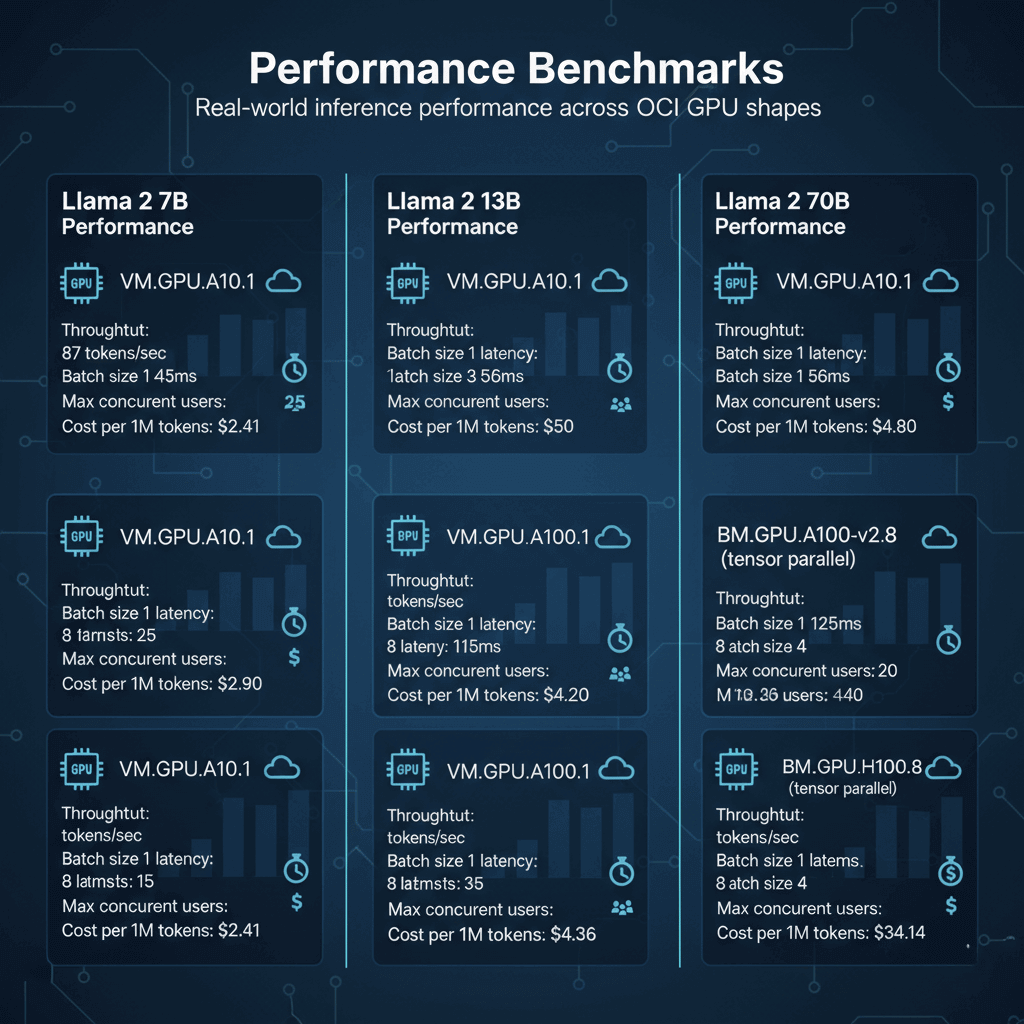
Real-world inference performance across OCI GPU shapes.
Llama 2 7B — VM.GPU.A10.1: 87 tokens/sec, 45ms batch-1 latency, 25 max concurrent users, $2.41 per 1M tokens.
Llama 2 7B — VM.GPU.A100.1: 142 tokens/sec, 28ms batch-1 latency, 50 max concurrent users, $2.90 per 1M tokens.
Llama 2 13B — VM.GPU.A10.1: 52 tokens/sec, 68ms batch-1 latency, 15 max concurrent users, $4.03 per 1M tokens.
Llama 2 13B — VM.GPU.A100.1: 98 tokens/sec, 42ms batch-1 latency, 35 max concurrent users, $4.20 per 1M tokens.
Llama 2 70B — BM.GPU.A100-v2.8 (tensor parallel): 76 tokens/sec, 125ms batch-1 latency, 20 max concurrent users, $43.36 per 1M tokens.
Llama 2 70B — BM.GPU.H100.8 (tensor parallel): 134 tokens/sec, 71ms batch-1 latency, 40 max concurrent users, $34.14 per 1M tokens.
Shape Selection Decision Matrix
Choose the right GPU shape based on your requirements.
Development and Testing (up to 13B, cost-conscious): VM.GPU.A10.1 at $1,095/month.
Production Inference — Small Models (7B-13B, 100-500 req/min): VM.GPU.A100.1 at $2,153/month with high-availability load balancing.
Production Inference — Medium Models (13B-30B, 50-200 req/min): VM.GPU.A100.1 or VM.GPU.A10.2 at $2,153-$2,190/month.
Large Model Inference (70B+, enterprise): BM.GPU.A100-v2.8 at $17,228/month with tensor parallelism.
Ultra-Large Model Inference (175B+, performance-critical): BM.GPU.H100.8 at $23,922/month.
Cost Optimization Strategies
Reduce infrastructure costs while maintaining performance.
Reserved Capacity Discounts: 1-year commitment saves 20%; 3-year commitment saves 37%. Example: VM.GPU.A100.1 reserved = $1,722/month, saving $431/month versus on-demand.
Multi-Model Serving: Run multiple smaller models on a single GPU shape to maximize utilization and reduce per-model costs.
Auto-Scaling: Configure instance pools with custom metrics to scale down during off-peak hours and reduce idle GPU spend by 40-60%.
Instance Provisioning and Configuration
Deploy GPU instances with optimal settings for LLM workloads. After provisioning, install the NVIDIA GPU driver and CUDA toolkit via cloud-init.
Configure Docker with the NVIDIA container runtime to enable GPU access from containers. Set the appropriate VRAM limits in your inference server configuration to match the selected shape.
Monitoring and Performance Tuning
Track GPU utilization and optimize for cost efficiency. Collect GPU metrics using DCGM Exporter and expose them to Prometheus.
Monitor GPU utilization, memory usage, temperature, and power draw. Set alerts when utilization drops below 60% consistently — that signals an opportunity to right-size to a smaller shape.
Conclusion
Selecting the right GPU shape requires balancing performance needs with budget constraints. For development and small models under 13B parameters, VM.GPU.A10.1 provides excellent value at $1,095/month.
Production deployments of 7B-30B models benefit from VM.GPU.A100.1's superior throughput at $2,153/month.
Large 70B models require BM.GPU.A100-v2.8 bare metal servers with tensor parallelism. Ultra-large 175B+ models demand BM.GPU.H100.8 for acceptable latency.
Optimize costs through reserved instances, multi-model serving, and auto-scaling. Start with smaller shapes for proof-of-concept, then scale to production hardware once workload patterns stabilize.
For the complete Oracle Cloud LLM deployment strategy, including platform comparison and production patterns, see our Oracle Cloud LLM deployment guide.
Frequently Asked Questions
What GPU shape should I choose for deploying Llama 2 70B in production, and how does it compare cost-wise to AWS and Azure?
For Llama 2 70B production deployment, choose BM.GPU.A100-v2.8 with 8x A100 GPUs providing 320GB total VRAM. This delivers 76 tokens/second throughput handling 20-30 concurrent users at 125ms average latency.
Monthly cost is $17,228 on OCI versus $25,920 on AWS (p4d.24xlarge) and $23,040 on Azure (ND96asr_v4) — representing 34% and 25% savings respectively.
For smaller 70B deployments under 50M tokens monthly, consider VM.GPU.A100.1 with INT8 quantization reducing memory to 35GB at $2,153/month.
How do I implement auto-scaling for GPU instances on OCI to optimize costs during variable traffic?
Create an instance pool with minimum 2 instances for high availability and maximum 8 for peak traffic.
Configure scaling rules based on GPU utilization using OCI Monitoring: scale up at 70% average utilization over 5 minutes, scale down at 30% over 15 minutes.
Use OCI Functions with custom scaling logic monitoring queue depth, triggering scale-up when pending requests exceed 100. Pre-warm instances using container image caching to reduce cold start from 120 seconds to 30 seconds.
Expected cost savings: 40-60% compared to running maximum capacity 24/7.
Can I use OCI GPU shapes for fine-tuning large models, and how do A100 and H100 compare for training?
Yes. For fine-tuning Llama 2 7B on BM.GPU.A100-v2.8, expect 180 samples/second using DeepSpeed ZeRO-2.
BM.GPU.H100.8 achieves 320 samples/second — 78% faster — with 3x faster FP8 training via Transformer Engine. For 13B models: A100 reaches 92 samples/second, H100 reaches 165 samples/second.
For 70B fine-tuning, only H100 handles the full model with gradient checkpointing at 18 samples/second. Use A100 for budget-conscious experimentation; choose H100 for production fine-tuning pipelines requiring rapid iteration.
Summarize this post with:
Ready to put this into production?
Our engineers have deployed these architectures across 100+ client engagements — from AWS migrations to Kubernetes clusters to AI infrastructure. We turn complex cloud challenges into measurable outcomes.