The Scalability Questions That Kill Startup Deals
Discover the scalability questions investors ask that derail funding. Learn to prepare answers that demonstrate your startup's growth potential.
TLDR;
- Scalability questions separate fundable companies from rejections
- Investors fund future capacity, not current size — they ask about 10x growth, cost scaling, and risk
- Credibility killers: Vague answers, "we'll fix it later", claims without data
- Prepare: Architecture narrative, cost/performance forecasts, scaling milestones tied to growth
The meeting started well. Your metrics impressed. Your vision resonated. Then the investor asked: "What happens when you have ten times more users?" Your answer determined whether discussions continued or quietly ended.
Scalability questions appear in nearly every serious fundraising conversation. For European SaaS founders pursuing Series A or B rounds, these questions separate fundable companies from those that receive polite rejections. The founders who answer confidently close deals. Those who stumble face extended timelines, reduced valuations, or silent passes.
Why Scalability Comes Up in Every Serious Investor Conversation
Growth potential drives valuation multiples. Investors pay premiums for startups that can expand efficiently. According to SaaS Capital's annual survey, companies with demonstrated scalability command valuations 2-3x higher than comparable companies with uncertain growth capacity.
Scalability equals risk assessment in investor minds. When investors evaluate your scalability, they assess whether their capital will fuel growth or fix problems. Capital spent on replatforming generates no returns. Capital spent on customer acquisition with scalable infrastructure multiplies.
Investors fund future capacity, not current size. Your present state interests investors less than your potential state. Bessemer Venture Partners' research shows that the ability to scale efficiently often matters more than current revenue when projecting returns on early-stage investments.
What Investors Actually Mean by "Scalability"
Scalability extends beyond user growth. While handling more customers matters, investors think about scalability across multiple dimensions. Can your team scale? Can your processes scale? Can your unit economics improve with scale?
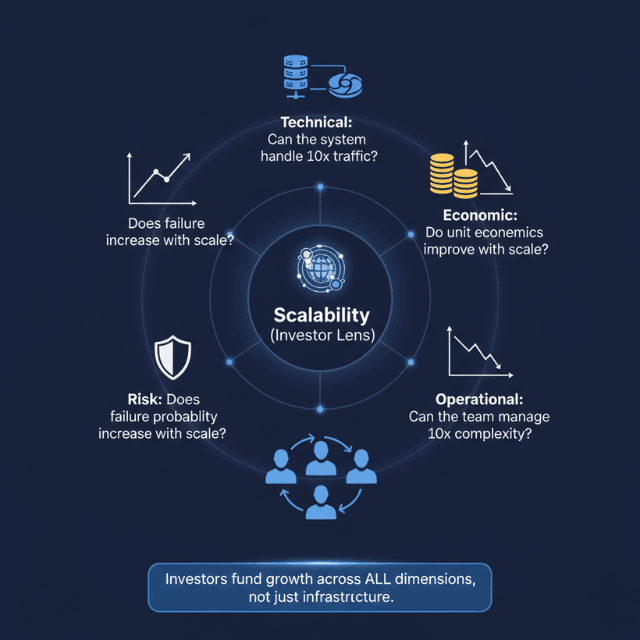
Infrastructure, costs, and operations all factor into scalability assessments. Your database can handle more queries, but does your cost per query decrease? Your servers can process more requests, but does that require proportionally more operations staff?
Team and process readiness complete the scalability picture. According to First Round Capital's operational research, startups that scale infrastructure without scaling operational maturity often face production incidents that damage customer relationships and team morale.
Common Scalability Questions Investors Ask
Can This System Handle 10x Growth?
Load, performance, and bottlenecks reveal architectural maturity. Investors want to know where your system will strain first. Which database tables grow fastest? Which services receive the most traffic? Which dependencies create constraints?
Architecture assumptions surface under this questioning. Every system makes assumptions about usage patterns. Investors want to understand your assumptions and assess their validity. If you assumed users would average five API calls per session but they actually average fifty, your capacity planning falls apart.
What Happens to Costs as You Scale?
Unit economics under growth determine eventual profitability. Andreessen Horowitz's analysis of cloud costs demonstrates that infrastructure expenses can exceed 50% of revenue for SaaS companies that have not optimised their architecture for cost efficiency.
Infrastructure and operational leverage separate good investments from problematic ones. Investors favour architectures where doubling users does not double infrastructure costs. This leverage comes from efficient caching, appropriate service design, and thoughtful resource allocation.
How Risky Is Scaling This Product?
Failure points multiply with scale. A bug that affects 1% of sessions becomes unacceptable at 10x volume. An edge case that crashes one server per month crashes servers daily at scale. Investors assess whether you have identified and mitigated these risks.
Recovery and resilience matter more at scale. Small startups can often recover from outages with heroic individual effort. Scaled companies need systematic resilience. Google's Site Reliability Engineering practices have become the benchmark that sophisticated investors use to evaluate operational maturity.
Scalability Red Flags That Quietly Kill Deals
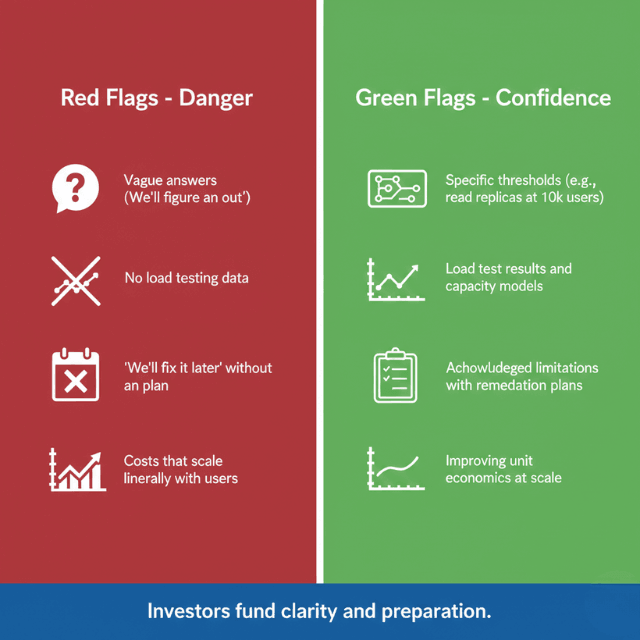
Vague or hand-wavy answers signal insufficient planning. When founders respond with "we will figure it out" or "cloud platforms handle that automatically," investors hear a team that has not done the work. Specificity builds confidence.
"We will fix it later" responses concern experienced investors. Every startup has technical debt. The question is whether founders understand their debt and have plans to address it. Acknowledging limitations with remediation plans works better than dismissing concerns.
No data or planning behind claims destroys credibility. If you claim your system can handle 100x growth but cannot explain why, investors discount everything else you say. Back assertions with load tests, architecture diagrams, and capacity models.
How Scalability Doubts Translate Into Deal Risk
Lower valuations reflect increased risk premiums. When investors lack confidence in scalability, they reduce their offers to account for potential problems. A startup valued at 10x revenue with proven scalability might receive only 6x with uncertainty.
Slower fundraising cycles drain founder attention. Investors who have scalability concerns often request additional diligence, introduce technical advisors for review, or simply take longer to make decisions. This extended process exhausts founders and can miss market windows.
Requests for technical audits add complexity and cost. Some investors condition term sheets on third-party technical assessments. While these audits can ultimately help, they add weeks to timelines and create additional negotiation points around findings.
Why Founders Get Caught Off Guard by Scalability Questions
Focus on product-market fit consumes early-stage attention. Founders correctly prioritise customer acquisition and retention over infrastructure optimisation. But this focus can leave scalability narratives underdeveloped when fundraising begins.
Technical decisions made early become locked in. The database you chose at launch, the cloud provider you selected, the monolith versus microservices decision all create path dependencies. Changing these decisions grows increasingly expensive, yet they fundamentally shape scalability.
Scalability gets assumed rather than validated. Founders often believe their architecture will scale because modern cloud platforms provide elastic capacity. But application architecture must support that elasticity. AWS Well-Architected Framework research shows that most scalability limitations come from application design, not infrastructure constraints.
How Founders Can Prepare for Scalability Due Diligence
Develop a clear architecture narrative before investor meetings. Know your system. Understand where it excels and where it strains. Practice explaining your architecture to non-technical audiences and answering follow-up questions.
Create cost and performance forecasting models. Build spreadsheets that project infrastructure costs at different scale points. Conduct load tests that validate your capacity assumptions. Document the results for investor presentations.
Define scaling milestones tied to growth targets. Know what changes you will make when you hit specific thresholds. At 10,000 users, you will add database read replicas. At 50,000 users, you will implement caching layers. At 200,000 users, you will decompose the monolith. This roadmap demonstrates planning sophistication.
How EaseCloud Helps Startups Answer Scalability Questions With Confidence
Scalability readiness assessments identify gaps before investors do. Our certified cloud architects evaluate your systems against the questions investors commonly ask. You learn where you stand and what to address before fundraising conversations begin.
Architecture and cost reviews provide supporting documentation. We create materials that demonstrate your scalability story with data rather than assertions. Load test results, capacity models, and infrastructure cost projections give investors the evidence they need.
Investor-ready technical explanations bridge communication gaps. We help founders translate technical reality into business language. Whether you need to explain your architecture to a non-technical partner or defend specific decisions to a technical due diligence team, we prepare you for both scenarios.
Scalability Confidence Wins Deals
Clarity beats perfection in investor conversations. You do not need a perfectly scalable system. You need a clear understanding of your current state, known limitations, and credible plans for improvement. Investors fund teams that demonstrate this understanding.
Preparation reduces investor risk perception. When you answer scalability questions with specificity and confidence, investors perceive lower execution risk. This perception directly impacts valuations and terms.
The founders who close deals fastest are those who have done the preparation work. They know their numbers, understand their constraints, and can articulate their scaling strategy clearly. That preparation pays returns that far exceed the investment.
FAQs on Scalability and Investor Readiness
Do investors require systems to be fully scalable before funding?
No. Investors understand that early-stage companies have scaling work ahead. They want to see that founders understand their current limitations and have credible plans to address them. The roadmap matters more than present perfection.
How technical should scalability answers be?
Match your audience. With non-technical investors, focus on business implications. With technical due diligence teams, provide architectural detail. The ability to adjust your communication demonstrates versatility that investors value.
Can scalability issues delay or kill deals?
Yes. Significant scalability concerns can extend due diligence timelines, reduce offered valuations, or cause investors to pass entirely. Addressing these concerns proactively prevents these outcomes.
When should startups validate scalability?
Begin scalability preparation three to six months before planned fundraising. This timeline allows for load testing, architecture improvements, and documentation development without rushed execution.
Should founders bring in external experts before fundraising?
Often yes. External architecture reviews provide objective assessments that founders may lack internally. They also create credibility through third-party validation that investors recognise.
Ready to answer scalability questions with confidence? EaseCloud helps European startups prepare for technical due diligence. Schedule a scalability readiness assessment to identify gaps, build your narrative, and enter investor conversations fully prepared.
Summarize this post with:
Ready to put this into production?
Our engineers have deployed these architectures across 100+ client engagements — from AWS migrations to Kubernetes clusters to AI infrastructure. We turn complex cloud challenges into measurable outcomes.