Downtime Costs Startups More Than You Think (AWS Reliability & DR Explained)
Discover the hidden costs of downtime for startups, from customer churn to missed growth opportunities, and how AWS reliability prevents them.
TLDR;
- Downtime costs 3x more than visible revenue loss (churn, brand damage, team distraction, slower sales)
- Common gaps: Single-AZ architectures, no redundancy, weak monitoring
- Cost-effective fixes: Multi-AZ databases, automated recovery, alerts that catch issues before users notice
When your application goes offline, the lost revenue appears immediately on your dashboard. What does not appear is the full cost of that outage. Customer relationships erode silently. Brand reputation suffers in ways that take months to measure.
Team productivity drops as engineers fight fires instead of building features. For startups operating on limited runway and chasing aggressive growth targets, these hidden costs often exceed the visible losses by a factor of three or more.
This article breaks down the true cost of downtime for startups, identifies common reliability gaps in AWS-based architectures, and explains how targeted reliability investments protect your growth trajectory.
Why Startups Underestimate the True Cost of Downtime
Most founders think about downtime in terms of immediate revenue loss. This narrow view creates dangerous blind spots.
Focus on visible revenue only captures perhaps 30% of actual damage. When an e-commerce checkout fails for an hour, you can calculate lost transactions. What you cannot easily measure is how many of those visitors never return, or how many share their frustration with colleagues.
Ignoring long-term damage compounds the problem. According to Harvard Business Review research, acquiring a new customer costs 5-25 times more than retaining an existing one. Every customer lost to reliability issues must be replaced at significant expense.
Overconfidence in early infrastructure leads to preventable failures. The AWS setup that worked for your first hundred users rarely scales to thousands without reliability improvements. Architecture decisions made during rapid prototyping often create single points of failure that surface only during growth.
The Direct Financial Costs of Downtime
Start with the measurable losses before examining hidden costs.
Lost transactions and signups hit immediately. For subscription businesses, Gartner research estimates average downtime costs at approximately $5,600 per minute. Early-stage startups see lower absolute numbers but higher relative impact against limited revenue.
SLA penalties and refunds create additional exposure. Enterprise contracts increasingly include uptime guarantees. Falling below committed service levels triggers credits that reduce MRR directly. For European B2B startups, GDPR-related downtime can create regulatory exposure beyond simple refunds.
Emergency engineering costs drain resources. When production fails at 2 AM, you pay premium rates for incident response. If the issue requires external specialists, costs escalate further. According to IT Service Management Forum, unplanned outages cost 35% more to resolve than planned maintenance activities.
The Hidden Costs That Hurt Even More
Beyond direct financial impact, downtime creates damage that compounds over time.

Customer churn and trust erosion happen gradually. Zendesk research shows that 61% of customers switch to competitors after one bad experience. For startups building product-market fit, losing early adopters interrupts the feedback loop essential for product development.
Brand reputation damage spreads through networks. In European B2B markets, CTOs and technical decision-makers share experiences at conferences, in Slack communities, and during vendor evaluations. A reliability problem mentioned in these contexts can disqualify you from consideration months later without your knowledge.
Slower sales and partnerships result from credibility questions. Enterprise buyers conduct technical due diligence. Discovering a pattern of outages during this process delays deals and shifts negotiating power away from you. Strategic partnership discussions stall when potential partners question your operational maturity.
How Downtime Slows Growth and Momentum
Reliability problems create drag that compounds during growth phases.
Missed launches and campaigns waste marketing investment. Product launch days and promotional campaigns drive traffic spikes. If your infrastructure fails under load, you lose not just immediate conversions but the momentum that successful launches create. According to AWS Elastic Load Balancing documentation, proper load distribution prevents the cascade failures that often occur during traffic surges.
Increased churn during growth phases amplifies losses. When you scale from 100 to 1,000 customers, reliability problems affect ten times more users. The percentage of churned customers might stay constant, but absolute numbers grow significantly.
Reduced investor confidence affects future funding. Series A and beyond investors evaluate operational metrics alongside growth numbers. A history of outages signals technical debt and operational immaturity that sophisticated investors recognize and discount in valuations.
Common AWS Reliability Gaps in Startups
Understanding where failures originate helps you prevent them.
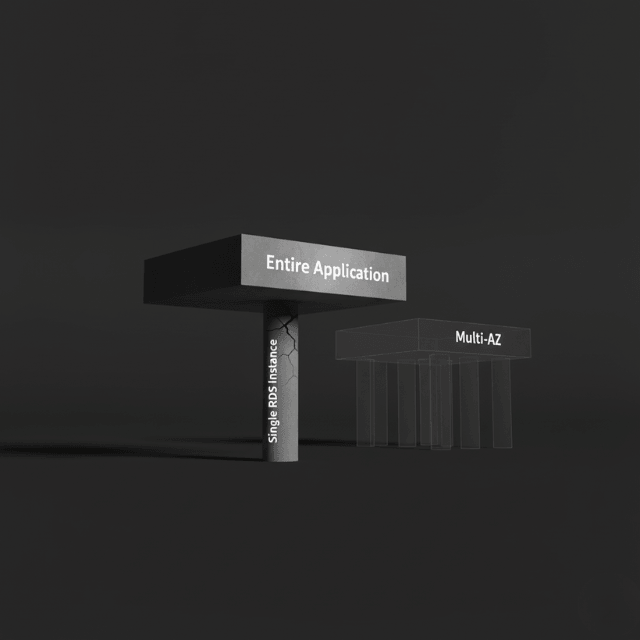
Single points of failure cause most startup outages. Running your database on a single RDS instance without Multi-AZ replication means any instance failure takes your application offline. According to the AWS Well-Architected Framework, eliminating single points of failure is a foundational reliability practice.
No redundancy or failover extends outage duration. Without automated failover, your team must detect problems, diagnose root causes, and manually restore service. This process typically takes hours rather than the seconds or minutes that automated systems require.
Weak monitoring and alerting delays response times. Many startups run minimal monitoring, learning about outages from customer complaints rather than internal alerts. Amazon CloudWatch provides native monitoring capabilities, but configuring meaningful alerts requires deliberate effort.
How AWS Reliability and DR Reduce Downtime Costs
AWS provides native services that address common reliability gaps at startup-appropriate costs.
High availability architecture prevents many outages entirely. Multi-AZ deployments for Amazon RDS maintain synchronous standby replicas that automatically assume primary responsibility during failures. This configuration typically adds 50-100% to database costs but eliminates a major failure category.
Automated recovery mechanisms minimize outage duration. Auto Scaling groups detect unhealthy instances and launch replacements automatically. Elastic Load Balancing routes traffic away from failed instances within seconds. These services reduce mean time to recovery from hours to minutes.
Disaster recovery readiness protects against catastrophic failures. For startups handling regulated data or serving enterprise customers, DR capabilities provide business continuity even during regional AWS outages. Strategies range from simple cross-region backups to active-active multi-region deployments.
Cost vs Risk Comparing Prevention and Recovery
Smart reliability investment requires understanding the economics of prevention versus recovery.
Comparing prevention vs recovery costs reveals clear patterns. According to IBM Security research, the average cost of a data breach reached $4.45 million in 2023. For startups, the figures are lower but the relative impact often higher. Spending a few hundred dollars monthly on redundancy and monitoring prevents losses that could exceed your monthly burn rate.
Avoiding over-engineering preserves capital for growth. Not every startup needs multi-region active-active deployment. Match your reliability investments to actual risk exposure. A B2B SaaS product with primarily weekday usage has different requirements than a consumer application with 24/7 global traffic.
Making cost-aware reliability decisions means prioritizing by impact. Focus first on failures that affect the most users or the most valuable transactions. A brief outage in a background batch process matters less than checkout failures during peak sales hours.
When Downtime Costs Signal Time to Act
Certain patterns indicate your reliability investments have fallen behind your business needs.
Repeated outages from similar causes suggest systemic problems rather than bad luck. If database connection exhaustion has caused three outages this quarter, the underlying architecture needs attention.
Customer complaints and churn directly tied to reliability show business impact clearly. When cancellation surveys cite "reliability concerns" or support tickets spike after each outage, the cost of inaction becomes concrete.
Revenue dependency on uptime increases as you grow. Early startups can absorb occasional outages. Once your MRR reaches levels where an hour of downtime costs more than a month of reliability improvements, the investment equation changes.
How EaseCloud Helps Startups Minimize Downtime Impact
Building reliability expertise in-house takes time most startups cannot spare. EaseCloud accelerates the process with targeted support.
Reliability and DR assessments identify gaps in your current architecture and prioritize improvements based on your specific risk profile and budget constraints.
Architecture improvements implement proven patterns for high availability on AWS. From Multi-AZ database configurations to auto-scaling implementations, EaseCloud brings experience from dozens of similar projects.
Ongoing monitoring and optimization ensures your reliability posture evolves with your business. As traffic grows and requirements change, your infrastructure adapts accordingly.
Final Thoughts
Downtime costs more than lost revenue. Customer trust, brand reputation, team productivity, and growth momentum all suffer when your product goes offline. For startups, where every customer relationship matters and runway is limited, these hidden costs often exceed visible losses several times over.
The good news: AWS provides cost-effective ways to prevent most common failures. Multi-AZ deployments, automated recovery, and proper monitoring form a reliability foundation that grows with your business. The key lies in making these investments before the costs of inaction force your hand.
FAQs
How much does downtime really cost a startup?
Direct costs vary by revenue model, but hidden costs typically multiply visible losses by 3-5x. A SaaS startup with $50,000 MRR might see $500 in lost transactions during an hour outage, but $2,000-3,000 in total impact including churn, reputation damage, and team productivity loss.
What AWS services help reduce downtime?
Key services include Multi-AZ RDS for database redundancy, Elastic Load Balancing for traffic distribution and health checking, Auto Scaling for capacity management, and CloudWatch for monitoring and automated alerting.
Is disaster recovery expensive for startups?
Basic DR strategies cost relatively little. Cross-region backups add minimal expense. Pilot light configurations typically increase infrastructure costs by 10-20%. Full warm standby deployments may add 30-50% to baseline costs.
How can startups measure downtime impact?
Track direct metrics like lost transactions and support ticket volume. Measure indirect indicators like trial conversion rates, customer churn timing relative to incidents, and deal velocity changes following outages.
When should startups invest in AWS reliability?
Begin with foundational practices like Multi-AZ deployments and monitoring from day one. Add redundancy for critical paths as you achieve product-market fit. Implement formal DR planning when you handle regulated data or sign enterprise contracts.