How to Balance Speed vs Stability When Scaling a Startup
Learn how startup founders balance speed and stability when scaling. Practical frameworks, warning signs, and infrastructure decisions that protect growth.
TLDR;
- Speed and stability are complementary, not opposing forces
- Early stage: Prioritize speed while searching for product-market fit
- Growth stage: Shift toward stability as customers depend on you
- Focus stability investments on customer-facing systems
- Watch for warning signs: increasing incidents, slower dev velocity
Startup founders face constant tension between shipping fast and building systems that work reliably. Move too quickly and you risk catastrophic failures that destroy customer trust. Move too slowly and competitors capture your market before you gain traction. European B2B startups face additional pressure from regulatory requirements like GDPR that demand stable, compliant infrastructure from day one. This guide provides a practical framework for making these decisions at every stage of growth.
Why Speed vs Stability Is the Hardest Scaling Trade-Off
Every founder feels the pressure to move fast. Y Combinator research consistently emphasizes that startups die from moving too slowly more often than from moving too fast. Yet the consequences of instability can be equally fatal.
The challenge intensifies because resources remain limited at every stage. You cannot hire enough engineers to do everything perfectly. You cannot afford enterprise-grade infrastructure before generating enterprise-level revenue. Every decision about where to invest engineering time carries real opportunity costs.
For European founders, this trade-off becomes more complex. GDPR compliance requires data protection measures that add engineering overhead. Financial services startups must satisfy PSD2 requirements. Healthcare companies need to address regional data residency rules. These requirements create stability demands that cannot be deferred.
What "Speed" and "Stability" Really Mean in a Startup
Speed does not mean rushing or cutting corners. True velocity comes from removing friction in development and deployment processes. It means faster feedback loops, not reckless shipping.
Stability does not mean over-engineering or building for scale you may never reach. Stability means your current customers can rely on your product. It means critical failures get caught before reaching production. It means incidents get resolved quickly when they occur.
According to the DORA State of DevOps Report, elite teams achieve both speed and stability simultaneously. They deploy more frequently while maintaining lower failure rates. This finding challenges the assumption that founders must sacrifice one for the other.
Both speed and stability serve the same goal: sustainable growth. Speed without stability creates growth that cannot be maintained. Stability without speed creates perfect systems that never reach customers.
Common Ways Startups Get This Balance Wrong
Moving Fast Without Guardrails
Many early-stage founders skip automated testing to ship faster. They deploy directly to production without staging environments. They ignore monitoring until something breaks catastrophically.
The Accelerate book research by Nicole Forsgren demonstrates that these shortcuts actually slow teams down over time. Without automated testing, developers spend more time manually verifying changes. Without monitoring, debugging production issues takes hours instead of minutes.
Infrastructure limits also get ignored under time pressure. Database connections get exhausted. Memory usage grows unbounded. These problems emerge suddenly when user load increases, creating emergencies at the worst possible moments.
Over-Optimizing Stability Too Early
Other founders make the opposite mistake. They spend months building perfect CI/CD pipelines before validating product-market fit. They architect for millions of users while serving hundreds.
Over-engineering delays launches and burns runway. It creates complexity that slows future development. Worst of all, it may optimize systems that will be completely rebuilt once customer feedback arrives.
The Lean Startup methodology warns against building beyond current validated needs. Every hour spent on premature optimization is an hour not spent learning from customers.
The Hidden Costs of Getting the Balance Wrong
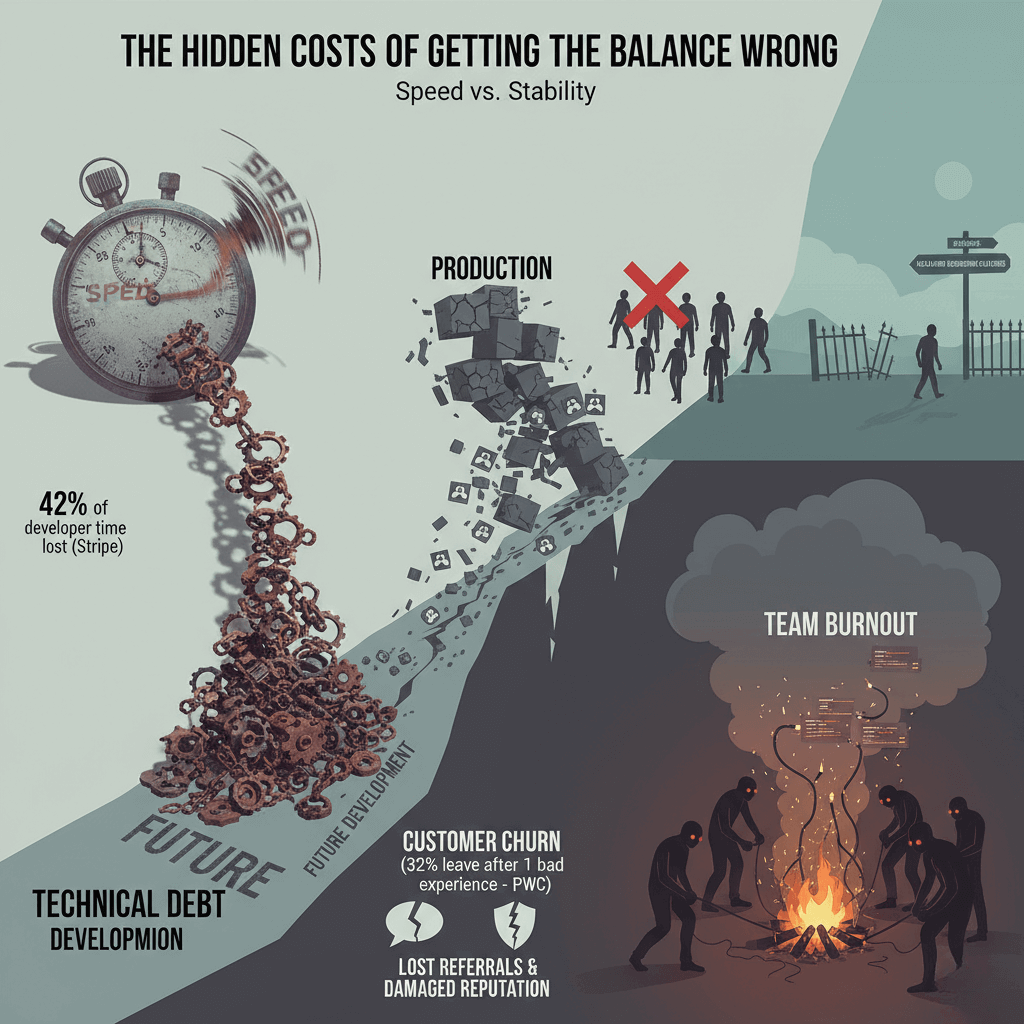
Technical debt accumulates silently when speed repeatedly wins over stability. Each shortcut creates drag on future development. Research from Stripe found that developers spend 42% of their time dealing with technical debt and bad code.
Customer churn accelerates when stability problems reach production. PwC research indicates that 32% of customers will leave a brand they love after just one bad experience. For B2B startups, lost customers also mean lost referrals and damaged reputation.
Team burnout follows extended periods of firefighting. Engineers who constantly fix production emergencies cannot do their best work. Talented developers leave for companies with healthier engineering cultures.
Founder-Level Framework to Balance Speed vs Stability
Start by defining acceptable risk for your current stage. What failures would be embarrassing versus catastrophic? A brief outage during low-traffic hours differs vastly from losing customer data.
Decide where speed matters most for your business right now. Customer-facing features that drive acquisition may need velocity. Internal tools may tolerate slower development cycles.
Stabilize only what directly impacts customers. Your checkout flow needs reliability. Your internal admin dashboard can tolerate occasional issues. Prioritize stability investments based on customer impact, not engineering perfectionism.
How Startup Stage Changes the Speed vs Stability Equation
During early traction, speed dominates. You are searching for product-market fit. The product will change substantially based on customer feedback. Heavy infrastructure investment may become worthless after pivots.
During growth and scale, the balance shifts toward stability. You have validated your market. Existing customers depend on your product. New customers expect reliability that matches your pricing.
Pre-fundraising periods demand visible operational maturity. According to Bessemer Venture Partners, investors evaluate infrastructure scalability alongside business metrics. Post-fundraising, you have runway to invest in stability foundations.
Where Infrastructure Decisions Create Scaling Risk
Deployment pipelines determine how quickly you can ship fixes when problems emerge. Manual deployments create bottlenecks. Automated pipelines with rollback capabilities let you move fast safely.
Monitoring and alerting systems define how quickly you detect problems. Without proper observability, issues can affect customers for hours before anyone notices. Datadog's State of Serverless report shows that organizations with mature monitoring practices resolve incidents 70% faster.
Capacity planning prevents sudden failures during traffic spikes. European SaaS companies often see concentrated usage patterns during business hours. Without headroom, success can cause outages at the worst possible moment.
Signals That You Need to Shift Toward Stability
Increasing incidents suggest your current balance has tilted too far toward speed. Track incident frequency and severity. A rising trend demands infrastructure investment.
Slower development velocity often results from accumulated technical debt. When simple changes require extensive testing because systems are fragile, stability investments actually enable future speed.
Customer trust erosion appears in support tickets, churn data, and sales conversations. When prospects ask about reliability or customers complain about downtime, the market is sending a clear signal.
How EaseCloud Helps Startups Scale Without Breaking Stability
EaseCloud works with European B2B startups to identify scaling risks before they become emergencies. Our infrastructure readiness reviews examine deployment pipelines, monitoring coverage, and capacity planning to find gaps that could cause problems during growth.
We help founders make informed decisions about where to invest limited engineering resources. Not every system needs enterprise-grade reliability. We help you determine which ones do and build appropriate foundations.
Our approach balances speed with reliability by implementing automation and observability that actually accelerates development while catching problems earlier.
Contact EaseCloud for a free infrastructure assessment tailored to your startup's current stage and growth plans.
Final Thoughts
Smart founders scale fast, but not blind. Speed and stability are not opposing forces to be traded against each other. They are complementary capabilities that elite teams develop together.
Reframe speed as intentional execution rather than reckless shipping. Build just enough stability infrastructure to support your current customers and near-term growth. Adjust the balance as your stage evolves.
The founders who scale successfully treat this as an ongoing calibration, not a one-time decision. They watch the signals, adjust their approach, and avoid both the trap of moving too slowly and the trap of building on unstable foundations.
FAQs
Is moving fast always risky for startups?
No. Moving fast with appropriate guardrails like automated testing, monitoring, and staged rollouts actually reduces risk compared to slow, manual processes. The DORA research shows elite teams achieve both higher velocity and higher stability.
When should startups prioritize stability?
Prioritize stability when you have validated product-market fit, when incidents are increasing, when customer trust is eroding, or when preparing for fundraising due diligence. The specific timing depends on your business context.
How can small teams maintain stability while scaling?
Focus stability investments on customer-facing systems. Use managed services that handle operational complexity. Implement monitoring and alerting so you catch problems quickly. Automate deployments to reduce human error.
Does technical debt always slow growth?
Technical debt slows growth when it affects systems that change frequently or impact customers directly. Some technical debt in rarely-changed systems may be acceptable. The key is making conscious decisions about where to accept debt.
How do investors view speed vs stability decisions?
Investors want to see appropriate decisions for your stage. Early-stage investors expect velocity. Growth-stage investors evaluate operational maturity. Demonstrating thoughtful balance signals strong technical leadership.