CTO vs AWS Consultant: Who Should Own Cloud Strategy?
CTO or AWS consultant for cloud strategy? Learn which ownership model works best for startups and how to create clear accountability for AWS decisions.
TLDR;
- Best model: CTO leads product-aligned decisions + consultant advises on architecture/cost/risk + founders maintain oversight
- Pure CTO ownership lacks AWS-specific depth; pure consultant ownership lacks product context
- Clear boundaries: CTO owns product/team decisions; consultants recommend and validate; founders stay informed for board
Cloud strategy ownership is one of the most misunderstood aspects of startup infrastructure. Founders often default to assigning it entirely to their CTO or outsourcing it completely to consultants.
Both extremes create problems. The right answer depends on your startup stage, team capabilities, and growth plans.
This guide breaks down the strengths and limitations of each approach and shows you how to create an ownership model that delivers results.
Why Cloud Strategy Ownership Matters for Founders
AWS decisions affect cost, scale, and reliability. According to Gartner's cloud spending analysis, organisations spend an average of 30% of their IT budget on cloud services. Without clear ownership, this spending lacks strategic direction.
Misaligned ownership creates long-term risk. When nobody truly owns cloud strategy, decisions happen reactively.
Issues get patched rather than solved. Architecture evolves haphazardly rather than intentionally. Technical debt accumulates until it constrains growth.
Founders are accountable for outcomes, even if they lack technical backgrounds. Investors, board members, and customers hold founders responsible for infrastructure reliability and cost management.
This accountability means founders need visibility into cloud strategy regardless of who executes it.
What "Owning Cloud Strategy" Actually Means
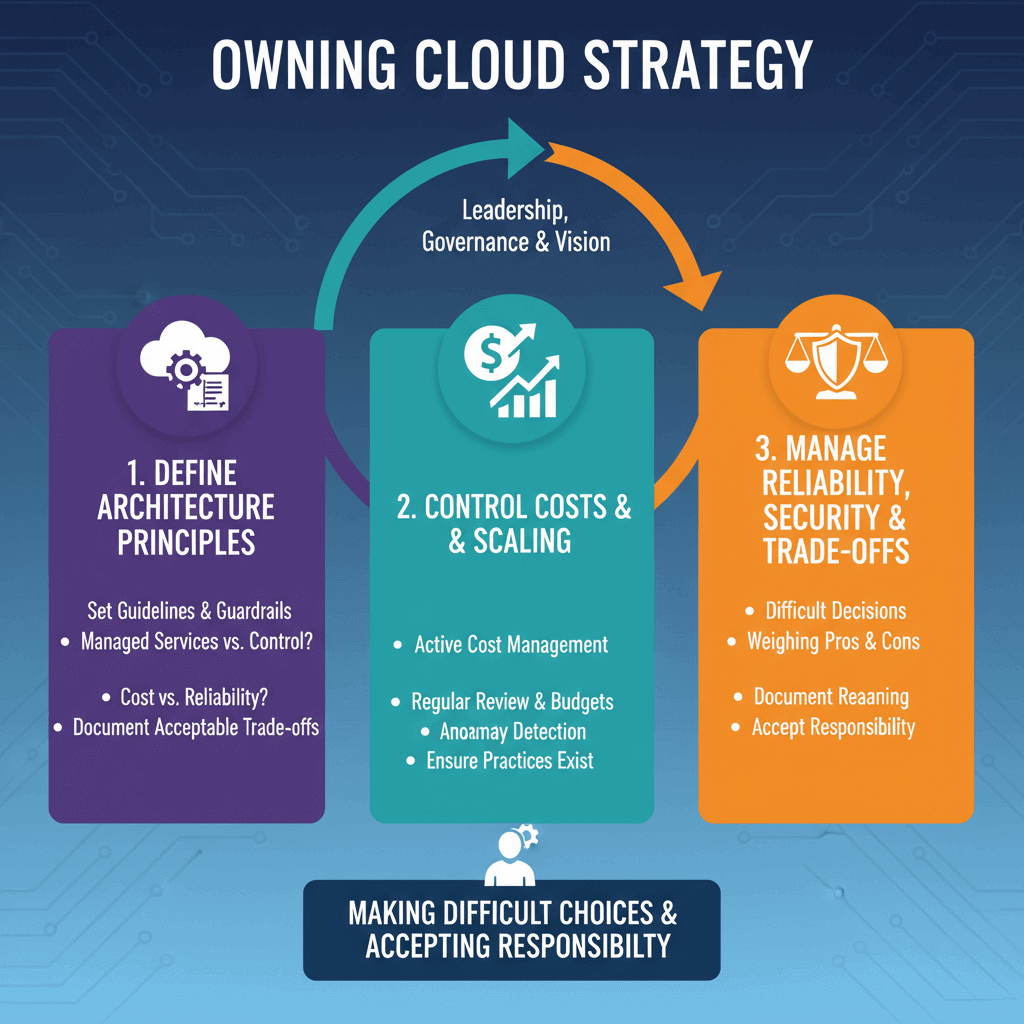
Defining architecture principles means setting the guidelines that shape infrastructure decisions. These principles address questions like: Do we prioritise managed services or control? How do we balance cost against reliability? What trade-offs are acceptable?
Controlling cloud costs and scaling plans requires active management. According to AWS cost optimization guidance, effective cost control needs regular review, clear budgets, and mechanisms to catch anomalies. Ownership means ensuring these practices exist.
Managing reliability, security, and trade-offs involves making difficult decisions. Every architectural choice involves trade-offs. The owner of cloud strategy makes these calls, documents the reasoning, and accepts responsibility for the consequences.
The CTO's Role in AWS Strategy
Strengths a CTO Brings to Cloud Strategy
Deep product and team context gives CTOs unique perspective. They understand what the application needs, how the engineering team works, and what constraints matter. This context shapes better architectural decisions.
Long-term technical vision ensures infrastructure decisions align with product direction. A CTO can anticipate how architectural choices affect features planned for the next twelve months, avoiding decisions that create future obstacles.
Internal execution ownership means the CTO can implement decisions directly. They manage the team doing the work and can ensure follow-through.
According to AWS Well-Architected Framework guidance, this integration between strategy and execution improves outcomes.
Where CTO-Led AWS Strategy Often Breaks Down
Limited AWS-specific depth is common. Most CTOs have broad technical expertise but may lack deep knowledge of AWS services, pricing models, and optimisation techniques. AWS offers over 200 services, and mastering them takes dedicated focus.
Operational overload dilutes attention. CTOs manage hiring, technical direction, team issues, and often write code. Adding full cloud strategy responsibility can exceed their capacity, leading to reactive rather than proactive management.
Bias toward building instead of optimising reflects engineering culture. CTOs often prefer creating new capabilities over improving existing infrastructure. This bias can lead to neglected cost management and deferred maintenance.
The AWS Consultant's Role in Cloud Strategy
Strengths an AWS Consultant Brings
AWS best practices and benchmarks provide valuable perspective. Consultants see dozens of implementations and understand what works. They bring pattern recognition that accelerates good decisions and helps avoid common mistakes.
Cost optimisation expertise often delivers immediate value. According to Flexera research, most organisations waste 28% of cloud spend. Consultants typically identify 20-40% savings in their first assessment.
Experience across multiple startup stages enables stage-appropriate advice. A consultant who has helped companies from seed to Series C understands what infrastructure makes sense when and how to plan transitions.
Limitations of Consultant-Owned Strategy
Less product context means consultants may miss nuances. They do not sit in your daily standups or understand why certain features matter. This distance can lead to technically sound but practically misaligned recommendations.
Not embedded in daily execution creates follow-through challenges. Consultants advise, but your team implements. Without strong handoff processes, recommendations can stall or get implemented incorrectly.
Risk of tactical rather than strategic focus emerges in engagement-based relationships. Consultants often optimise for clear deliverables within their scope rather than long-term strategic outcomes that extend beyond their engagement.
Common Founder Mistakes When Choosing Ownership
Assuming CTO equals cloud expert is the most frequent error. Technical excellence in software development does not automatically translate to AWS expertise. Cloud platforms are specialised domains requiring dedicated learning.
Outsourcing strategy entirely creates dependency without ownership. When consultants own strategy and leave, knowledge leaves with them. Your team lacks the understanding to maintain and evolve the architecture.
No single point of accountability leads to gaps. When ownership is shared without clear boundaries, important decisions fall between responsibilities. Issues persist because fixing them is nobody's specific job.
The Best Model: Shared Ownership With Clear Boundaries
CTO owns product-aligned decisions. Architecture choices that directly affect product capabilities, development velocity, and team operations belong to the CTO. They understand these impacts best.
AWS consultant advises on architecture, cost, and risk. Specialists bring expertise in AWS services, pricing optimisation, and reliability patterns. They provide recommendations and validate decisions rather than making them unilaterally.
Founder maintains strategic oversight. According to Y Combinator's guidance on technical leadership, founders should stay informed about infrastructure decisions even when not driving them. This visibility enables informed board conversations and strategic alignment.
How Founders Should Decide Who Owns AWS Strategy
Startup stage and growth plans shape the answer. Pre-seed companies with technical founders often handle cloud strategy internally. Growth-stage startups with scaling challenges benefit more from specialist involvement.
Team experience level matters significantly. If your CTO has led infrastructure at scale before, they may need minimal support. If they are earlier in their career or from a different technical background, consultant guidance adds value.
Cost sensitivity and runway influence the decision. Engaging consultants requires budget but typically delivers positive ROI through savings identified. Consider what runway you would gain or lose with each approach.
Red Flags That Your AWS Strategy Has No Real Owner
Rising costs with no explanation indicates absent ownership. When nobody can explain why bills increased, nobody is watching closely enough. Effective ownership means being able to attribute every significant cost change.
Repeated firefighting suggests reactive rather than proactive management. If your team constantly addresses infrastructure emergencies, the strategic layer is missing. Good cloud strategy prevents fires rather than fighting them.
No documented cloud decisions leaves institutional knowledge vulnerable. According to AWS documentation best practices, architectural decisions should be recorded with rationale. Missing documentation indicates missing strategic process.
How EaseCloud Supports Founder-Led AWS Strategy
EaseCloud acts as a strategic AWS partner rather than a replacement CTO. We complement your technical leadership with specialised cloud expertise, not compete with it.
We help CTOs make better AWS decisions by providing the benchmarks, best practices, and outside perspective that accelerate good choices. Our engagement model ensures knowledge transfer to your team.
We give founders clarity and confidence through clear reporting and explanations that translate technical infrastructure into business terms. You stay informed without needing to become an AWS expert yourself.
Final Takeaway
Founders must own the decision even if they do not own the tools. Cloud strategy is too important to delegate without oversight. Whether your CTO leads day-to-day or you engage consultants for support, maintain visibility and accountability at the founder level.
Clear responsibility frameworks beat title-based assumptions. Define who makes what decisions, who advises, and who reviews outcomes. Write it down, communicate it clearly, and revisit it as your startup evolves.
Leadership matters more than titles. The best cloud strategies emerge from founders who engage thoughtfully with infrastructure decisions, CTOs who acknowledge their knowledge boundaries, and consultants who empower rather than replace internal capabilities.
Discuss your cloud strategy ownership model with EaseCloud.
FAQs
Should a startup CTO manage AWS strategy alone?
Rarely. Most CTOs benefit from specialist support, whether for cost optimisation, architecture review, or ongoing advisory.
The question is degree of involvement, not whether to involve specialists at all.
When should founders bring in an AWS consultant?
Consider consultants when costs grow faster than revenue, before major scaling events, during fundraising preparation, or when your team lacks specific AWS expertise needed for upcoming projects.
Can AWS consultants replace a CTO?
No. Consultants lack the product context, team integration, and daily presence that technical leadership requires.
They complement CTO capability but do not substitute for it.
How do founders stay involved without micromanaging?
Establish regular review cadences, agree on metrics that indicate health, and create escalation triggers.
Stay informed through dashboards and summaries rather than participating in every decision.
What ownership model works best before fundraising?
Investors want to see clear accountability.
Whether your CTO or an external advisor leads cloud strategy, ensure someone can answer detailed questions about infrastructure costs, architecture rationale, and scaling plans during due diligence.