Building Your Startup's Cloud Strategy from Day One
A startup’s cloud strategy can fuel growth or drain runway—without planning, teams waste 35–40% on cloud spend, fight outages, and build debt, while smart foundations enable scalable, secure, and cost-efficient growth from day one.
Why Your Startup's Cloud Strategy Can't Wait
Here's a truth bomb: Your cloud strategy will either accelerate your startup's growth or become the technical debt that kills it. There's no middle ground.
I've seen startups burn through $50,000 monthly on unused cloud resources while struggling to handle basic traffic spikes. I've also seen two-person teams build platforms that scale to millions of users without breaking a sweat. The difference? They had a cloud strategy from day one.
Think of your cloud strategy like your startup's foundation. Build it wrong, and every floor you add makes the whole building shakier. Build it right, and you can scale to skyscraper heights. The best part? Unlike physical buildings, you can evolve your cloud architecture, but only if you plan for it from the start.
The Real Cost of No Strategy
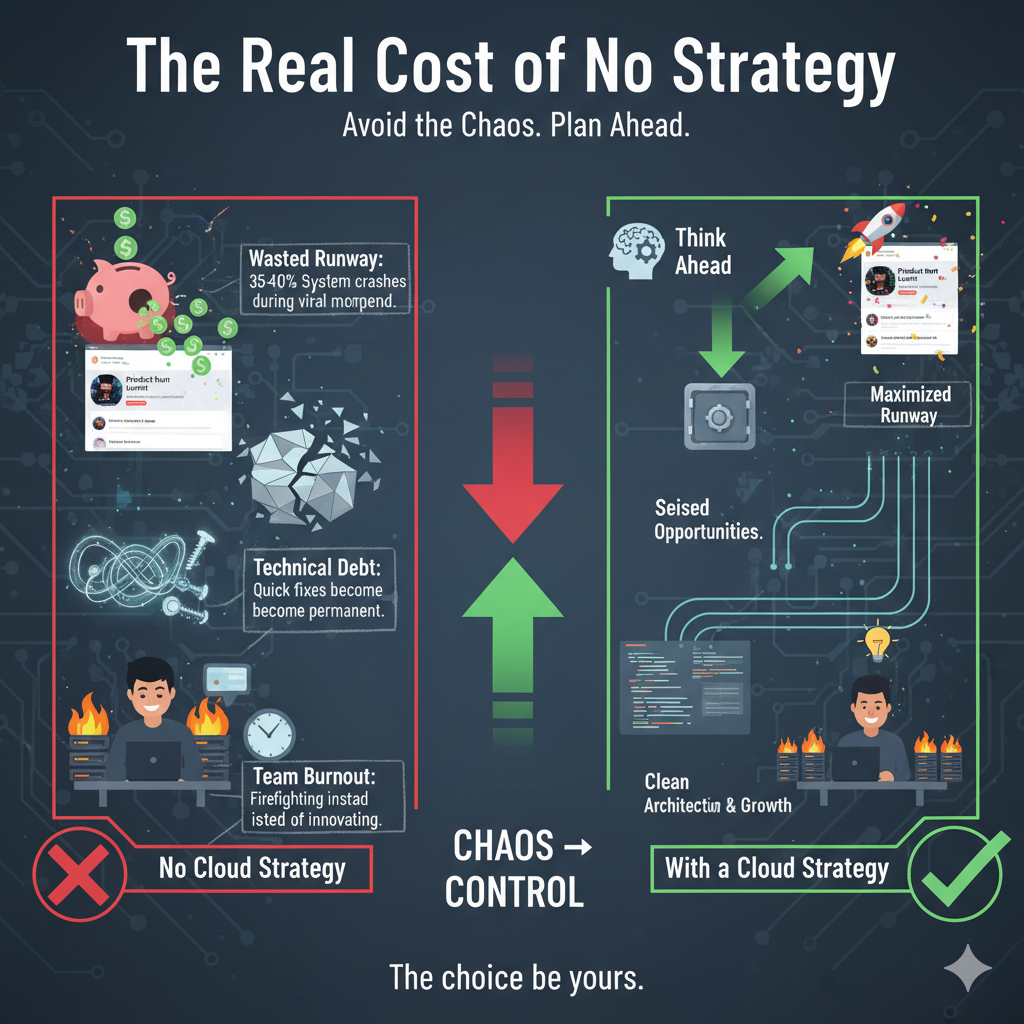
Let's talk about what happens without a cloud strategy. You start with a simple AWS account, spin up some servers, and things work great... until they don't.
Suddenly, your monthly cloud bill jumps from $500 to $5,000 because someone forgot to turn off that GPU instance. Your database crashes during your Product Hunt launch. Your lead engineer spends weekends firefighting instead of building features. Sound familiar?
Here's what poor cloud planning actually costs:
- Wasted runway: Startups without strategies waste 35-40% of cloud spend
- Lost opportunities: System crashes during viral moments you can't recreate
- Technical debt: Quick fixes that become permanent problems
- Team burnout: Engineers maintaining infrastructure instead of innovating
The irony? Avoiding these problems isn't complicated. It just requires thinking ahead.
Building Your Cloud Foundation
Start with Business Goals, Not Technology
Your cloud strategy should answer one question: How does this help us win? Every technical decision should map to a business objective.
Are you building a B2B SaaS product? You'll need rock-solid reliability and enterprise-grade security from the start. Creating a consumer app? Focus on global scalability and cost per user. Building an AI startup? Plan for massive compute spikes during model training.
Too many startups get seduced by cool technology. "Let's use Kubernetes!" they say, while their two-person team struggles to maintain it. Pick boring technology that works. You can always add complexity later.
Design for Evolution, Not Perfection
Your first architecture won't be your last, and that's okay. The key is building systems that can evolve without complete rewrites.
Start simple: A monolithic application with clear module boundaries. Use managed services like RDS for databases instead of running your own. Implement CI/CD from day one so changes are easy. Design your code so features can be extracted into microservices later.
One startup I know started with a single Laravel application. Two years later, they're processing millions of transactions daily with the same core architecture, just evolved. They added caching when queries got slow, CDN when they went global, and extracted their payment processing into a separate service when it needed different scaling. Evolution, not revolution.
Make Cost Optimization Cultural
In startups, every dollar matters. Cloud costs should be everyone's responsibility, not just the CTO's worry.
For a detailed breakdown of expenses and advantages, check out this guide on Fractional CTO cost & benefits.
Implement cost visibility from the beginning. Tag every resource with its owner and purpose. Set up billing alerts before you need them. Review costs weekly as a team. Celebrate cost optimizations like you celebrate new features.
Use the cloud's elasticity to your advantage. Dev environments should shut down at night. Use spot instances for batch processing. Leverage serverless for variable workloads. One startup reduced their bill by 60% just by implementing auto-shutdown for non-production resources.
Common Mistakes That Kill Startups
Over-Engineering Too Early
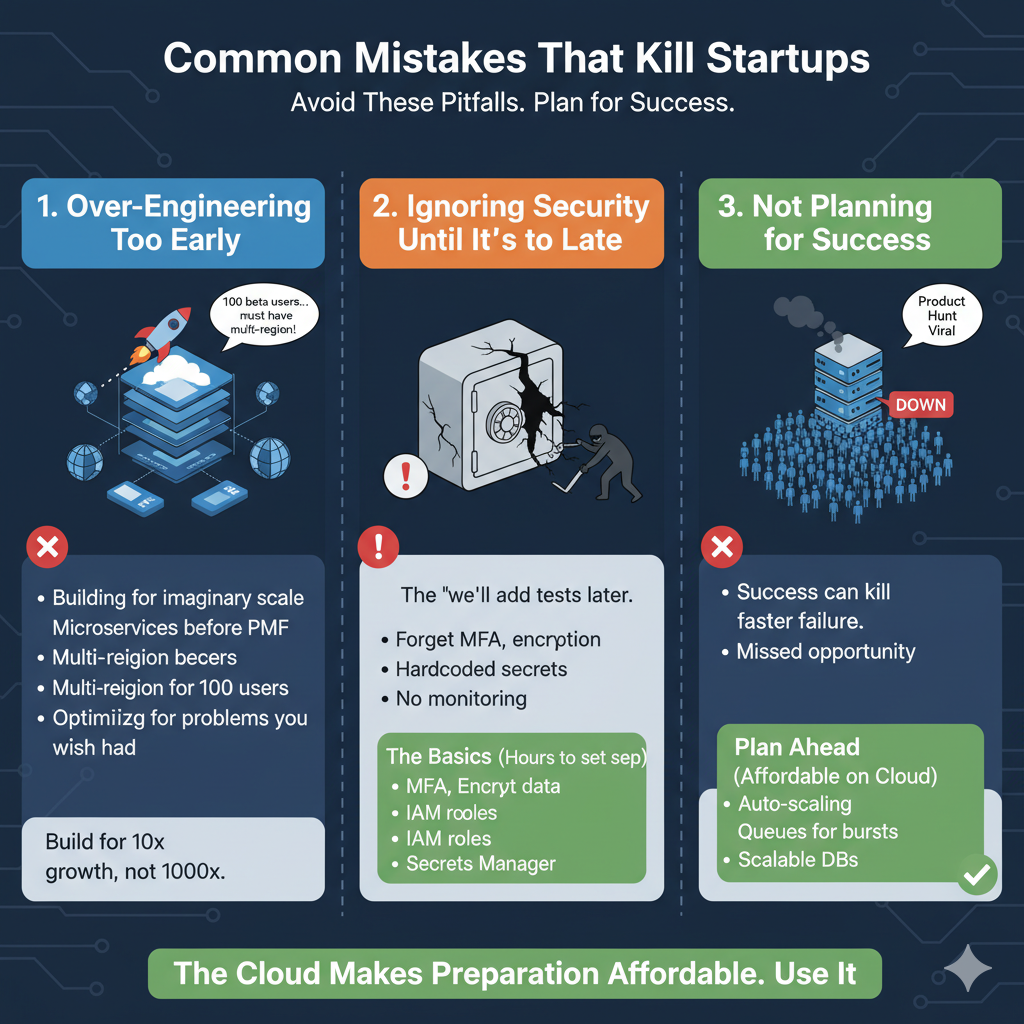
I see this constantly: Startups building for imaginary scale. They implement microservices before having product-market fit. They set up multi-region deployments for their 100 beta users. They optimize for problems they wish they had.
Here's the truth: It's better to have scaling problems than no users. Build for 10x growth, not 1000x. When you hit that 10x, you'll have resources (and reasons) to rebuild.
Ignoring Security Until It's Too Late
"We'll add security later" is the startup equivalent of "we'll add tests later", it never happens, and when it bites, it bites hard.
You don't need enterprise-grade security on day one, but you need the basics: Enable MFA for all accounts. Encrypt data by default. Use IAM roles, not access keys. Set up basic monitoring and alerts. Store secrets in a secrets manager, not in code.
These practices take hours to implement initially but months to retrofit later. Plus, investors increasingly scrutinize security during due diligence. Better to have good habits from the start.
Not Planning for Success
Ironically, success can kill startups faster than failure. Your Show HN post goes viral. TechCrunch features you. Suddenly, you have 100,000 users trying your product... and it's down.
Plan for traffic spikes from day one. Implement auto-scaling, even if you never need it. Use queues to handle burst traffic. Design databases that can scale horizontally. Test what happens when things go viral. The cloud makes this preparation affordable, use it.
When to Bring in Cloud Consultants
You don't need consultants for everything, but knowing when to call them can save your startup. Here's when outside expertise pays off:
During initial architecture: A two-week engagement to review your plans can prevent months of rework. Think of it as insurance against expensive mistakes.
Before major scaling events: Launching a big partnership? Preparing for Black Friday? Consultants can ensure you're ready for 100x traffic.
When things break: If you're firefighting constantly, consultants can help you break the cycle and build sustainable solutions.
For specific expertise: Need to pass SOC 2 compliance? Implementing machine learning pipelines? Sometimes specialized knowledge is worth buying.
Many consultants offer startup-friendly pricing, including equity arrangements or deferred payment. The key is finding consultants who understand startup constraints and can provide focused, high-impact help.
Measuring Cloud Strategy Success
How do you know if your cloud strategy is working? Track these metrics:
Cost per customer: This should decrease as you scale. If it's increasing, something's wrong.
Deployment frequency: Can you ship features daily? If not, your infrastructure might be the bottleneck.
Recovery time: How fast can you recover from failures? Minutes is good, hours is acceptable, days means trouble.
Developer productivity: Are engineers building features or fighting fires? Track the ratio.
Scale readiness: Can you handle 10x traffic without manual intervention? Test it regularly.
Your Cloud Strategy Action Plan
Ready to build your cloud strategy? Here's your roadmap:
- Define your North Star: What business outcome does your cloud strategy serve?
- Start simple, think evolution: Build the minimum viable infrastructure that can grow with you
- Implement cost controls: Set up tagging, monitoring, and alerts before you need them
- Automate everything: CI/CD, scaling, backups, if you do it twice, automate it
- Plan for success: Build systems that can handle viral growth without your intervention
- Measure and iterate: Review your strategy monthly and adjust based on what you learn
The Bottom Line
Your startup's cloud strategy isn't about technology, it's about building a foundation for growth. Get it right, and the cloud becomes your unfair advantage: infinite scalability, global reach, and enterprise capabilities at startup prices.
Get it wrong, and you'll waste precious runway on infrastructure problems while competitors focus on customers.
The good news? You don't have to be perfect. You just need to be thoughtful. Start with clear business goals, build for evolution, and maintain the discipline to optimize continuously.
Your cloud strategy is an investment in your startup's future. The best time to create it was when you started. The second-best time is now. Don't wait until you're drowning in technical debt or bleeding cash on cloud bills.
Take control of your cloud destiny today. Your future scaled-up self will thank you.
Frequently Asked Questions
What is a cloud strategy and why does my startup need one?
A cloud strategy is a plan that defines how your startup will use cloud technologies to support your business goals. It helps you avoid wasted spend, scale reliably, and build a strong foundation for growth. Without a strategy, startups often face runaway costs, system failures, and technical debt that slows progress.
When should my startup start planning its cloud strategy?
The best time to build your cloud strategy is from day one. Planning early ensures that your architecture evolves sustainably as you scale, rather than forcing costly rewrites or firefighting later.
What common mistakes should startups avoid when building a cloud strategy?
Startups often over-engineer too early by adopting complex technologies before product-market fit, ignore basic security practices, or fail to plan for success (like traffic spikes). Focusing on simplicity and evolution is key.
How can I keep cloud costs under control while growing?
Cost optimization should be part of your culture. Use resource tagging, billing alerts, auto-scaling, and regular cost reviews to track and reduce unnecessary spend. Making every team member accountable for cost helps protect your runway.
What metrics should I track to measure the success of my cloud strategy?
Track metrics like cost per customer, deployment frequency, recovery time from failures, and scale readiness. These indicators show whether your cloud setup supports business growth efficiently.