Designing Cloud-Native Architectures
Explore cloud-native architecture patterns—microservices, event-driven design, Saga, CQRS, API Gateways, and Service Meshes—for resilient, scalable systems.
Introduction
Cloud native architecture patterns provide reusable solutions to common challenges in distributed cloud environments. These patterns enable independent scaling through microservices, maintain data consistency via event-driven architectures like Saga and CQRS, and manage cross-cutting concerns through API Gateways and Service Meshes. Mastering these patterns is essential for building resilient, scalable cloud native systems.
Microservices Architecture
Microservices structure applications as collections of small, independently deployable services focused on specific business capabilities. Each service owns its data and business logic, communicating through well-defined APIs using REST over HTTP or asynchronous messaging.
Benefits include improved scalability through independent service scaling, enhanced resilience as failures don't cascade across the system, faster development cycles with focused teams working on discrete services, and technology diversity enabling optimal tool selection per service.
Challenges introduce significant complexity. Distributed systems require sophisticated service discovery, load balancing, and fault tolerance. Data consistency becomes difficult when transactions span services, requiring patterns like Saga or eventual consistency. Network latency and reliability become critical concerns as inter-service communication increases.
Best practices include designing services around business domains using Domain-Driven Design, implementing API contracts with versioning strategies, adopting database-per-service patterns for true independence, implementing circuit breakers and retry logic for resilience, and investing in comprehensive observability through distributed tracing.
The Strangler Fig pattern enables gradual migration from monoliths by routing specific functionality to new microservices while maintaining the existing monolith, eventually replacing the legacy system entirely. This incremental approach reduces risk and enables teams to learn microservices patterns while delivering continuous value.
Event-Driven Architecture
Event-driven architecture enables services to communicate asynchronously through events. Producers emit events to brokers without knowing consumers, while subscribers process events independently. This publish-subscribe model supports complex workflows without tight coupling.
Benefits include improved scalability as producers and consumers scale independently, enhanced resilience through buffering and retry mechanisms, better extensibility as new consumers are added without modifying producers, and natural support for real-time processing.
Modern event streaming platforms like Apache Kafka, AWS Kinesis, and Azure Event Hubs provide durable, ordered event logs enabling both real-time processing and historical replay. These platforms support complex event processing including filtering, aggregation, and correlation across streams.
Key patterns include Event Notification where services emit events about state changes, Event-Carried State Transfer where events contain complete state information eliminating queries to producers, and Event Sourcing where all state changes are stored as immutable event sequences.
Implementing event-driven architecture requires attention to event schema design and versioning, delivery semantics (exactly-once vs. at-least-once), event ordering guarantees, and failure handling. Dead-letter queues capture unprocessable events, idempotent consumers handle duplicates safely, and compensating transactions provide failure recovery mechanisms.
Managing Distributed Transactions with Sagas
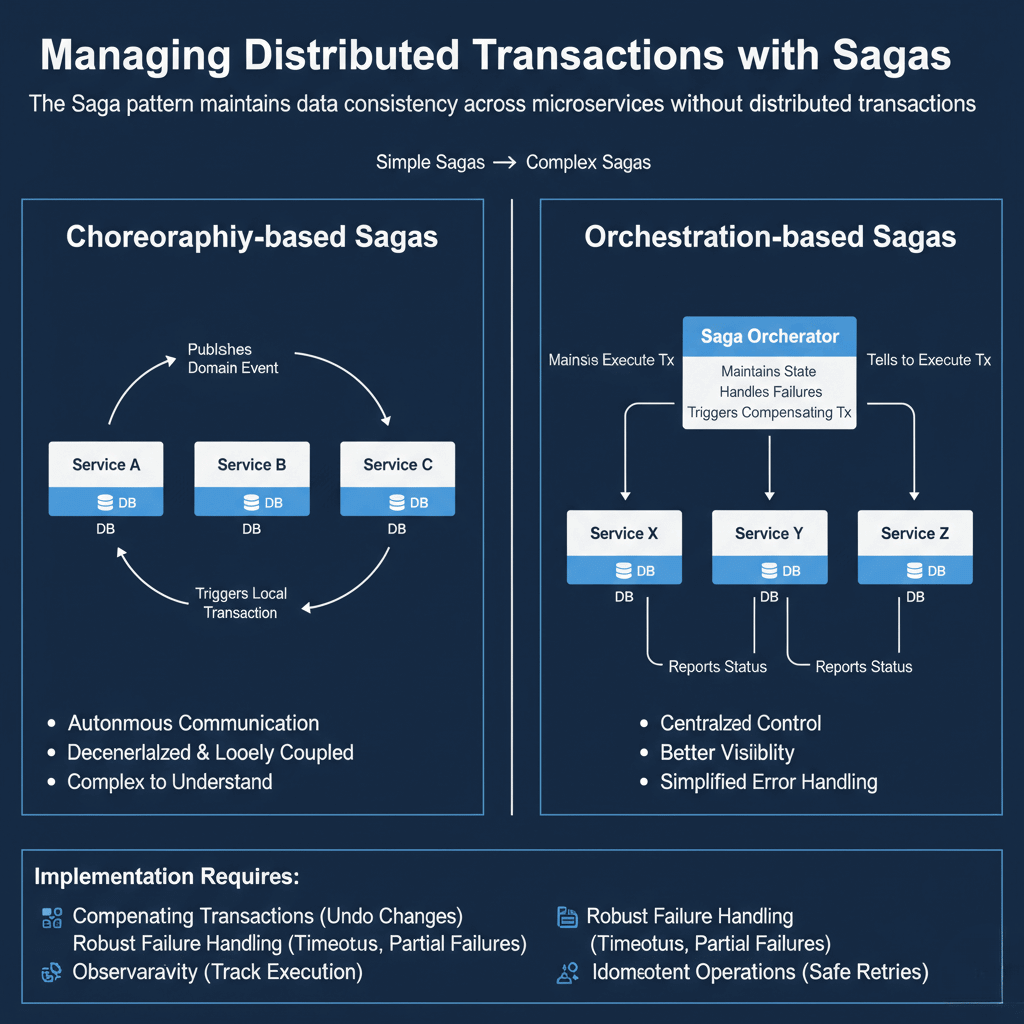
The Saga pattern maintains data consistency across microservices without distributed transactions. A saga represents a sequence of local transactions where each updates its database and publishes events triggering the next step. When failures occur, compensating transactions undo preceding changes.
Choreography-based sagas have each service publish domain events triggering local transactions in other services. Services communicate autonomously without central coordination, promoting decentralization and loose coupling. This approach can become difficult to understand as sagas grow complex.
Orchestration-based sagas use central orchestrators telling participants what transactions to execute. Orchestrators maintain saga state, handle failures, and trigger compensating transactions when necessary. This provides better visibility and simplifies error handling but introduces a central component.
Choosing between choreography and orchestration depends on complexity. Simple sagas with few steps benefit from choreography's simplicity. Complex workflows with many participants or sophisticated error handling justify orchestration's additional structure.
Implementation requires careful design of compensating transactions that semantically undo operations, robust handling of partial failures and timeouts, observability to track execution across services, and idempotent operations to safely handle retries.
Separating Reads and Writes with CQRS
Command Query Responsibility Segregation separates reading data from modifying data using different models. Commands change system state while queries retrieve data for display, enabling independent optimization of each path.
The separation allows write models to focus on enforcing business invariants and maintaining transactional integrity while read models denormalize data into query-optimized views. Read models might aggregate data from multiple write models, pre-compute calculations, or structure data for specific UI requirements.
CQRS pairs naturally with Event Sourcing where the write side stores state changes as immutable events. Read models subscribe to these events, building materialized views optimized for queries. This combination provides complete audit trails, temporal queries, and ability to rebuild read models when requirements change.
Benefits include independent scaling of read and write workloads, optimized data models for different access patterns, improved security through clear command/query separation, and better performance through specialized read models. Systems with high read-to-write ratios or complex business logic requiring strong consistency on writes benefit most.
CQRS introduces complexity through eventual consistency between command and query models, requiring UI considerations, maintaining multiple data representations increasing operational overhead, and potential overuse. Apply selectively to bounded contexts where benefits justify complexity, not as blanket architectural approach.
Using API Gateways and Service Meshes
API Gateway provides a single entry point for client applications to access backend microservices. Gateways handle request routing to appropriate services, API composition aggregating multiple service calls, protocol translation, and authentication/authorization before requests reach internal services.
Advanced capabilities include rate limiting and throttling preventing abuse, request/response transformation adapting internal APIs to client needs, caching reducing backend load, and circuit breaking preventing cascading failures. Premium gateways like Kong, Apigee, AWS API Gateway, and Azure API Management provide these features as managed services.
Best practices include implementing multiple gateways for different client types using the Backend for Frontend pattern, deploying gateways redundantly across availability zones, implementing comprehensive observability, and carefully managing API versioning strategies.
Service Mesh provides dedicated infrastructure for service-to-service communication, implementing cross-cutting concerns without requiring application code changes. The data plane comprises lightweight proxies (often Envoy) deployed as sidecars intercepting network communication. The control plane configures proxies, distributes policies, and collects telemetry.
Service meshes provide sophisticated traffic management through intelligent load balancing, canary deployments, traffic shifting, and fault injection. Security features include automatic mutual TLS encryption, fine-grained access control policies, and certificate management. Observability capabilities automatically collect metrics, distributed traces, and access logs for all service communication.
Despite powerful benefits, service meshes introduce operational complexity and performance overhead. Organizations should adopt when microservices environments reach sufficient complexity that manual management of cross-cutting concerns becomes unsustainable, typically with dozens or more production services.
Conclusion
Cloud native architecture patterns provide proven solutions for building resilient, scalable distributed systems. Microservices enable independent deployment and scaling, event-driven architecture decouples services through asynchronous communication, Saga and CQRS patterns handle data consistency challenges, and API Gateways and Service Meshes manage infrastructure concerns.
Success requires thoughtfully combining patterns aligned to specific contexts and requirements. Start with foundational patterns like containerization and 12-factor principles, then progressively introduce more sophisticated patterns as complexity and scale demand them. Balance architectural sophistication with developer accessibility, and continuously refine implementations based on operational experience.
Mastering these patterns enables architects to design systems delivering exceptional business value while maintaining the operational characteristics modern cloud platforms demand.