Build Usage-Based Pricing That Maximizes Revenue
Implement usage-based pricing models for SaaS products using metering infrastructure, billing platforms, and pricing strategies that align costs with customer value.
TL;DR
- Usage-based pricing is now dominant: 85% of software companies use or plan consumption-based pricing. Organizations report 38% faster revenue growth compared to subscription-only models, with higher net dollar retention.
- Pick value metrics that align with customer value: Charge for what customers actually value—API calls, data processed, active users, compute hours. Avoid confusing metrics that make costs unpredictable. Start with one primary metric; add secondary only when necessary.
- Metering infrastructure must be accurate and scalable: Capture every billable event reliably using event-driven architectures (Kafka, Kinesis). Implement idempotency to prevent duplicate billing. Provide real-time usage dashboards so customers see consumption and avoid bill shock.
- Hybrid models win: Combine base subscription (60-70% of revenue) for predictability with usage charges (30-40%) for expansion. Pure usage-based works for infrastructure/APIs; subscriptions alone leave expansion on the table.
- Forecast usage-based revenue by cohort: Analyze how new customers grow usage over months 1-12—most follow predictable trajectories. Segment by usage tier (light vs. power users) for accurate projections. Specialized tools (Drivetrain, Mosaic) improve accuracy at scale.
- Migrate existing customers gradually over 12-18 months: Offer opt-in incentives for early migration; require transition at renewal. Grandfather long-tenured customers on legacy pricing to prevent churn.
Usage-based pricing has become the dominant SaaS pricing model, with 85% of software companies implementing or planning consumption-based pricing.
This shift reflects changing customer expectations for pricing transparency and alignment between costs and value delivered. Organizations implementing usage-based models report 38% faster revenue growth compared to traditional subscription-only approaches.
The challenge lies in selecting appropriate value metrics, implementing accurate metering infrastructure, and designing pricing tiers that capture value while remaining competitive.
Hybrid models combining base subscriptions with usage charges deliver optimal results for most SaaS businesses, providing predictable baseline revenue while enabling expansion as customers derive greater value.
This guide explores value metric selection, metering implementation, billing platform integration, and pricing tier design for successful usage-based pricing.
Selecting Value Metrics
Value metrics determine what customers pay for and directly impact pricing perception. Effective metrics correlate clearly with customer value delivery, enabling customers to predict costs easily. Common SaaS value metrics include API calls or requests processed, data stored or processed, active users or seats, compute hours or serverless invocations, and transactions or messages delivered.
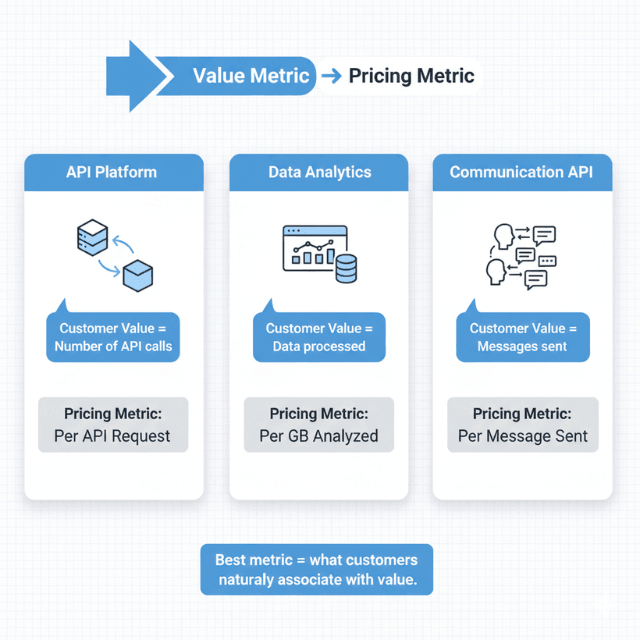
The optimal metric aligns with how customers experience value. A data analytics platform might charge per query executed or gigabyte analyzed. A communication API charges per message sent or minute consumed. Machine learning platforms bill for training hours and inference requests. Avoid metrics that confuse customers or create unpredictable billing.
Multiple value metrics work for complex products offering diverse capabilities. Snowflake separates storage and compute pricing. Datadog charges for hosts monitored plus custom metrics. This granularity provides clarity but increases complexity. Start with a single primary metric and add secondary metrics only when necessary for fair value capture.
Metering Infrastructure
Accurate usage metering forms the foundation of usage-based pricing. Every relevant event must be captured, deduplicated, and stored reliably for billing. Event-driven architectures using Kafka, AWS Kinesis, or cloud-native event buses provide scalable, reliable metering infrastructure.
Metering systems must handle scale, processing thousands or millions of events per second during peak usage. Implement idempotency preventing duplicate billing from retried events. Store usage data with sufficient retention for billing disputes and compliance requirements, typically 12-24 months.
Real-time usage visibility empowers customers to monitor consumption and predict costs. Provide dashboards showing current usage, month-to-date costs, and projected end-of-month totals. Usage alerts notify customers when approaching thresholds, preventing bill shock from unexpected consumption spikes.
Billing Platform Selection
Usage-based billing platforms handle metering aggregation, pricing calculation, and invoice generation. Leading platforms include Stripe Billing for integrated payment processing, Orb for flexible pricing experimentation, Maxio for complete financial operations integration, Chargebee for user-friendly metered billing, and Lago for open-source customization.
Evaluate platforms on metering scalability supporting event volumes, pricing flexibility accommodating complex tier structures, integration quality with CRM and accounting systems, customer visibility features including usage dashboards, and revenue recognition compliance for financial reporting.
Cloud provider native tools like AWS Marketplace Metering Service integrate directly with cloud resource consumption but limit pricing flexibility. Third-party platforms provide more sophisticated pricing models and better customer experience at the cost of additional integration complexity.
Pricing Tier Design
Hybrid models combining base subscriptions with usage charges deliver optimal results for most SaaS companies. The subscription component provides predictable baseline revenue while usage charges capture expansion as customers grow. Allocate 60-70% of expected revenue to base subscription with 30-40% from usage for balanced predictability and growth.
Pure usage-based pricing works for infrastructure and developer tools where consumption directly correlates with value. AWS Lambda charges purely for invocations and duration. Twilio bills per API call. This model maximizes flexibility but creates revenue unpredictability requiring sophisticated forecasting.
Tiered usage pricing applies volume discounts as consumption increases. Lower per-unit costs at higher volumes incentivize growth while rewarding larger customers. Design tiers balancing customer value perception against desired gross margins, typically targeting 70-85% for healthy SaaS businesses.
Revenue Forecasting
Usage-based revenue forecasting proves more complex than subscription models but follows predictable patterns. Analyze historical cohorts identifying how new customers grow usage over months 1-12. Most customers exhibit consistent growth trajectories enabling reliable forecasting.
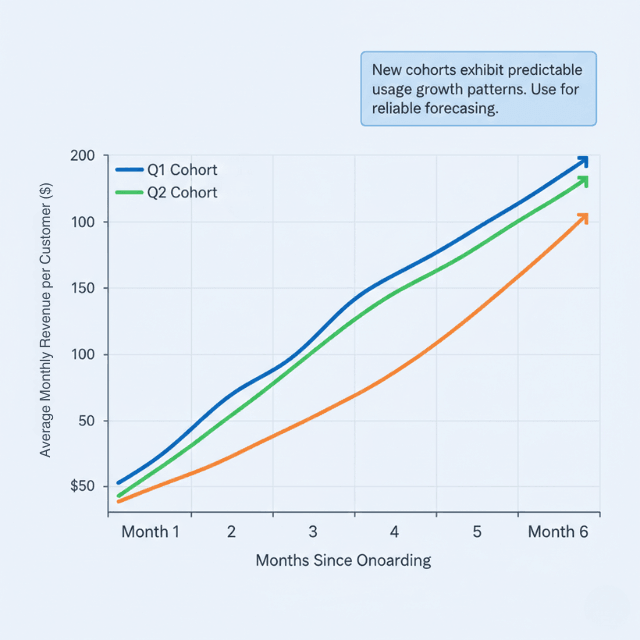
Segment customers by usage tiers forecasting each separately. Light users show different patterns than power users. Weighted forecasts across segments provide more accurate projections than aggregate approaches. Layer in new customer acquisition assumptions and expansion rates.
Specialized tools like Drivetrain, Mosaic, or built-in Maxio forecasting incorporate machine learning improving accuracy over time. Manual forecasting in spreadsheets works initially but scale challenges emerge with complex multi-metric pricing and large customer bases.
Implementation Best Practices
Start with hybrid models rather than pure usage-based pricing. The subscription component de-risks revenue while you refine usage metering and customer value metrics. Test pricing with pilot customers gathering feedback before full rollout.
Migrate existing customers gradually over 12-18 months. Offer opt-in incentives for early migration then require transition at renewal. Grandfather long-tenured customers on legacy pricing preventing churn from pricing changes.
Monitor cost-to-serve ensuring pricing maintains target gross margins. Usage-based pricing should align with underlying cloud costs preventing margin compression as customers scale. Regularly review cloud infrastructure costs adjusting pricing when necessary to maintain healthy unit economics.
Conclusion
Usage-based pricing aligns costs with customer value, driving faster growth and improved retention compared to traditional subscription models. Success requires thoughtful value metric selection correlating with customer outcomes, robust metering infrastructure capturing every billable event accurately.
Flexible billing platforms handling complex pricing calculations, and hybrid models balancing predictable subscription revenue with usage-based expansion. Implement gradual customer migration and continuous monitoring validating that pricing maintains target margins while delivering customer value.
Organizations mastering usage-based pricing report 38% faster revenue growth, higher net dollar retention, and stronger customer alignment through transparent value-based pricing models.
Frequently Asked Questions
Should I use pure usage-based pricing or hybrid subscription plus usage?
Hybrid models work best for most SaaS companies, providing 60-70% predictable subscription revenue with 30-40% usage-based expansion.
Pure usage-based pricing suits infrastructure tools and APIs where consumption directly correlates with value. Subscriptions with usage overlays balance revenue predictability against growth potential.
How do I prevent bill shock for customers on usage-based pricing?
Provide real-time usage dashboards showing current consumption and projected month-end costs. Implement spending alerts at customizable thresholds like 80%, 100%, and 120% of expected spend.
Offer usage caps allowing customers to set hard limits preventing runaway costs. Transparent pricing calculators help customers estimate costs before onboarding.
What metrics should I track for usage-based pricing success?
Monitor revenue predictability through variance between forecasts and actuals. Track net dollar retention showing expansion from usage growth. Measure cost-to-serve ensuring pricing maintains target gross margins of 70-85%.
Analyze usage distribution across customer tiers identifying concentration risks or underutilized capacity. Review customer feedback on pricing transparency and fairness.
Summarize this post with:
Ready to put this into production?
Our engineers have deployed these architectures across 100+ client engagements — from AWS migrations to Kubernetes clusters to AI infrastructure. We turn complex cloud challenges into measurable outcomes.