How to Forecast AWS Costs Before Scaling Users
Learn to forecast AWS costs accurately before scaling users. Practical methods for startups to predict cloud spend and avoid budget surprises.
TLDR;
- Cost forecasting prevents budget surprises by modeling user growth → infrastructure costs
- Key steps: Baseline from 3-6 months data, model 2x/5x/10x scenarios, account for peak vs average, include migration costs
- AWS tools extrapolate history but fail at scenario modeling — supplement with your own analysis
User growth should bring celebration, not budget panic. Yet many startups discover their AWS bill has tripled after successfully acquiring customers, turning a growth milestone into a financial crisis. Accurate cost forecasting transforms this uncertainty into predictable planning.
This article explains how to forecast costs using AWS cost optimization principles before scaling users. You will learn what drives cloud costs during growth, how to model different scenarios, and where native AWS tools fall short. By the end, you can build forecasts that give your finance team confidence and your engineering team clear targets.
Why Forecasting AWS Costs Is Critical Before User Growth
Scaling multiplies infrastructure spend in ways that surprise teams accustomed to stable bills. A tenfold user increase rarely means tenfold cost increase, but the actual multiplier depends on architectural decisions and usage patterns that require analysis to understand.
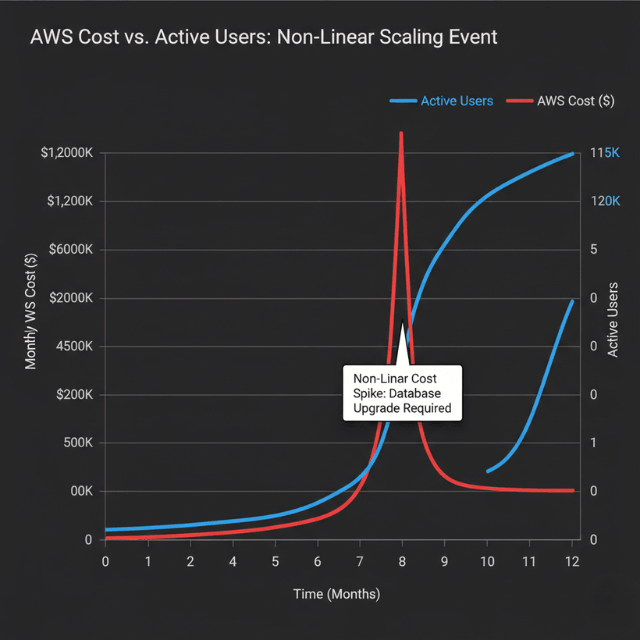
Unplanned cost spikes reduce runway at precisely the moment startups need capital for customer acquisition and product development. According to CNCF's 2024 FinOps report, 49% of organizations cite lack of cost predictability as a major challenge.
Forecasting enables confident growth decisions. When founders understand the cost implications of reaching 50,000 users versus 100,000 users, they can align infrastructure investment with business milestones and communicate realistic budgets to investors.
Why Most Startups Struggle with AWS Cost Forecasting
Many startups base forecasts solely on current AWS bills, assuming future costs will follow past patterns. This approach ignores architectural thresholds where costs increase non-linearly.
Assuming costs scale linearly with users leads to underestimation. A database that costs 500 EUR monthly for 10,000 users might require a larger instance type at 50,000 users, jumping to 2,000 EUR monthly rather than the expected 2,500 EUR.
Ignoring usage-based pricing models causes forecasting errors. Services like Amazon DynamoDB charge based on read and write operations, not user counts. Understanding how user behavior translates to service usage requires domain-specific analysis.
What Actually Drives AWS Costs as Users Scale
Compute usage patterns determine EC2 and container costs. More users typically mean more application instances, but the relationship depends on request patterns, session duration, and resource efficiency. Optimize compute before scaling to reduce the multiplier.
Storage and data growth accumulate over time. Each user generates data that persists in databases, S3 buckets, and backup systems. Unlike compute, which can scale down during low-traffic periods, storage costs persist continuously.
Data transfer and API usage create hidden expenses. AWS data transfer pricing charges for data leaving AWS regions and moving between services. High-traffic applications with external API calls or cross-region architectures face significant transfer costs.
Managed services carry hidden charges beyond base pricing. Features like automated backups, enhanced monitoring, and premium support tiers add costs that scale with usage. Review service pricing pages completely, not just headline rates.
Mapping User Growth to Infrastructure Usage
Translating users into resource demand requires understanding your application's characteristics. Measure current per-user metrics including average requests per session, data stored per user, and compute time per request.
Identify per-user cost drivers by categorizing spending. Which costs increase with active users? Which increase with total registered users? Which remain fixed regardless of user count? This categorization enables accurate modeling.
Understanding non-linear scaling behavior prevents surprises. Database connections might support 1,000 concurrent users but require architectural changes at 5,000. Caching effectiveness might decrease at scale. Document these thresholds from your architecture.
A Step-by-Step Approach to Forecast AWS Costs
Establish a Baseline from Current Usage
Export three to six months of billing data from AWS Cost Explorer. Categorize spending by service, tag costs by application component, and identify trends. This baseline anchors your projections in real data.
Model Multiple Growth Scenarios
Create forecasts for 2x, 5x, and 10x user growth. Each scenario requires different assumptions. At 2x, current architecture likely holds. At 10x, you probably need architectural changes. Model both the infrastructure needed and the transition costs.
Account for Peak vs Average Usage
Traffic varies throughout the day and week. Peak usage might be 3x average usage. Ensure your forecast accounts for provisioning capacity to handle peaks while calculating average costs based on actual utilization patterns.
Include One-Time and Scaling-Related Costs
Migration costs, architectural improvements, and tooling investments precede scale. A database upgrade might cost 5,000 EUR in engineering time plus downtime risk. Include these transitional expenses in your total cost model.
AWS Tools That Help with Cost Forecasting
AWS Cost Explorer provides historical analysis and basic forecasting based on past trends. The forecasting feature projects future spend assuming current patterns continue, useful for stable environments but less accurate during growth phases.
AWS Budgets tracks spending against targets and alerts when forecasts indicate budget overruns. Setting forecasted amount alerts provides early warning when spending trajectories change.
Native tools fall short for scenario modeling. AWS tools extrapolate from history rather than modeling architectural changes or user growth scenarios. Startups planning significant growth need supplementary analysis beyond built-in features.
Common Forecasting Mistakes That Lead to Budget Surprises
Overlooking data transfer costs affects applications with mobile clients, external API integrations, or multi-region deployments. Transfer costs often exceed initial estimates because teams focus on compute and storage during planning.
Underestimating database scaling causes forecast errors because databases require careful capacity planning. Connection pooling, read replicas, and instance sizing decisions affect costs significantly. Model database growth separately from application compute.
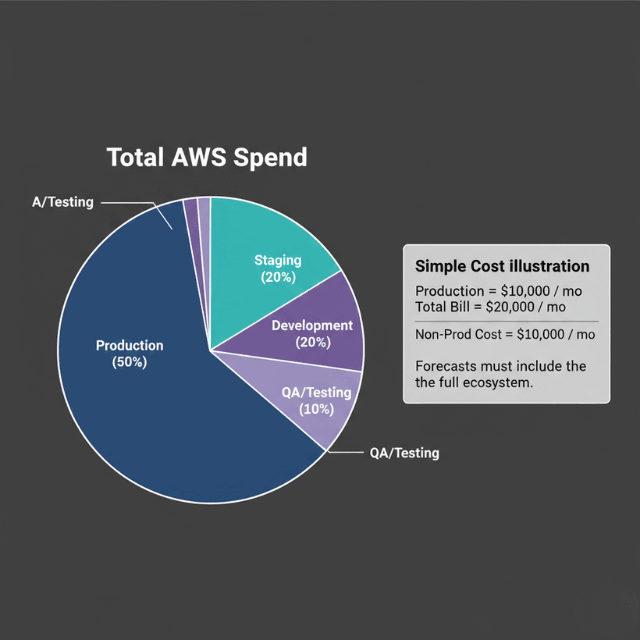
Forgetting non-production environments inflates actual costs beyond forecasts. Development, staging, and testing environments multiply infrastructure spend. If production costs 10,000 EUR monthly and you maintain three non-production environments at 30% capacity each, add 9,000 EUR to your forecast.
Balancing Cost Forecasting with Performance and Reliability
The cheapest possible setup creates reliability risks. Minimal redundancy saves money until an outage costs more in lost revenue and reputation than the savings accumulated. Factor reliability requirements into cost models.
Performance versus cost trade-offs require business context. A 50ms latency improvement might justify 2,000 EUR monthly for a trading platform but not for a content management system. Align technical decisions with business value.
Forecasts should reflect business priorities, not just technical minimums. If reliability is paramount, forecast for Multi-AZ deployments and adequate headroom. If rapid iteration matters, include buffer for experimentation and quick scaling.
When AWS Cost Forecasting Becomes Too Complex Internally
Rapid or unpredictable growth makes forecasting difficult. When user acquisition depends on viral factors or enterprise sales with variable deal sizes, forecasting becomes scenario planning across wide ranges.
Multiple services and regions multiply complexity. A startup using 15 AWS services across three regions faces combinatorial complexity that exceeds spreadsheet-based analysis. Service interactions create dependencies that simple models miss.
Limited in-house cloud expertise affects forecast accuracy. Teams without deep AWS experience miss pricing nuances, optimization opportunities, and architectural alternatives that significantly affect cost projections.
How EaseCloud Helps Startups Forecast AWS Costs Accurately
EaseCloud provides growth-based cost modeling that translates business projections into infrastructure cost forecasts. We analyze your architecture, usage patterns, and growth targets to build models that account for non-linear scaling and architectural transitions.
Scenario planning and projections give founders confidence for fundraising conversations and budget planning. We model multiple growth trajectories and identify the decision points where architectural changes become necessary.
Ongoing cost governance support keeps forecasts accurate as your infrastructure evolves. Quarterly reviews compare actual costs to projections, refine models based on observed patterns, and adjust for business changes. European startups benefit from our understanding of EU data residency requirements and their cost implications.
Final Thoughts: Scale Users with Financial Confidence
AWS cost forecasting requires understanding your architecture, your usage patterns, and the pricing models of services you depend on. Build forecasts from current baselines, model multiple scenarios, and account for the hidden costs that catch teams by surprise.
Proactive planning beats reactive cost cutting. Knowing that 50,000 users will cost 25,000 EUR monthly enables confident decisions. Discovering that cost after the fact creates crisis management instead of strategic planning.
FAQs About Forecasting AWS Costs
Can AWS costs be forecasted accurately?
Yes, with proper methodology. Forecasts within 15-20% accuracy are achievable for stable architectures. Accuracy decreases for rapid growth scenarios or significant architectural changes.
How far ahead should startups forecast AWS spend?
Quarterly forecasts provide actionable planning horizons. Annual forecasts help with budgeting and fundraising. Beyond one year, focus on order-of-magnitude estimates rather than precise figures.
Which AWS services increase costs the fastest as users scale?
Databases, data transfer, and managed services with usage-based pricing typically grow fastest. Compute costs are more predictable because auto-scaling behavior is well understood.
Are AWS pricing calculators reliable?
AWS Pricing Calculator provides reasonable estimates for known configurations but cannot model usage patterns or architectural decisions. Use calculators as inputs to broader forecasting models, not as complete forecasts.
Should startups use AWS consultants for cost forecasting?
External expertise adds value when internal teams lack AWS pricing expertise, when growth scenarios are complex, or when accurate forecasts are required for fundraising. The investment typically returns through better planning and avoided surprises.
Summarize this post with:
Ready to put this into production?
Our engineers have deployed these architectures across 100+ client engagements — from AWS migrations to Kubernetes clusters to AI infrastructure. We turn complex cloud challenges into measurable outcomes.