Cost Savings Through Optimization for Startups
Cut infrastructure costs with proven optimization strategies for startups. Learn right-sizing, caching ROI, database efficiency, and cloud cost management to extend runway without sacrificing performance.
TL;DR
- Every dollar saved = runway extended: Startups gain disproportionate advantage from optimization. Efficient code means serving more traffic on the same infrastructure, delaying capital-intensive scaling.
- Right-size everything: Analyze actual usage—many instances, databases, and services are over-provisioned. Use auto-scaling for demand, spot instances for fault-tolerant workloads, and reserved instances for predictable baseline capacity.
- Caching delivers highest ROI: A few days implementing Redis/Memcached or CDN caching can slash database load and origin traffic. Each cache hit is free performance and avoided compute cost.
- Database efficiency is critical: Databases often dominate startup bills. Optimize with query tuning, proper indexing, connection pooling, read replicas, and archiving cold data. Small changes here yield massive savings.
- Measure and monitor relentlessly: Implement cost allocation tags, budget alerts, and regular cost reviews. Track cost per user/transaction—not just aggregate spend. Optimization without measurement is guesswork.
Every dollar saved on infrastructure is a dollar available for product development, marketing, or runway extension. Startups operating with limited capital gain disproportionate advantage from optimization.
While large enterprises can throw resources at performance problems, startups must solve them efficiently. Optimization transforms resource constraints from limitations into competitive advantages.
The Economics of Performance Optimization
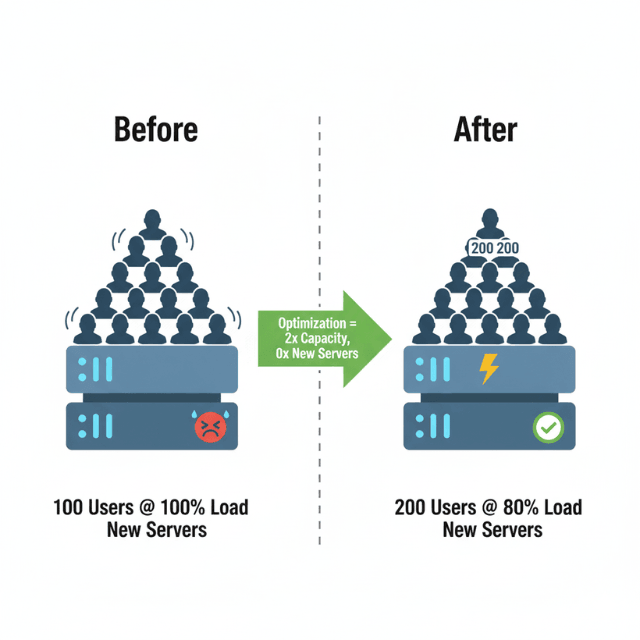
Efficient code requires fewer resources to accomplish the same work. An application that processes requests twice as fast can serve twice the traffic on the same infrastructure. This relationship directly connects optimization to cost reduction.
Cloud billing models amplify inefficiency costs. Pay-as-you-go pricing means every wasted compute cycle costs money. Poorly optimized applications trigger auto-scaling that adds instances unnecessarily. Monthly bills reflect every inefficiency.
The optimization investment payback period is often short. A few days of engineering effort can produce savings that recur every month indefinitely. Even modest improvements compound over time as traffic grows.
Consider the cost structure of typical SaaS applications. Compute resources often represent 40-60% of infrastructure costs. Database services typically account for 20-40%. Storage, bandwidth, and third-party services comprise the remainder. Optimization opportunities exist across all categories.
Early-stage startups often pay proportionally more for infrastructure than later-stage companies. They lack the volume to negotiate enterprise discounts. They may over-provision out of caution. Optimization provides the efficiency that volume-based discounts provide to larger companies.
Optimization creates headroom for growth. Instead of adding infrastructure capacity before traffic demands it, optimization extends existing capacity further. This delayed spending preserves capital for other priorities.
Infrastructure Cost Reduction Strategies
Right-sizing instances provides immediate savings. Many applications run on instances larger than necessary. Monitor CPU and memory utilization across your fleet. Instances consistently utilizing less than 40% of resources may be over-provisioned.
Implement auto-scaling that responds to actual demand. Fixed instance counts either waste resources during low traffic or underperform during peaks. Auto-scaling that adds instances when needed and removes them when traffic decreases optimizes costs dynamically.
Use spot instances or preemptible VMs for appropriate workloads. Cloud providers offer significant discounts for instances that can be interrupted. Background processing, batch jobs, and development environments often tolerate interruption. Savings of 60-90% are common.
Reserved instances provide savings for predictable workloads. Committing to one or three year terms reduces costs by 30-60% compared to on-demand pricing. Analyze historical usage patterns to identify candidates for reserved capacity.
Container orchestration improves resource utilization. Kubernetes and similar platforms pack workloads efficiently onto nodes. Multiple services sharing resources achieve higher utilization than dedicated instances for each service.
Serverless computing eliminates idle costs. Functions-as-a-service platforms charge only for execution time. Workloads with variable or unpredictable demand benefit most. Migration from always-on servers to serverless can dramatically reduce costs for appropriate applications.
Review and eliminate unused resources. Orphaned volumes, unused IP addresses, forgotten development environments, and abandoned experiments accumulate charges. Regular audits identify resources to terminate.
Database Optimization for Cost Efficiency
Database services often represent the largest single line item in SaaS infrastructure bills. Optimization here yields proportionally large savings.
Query optimization reduces database load. Inefficient queries consume CPU and I/O resources unnecessarily. A single poorly-written query executed frequently can dominate database utilization. Identify and optimize slow queries using database profiling tools.
Proper indexing accelerates queries while reducing resource consumption. Queries using indexes retrieve data without full table scans. Less work per query means more queries per dollar. Analyze query patterns and add indexes for frequent access patterns.
Connection pooling prevents connection overhead. Establishing database connections is expensive. Connection pools maintain reusable connections. Applications share pooled connections efficiently rather than creating connections per request.
Read replicas distribute query load. Directing read queries to replicas reduces primary database load. This distribution often costs less than scaling primary database resources vertically.
Caching reduces database dependency. Queries that return identical results repeatedly waste database resources. Caching layers store results for reuse. Fewer database queries means smaller database requirements.
Archive cold data to cheaper storage. Data that users rarely access still costs money to store and index. Moving historical data to archive storage reduces database size and costs. Keep recent, frequently accessed data in performant storage.
Consider managed database sizing carefully. Cloud database services often overprovision resources by default. Analyze actual workload requirements and right-size instances accordingly. Upgrading is usually simple if needs increase.
Caching Returns on Investment
Caching represents one of the highest-ROI optimization investments. Implementation effort is typically modest while impact on both performance and cost can be dramatic.
Application-level caching with Redis or Memcached offloads database queries. Cached data serves from memory in microseconds rather than querying databases in milliseconds. Each cache hit represents work the database didn't need to do.
CDN caching reduces origin server load. Static assets served from CDN edge locations require no origin server processing. Dynamic content caching, where appropriate, further reduces origin traffic. CDN costs are typically far lower than origin server costs for equivalent traffic.
Browser caching eliminates repeat downloads entirely. Proper cache headers let browsers reuse downloaded assets across page views. Reduced bandwidth usage lowers transfer costs.
API response caching reduces backend processing. Responses that don't change frequently can be cached. Each cached response represents compute cycles saved. Implement cache invalidation carefully to ensure data freshness.
Cache hit rates indicate efficiency. Monitor cache hit rates across all caching layers. Low hit rates suggest optimization opportunities: adjusting cache expiration, improving cache key design, or increasing cache size.
Calculate caching ROI explicitly. Compare infrastructure costs before and after caching implementation. Factor in cache infrastructure costs (Redis instances, CDN fees). The net savings justify continued caching investment.
Cloud Cost Management
Cloud provider billing complexity obscures optimization opportunities. Active cost management reveals savings invisible in aggregate bills.

Implement cost allocation tags. Tag resources by team, project, and environment. Tagged resources enable granular cost analysis. Untagged resources often represent waste or forgotten experiments.
Set up billing alerts at multiple thresholds. Alerts at 50%, 80%, and 100% of budget provide early warning. Investigate unexpected increases before they compound. Rapid response limits budget overruns.
Use cloud provider cost analysis tools. AWS Cost Explorer, Google Cloud Billing reports, and Azure Cost Analysis reveal spending patterns. Identify trends, outliers, and optimization opportunities through these dashboards.
Consider third-party cost optimization tools. Services like Spot.io, CloudHealth, and Kubecost provide additional analysis capabilities. Automated recommendations identify savings opportunities. Some tools automatically implement optimizations.
Negotiate enterprise agreements when reaching scale. Volume-based discounts become available as spending increases. Custom pricing often provides 20-40% reductions. Engage cloud provider account teams to explore options.
Review data transfer costs specifically. Egress charges accumulate unexpectedly. Cross-region traffic, CDN origin pulls, and API responses all incur transfer costs. Optimizing data locality and caching reduces transfer expenses.
Schedule non-production resources. Development and staging environments running 24/7 waste resources when teams work normal hours. Schedule these environments to run only during business hours. Savings of 70% or more are achievable.
Measuring Optimization ROI
Quantifying optimization returns justifies continued investment. Vague claims of "improved efficiency" don't secure budget allocation. Specific dollar figures demonstrate value.
Establish cost baselines before optimization. Document current spending across relevant categories. Include not just direct infrastructure costs but also related expenses like monitoring tools and support services.
Track costs per transaction or user. Aggregate spending is difficult to interpret. Cost per API call, cost per active user, or cost per 1,000 page views provide meaningful efficiency metrics. These metrics reveal whether efficiency keeps pace with growth.
Attribute savings to specific optimizations. When possible, measure the isolated impact of individual changes. This attribution helps prioritize future work and demonstrates engineering value.
Calculate fully-loaded optimization costs. Engineering time has value. Include the cost of developer hours when calculating optimization ROI. Many optimizations still show positive returns even with full engineering cost accounting.
Project savings forward. Monthly savings compound. A $500/month reduction in infrastructure costs represents $6,000 annually and $30,000 over five years. These projections help justify optimization investment.
Report optimization results to stakeholders. Regular reporting builds organizational appreciation for optimization work. Connect technical improvements to business outcomes. Build the case for continued investment.
Sustainable Cost Optimization Practices
One-time optimization produces one-time savings. Sustainable practices maintain efficiency as applications evolve.
Include cost considerations in architecture decisions. Evaluate cost implications during design, not just after deployment. Some architectural choices are expensive to change later.
Build cost monitoring into development workflows. Developers should see cost impacts of their changes. Include cost metrics in deployment dashboards. Create feedback loops that encourage efficiency.
Review costs regularly. Monthly or quarterly cost reviews identify drift before it becomes severe. Compare actual spending to forecasts. Investigate variances.
Allocate engineering capacity for optimization. Feature development pressure can crowd out optimization work. Reserve time for efficiency improvements. Some teams dedicate a percentage of each sprint; others schedule focused optimization periods.
Establish efficiency targets. Set goals for metrics like cost per user or cost per transaction. Track progress toward these goals. Celebrate improvements.
Learn from cost incidents. When unexpected costs occur, understand root causes. Implement preventive measures. Document learnings for future reference.
Optimization creates compounding advantages for startups. Lower costs enable faster growth, extended runway, and better unit economics. These advantages attract customers and investors alike.
Conclusion
For capital-constrained startups, optimization isn't just a technical nicety—it's a survival strategy.
Every infrastructure dollar saved directly extends runway, enabling more time to find product-market fit, acquire customers, and grow revenue.
The compounding effect is powerful: an application that handles 2x the traffic on the same infrastructure grows without proportional cost increases.
By embedding cost awareness into architecture decisions, regularly right-sizing resources, and aggressively pursuing high-ROI investments like caching and database tuning, startups transform resource constraints into competitive advantages.
The most capital-efficient startups don't just spend less—they build systems designed from day one to scale without waste.
FAQs
Where should a startup start with cost optimization?
Begin with visibility and quick wins. Implement cost allocation tags and budget alerts immediately.
Then tackle low-effort, high-impact changes: right-sizing obviously over-provisioned instances, deleting unattached volumes, and implementing basic caching (Redis for database queries, CDN for static assets). These typically deliver 20-40% savings with minimal engineering time, funding further optimization work.
How do I know if my database is costing too much?
Track database cost per transaction or per active user. Compare to industry benchmarks (typically $0.10-0.50 per 1,000 API requests). Enable slow query logging and look for queries scanning large tables without indexes.
Check connection count—excessive connections may indicate pooling issues. Most importantly, analyze actual utilization: many cloud databases are 2-4x larger than needed for sustained load.
When does optimization stop making sense for a startup?
Optimization hits diminishing returns when the engineering time cost exceeds the savings. If a senior engineer spends a week to save $50/month, that's a poor ROI (except as learning).
Focus on the 80/20 rule: the biggest savings come from the first 20% of effort. Once you've right-sized, added caching, and optimized top queries, additional effort yields smaller returns. At that point, shift focus to growth—but keep monitoring costs to catch future drift.
Summarize this post with:
Ready to put this into production?
Our engineers have deployed these architectures across 100+ client engagements — from AWS migrations to Kubernetes clusters to AI infrastructure. We turn complex cloud challenges into measurable outcomes.