SQL vs NoSQL Performance Optimization Considerations
Compare SQL vs NoSQL performance for SaaS workloads. Learn indexing, sharding, denormalization, and when to choose each database type based on access patterns.

TLDR;
- SQL excels at complex queries and transactions – joins, aggregations, ACID consistency. Use for financial systems, reporting. Optimize with indexes, connection pools, read replicas.
- NoSQL excels at scale and simple access patterns – key-value (Redis), document (MongoDB). Model data around access patterns, embed related data, denormalize for reads.
- SQL scales vertically or with sharding (complex). NoSQL scales horizontally by design – add nodes, auto-distribute.
- Start with PostgreSQL as default. Add NoSQL only for specific access patterns (caching, high-volume writes, rapidly evolving schemas).
Database choice significantly affects application performance characteristics. SQL databases and NoSQL databases optimize for different workloads and scale in different ways. Understanding these differences enables choosing the right database and optimizing it effectively for your specific use case.
Fundamental Performance Differences
SQL databases optimize for data consistency and complex queries. ACID transactions ensure data integrity. Schema enforcement prevents invalid data. Rich query languages enable complex data retrieval. These capabilities have performance costs.
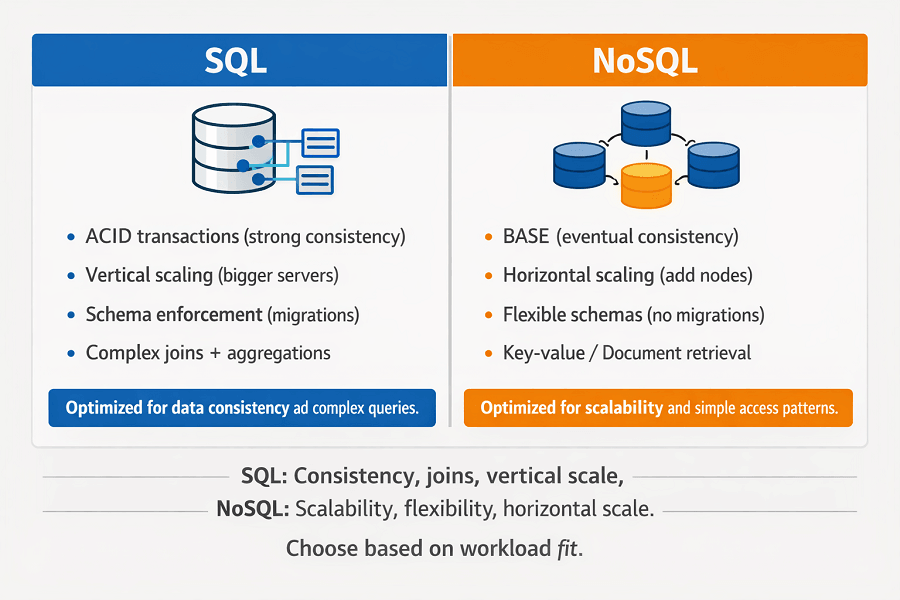
NoSQL databases optimize for scalability and simple access patterns. Flexible schemas adapt to changing requirements. Distributed architectures scale horizontally. Simpler query models enable consistent performance. These trade-offs suit specific use cases.
Read performance differs by access pattern. SQL excels at complex joins and aggregations. NoSQL excels at key-value lookups and document retrieval.
Write performance differs by consistency requirements. SQL transactions add overhead for consistency guarantees. Many NoSQL databases offer eventual consistency for better write throughput.
Neither approach is universally faster. Performance depends on workload fit. SQL databases poorly suited to workloads perform worse than well-suited NoSQL databases, and vice versa.
Understanding your access patterns determines which performs better. Random key lookups favor NoSQL. Complex analytical queries favor SQL. Most applications have mixed patterns requiring thoughtful design.
SQL Database Performance
Query optimization leverages the query planner. Well-designed schemas and proper indexing enable efficient query execution. Poor design forces expensive table scans.
Indexing strategy critically affects performance. Indexes accelerate queries but slow writes. Strategic indexing based on query patterns provides the best balance.
-- Optimized for common query patterns
CREATE INDEX idx_orders_customer_date ON orders(customer_id, created_at DESC);

-- Query uses index efficiently
SELECT * FROM orders
WHERE customer_id = 123
ORDER BY created_at DESC
LIMIT 20;
Connection pooling reduces overhead. SQL database connections are expensive. Pools maintain reusable connections for efficiency.
Query analysis reveals optimization opportunities. EXPLAIN plans show query execution. Slow query logs identify problem queries.
Normalization versus denormalization affects performance. Normalized schemas reduce redundancy but require joins. Denormalization speeds reads at the cost of write complexity.
Transactions provide consistency but add overhead. Minimize transaction scope. Avoid long-running transactions that block others.
Read replicas scale read capacity. Replicas serve read queries while the primary handles writes. This pattern suits read-heavy workloads.
NoSQL Database Performance
Document databases like MongoDB optimize for document operations. Retrieving or updating entire documents is fast. Queries across documents require careful design.
// MongoDB document retrieval
db.users.findOne({ _id: ObjectId("...") });  // Very fast

// Cross-document query needs proper indexes
db.orders.find({ userId: userId }).sort({ createdAt: -1 }).limit(20);
Key-value stores like Redis provide fastest simple lookups. Get and set by key happen in microseconds. Limited query capabilities constrain use cases.
Wide-column stores like Cassandra optimize for time-series and event data. Write throughput is exceptional. Query flexibility is limited.
Document structure affects performance. Embedded documents reduce lookups but increase document size. References require multiple queries.
// Embedded: one query, larger documents
{
  _id: "order1",
  customer: { name: "John", email: "john@example.com" },
  items: [...]
}

// Referenced: multiple queries, smaller documents
{
  _id: "order1",
  customerId: "customer1",
  items: [...]
}
Secondary indexes enable queries beyond primary key. Design indexes based on query patterns. Unused indexes waste resources.
Consistency levels trade durability for speed. Strong consistency ensures reads see latest writes but adds latency. Eventual consistency improves performance but requires handling stale reads.
Scaling Approaches
SQL databases traditionally scale vertically. Larger servers with more CPU, memory, and storage handle more load. This approach has limits.
SQL horizontal scaling requires sharding. Distributing data across servers adds complexity. Application logic often handles routing. Some databases provide built-in sharding.
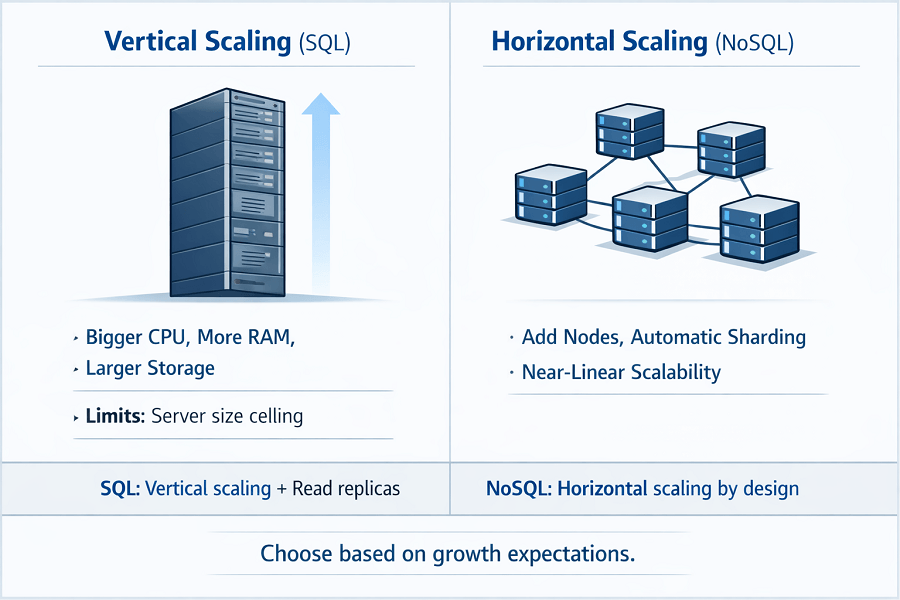
NoSQL databases typically scale horizontally by design. Adding nodes increases capacity. Data distributes automatically across nodes.
Replication strategies differ. SQL uses primary-replica patterns for read scaling. NoSQL often uses multi-master or peer-to-peer replication.
Partition strategies affect performance. Range partitioning works well for time-series queries. Hash partitioning distributes load evenly.
# Simple hash-based sharding logic
def get_shard(user_id, num_shards=4):
    return hash(user_id) % num_shards
Geographic distribution serves global users. NoSQL databases often have built-in geo-replication. SQL databases require more complex setup.
Capacity planning differs. SQL capacity depends on query complexity and data relationships. NoSQL capacity often depends on data volume and request rates.
Data Modeling for Performance
SQL modeling starts with entities and relationships. Normalize to reduce redundancy. Join tables as needed for queries.
NoSQL modeling starts with access patterns. Model data to serve specific queries. Duplicate data if it improves query performance.
// NoSQL: Model for access patterns
// Query 1: Get user with recent orders
{
  _id: "user:123",
  name: "John",
  recentOrders: [
    { orderId: "o1", total: 150, date: "2025-01-15" },
    { orderId: "o2", total: 75, date: "2025-01-10" }
  ]
}

// Query 2: Get order details
{
  _id: "order:o1",
  userId: "user:123",
  items: [...],
  total: 150
}
Denormalization in NoSQL trades storage for read performance. Storing the same data in multiple places eliminates joins.
Write amplification is the cost of denormalization. Updating denormalized data requires updating multiple locations.
Time-series data suits wide-column stores. Cassandra and similar databases optimize for append-heavy, time-ordered data.
Graph data suits graph databases. Neo4j and similar databases optimize for traversing relationships.
Choosing Based on Workload
Transaction-heavy workloads favor SQL. Financial systems, inventory management, and other domains requiring ACID transactions benefit from SQL's consistency guarantees.
High-write throughput favors NoSQL. Logging, metrics, and event streaming generate massive write volumes that NoSQL handles efficiently.
Complex queries favor SQL. Ad-hoc analytics, reporting, and queries with complex joins benefit from SQL's expressive query language.
Simple access patterns favor NoSQL. Key-value lookups, document retrieval, and predictable query patterns suit NoSQL's strengths.
Rapidly evolving schemas favor NoSQL. Schema flexibility accommodates changing requirements without migrations.
| Workload | SQL | NoSQL |
|---|---|---|
| Complex transactions | Excellent | Limited |
| High write volume | Good | Excellent |
| Complex queries | Excellent | Limited |
| Key-value access | Good | Excellent |
| Schema stability | Excellent | Good |
SQL for complex queries/ACID. NoSQL for horizontal scaling/flexible schemas. We help you choose and optimize.
Complex transactions → SQL. High write volume → NoSQL. Complex joins → SQL. Key-value access → NoSQL. Most applications need a hybrid approach.
Our cloud-native development teams help you:
- Evaluate your access patterns – Which database fits your workload?
- Design optimal schema – SQL normalization vs NoSQL denormalization
- Implement polyglot persistence – Right database for each data type
- Avoid common pitfalls – Using NoSQL for transactional workloads or SQL for massive write throughput
Hybrid Approaches
Polyglot persistence uses multiple databases. Different data types live in databases suited to their access patterns.
SQL for core business data. Transactional operations, relationships, and reporting use SQL databases.
NoSQL for specific needs. Caching (Redis), full-text search (Elasticsearch), and sessions (Redis) use purpose-built stores.
Event sourcing patterns combine approaches. SQL may store current state while NoSQL stores event logs.
# Example polyglot architecture
class OrderService:
    def __init__(self):
        self.postgres = PostgresClient()  # Transactional data
        self.redis = RedisClient()        # Caching
        self.elasticsearch = ESClient()   # Search

    def create_order(self, order_data):
        # Write to SQL for consistency
        order = self.postgres.create_order(order_data)

        # Update cache
        self.redis.set(f"order:{order.id}", order)

        # Index for search
        self.elasticsearch.index("orders", order)

        return order
Synchronization between systems requires careful design. Event-driven updates maintain consistency across databases.
Operational complexity increases with database count. Each database requires monitoring, maintenance, and expertise.
Conclusion
Neither SQL nor NoSQL is universally faster – performance depends entirely on workload fit. SQL databases deliver complex queries and strong consistency at scale, but require careful indexing and schema design. NoSQL databases provide horizontal scaling and simple access patterns, but sacrifice complex query capability and transactional guarantees.
The trend is not SQL vs NoSQL, but smart hybrid (polyglot) persistence: use SQL for transactional business data, Redis for caching, Elasticsearch for search, Cassandra for time-series events. Start with SQL (PostgreSQL) as your default. Add NoSQL databases only when specific access patterns demand it. Model for performance: SQL = normalize relationships, NoSQL = embed and denormalize.
Frequently Asked Questions
1. When should I denormalize in SQL?
Denormalize only when query performance demands it and you accept the trade-offs. Use cases: reporting tables (aggregated data), frequently accessed dashboards, caching materialized views. Cost: update complexity (multiple places), storage overhead, potential inconsistency. Start normalized, denormalize only when you measure a performance problem.
2. How do I choose between MongoDB and PostgreSQL?
PostgreSQL when your schema is stable, queries are complex (joins, aggregations), data consistency matters, and relationships exist. MongoDB when your schema evolves rapidly, data is document-structured (nested), you need horizontal scaling, or joins are rare. PostgreSQL now has JSONB – it handles many document workloads well, reducing the need for separate NoSQL.
3. What consistency level should I use in Cassandra?
QUORUM (default) balances consistency and availability – reads/writes must reach >50% of replicas. Use for most production workloads. ONE for high throughput, lower consistency (analytics, logs). ALL for strong consistency (rare, high latency). For financial transactions, avoid Cassandra – use SQL instead. Cassandra is eventually consistent by design – misaligned expectations cause problems.