Building Internal Developer Platforms
Learn how to build Internal Developer Platforms with golden paths, Kubernetes, and cloud-native tools to boost developer productivity and scale DevOps.
Introduction
Platform engineering creates self-service infrastructure through Internal Developer Platforms that reduce cognitive load and accelerate software delivery. As 15.6 million developers work with cloud native tools while organizations face critical skill gaps, platform engineering provides the foundation for productive development without overwhelming complexity. This guide covers IDP architecture, golden paths, best practices, and implementation strategies that enable teams to deliver faster while maintaining reliability and security.
Understanding Platform Engineering
Platform engineering designs and maintains Internal Developer Platforms that enable software teams to autonomously deliver applications. Unlike traditional operations teams responding to tickets, platform engineering treats the platform as a product with developers as customers.
Platform engineering reduces cognitive load by creating well-paved paths through complex technical environments. Platform engineers select, integrate, and maintain standardized toolchains for CI/CD, observability, security scanning, and infrastructure management. They package these capabilities into self-service workflows consumable without deep infrastructure expertise.
The approach recognizes that the explosion of tools, frameworks, clouds, and architectural patterns creates overwhelming complexity. Organizations expecting every developer to navigate this independently face slower delivery, inconsistent practices, fragmented tooling, and operational fragility. Platform engineering centralizes infrastructure expertise while distributing capability through self-service platforms.
The platform engineering mission pursues interconnected goals: standardize infrastructure and deployment patterns ensuring consistency, automate repetitive tasks eliminating toil and reducing errors, provide self-service capabilities respecting developer autonomy while establishing guardrails, and abstract complexity through intuitive interfaces hiding implementation details while exposing necessary controls.
Platform teams measure success through developer productivity metrics, platform adoption rates, and business outcomes rather than traditional operations metrics alone. This product mindset fundamentally distinguishes platform engineering from previous infrastructure management approaches.
Platform Engineering vs DevOps
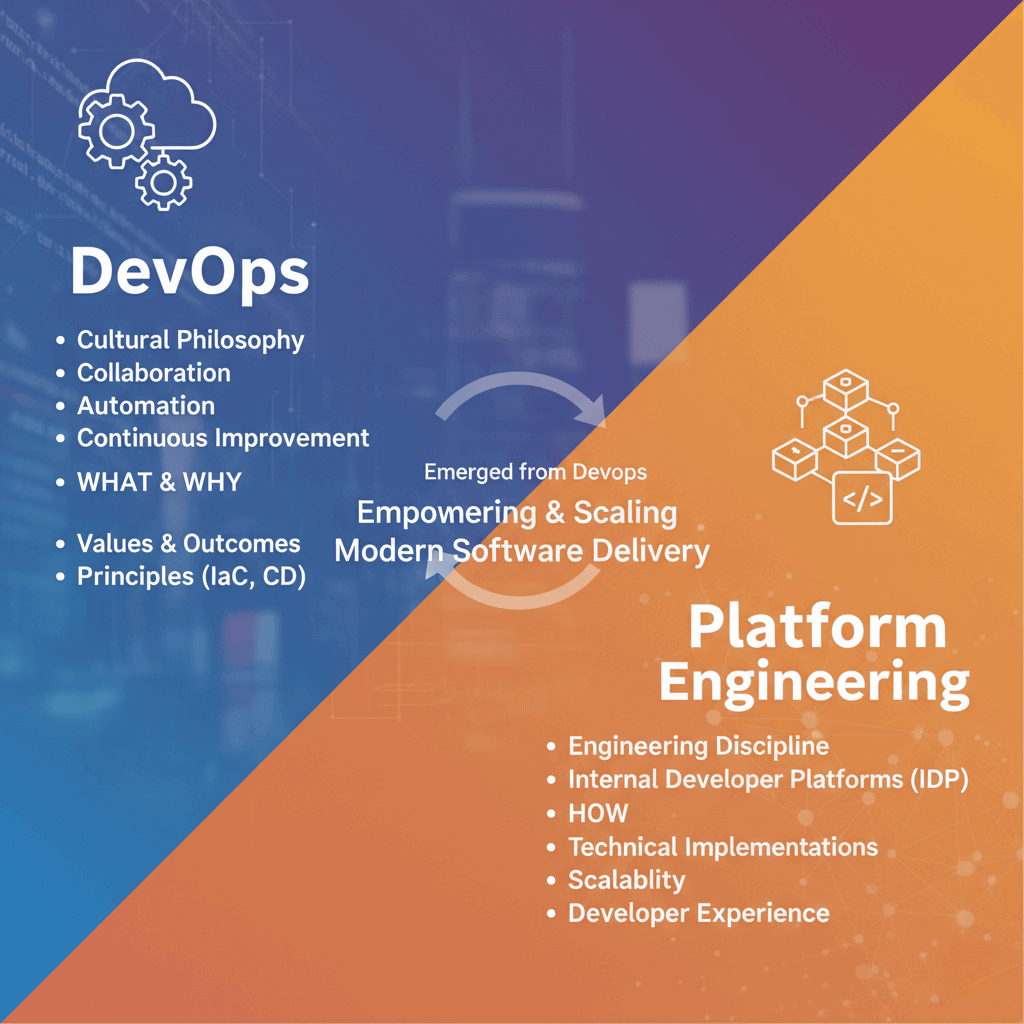
DevOps is a cultural philosophy emphasizing collaboration between development and operations, automation of delivery pipelines, and continuous improvement. Platform engineering is an engineering discipline building specific products (Internal Developer Platforms) that support and scale DevOps practices.
DevOps defines "what" and "why," the cultural values and desired outcomes guiding software delivery. Platform engineering addresses "how," the concrete technical implementations making DevOps practices accessible and sustainable at scale. DevOps established principles like infrastructure as code and continuous delivery; platform engineering builds platforms making these principles practical for hundreds or thousands of developers.
Complementary, not competitive - Platform engineering emerged from DevOps culture and remains fundamentally aligned with DevOps values. As DevOps practices matured and organizations scaled, patterns emerged requiring reusable infrastructure. Platform engineering addresses these patterns through Internal Developer Platforms.
Where DevOps roles typically have broad remits covering application delivery, infrastructure, security, and monitoring, platform engineering roles focus specifically on the platform product. Platform engineers prioritize developer experience, platform reliability, and capability delivery. They think in terms of platform features, API design, and internal customer satisfaction.
Internal Developer Platforms
The Internal Developer Platform represents the tangible output of platform engineering work. An IDP consolidates the technology stack, tools, and workflows engineering organizations need into a cohesive, self-service platform establishing "golden paths" for common development tasks.
Core components include the developer portal providing the primary interface where developers discover services, access documentation, provision resources, and monitor applications. Spotify's Backstage has emerged as the leading open-source platform for building developer portals.
Infrastructure provisioning capabilities allow developers to request and configure cloud resources, Kubernetes clusters, databases, and services through standardized interfaces. Tools like Crossplane enable infrastructure provisioning through Kubernetes-native APIs.
CI/CD pipeline integration connects source code repositories to automated build, test, and deployment workflows. IDPs integrate with GitHub Actions, GitLab CI, Jenkins, Tekton, or Argo CD providing standardized deployment pipelines enforcing quality gates, security scanning, and release policies.
Observability integration provides developers with insight into application behavior, performance metrics, logs, and traces. Embedding Prometheus, Grafana, Jaeger, or commercial observability platforms makes monitoring accessible without requiring instrumentation expertise.
Security and compliance capabilities enforce organizational policies, scan for vulnerabilities, manage secrets, and implement access controls. IDPs integrate Vault for secrets management, policy engines like Open Policy Agent, and security scanning to automatically enforce security standards.
Golden Paths
Golden paths represent the opinionated, well-documented, and fully supported way to build and deploy applications within an organization. Rather than forcing developers down a single path or allowing complete freedom leading to fragmentation, golden paths provide structured guidance while preserving flexibility.
Spotify pioneered the golden path concept to solve ecosystem fragmentation at scale. Each team had freedom to choose tools and technologies, but this created operational chaos, duplicated effort, and inconsistent practices. Golden paths provided clear recommendations while allowing teams to deviate when genuinely necessary.
Effective golden paths provide clear documentation and examples developers can follow without extensive research. They include built-in automation handling infrastructure provisioning, deployment, and operational tasks. They incorporate security and compliance controls by default, making the secure path the easy path. They offer escape hatches for legitimate special cases while making the standard path so easy that most teams naturally follow it.
Platform teams create golden paths by studying common development patterns, identifying frequently repeated tasks, and building self-service capabilities eliminating toil. A golden path for deploying microservices might include service templates, automated Kubernetes manifest generation, integrated CI/CD pipelines, standardized observability instrumentation, and automatic service mesh registration.
Leveraging Cloud-Native Technologies
Kubernetes as the platform foundation provides orchestration capabilities, extensibility mechanisms, and operational patterns aligning with platform engineering goals. Namespaces enable resource isolation, allowing multiple teams working independently within shared clusters . Custom Resource Definitions extend Kubernetes functionality, allowing platform teams to define higher-level abstractions matching organizational concepts. Operators automate complex operational workflows by encapsulating domain-specific logic into Kubernetes-native controllers.
Containers and immutable infrastructure provide packaging and isolation primitives making cloud native platforms practical. Containers bundle application code with dependencies into portable units running consistently across environments. Platform teams establish container build standards, maintain base images with security patches, and provide container registries with vulnerability scanning.
Service meshes like Istio, Linkerd, and Consul provide infrastructure-level capabilities for service-to-service communication, traffic management, security, and observability. Platform teams deploy service meshes as part of the IDP, giving all applications automatic mutual TLS, traffic routing, circuit breaking, and distributed tracing without requiring developers to implement these capabilities in application code.
Best Practices
Start with developer experience - Platform engineering succeeds when developers enthusiastically adopt the platform because it makes their work easier. Begin by understanding developer workflows, pain points, and needs through surveys, interviews, and observation. Every platform feature should improve developer experience through reduced cognitive load, faster feedback loops, or eliminated toil.
Embrace progressive standardization - Avoid mandating platform adoption through organizational fiat. Build platforms providing compelling value that teams naturally adopt. Start by solving the most painful problems with golden paths demonstrably improving workflows. Allow teams to deviate from golden paths when they have legitimate requirements, but make the standard path so easy that deviations remain rare.
Automate ruthlessly, but incrementally - Automation represents a core platform engineering value, but attempting automation from day one leads to fragile, over-engineered systems. Automate incrementally by identifying frequent manual tasks with well-defined steps causing significant toil. Focus automation on workflows crossing team boundaries, requiring specialized expertise, or involving compliance-sensitive operations.
Build observability into everything - Platform teams must maintain visibility into platform health, resource utilization, developer usage patterns, and application behavior. Instrument all platform components with metrics, structured logging, and distributed tracing. Make observability accessible to developers by integrating monitoring and logging directly into the developer portal.
Implement security by default - Security and compliance should be intrinsic platform capabilities rather than bolt-on additions. Use network policies, pod security standards, RBAC, and service mesh mutual TLS establishing defense-in-depth by default. Integrate security scanning into CI/CD pipelines. Make the secure approach the easiest approach through golden paths including security best practices automatically.
Measure what matters - Define clear metrics reflecting developer productivity, platform reliability, and business value. Track platform adoption rates, deployment frequency, lead time for changes, and time to restore service. Survey developers regularly gathering qualitative feedback about platform experience. Use metrics to guide continuous improvement and demonstrate platform value to leadership.
Tools for Platform Engineering
Developer portals - Backstage has emerged as the leading open-source platform for building developer portals, providing software catalogs, templating systems, and plugin architecture. Port offers a commercial alternative with fully managed service reducing operational burden.
Infrastructure provisioning - Crossplane extends Kubernetes with infrastructure provisioning capabilities, allowing platform teams to define and manage cloud resources through Kubernetes-native APIs. Terraform remains widely used for infrastructure as code. Pulumi offers infrastructure as code using general-purpose programming languages.
CI/CD and GitOps - Argo CD has become the standard for Kubernetes-native GitOps continuous delivery, monitoring Git repositories and automatically synchronizing cluster state. Flux CD provides similar capabilities with different architecture. Tekton offers Kubernetes-native framework for building CI/CD systems with reusable pipeline components.
Observability - The Prometheus ecosystem provides cloud native monitoring with metrics collection, alerting, and time-series data storage, supporting cloud cost optimization and FinOps best practices. Grafana offers visualization and dashboarding capabilities. OpenTelemetry provides vendor-neutral instrumentation, collection, and export of telemetry data.
Policy and security - Open Policy Agent enables declarative policy-as-code across Kubernetes and infrastructure. Kyverno provides Kubernetes-native policy management with YAML-based policy language. HashiCorp Vault manages secrets, encryption keys, and identity-based access across cloud native platforms.
Implementation Strategy
Assess current state - Document existing tools, workflows, and infrastructure patterns. Survey developers to understand pain points and workflow inefficiencies. Interview engineering leaders to understand business objectives and organizational constraints. Define a clear vision for your platform engineering initiative addressing what problems the platform will solve and which developers it will serve.
Build a cross-functional team - Platform engineering requires diverse skills spanning infrastructure, software development, developer experience design, and product management. Assemble a team combining operational expertise with product thinking. Include a product manager treating developers as customers and maintaining the platform roadmap.
Start small with high-impact use cases - Identify high-impact use cases addressing significant pain points and demonstrating clear value. Common starting points include standardizing development environment setup, automating infrastructure provisioning for new services, or streamlining deployment workflows. Build minimal viable platform capabilities solving specific problems well.
Establish golden paths iteratively - Identify workflows multiple teams perform repeatedly with similar requirements. Build templates, automation, and documentation capturing best practices. Launch golden paths alongside documentation and examples. Gather feedback continuously and improve based on real-world usage.
Invest in documentation and education - Platform adoption depends on documentation quality and developer education. Provide clear documentation covering common use cases, API references, troubleshooting guides, and architectural concepts. Conduct workshops and hands-on training sessions helping developers understand platform capabilities.
Conclusion
Platform engineering for cloud native environments represents a fundamental shift in how organizations approach infrastructure, tooling, and developer productivity. By building Internal Developer Platforms providing self-service capabilities, establishing golden paths, and abstracting complexity, platform engineering enables software organizations to scale delivery while maintaining consistency, security, and operational excellence.
The cloud native ecosystem built on Kubernetes, containers, microservices, and declarative infrastructure provides powerful primitives platform engineers leverage to build sophisticated platforms. Tools like Backstage, Crossplane, Argo CD, and the broader CNCF environment offer proven building blocks accelerating platform development while ensuring compatibility with industry standards.
Successful platform engineering balances technical excellence with product thinking, treating developers as customers whose experience determines platform success. Platform teams must understand developer workflows, continuously gather feedback, and iterate based on real-world usage. They must provide compelling golden paths making the right thing the easy thing while allowing flexibility for edge cases.
As organizations face mounting pressure to deliver software faster while managing exponential infrastructure complexity, platform engineering provides a sustainable path forward. Organizations investing in platform engineering today position themselves to thrive in an increasingly cloud native world where software excellence determines competitive advantage.